Weekly Data Recap: S&P Pantera Index Launches, Robinhood Chain Volume Climbs to Top 4

marsbitОпубликовано 2026-07-27Обновлено 2026-07-27

Введение

Weekly Data Recap: S&P Pantera Index Launches, Robinhood Chain Volume Ranks Fourth This week saw a mixed performance for risk assets amidst internal reshuffling. Bitcoin closed slightly down at $64,444, while Ethereum gained 0.6%. A key development was the launch of the S&P Pantera Digital Assets Index (SPPDA), co-created by S&P Dow Jones Indices and Pantera Capital. This 18-token benchmark index, powered by Artemis's revenue and supply data, filters for protocols with actual revenue and weights constituents by market cap. Notably, Bitcoin and XRP were excluded due to the revenue requirement. Meanwhile, Robinhood Chain, an Arbitrum Orbit L2 launched on July 1st, surged to become the fourth-largest chain by DEX volume with $4.7B weekly trading. However, analysis reveals a gap between its intended purpose and current reality. While marketed for tokenizing real-world assets (RWAs) like stocks, the chain is currently dominated by memecoin trading, accounting for ~75% of DEX volume. Robinhood's own stock tokens represent only 4.2% of the chain's $595M TVL, with 70% locked in third-party protocols like Morpho and Ethena. Uniswap commands a near-monopoly (98%) on the DEX layer. The launchpad pons.family captured most activity, generating fees roughly five times the chain's total gas fees. Robinhood currently earns basic transaction fees, while third-party applications capture significant economic value, illustrating a "fat app, skinny chain" dynamic. Other notable developments in...

Author: Artemis Analytics

Compiled by: Deep Tide TechFlow

Deep Tide Intro:S&P and Pantera launched the first crypto index screened based on protocol revenue, with Artemis providing data support. While Robinhood Chain's DEX trading volume has climbed into the industry's top four, the reality is: 70% of its TVL comes from Morpho and Ethena, stock tokens account for only 4.2%, and the memecoin casino still contributes 75% of the trading volume. This chain, which was meant for RWA tokenization, is currently being monetized by third-party protocols, with Robinhood only earning basic fees.

Market Overview

Risk assets traded sideways, but internal structure adjusted sharply. Bitcoin closed at $64,444, down 0.7%. Ethereum rose 0.6%.

The six-week outflow streak for ETFs finally stopped:

  • Spot Bitcoin ETFs: Net inflow of $75.5 million from July 13–17, net inflow of $33.9 million from July 20–24
  • Total Bitcoin ETF AUM: $78.9 billion
  • Ethereum ETFs: Net inflow of about $104 million per week over the past two weeks

The real repricing happened in the interest rate market. The probability of a Fed rate hike on July 28–29 surged from 10.7% on July 15 to nearly 35% by July 22, almost entirely due to Brent crude approaching $100 driven by Iran conflict.
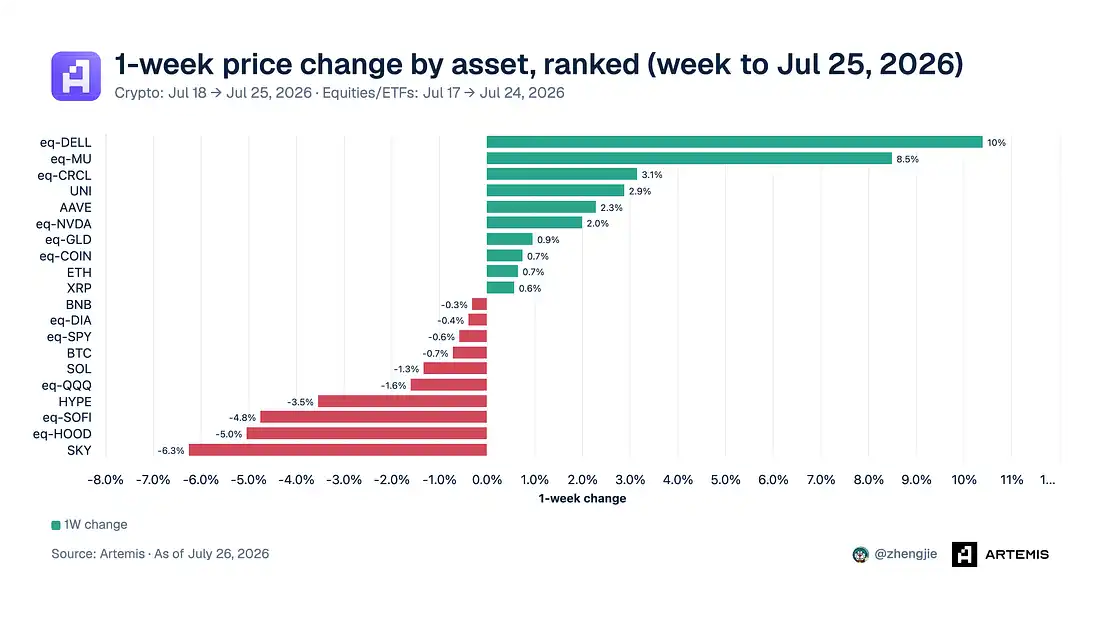
Chart: Weekly asset price performance, cryptocurrencies mixed vs. stocks/ETFs, eq-DELL leads gains at ~10%. Source: Artemis

Unlike last week, semiconductor stocks rebounded. Dell (+10.4%) and Micron (+8.5%) led gains, a sharp reversal for memory chips after Micron plunged 28% from its June high. Nvidia (+2.0%) outperformed its anchor index, the Nasdaq 100 (-1.5%). DeFi continued its rise, with UNI (+2.9%) and AAVE (+2.3%).

Crypto stocks were mixed. Circle (+3.2%) was the only stock with material gains. Coinbase (+0.75%) gave back all of its 9.6% gain from July 21 driven by the CLARITY Act.

The hardest hit were retail fintech stocks: SKY (-6.2%), HOOD (-5.0%) and SOFI (-4.8%), with HYPE (-3.5%) following closely. Bitcoin (-0.7%) and major indices barely moved (SPY -0.5%, Dow -0.3%).

A basket of stocks averaged a gain of 0.41%, median +0.18%.

S&P Pantera Digital Asset Index Launches, Powered by Artemis Data

S&P Dow Jones Indices and Pantera Capital launched the S&P Pantera Digital Asset Index (SPPDA) on July 20th.

This is an 18-token benchmark index that screens for projects with protocol revenue from the S&P Crypto Broad Digital Asset Index, then weights them by market cap.

Artemis provides revenue classification, circulating supply, and total supply data. Lukka provides pricing.

The top five component tokens by weight are ETH, BNB, SOL, TRX, and HYPE.
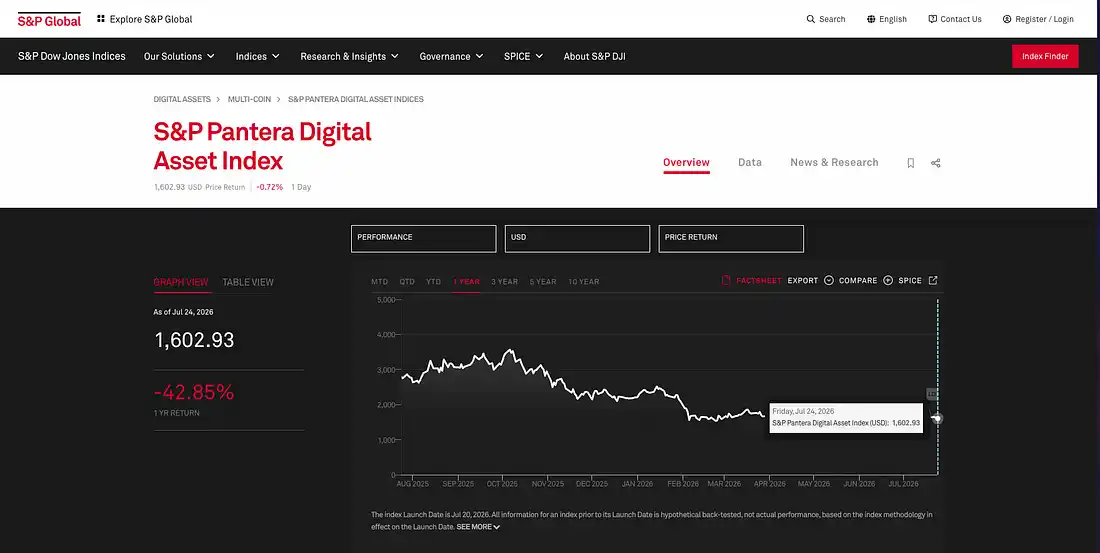
Chart: S&P Pantera Digital Asset Index (SPPDA), powered by Artemis revenue data, screened by protocol revenue, weighted by market cap. Source: Artemis

Both Bitcoin and XRP fail the revenue test outright. For scale: XRP's entire 14-year history of burned fees totals about $16 million, while the 18 selected tokens generate over $3 billion in revenue annually.

S&P is positioning this index carefully. The methodology calls protocol revenue an "objective, rules-based indicator of economic activity" and explicitly states it does not imply investment return or cash flow.

Simply put, revenue determines which tokens make the cut, market cap determines how much you hold. So if you read the headlines and thought this was a way to hold the biggest earners in crypto, you'd be wrong.

Additionally, tokens need at least 30% of supply actually circulating to qualify, quietly weeding out projects whose valuations are built on locked-up tokens.

This rule runs on Artemis's circulating supply data and hasn't been reported on yet. The first component rebalance will be determined on the third Friday of August, effective September 18th.

Robinhood Chain: What's Actually Happening

Let's be clear on what Robinhood Chain is, because most people skipped that part.

Robinhood Chain is an Arbitrum Orbit L2, meaning Robinhood rents Ethereum's security and runs its own cheap, fast transaction layer on top of it. It launched on July 1st.

The pitch was tokenizing real-world assets: putting stocks, ETFs, and private equity on-chain. Robinhood's customers could trade them 24/7, including in places where they can't open a US brokerage account. What actually launched was a memecoin casino, and what's happening now is that casino slowly turning into what it was supposed to be (RWA tokenization).

Just last week, we showed Robinhood Chain becoming a leading chain for DEX volume on a peak day. For the full week of July 18–25, it ranked fourth at $4.7 billion, behind BSC, Ethereum, and Base, ahead of Solana.
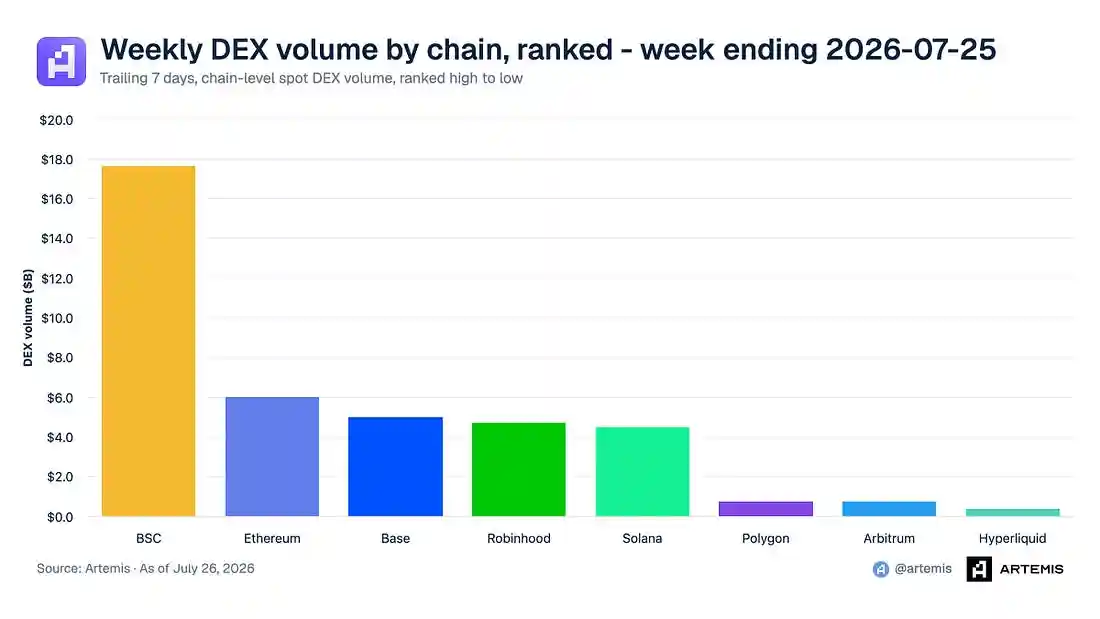
Chart: DEX Volume Ranking by Chain for July 18–25, Robinhood Chain ranks fourth at $4.7B, behind BSC, Ethereum, Base. Source: Artemis

Activity on Robinhood Chain:
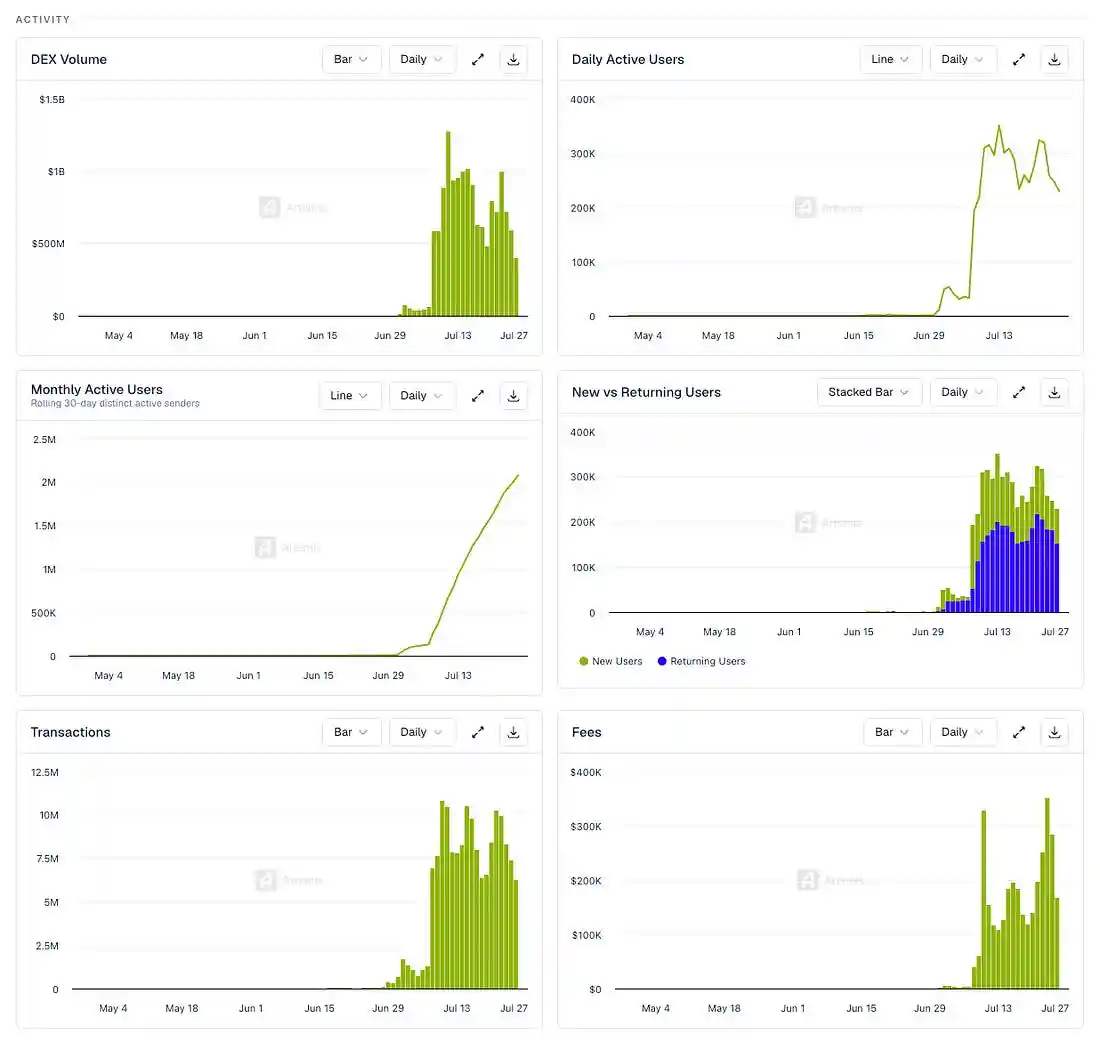
Chart: Robinhood Chain Activity Metrics – DEX daily volume ~$500M, daily active users ~250K, monthly active users 2.1M. Source: Artemis

  • DEX volume averaging ~$500 million daily
  • Daily Active Users averaging ~250,000
  • Monthly Active Users hit a new ATH of 2.1 million
  • About two-thirds of DAUs are returning users
  • Transaction count averaging ~6 million daily
  • Fees averaging ~$200,000 daily

Most of the Money on Robinhood Chain Isn't Robinhood's

As of July 25th, TVL was $595.1 million, a massive jump from almost zero in mid-June. The composition is key:

  • Morpho: $236.2 million
  • Ethena: $177 million
  • Uniswap: $48.3 million
  • Maple: $48.1 million
  • Lighter: $25 million
  • Robinhood Stock Tokens: $24.7 million

Morpho and Ethena together account for 70% of the on-chain money. Robinhood stock tokens make up only 4.2%.
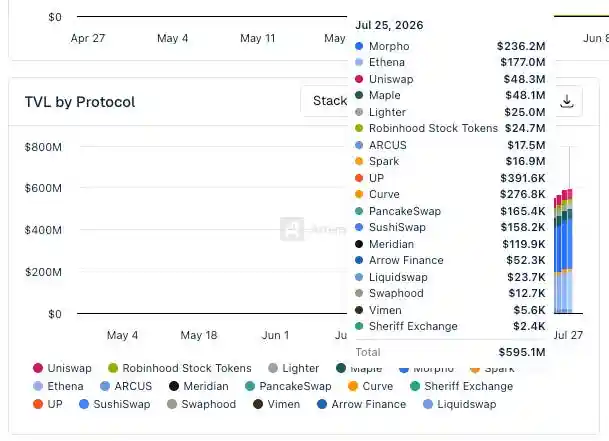
Chart: Robinhood Chain TVL Composition as of July 25, Morpho + Ethena account for 70%, Robinhood stock tokens only 4.2%. Source: Artemis

Uniswap Has a Complete Monopoly on the Trading Layer

Of the $397.4 million in DEX volume on July 25th:

  • Uniswap V3: $251.9 million
  • Uniswap V4: $80.1 million
  • Uniswap V2: $58.4 million
  • All other protocols combined: less than $7 million

That's 98% Uniswap. Arcus, PancakeSwap, and all forks on-chain share the remainder.
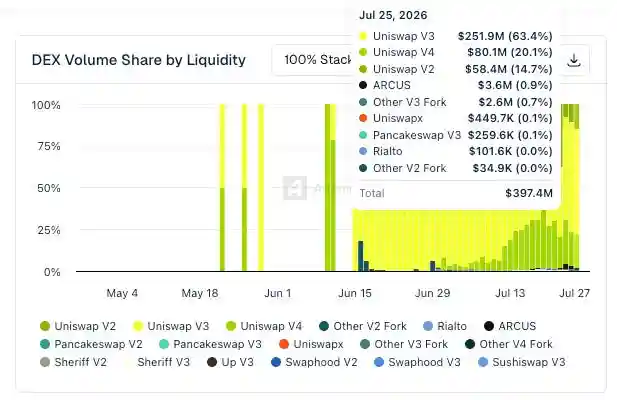
Chart: DEX Volume by Liquidity Share on July 25, Uniswap V3 63.4%, V4 20.1%, total 98%. Source: Artemis

Memecoins still account for the majority of all DEX volume:

  • Memecoin pairs: $297 million (74.7%)
  • Ethereum: $64.2 million (16.1%)
  • Robinhood stock token pairs: $36 million (9.1%)
  • Protocol token pairs: $219.6K (0.1%)

One Launchpad Accounts for Most of the On-Chain Activity

On July 25th, pons.family accounted for:

  • $99.7 million out of $155.8 million in launchpad volume (64%)
  • 1.3 million out of 1.6 million launchpad transactions (81%)
  • 11,200 out of 17,600 tokens deployed (64%)

The second-largest platform, Bankr, did $13.1 million.

Over seven days, pons.family generated $7.86 million in total fees on $826 million in volume. Total gas fees for the chain in the same period were about $1.51 million.

The application layer revenue was about five times that of the L2.
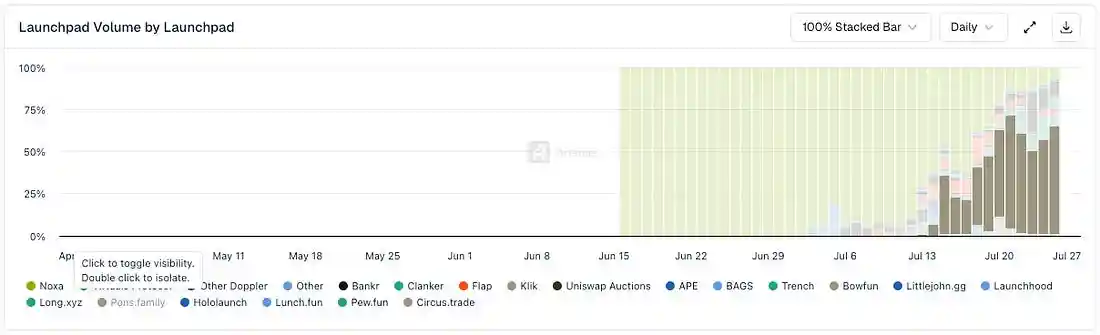
Chart: Launchpad Volume Distribution, pons.family accounts for 64% of launchpad volume and 81% of transactions. Source: Artemis

What It Was Built For: Small, Growing Fast, Broader Than Stocks

Total on-chain tokenized market cap is $24.8 million:

  • Stocks: $19.1 million
  • Private Equity: $1.9 million
  • ETFs: $1.5 million
  • Commodities: $1.2 million
  • US Treasuries: $800,100

That's up about 4.5x from about $5.5 million on June 29th, in less than a month. Tokenized equity holders grew from 29,407 to 48,470 in five days. Stock token pairs now account for 9.1% of DEX volume, averaging $36 million daily, compared to 74.7% for memecoins.
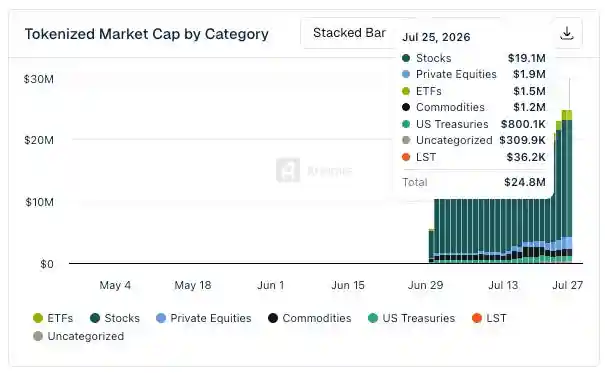
Chart: Total On-Chain Tokenized Market Cap by Category, Stocks lead at $19.1M, total $24.8M. Source: Artemis

Robinhood built the distribution channel. Third parties capture the economic upside. Morpho and Ethena hold deposits. Uniswap clears trades. Pons.family takes fees. Robinhood earns the base fee, annualized to about $78 million.

This is the fat application, thin chain theory with a public company P&L attached.

Chart of the Week

Hyperliquid open interest reached a new all-time high of $11.4 billion on July 24, 2026.
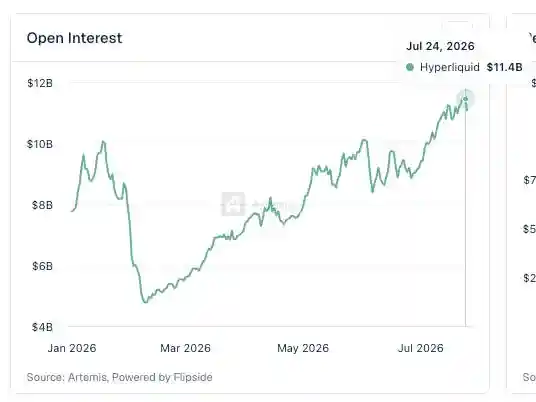
Chart: Hyperliquid Open Interest hits new ATH of $11.4B on July 24. Source: Artemis / Flipside

Ethereum ETFs saw net inflows of about $104 million over the past two weeks, while Bitcoin flows were more volatile.
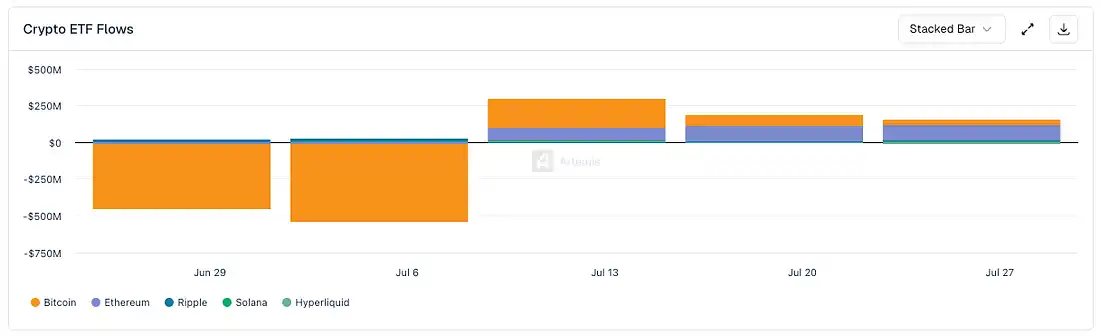
Chart: Crypto ETF Flows, Ethereum net inflow ~$104M over past two weeks, Bitcoin more volatile. Source: Artemis

Other Notable News

  • The London Stock Exchange announced LSE 24 on July 21, a 24/5 trading venue with native access for AI agents and on-chain settlement; two days later the SEC announced a September 17th roundtable on 24-hour US equity trading.
  • Strategy sold $263.5 million of MSTR stock between July 13–19, marking a fourth consecutive week without buying Bitcoin, boosting its dollar reserves to $3.225 billion against ~$1.76 billion in annual preferred stock and interest obligations.
  • Nine companies including Strategy, BlackRock, Coinbase, and Galaxy pledged $15 million over three years for Bitcoin post-quantum research, with over 7 million BTC in outputs with exposed public keys.
  • Regulators missed the July 18th rulemaking deadline for the GENIUS Act, with no final rules from any of the six agencies, pushing full implementation to January 18, 2027, while stablecoin supply still grew 18.6% to $308.1 billion.
  • PayPal's board formally rejected Stripe and Advent's $60.50 per share acquisition offer, hired Goldman Sachs and Evercore, and is seeking a price near $70 ahead of July 28th earnings.
  • The CLARITY Act still hasn't had a cloture motion filed, with the August 7th recess being the key deadline.


Трендовые криптовалюты

Связанные с этим вопросы

QWhat are the key criteria used to screen tokens for inclusion in the S&P Pantera Digital Asset Index (SPPDA), and why are Bitcoin and XRP excluded?

AThe S&P Pantera Digital Asset Index screens tokens based on their ability to generate protocol revenue. Tokens are selected from the S&P Cryptocurrency Broad Digital Assets Index and must have at least 30% of their supply in circulation. The weights are then determined by market capitalization. Bitcoin and XRP are excluded because they failed the protocol revenue test. For example, the article notes that XRP's total burned value over its entire 14-year history is only about $16 million, whereas the 18 selected tokens generate over $3 billion in annual revenue.

QAccording to the data, what is the current composition of Total Value Locked (TVL) on the Robinhood Chain, and what does this reveal about the chain's actual use versus its intended purpose?

AAs of July 25th, the TVL on Robinhood Chain was $595.1 million. Its composition reveals a significant divergence from its intended purpose of RWA tokenization. Morpho ($236.2M) and Ethena ($177M) together account for approximately 70% of the TVL. In contrast, Robinhood's tokenized stocks only represent $24.7 million, or 4.2% of the total. This shows that most of the capital on the chain is from third-party DeFi protocols, not from the RWA assets it was primarily built to host.

QWhat is the dominant DEX on the Robinhood Chain in terms of trading volume, and what types of assets constitute the majority of its DEX trading activity?

AUniswap is the dominant DEX on the Robinhood Chain, accounting for approximately 98% of its total DEX volume as of July 25th. This breakdown includes Uniswap V3 (63.4%), V4 (20.1%), and V2. The vast majority of DEX trading activity, about 74.7%, is in memecoin trading pairs. Tokenized stocks represent 9.1% of the volume, and Ethereum trading pairs make up 16.1%.

QWhat major event triggered a significant repricing in the interest rate market during the week discussed in the article, and how did this affect crypto and stock assets?

AThe significant repricing in the interest rate market was triggered by escalating tensions between the US and Iran, which pushed Brent crude oil prices toward $100 per barrel. This caused the probability of a Federal Reserve rate hike to surge from 10.7% on July 15th to nearly 35% by July 22nd. In response, crypto and stock assets showed mixed performance. Semiconductors like Dell and Micron rebounded strongly, while retail fintech stocks (e.g., Robinhood, SoFi) were the hardest hit, declining significantly. Bitcoin and major stock indices like the S&P 500 saw only minor movements.

QWhat is the 'fat app, thin chain' theory, and how does the current economic activity on the Robinhood Chain serve as an example of it?

AThe 'fat app, thin chain' theory suggests that the majority of value and economic activity (the 'fat' part) occurs at the application layer (dApps, protocols), while the underlying blockchain (the 'thin' chain) primarily provides basic security and settlement, earning relatively minimal fees. Robinhood Chain is a prime example. Third-party applications like Morpho, Ethena, Uniswap, and pons.family capture most of the economic value through TVL, trading fees, and launchpad fees. In contrast, the Robinhood Chain itself only earns the foundational gas fees, estimated at an annualized rate of about $78 million, while the application layer's revenue is roughly five times higher.

Похожее

Memecoins вернули себе 29% спотового объема торгов на децентрализованной бирже Solana, это самый высокий показатель с августа 2025 года

За последнюю неделю июля доля мемекойнов в спотовом объеме торгов на DEX Solana достигла 29%, что является максимальным показателем с августа прошлого года. Этот всплеск связан с токеном $ANSEM («Черный бык»), который после запуска в конце июня показал рост на 18 000% за три дня и привлек внимание к сегменту. Однако данные показывают, что Solana — это не только мемы. Пары SOL/стейблкоин составили 37% объема, а обмен стейблкоинами — 22%. Объем предложения стейблкоинов в сети превысил $15 млрд и оставался стабильным. Кроме того, Solana лидирует по количеству токенизированных реальных активов (RWA), разместив 2582 актива на сумму более $3,5 млрд. Таким образом, возрождение мемекойнов носит циклический характер, в то время как фундаментальная инфраструктура сети, включая стейблкоины и RWA, продолжает устойчиво развиваться.

cryptonews.ru5 мин. назад

Memecoins вернули себе 29% спотового объема торгов на децентрализованной бирже Solana, это самый высокий показатель с августа 2025 года

cryptonews.ru5 мин. назад

ФСБ объявила Павла Дурова в международный розыск по делу о содействии терроризму

Павел Дуров объявлен в международный розыск по инициативе ФСБ. Основателю мессенджера Telegram предъявлено обвинение в содействии террористической деятельности. В ведомстве утверждают, что многочисленные каналы и боты в Telegram используются украинскими спецслужбами и экстремистами для подготовки диверсий на территории России. В частности, через чат-бота «Дайвинчик», по данным ФСБ, осуществлялась вербовка и координация преступлений. За последний год силовые структуры задержали 46 человек в возрасте от 12 до 22 лет в различных регионах России. Все они, согласно следствию, действовали по заданиям иностранных спецслужб. На фоне этого возбуждён ряд уголовных дел, в рамках одного из которых и было предъявлено обвинение Дурову. ФСБ также отмечает, что, несмотря на внесение «Дайвинчика» в реестр запрещённых сайтов, незаконный контент в нём не удалён. Данное дело продолжает серию претензий российских властей к политике модерации в Telegram. Павел Дуров пока никак не прокомментировал обвинение.

cryptonews.ru6 мин. назад

ФСБ объявила Павла Дурова в международный розыск по делу о содействии терроризму

cryptonews.ru6 мин. назад

Virtuals представляет Hyperboost: +14 дней наград для каждого выпущенного токена, чтобы противостоять «проклятию пика в первый день»

Virtuals Protocol запустил механизм Hyperboost 27 июля, пытаясь бороться с явлением, когда более 75% выпущенных на платформе токенов достигают пикового объема торгов в течение 24 часов после "выпуска" (graduation), а затем резко снижаются. Суть Hyperboost заключается в преобразовании части ранее неактивного предложения токена, оставшегося после выпуска с bonding curve, в 14-дневный пул ежедневных вознаграждений. Награды автоматически распределяются между трейдерами (пропорционально их дневному объему торгов) и создателями контента в соцсетях, таких как X. Механизм применяется автоматически ко всем токенам, выпущенным после 27 июля. Однако первые данные по таким токенам (например, AMARA, MAGE, GTR) показывают сохранение типичной модели резкого падения после выпуска. Сообщество задает вопросы о потенциальных рисках, таких как стимулирование накрутки объема торгов (wash trading) для получения доли вознаграждений, а также о недостаточной прозрачности критериев оценки контента. Экосистема Virtuals насчитывает более 18 000 AI Agent токенов. Hyperboost — это попытка оживить торговлю на платформе. Несмотря на возможное позитивное влияние на спрос на родной токен VIRTUAL, для оценки эффективности нового механизма потребуется наблюдение за данными в течение нескольких недель.

marsbit19 мин. назад

Virtuals представляет Hyperboost: +14 дней наград для каждого выпущенного токена, чтобы противостоять «проклятию пика в первый день»

marsbit19 мин. назад

Ложный предпринимательский бум: В США ежегодно регистрируется 5,8 миллиона новых компаний, 70% из которых никогда никого не наймут

Заголовок: Ложный бум стартапов: в США ежегодно регистрируется 5,8 млн новых компаний, 70% никогда не наймут сотрудников. В 2025 году в США был зарегистрирован рекордный уровень новых бизнес-заявок — около 6 миллионов. Однако данные скрывают неудобную правду: 70% этих новых предприятий классифицируются как «потенциальные безработные», то есть они никогда не планируют создавать рабочие места. Эта доля удвоилась за последние два десятилетия, в то время как доля компаний с высоким потенциалом найма сократилась вдвое. Автор вводит концепцию «ложного бума стартапов» или «фальшивого бизнеса» — явления, когда хобби или побочные проекты регистрируются как компании (часто LLC) без реального намерения вести серьёзную коммерческую деятельность. Создать LLC стало чрезвычайно просто и дёшево (около $130 и 15 минут), что сделало «основание компании» модным увлечением. Основная причина этой тенденции — социальный статус и культ «основателя». Звание «founder» стало символом успеха, независимости и привлекательности, особенно среди поколения Z. Многие добавляют его в свои профили в соцсетях, чтобы улучшить личный бренд, даже если их «бизнес» практически не приносит дохода. Автор критикует это явление, считая, что оно обесценивает настоящий предпринимательский дух и создаёт ложное впечатление, что начать бизнес — легко. Он приводит статистику: 20% компаний закрываются в первый год, половина — в течение пяти лет, и лишь 0,05% стартапов получают венчурное финансирование. Вывод: вместо того чтобы заниматься «фальшивым бизнесом» в подвешенном состоянии, важно делать осознанный выбор — либо полностью посвятить себя предпринимательству, приняв все риски и жертвы, либо найти смысл в других сферах жизни. Истинный смысл приходит через глубокую вовлечённость и преданность делу, а не через создание видимости.

marsbit20 мин. назад

Ложный предпринимательский бум: В США ежегодно регистрируется 5,8 миллиона новых компаний, 70% из которых никогда никого не наймут

marsbit20 мин. назад

Промпт Opus 5 для создания игр стал вирусным: за 24 часа воссозданы шедевры уровня AAA

Недавно нашумевший промпт Opus 5 для создания игр стал вирусным в X. Используя метод «Цикла испытаний», пользователи демонстрируют, как с его помощью можно за 24 часа создать прототипы игр, напоминающие AAA-проекты. Суть промпта, разработанного Мэттом Шумером, заключается в системе из нескольких агентов ИИ: главный агент разбивает задачу (например, «создать шутер уровня Call of Duty») на части, специализированные агенты выполняют их, а независимый «агент-судья» сравнивает результат с эталонными AAA-играми и отправляет на доработку, пока качество не станет удовлетворительным. Наиболее яркий пример — пользователь Anshu, который за сутки создал браузерную космическую игру-исследователь The Long Silence, вдохновленную Outer Wilds. Процесс состоял из трех этапов: постановка базовой цели для Opus 5 с использованием Three.js, 24-часовой цикл улучшения графики с параллельной работой агентов и сравнением со «Starfield», и финальная ручная оптимизация. Игра уже доступна онлайн. Методология вызвала волну творчества: другие пользователи создали картинговые гонки, клон Cyberpunk 2077 («Claudepunk 2077») и прочее, используя Opus 5 или аналогичные модели вроде GPT-5.6 Sol. Ключевой вывод — введение «агента-судьи» и цикличной проверки против эталона эффективно раскрывает способности современных ИИ к долгосрочному планированию и итерациям, что подтверждает растущий разрыв между публичным восприятием и реальными возможностями передовых моделей.

marsbit24 мин. назад

Промпт Opus 5 для создания игр стал вирусным: за 24 часа воссозданы шедевры уровня AAA

marsbit24 мин. назад

Торговля

Спот

Популярные статьи

Как купить S

Добро пожаловать на HTX.com! Мы сделали приобретение Sonic (S) простым и удобным. Следуйте нашему пошаговому руководству и отправляйтесь в свое крипто-путешествие.Шаг 1: Создайте аккаунт на HTXИспользуйте свой адрес электронной почты или номер телефона, чтобы зарегистрироваться и бесплатно создать аккаунт на HTX. Пройдите удобную регистрацию и откройте для себя весь функционал.Создать аккаунтШаг 2: Перейдите в Купить криптовалюту и выберите свой способ оплатыКредитная/Дебетовая Карта: Используйте свою карту Visa или Mastercard для мгновенной покупки Sonic (S).Баланс: Используйте средства с баланса вашего аккаунта HTX для простой торговли.Третьи Лица: Мы добавили популярные способы оплаты, такие как Google Pay и Apple Pay, для повышения удобства.P2P: Торгуйте напрямую с другими пользователями на HTX.Внебиржевая Торговля (OTC): Мы предлагаем индивидуальные услуги и конкурентоспособные обменные курсы для трейдеров.Шаг 3: Хранение Sonic (S)После приобретения вами Sonic (S) храните их в своем аккаунте на HTX. В качестве альтернативы вы можете отправить их куда-либо с помощью перевода в блокчейне или использовать для торговли с другими криптовалютами.Шаг 4: Торговля Sonic (S)С легкостью торгуйте Sonic (S) на спотовом рынке HTX. Просто зайдите в свой аккаунт, выберите торговую пару, совершайте сделки и следите за ними в режиме реального времени. Мы предлагаем удобный интерфейс как для начинающих, так и для опытных трейдеров.

1.7k просмотров всегоОпубликовано 2025.01.15Обновлено 2026.06.02

Как купить S

Sonic: Обновления под руководством Андре Кронье – новая звезда Layer-1 на фоне спада рынка

Он решает проблемы масштабируемости, совместимости между блокчейнами и стимулов для разработчиков с помощью технологических инноваций.

2.4k просмотров всегоОпубликовано 2025.04.09Обновлено 2025.04.09

Sonic: Обновления под руководством Андре Кронье – новая звезда Layer-1 на фоне спада рынка

HTX Learn: Пройдите обучение по "Sonic" и разделите 1000 USDT

HTX Learn — ваш проводник в мир перспективных проектов, и мы запускаем специальное мероприятие "Учитесь и Зарабатывайте", посвящённое этим проектам. Наше новое направление .

1.9k просмотров всегоОпубликовано 2025.04.10Обновлено 2025.04.10

HTX Learn: Пройдите обучение по "Sonic" и разделите 1000 USDT

Обсуждения

Добро пожаловать в Сообщество HTX. Здесь вы сможете быть в курсе последних новостей о развитии платформы и получить доступ к профессиональной аналитической информации о рынке. Мнения пользователей о цене на S (S) представлены ниже.

活动图片