White House Concession Removes Ethical Hurdle, Clarity Act Races Against Final Window Before Recess?

Odaily星球日报Опубликовано 2026-07-21Обновлено 2026-07-21

Введение

On July 21st, industry sources reported that the Trump administration has agreed to include an ethics provision in the "Clarity Act" (Digital Asset Market Clarity Act of 2025). This concession addresses the long-standing conflict-of-interest concerns regarding government officials and the crypto industry, potentially removing the final major obstacle to the bill's progress. Additionally, Patrick Witt, the executive director of the White House's Digital Asset Advisory Committee, confirmed he will remain in his role to help finalize the bill, alleviating previous concerns about his potential departure. The Clarity Act aims to establish a unified federal regulatory framework for the U.S. digital asset market. Its core objective is to resolve regulatory ambiguity by defining different types of digital assets (digital commodities, investment contract assets, and permitted payment stablecoins) and clarifying the respective oversight roles of the SEC and CFTC. This would end the long-running jurisdictional dispute between the two agencies and provide clearer compliance paths for the industry. With the ethics issue moving toward resolution, the most urgent challenge now is time. The U.S. Congress is set to begin its August recess in mid-August, leaving only a few working weeks to finalize the text and advance the bill through the Senate. Industry advocates, like the Blockchain Association's Kristin Smith, stress that this is a critical moment. If negotiations conclude successfully ...

Original | Odaily Planet Daily (@OdailyChina)

Author | Azuma (@azuma_eth)

Beijing time, July 21st - Multiple industry sources have revealed that the Trump administration has agreed to include an ethics provision in the "Clarity Act" (Digital Asset Market Structure Bill), and the relevant text has been submitted to some Republican senators. Although the specific details of the provision are not yet fully public, industry participants generally believe this progress could clear the way for an updated version of the bill text (expected to be released in the coming days) and subsequent Senate voting.

Over the past year, negotiations surrounding the "Clarity Act" have progressed slowly. After parties gradually reached compromises on earlier disagreements such as stablecoin yields and DeFi regulation, the biggest remaining controversy was how to handle potential conflicts of interest between U.S. government officials and the crypto industry. With the White House expressing willingness to concede on the ethics provision, the last major obstacle that has long hindered the bill's progress is showing signs of possible resolution.

In addition to progress on the ethics provision, another positive signal regarding the "Clarity Act"'s push emerged this morning: Patrick Witt, Executive Director of the White House Digital Asset Advisory Committee responsible for driving the bill's passage, has confirmed he will remain in his position to help the bill through its final sprint. Previous reports suggested Witt might leave his post before the "Clarity Act" entered a critical Senate phase due to training obligations with the U.S. Army National Guard, which had sparked industry concerns about the bill's pace. Witt has now confirmed that his training mission will be postponed, allowing him to continue participating in the bill's passage process.
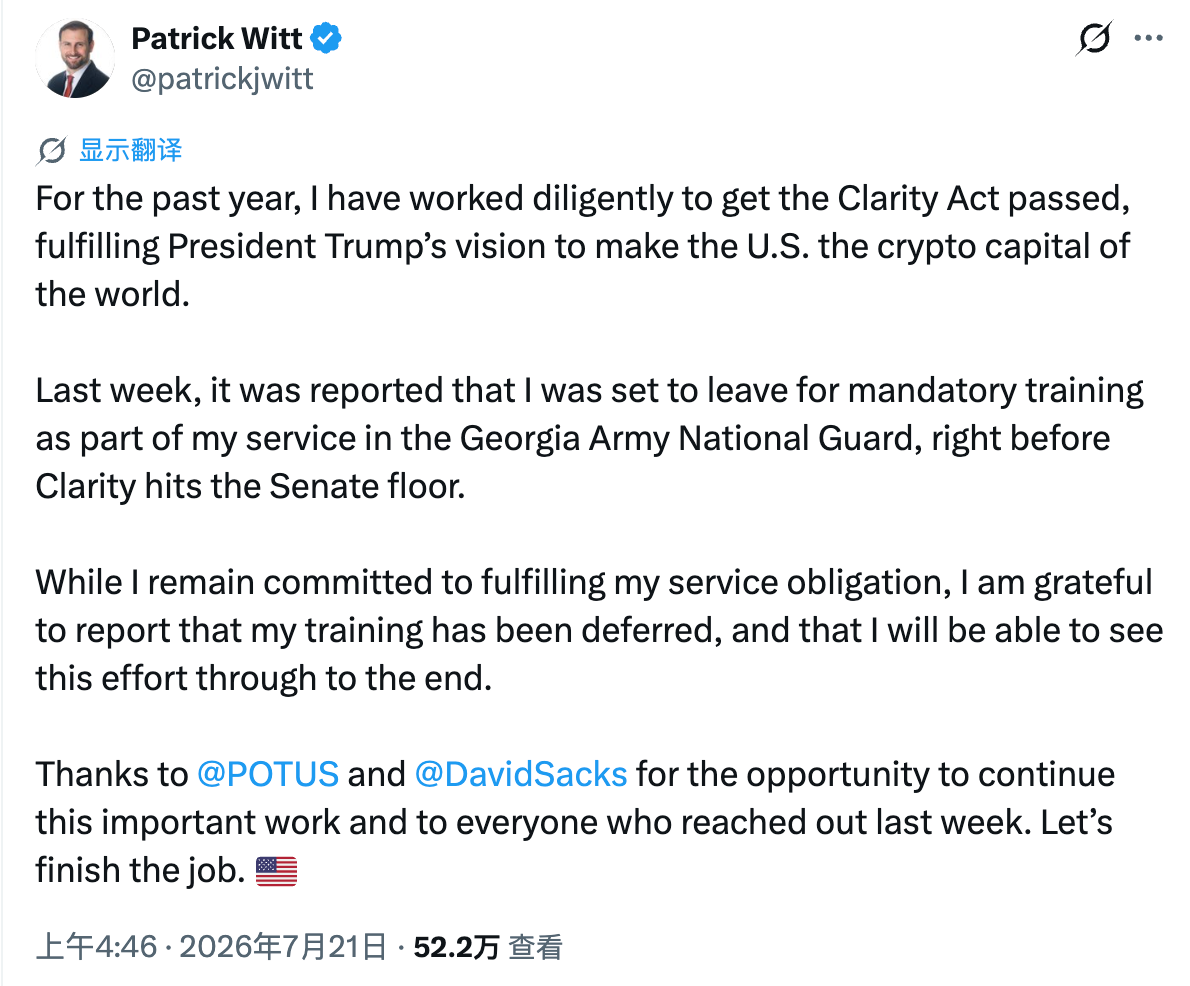
For the entire cryptocurrency industry, the latest developments may indicate that this nearly year-long regulatory standoff has finally reached its most critical turning point.

Content and Significance of the Clarity Act (Skip if Familiar)

As one of the core legislative pieces of the Trump administration's push for the U.S. to become a "global crypto hub," the full name of the "Clarity Act" is the *Digital Asset Market Clarity Act of 2025*. It aims to establish a unified federal regulatory framework for the U.S. digital asset market.

The core objective of this bill is to address the long-standing regulatory ambiguity faced by the U.S. crypto industry in recent years — clarifying the legal attributes of different digital assets and redefining the regulatory responsibilities between the U.S. Securities and Exchange Commission (SEC) and the Commodity Futures Trading Commission (CFTC).

Specifically, the Clarity Act attempts to establish a digital asset classification system, categorizing assets into digital commodities, investment contract assets, and permitted payment stablecoins. Among these, digital commodities with blockchain network functionality would be primarily regulated by the CFTC; investment contract assets involving fundraising and issuance would remain under SEC jurisdiction; stablecoin issuers would mainly be regulated by banking authorities.

The significance of this framework lies in ending the years-long turf war between the SEC and CFTC over digital asset regulatory authority, providing the industry with a clearer compliance path. In the past, under former SEC Chairman Gary Gensler, the SEC tended to classify a large number of digital assets as securities based on the Howey Test, expanding its regulatory scope through enforcement actions; meanwhile, the CFTC argued that some highly decentralized digital assets were closer to commodities and should fall under its purview. This long-standing conflict over regulatory boundaries has kept U.S. crypto businesses, trading platforms, and developers in an uncertain environment.

If the Clarity Act ultimately passes, the U.S. crypto industry may usher in its first comprehensive market structure regulatory framework. For the market, its short-term impact might be boosting sentiment through improved policy expectations, but the longer-term significance lies in reducing regulatory uncertainty and providing a clearer institutional basis for traditional financial institutions and long-term capital to enter the digital asset space.

The Final Disagreement: The Ethics Controversy

The Clarity Act's journey to this point has not been easy. On July 17th last year, the Clarity Act passed the U.S. House of Representatives with a vote of 294 to 134, securing support far exceeding the simple majority requirement. However, unlike the GENIUS Act, which progressed smoothly around the same time and was eventually signed by Trump, the Clarity Act encountered more complex political maneuvering after moving to the Senate.

Compared to the House, while Republicans still hold a majority in the Senate, the Clarity Act, as a major regulatory legislation affecting the entire digital asset market structure, still requires a degree of bipartisan support to proceed to a final vote. This means the bill faces a complex negotiation in the Senate centered on regulatory direction, industry interests, and political demands.

Over the past year, disagreements surrounding the Clarity Act have mainly focused on three areas — stablecoin yield rules, DeFi regulatory boundaries, and potential conflicts of interest between the Trump administration and the crypto industry. Now, the first two major disagreements have gradually cooled as negotiations progressed. Regarding stablecoin yields, once the most contentious issue, parties have reached a compromise solution: "prohibiting yield purely for holding stablecoins, but allowing rewards based on actual activities."

Now, the only issue remaining on the negotiation table is the final disagreement: the ethics issue. Over the past year of negotiations, Congressional members and the White House have spent significant time negotiating ethical clauses aimed at restricting the President, Vice President, members of Congress, and other federal officials from profiting from digital assets during their terms (refer to *Trump's 'Pay Stub' Exposed: Cryptocurrency Generates $1.4 Billion, Stock Trades Exceed 22,000*). With the latest developments this morning, it indicates a potential breakthrough in the last political battle surrounding the "Clarity Act."

More Pressing Than Content Disagreement: Time

However, compared to disputes over the bill's content, an even more pressing problem facing the "Clarity Act" now is time. The U.S. Congress typically enters its August recess in mid-August, leaving only about a dozen working days for both parties to complete text coordination and push for Senate consideration.

Kristin Smith, CEO of the Blockchain Association, which has played a significant lobbying role in the "Clarity Act" process, stated bluntly yesterday: "This is the most critical moment."
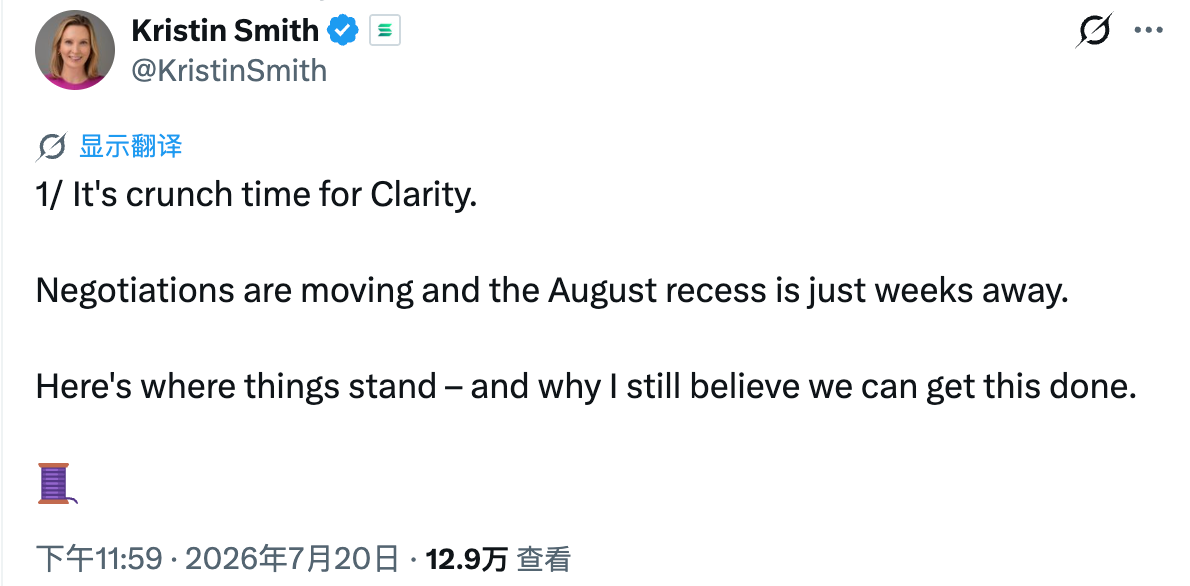
Smith said the "Clarity Act" has gone through a long process, and the current version already includes stronger illegal finance oversight provisions, more comprehensive consumer protection measures, and enhanced regulatory requirements for spot trading platforms. This is one of the most comprehensive digital asset market structure frameworks she has seen. If both sides can resolve the ethics-related disputes in the coming weeks, the "Clarity Act" might have a chance to complete a key breakthrough before the Congressional recess; but if negotiations stall again, this crypto regulatory framework, which has been in the works for over a year, may have to wait for a new political window.

A Historic Turning Point for Crypto Regulation?

Of course, there is still one final step before the "Clarity Act" truly becomes law. Even if the White House has agreed to accept the ethics provision, uncertainties remain regarding the subsequent text release, Senate consideration, and final bipartisan coordination. However, judging from the signals released so far, this digital asset market structure bill, which has undergone over a year of struggle, is getting closer to the finish line.

If the "Clarity Act" can achieve a breakthrough before the August 10th recess, it could become an important turning point in the history of cryptocurrency regulation in the United States and globally. Over the past few years, one of the biggest challenges for the global crypto industry has not been a lack of market demand, but the absence of a sufficiently clear, stable, and predictable regulatory framework. Different jurisdictions have vast differences regarding digital asset attributes, trading platform responsibilities, and issuance rules, forcing businesses and capital to navigate constantly changing regulatory environments.

The significance of the "Clarity Act" lies precisely in its attempt to establish a clearer rule system for digital assets through legislation. Once implemented, this framework could provide an important reference model for global markets. For trading platforms, it means a clearer registration and operation path; for developers, a more predictable innovation environment; and for traditional financial institutions, clearer compliance foundations for entering the digital asset space.

This is not just an upgrade of the U.S. regulatory system itself; it represents the global digital asset market gradually transitioning from the early stage of regulatory exploration to a more mature, institutionalized development phase.

Recommended Reading:

CLARITY Act Countdown: 25 Days Left – How Will the Crypto Market Respond if It Fails Before August Recess?


Трендовые криптовалюты

Связанные с этим вопросы

QWhat is the Clarity Act and what is its main purpose?

AThe Clarity Act, short for the Digital Asset Market Clarity Act of 2025, is a piece of legislation aimed at establishing a unified federal regulatory framework for the US digital asset market. Its main purpose is to resolve long-standing regulatory ambiguity by clearly defining the legal status of different digital assets (e.g., digital commodities, investment contract assets, stablecoins) and re-delineating the regulatory jurisdictions between the SEC and the CFTC.

QWhat was the most significant remaining obstacle to the Clarity Act's progress as described in the article?

AThe most significant remaining obstacle was the ethics provision. This involved handling potential conflicts of interest between US government officials and the cryptocurrency industry, specifically aiming to restrict federal officials from profiting from digital assets during their tenure. The article indicates recent progress, with the Trump administration agreeing to include such a provision.

QWhy is time considered a particularly urgent factor for the Clarity Act's passage?

ATime is urgent because the US Congress typically enters its August recess in mid-August. The article states there are only about a dozen working days left for both parties to finalize the bill's text and push it through Senate consideration before this recess. Missing this window could delay the bill until a new political opportunity arises.

QWho is Patrick Witt and what was the significance of him staying in his role?

APatrick Witt is the Executive Director of the White House Digital Asset Advisory Council, responsible for driving the bill's enactment. The significance of him confirming he would stay on is that it removes a potential disruption to the bill's final push. There were concerns he might leave for military training, but his training was postponed, allowing him to continue assisting the bill's passage.

QAccording to the article, what could be the broader global significance if the Clarity Act is passed?

AIf passed, the Clarity Act could represent a major turning point in global crypto regulation. It would provide a clearer, more stable, and predictable regulatory framework. This could serve as a key reference model for other jurisdictions, potentially helping the global digital asset market transition from an early exploratory regulatory phase to a more mature and institutionalized stage of development.

Похожее

Приближается ли Биткойн к очередной зоне накопления? ЭТОТ сигнал говорит «да»

Аналитики отмечают, что Bitcoin (BTC) переживает один из самых длительных медвежьих периодов, охватывающий три квартала и два календарных года, при этом его динамика отклонилась от рынка акций. Однако сохраняется корреляция с акциями Apple (AAPL). График соотношения BTC/AAPL с 2017 года движется в восходящем канале, где его нижняя граница традиционно сигнализирует о зоне недооценки (накопления) для Bitcoin, а верхняя — о перекупленности. В настоящее время соотношение приближается к линии поддержки, что, по историческим данным, может предшествовать новой фазе роста BTC. При этом в 2025 году нарушилась многолетняя корреляция годовой доходности Bitcoin с индексами S&P 500 и Nasdaq 100, что объясняется его более резкой реакцией на макроэкономические потрясения. В качестве подтверждающего сигнала для разворота рассматриваются поступления стейблкоинов на криптобиржи, которые указывают на готовность капитала к реинвестированию. За последние семь дней чистый приток составил $1,42 млрд, что значительно меньше оттока в $10 млрд за предыдущие 30 дней и пока недостаточно для уверенного старта ралли. Таким образом, соотношение BTC/AAPL указывает на возможное приближение к зоне накопления, но для подтверждения тренда необходимы более значительные притоки стейблкоинов.

ambcrypto7 мин. назад

Приближается ли Биткойн к очередной зоне накопления? ЭТОТ сигнал говорит «да»

ambcrypto7 мин. назад

BUILDon теряет 15% на фоне снижения активности фьючерсов — Будет ли новое падение?

Цена BUILDon упала на 15% за последние 24 часа до примерно $0.2068, что оказало давление на бычий настрой. Объем торгов снизился на 35.37% до $11.46 млн, а рыночная капитализация упала до $206.87 млн, что указывает на ослабление активности участников. Несмотря на давление продаж, цена удержалась выше ключевого уровня поддержки $0.20. Открытый интерес (Open Interest) на фьючерсном рынке сократился на 17.75% до $35.94 млн, что свидетельствует о закрытии позиций, а не об открытии новых ставок с плечом. Преобладали фиксация прибыли и ликвидации, а не агрессивные спекулятивные покупки. Хотя это снизило избыточное кредитное плечо, для нового роста потребуется стабилизация и рост открытого интереса на фоне возобновления спроса. Ставка финансирования (Funding Rate) оставалась положительной, но снизилась до около 0.0048%, что говорит о снижении готовности трейдеров поддерживать агрессивные бычьи позиции. Индикатор RSI, находясь на уровне 53.39, указывает на сохраняющееся, но ослабевающее преимущество покупателей. В итоге, коррекция BUILDon отражает общее охлаждение активности как на спотовом, так и на срочном рынках, а не массированные продажи. Удержание поддержки $0.20 и уровень RSI выше нейтрального оставляют возможность для повторной попытки тестирования сопротивления $0.2534, если участие рынка усилится. В противном случае потеря уровня $0.20 может привести к снижению к следующей поддержке около $0.10.

ambcrypto8 мин. назад

BUILDon теряет 15% на фоне снижения активности фьючерсов — Будет ли новое падение?

ambcrypto8 мин. назад

Во второй половине 2026 года сырьевые товары вступают в эпоху «частых черных лебедей»

По данным исследования Citi, начиная со второй половины 2026 года, рынок сырьевых товаров вступит в эпоху «частой черной лебеди» из-за наложения геополитических, климатических и технологических потрясений. Отчет группы Eric G Lee от 23 июля описывает потенциальные экстремальные риски с мощным ценовым воздействием. Ключевые рассмотренные сценарии рисков включают: * **Эскалация конфликта США и Ирана:** Низкая вероятность, но высокая угроза. Может привести к многолетнему кризису поставок, отправив цены на нефть до $200+/барр. и выше. * **Ограничения экспорта российской энергии:** Средняя вероятность. Удар по рынку СПГ и, особенно, трубопроводного газа для Европы может быть значительным. * **Гонка накопления критически важных минералов:** Высокая вероятность. Масштабные государственные закупки для стратегических запасов могут поднять цену меди выше $20 000/тонну. * **Волатильность золота:** Низкая вероятность прямого удара, но важный сценарий. Возможна краткосрочная коррекция на 15-20%, но в перспективе нескольких лет цена может достичь $6000/унцию. * **Сильное явление Эль-Ниньо:** Средняя вероятность, высокое воздействие. Может серьезно ударить по поставкам какао (вернув цены к $10 000/тонне), сахара и кофе робуста. * **Пузырь ИИ или его устойчивый рост:** Низкая/средняя вероятность, дифференцированное воздействие. Сокращение или ускорение строительства ЦОДов по-разному повлияет на спрос на медь, алюминий, электроэнергию и уран. * **Запуск «Силы Сибири-2»:** Средняя вероятность, высокое воздействие. Может привести к избытку СПГ на рынке к 2030-м годам и падению цен в Азии до $5-6/млн БТЕ. * **Экстремальная доктрина Монро:** Низкая вероятность, высокое воздействие. Гипотетическая блокировка экспорта нефти из Латинской Америки может расколоть рынок и взвинтить мировые цены. Эти сценарии не являются базовым прогнозом Citi, а рассматриваются как хвостовые риски для дополнения основных прогнозных рамок.

marsbit12 мин. назад

Во второй половине 2026 года сырьевые товары вступают в эпоху «частых черных лебедей»

marsbit12 мин. назад

Иена достигла 40-летнего минимума. Чем Япония оценит давление со стороны медведей?

Курс иены достиг 40-летнего минимума, приблизившись к отметке 164 иены за доллар. Министр финансов Японии предупредил о готовности принять «смелые» меры против неупорядоченных колебаний. Диапазон 163–165 стал зоной тестирования политики, где повышается вероятность валютных интервенций или более раннего повышения процентных ставок Банком Японии. Слабость иены отражается в индексе реального эффективного курса, усиливая инфляционное давление за счет роста стоимости импорта, особенно энергии. Это может подтолкнуть Банк Японии к ужесточению политики. Власти сначала повышают стоимость коротких позиций против иены с помощью вербальных интервенций. Прямая валютная интервенция остается возможной, но требует значительных ресурсов. Более медленными, но потенциально устойчивыми факторами поддержки иены являются ожидания повышения процентных ставок и возможная ребалансировка активов государственного пенсионного фонда (GPIF) в пользу внутренних активов. Сделки на положительном кэрри-трейде (заимствование в иенах для покупки высокодоходных активов) сейчас наиболее уязвимы для внезапного роста волатильности иены. Хотя массового закрытия позиций пока нет, запас прочности для коротких позиций по иене сокращается. Диапазон 163–165 становится зоной, где политические риски и рыночные ожидания будут постоянно переоцениваться.

marsbit13 мин. назад

Иена достигла 40-летнего минимума. Чем Япония оценит давление со стороны медведей?

marsbit13 мин. назад

Возвращение крипто-взломов: Являются ли убытки в $35 млн началом нового цикла DeFi FUD?

Возвращение хакерских атак в криптосфере: станут ли эксплойты на $35 млн началом нового цикла FUD в DeFi? За один день произошла серия из трех взломов кросс-чейн мостов, в результате которых общие потери составили $35,55 млн. Крупнейшей жертвой стал протокол AFX, потерявший $24,2 млн в USDC. Одновременно хакер, стоящий за масштабной атакой на Drift Protocol ($285 млн ранее в этом году), снова начал перемещать украденные средства, что возродило опасения инвесторов. Эти инциденты, сосредоточенные вокруг уязвимостей в мостах — одном из самых рисковых элементов инфраструктуры DeFi, угрожают подорвать восстановление сектора. После падения TVL в первой половине года, в июле наблюдался прирост более чем на $10 млрд. Однако новая волна взломов вносит неопределенность и может спровоцировать возвращение панических настроений (FUD), сместив фокус рынка с притока капитала на вопросы безопасности протоколов.

ambcrypto17 мин. назад

Возвращение крипто-взломов: Являются ли убытки в $35 млн началом нового цикла DeFi FUD?

ambcrypto17 мин. назад

Торговля

Спот

Популярные статьи

Как купить HOUSE

Добро пожаловать на HTX.com! Мы сделали приобретение Housecoin (HOUSE) простым и удобным. Следуйте нашему пошаговому руководству и отправляйтесь в свое крипто-путешествие.Шаг 1: Создайте аккаунт на HTXИспользуйте свой адрес электронной почты или номер телефона, чтобы зарегистрироваться и бесплатно создать аккаунт на HTX. Пройдите удобную регистрацию и откройте для себя весь функционал.Создать аккаунтШаг 2: Перейдите в Купить криптовалюту и выберите свой способ оплатыКредитная/Дебетовая Карта: Используйте свою карту Visa или Mastercard для мгновенной покупки Housecoin (HOUSE).Баланс: Используйте средства с баланса вашего аккаунта HTX для простой торговли.Третьи Лица: Мы добавили популярные способы оплаты, такие как Google Pay и Apple Pay, для повышения удобства.P2P: Торгуйте напрямую с другими пользователями на HTX.Внебиржевая Торговля (OTC): Мы предлагаем индивидуальные услуги и конкурентоспособные обменные курсы для трейдеров.Шаг 3: Хранение Housecoin (HOUSE)После приобретения вами Housecoin (HOUSE) храните их в своем аккаунте на HTX. В качестве альтернативы вы можете отправить их куда-либо с помощью перевода в блокчейне или использовать для торговли с другими криптовалютами.Шаг 4: Торговля Housecoin (HOUSE)С легкостью торгуйте Housecoin (HOUSE) на спотовом рынке HTX. Просто зайдите в свой аккаунт, выберите торговую пару, совершайте сделки и следите за ними в режиме реального времени. Мы предлагаем удобный интерфейс как для начинающих, так и для опытных трейдеров.

663 просмотров всегоОпубликовано 2025.04.27Обновлено 2026.06.02

Как купить HOUSE

Обсуждения

Добро пожаловать в Сообщество HTX. Здесь вы сможете быть в курсе последних новостей о развитии платформы и получить доступ к профессиональной аналитической информации о рынке. Мнения пользователей о цене на HOUSE (HOUSE) представлены ниже.

活动图片