The Ethereum Foundation Has Perished, Long Live a Plurality of Ethereum Organizations

Odaily星球日报Опубликовано 2026-07-10Обновлено 2026-07-10

Введение

The Ethereum Foundation (EF) has entered a period of significant upheaval, marked by major organizational restructuring and a shift towards a more decentralized leadership model. The EF's Protocol Support Team has officially disbanded, part of what is described as its largest-ever round of layoffs, cutting 20% of its staff. This follows the high-profile resignation of Executive Director Aya Wang and the departure of at least eight senior figures this year. This internal transformation coincides with the rise of new, independent non-profit organizations like Ethlabs and Ethereum Institutional, founded by former EF researchers. These entities aim to take on roles in research, development, and institutional adoption that were previously associated with the EF, signaling a fragmentation of the ecosystem's central guiding body. Simultaneously, the EF's security team is evolving its approach by deploying specialized AI agents to perform red-team testing on the Ethereum network, a process that has already identified real vulnerabilities. While the EF states AI complements rather than replaces human researchers, this technological shift presents further questions about the foundation's future structure and staffing. Criticism of the EF's centralized decision-making and market influence has been growing within the community. Faced with these internal reforms, external competition, and technological changes, the article suggests the Ethereum Foundation may be transitioning from a ce...

Original | Odaily Planet Daily (@OdailyChina)

Author | Wenser (@wenser 2010)
Last evening, the Ethereum Foundation's Protocol Support Team officially announced that the team has been formally dissolved. Previously, Wang Xiaowei, the co-executive director of the Ethereum Foundation, who was seen as "one of the representative figures of EF organizational reform," has also formally resigned. So far this year, at least 8 senior personnel have left the Ethereum Foundation.

On the other side of organizational and personnel changes are the encroachment and functional replacement of the Ethereum Foundation organization by non-profit independent institutions such as EthLabs and Ethereum Institutional; it is also technological progress like the recent adoption of AI agents for red-team testing of the ETH network by the Ethereum Foundation security team, which discovered real vulnerabilities.

As the ETH price faces wave after wave of industry scrutiny, what lies before the Ethereum Foundation are the more complex and diverse contradictions and tests following internal reforms. Related to this is the divisive transformation that Ethereum's leading body is now directly confronting.

The Era of Decline for the Ethereum Foundation: Rise of Contenders, Brain Drain, and the AI Shift

The Ethereum Foundation (hereinafter referred to as EF) has long been criticized for its rigid system, decision-making by a minority, organizational value, and market-influencing sell-offs. Criticisms within the Ethereum community are particularly fierce. Not long ago, Bankless founder David Hoffman even went so far as to "sell his last ETH holdings" to express his dissatisfaction with EF, calling on the Ethereum community to build the ecosystem in their own way.

Now, the formal dissolution of EF's Protocol Support Team has exposed the organization's internal conflicts and crisis of division like a thunderclap to all. It is noteworthy that this round of organizational changes is particularly different from the organizational changes initiated by Ethereum founder Vitalik last year—this is a thorough personnel purge, also seen as 'the largest round of layoffs since EF's founding,' rather than previous partial leadership changes.

When the Ethereum Ecosystem Leader Chooses to Sever Its Tail to Survive: The Whole Story of EF's Major Layoffs

Everything begins with the official announcement "New EF Structure" formally released by EF on June 23.

In this lengthy article spanning thousands of words, EF differentiated the new organizational structure into protocol layer, access layer, user layer, community layer, and institutional layer. It subsequently stated that "this organizational restructuring involves laying off 54 people, accounting for 20% of EF's members." What's even more disheartening is the beginning of the announcement: "Through this process, we have gained the structure, activities, and personnel needed to execute the critical tasks we will soon face." In other words, the laid-off personnel and departments were eliminated, unnecessary, and without value.

It must be said that EF, which has always presented itself as a research organization and ecosystem leader with a scholarly demeanor, has for the first time revealed the cold side of its organizational management.
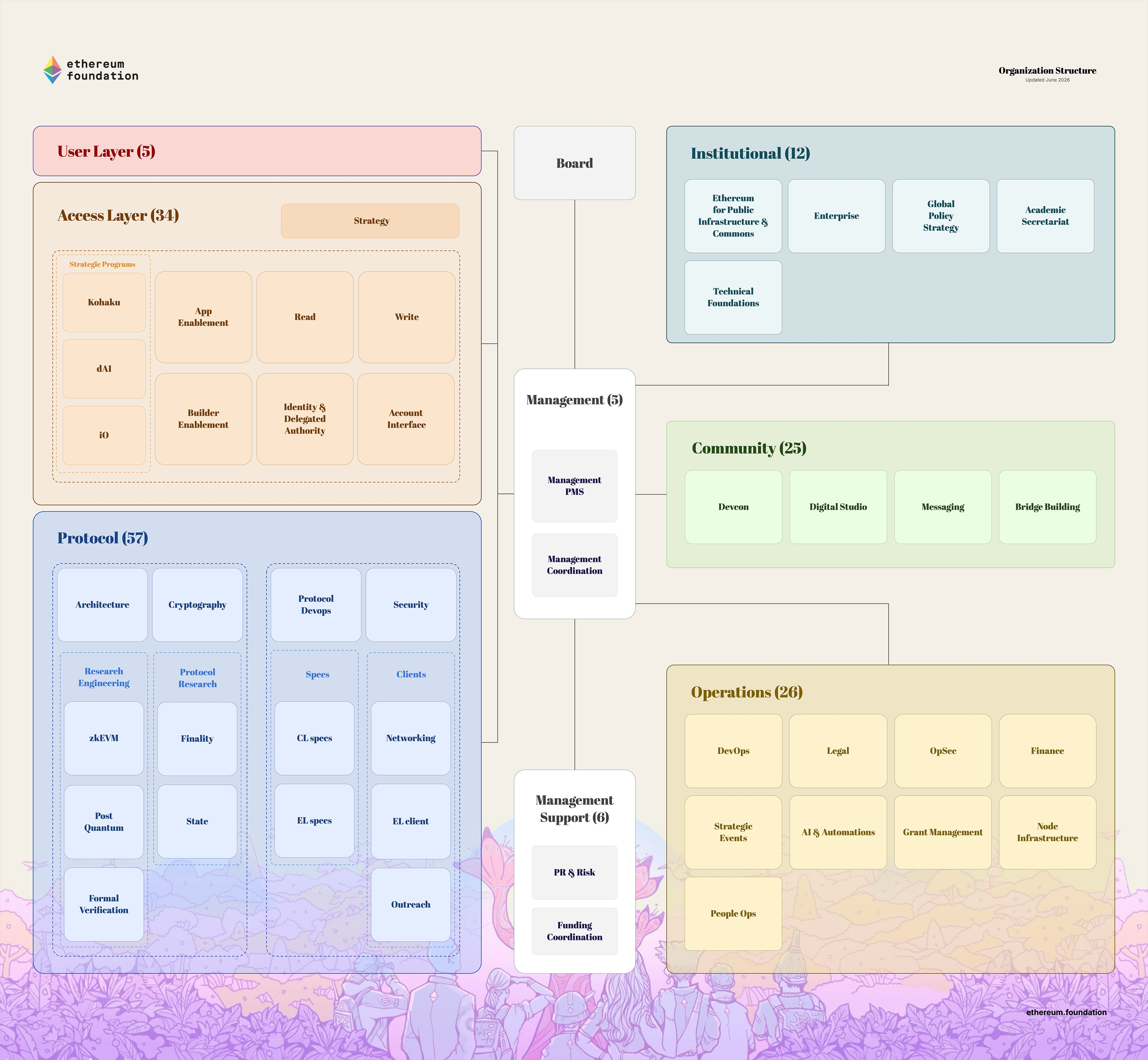
Schematic diagram of the new EF structure

The Dissolution of EF's Protocol Support Department Marks a Key Sign of EF's Organizational Split

It's worth mentioning that the work of EF's Protocol Support department leaned towards infrastructure construction, mainly responsible for coordinating the Ethereum protocol development process, including organizing and coordinating core developer meetings, tracking Ethereum network upgrades, supporting EIP advancement, and running the Ethereum protocol. Now, its main functions have been allocated to the protocol layer part of EF.

Coincidentally, on the same day EF announced its new structure, Ethlabs, a non-profit R&D lab co-founded by five former EF researchers, was officially announced. This organization aims to advance Ethereum as a settlement layer for the global economy and has received support from a series of investment institutions, Ethereum ecosystem projects, independent individuals, and EF foundation members, including Ethereum co-founder Joe Lubin (Chairman of Sharplink, founder of Consensys), ETH treasury company BitMine (Tom Lee's Ethereum treasury company), Sharplink, and crypto investment firm SNZ.
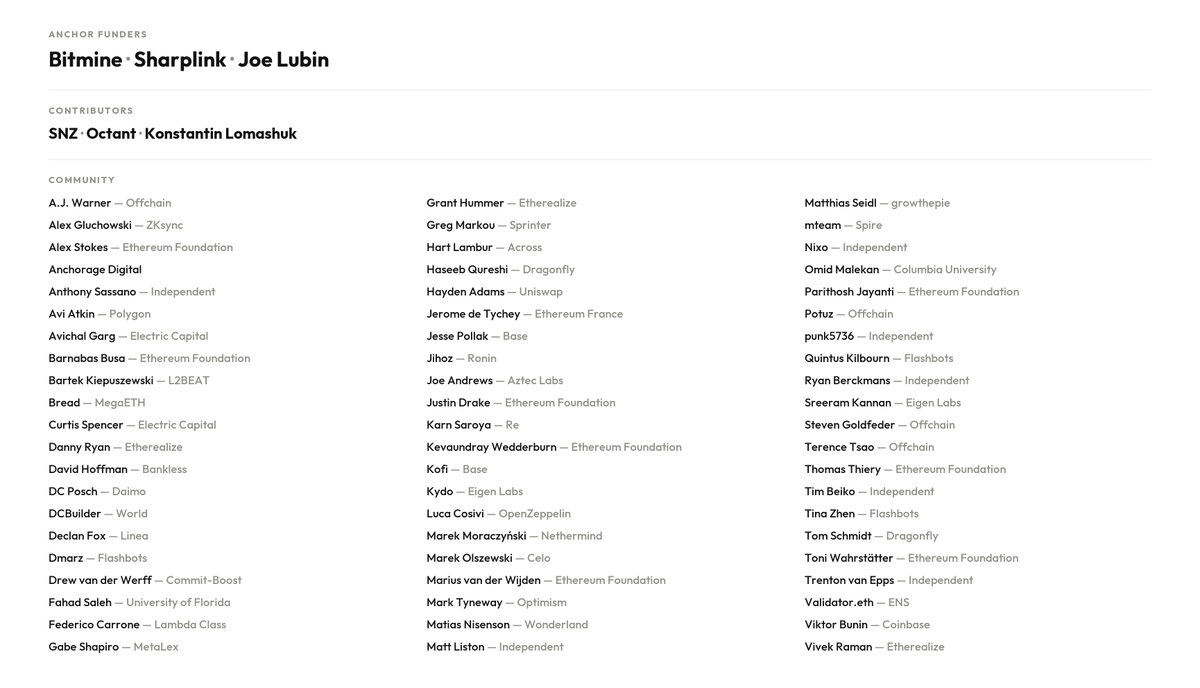
ETHLabs Community Participant List (Source: Official Account)

On July 1st, Ethereum Institutional, co-founded by former EF members David Walsh, Marius Smith, and Matthew Dawson, was officially unveiled.

This organization's main concept is "the institutional finance application plan for Ethereum," dedicated to promoting the institutionalization and institutional-grade application of Ethereum, its secondary nodes, applications, and the entire ecosystem. The organization also emphasizes collaboration with Ethlabs, Etherealize, and the Enterprise Ethereum Alliance, taking charge of institutional demand connection and explaining Ethereum's value proposition to banks; Ethlabs focuses on translating related demands into technical products. As a non-profit independent institution, Ethereum Institutional will provide free Ethereum application-related consulting to banks and asset management companies.

A week later, Ethereum Institutional announced the start of core team recruitment. In the coming weeks, the focus will be on hiring roles such as Institutional Business Development (Institutional GTM), Marketing & Community Operations, as well as technical positions like Solution Architect and Technical Project Lead.

Thus, the EF layoff storm officially concluded with the emergence of two major non-profit independent organizations and the dissolution of the Protocol Support department, drawing an imperfect full stop to the "internal organizational transformation" personally promoted by Vitalik last year. Beyond organizational-level fragmentation and the loss of high-level talent like Executive Director Wang Xiaowei, EF also faces the impact of AI technology.

The Era of AI Offense and Defense Begins, EF Security Team Upgrades Testing

Yesterday, researchers from the EF Protocol Security Team stated in a blog post that they have deployed a series of AI agents to test software relied upon by the Ethereum ecosystem, searching for vulnerabilities in cryptographic systems, protocol code, and smart contracts.

The vulnerabilities discovered by the AI agents include a remotely triggerable panic issue in the libp2p gossipsub peer-to-peer layer used by Ethereum consensus clients. This issue has been fixed and disclosed on GitHub as CVE-2026-34219.

The researchers stated that the AI agents were organized into specialized roles such as reconnaissance, search, patching, and verification, used to find potential attack paths, reproduce failures, and verify their applicability to production code. EF stated that AI has not replaced security researchers but has changed the way they work, enabling the team to cover a far greater scope than manual review. However, it requires researchers to make more cautious judgments on a large number of seemingly credible conclusions.

Considering today's news of the official launch of the GPT-5.6 model, subsequent maintenance of Ethereum protocol security may be jointly handled by AI models and EF security researchers. Moreover, although EF now mentions "AI has not replaced researchers," with the continuous development and evolution of AI models, personnel within the EF security team and perhaps the entire organization may be further reduced in the future. In other words, EF will also face the test of AI models on its organizational structure and the execution of its own functions.

Summary: EF Organizational Transformation Reaches a Staged Conclusion, May Become an Ecosystem Mascot in the Future?

In January of last year, we provided a systematic analysis of EF's organizational transformation in the article "Vitalik Fires the First Shot of 'Reform,' Where is the Ethereum Foundation Headed?" Back then, Vitalik was ambitiously and forcefully pushing for EF organizational change. In May this year, after more than a year of organizational innovation, Vitalik's tune changed, stating that "the Ethereum Foundation should not be the center of the ETH ecosystem and will shift towards a smaller, long-termism route."

It must be said that after ETH has grown into an asset with a market cap in the hundreds of billions, EF, the official ecosystem organization founded nearly a decade ago, has also entered the awkward situation of being "a large ship hard to turn." No wonder Vitalik previously even remarked—"I will no longer write regular blog posts, I have decided to try writing some science fiction on the topic of decentralized governance."

As former EF researcher and Ethlabs member Ansgar Dietrichs said on a podcast earlier this month, "After five years of failing to break through $5,000, ETH still lacks a clear value narrative."

Currently, it seems that EF is already struggling to shoulder the banner of "revitalizing the Ethereum ecosystem and driving ETH price breakthroughs." Future large-scale adoption and institutional investment may have to rely on organizations like Ethlabs, Ethereum Institutional, and Etherealize.

Perhaps, in the near future, playing the role of an "ecosystem mascot" would be more suitable for EF.

Recommended Reading

Ethereum Enters a "Mid-Life Crisis," Analyzing Development Performance from a Data Perspective

Given: ETH = Nokia, Find: Ethereum = iOS?

Ethereum Is "Sick," Are These Three Remedies Appropriate?

Where Lies the Path? A Brief Analysis of the Three Major Abstract Problems Facing the Ethereum Ecosystem Today

Enumerating the Seven Deadly Sins of Ethereum, Who Can Play Its "Salvation Oratorio"?

Where Lies the Orthodoxy of Ethereum? A Detailed Explanation of the "Cryptocurrency Masterpiece" in Vitalik's Heart

Ethereum's Tenth Anniversary: Revisiting ETH's Change of Ownership Journey, The Resurgence of Token Centralization

Are L2s a Detour for Ethereum?

Bankless Founder Liquidates ETH Holdings, Collective Disillusionment with Ethereum Faith

Трендовые криптовалюты

Связанные с этим вопросы

QWhat was the major announcement regarding the Ethereum Foundation's Protocol Support Team, and why is it significant?

AThe Ethereum Foundation's Protocol Support Team has officially disbanded. This is significant as it represents the largest round of layoffs in the EF's history, affecting 20% of its staff, and is seen as a major indicator of the organization's internal restructuring and fragmentation.

QWhat are two new non-profit independent organizations that emerged following the Ethereum Foundation's restructuring?

ATwo new non-profit independent organizations that emerged are Ethlabs, founded by five former EF researchers, and Ethereum Institutional, co-founded by former EF members. These organizations aim to take over functions related to R&D and institutional adoption of Ethereum, respectively.

QHow is the Ethereum Foundation's security team incorporating AI technology into its work?

AThe EF's security team has deployed a series of AI agents to test Ethereum's ecosystem software. These AI agents are organized into specialized roles to find potential attack paths, identify vulnerabilities (such as the CVE-2026-34219 issue), and verify fixes. The team states AI augments rather than replaces researchers, allowing them to cover much more ground.

QAccording to the article, what is one of the major criticisms faced by the Ethereum Foundation from within the community?

AOne major criticism from within the community is directed at the EF's perceived rigid structure, decision-making by a small group, questions about its organizational value, and its market-influencing ETH sell-offs. Bankless founder David Hoffman's public criticism and divestment from ETH is cited as an example of this discontent.

QWhat future role does the article suggest might be most suitable for the Ethereum Foundation?

AThe article suggests that, given its challenges in driving large-scale adoption and ETH price growth, the Ethereum Foundation's most suitable future role might be that of an 'ecological mascot' or a symbolic figurehead, while newer organizations lead practical development and institutional outreach.

Похожее

Пакет программного обеспечения Injective стал жертвой вредоносной атаки на цепочку поставок – Подробности

Злоумышленники скомпрометировали популярный пакет программного обеспечения Injective Labs, @injectivelabs/sdk-ts, в ходе атаки на цепочку поставок. Получив доступ к учетной записи законного участника проекта на GitHub, они распространили вредоносную версию пакета (v1.20.21) через npm под видом обновления с телеметрией. Вредоносный код, остававшийся неактивным при установке, активировался только при использовании разработчиками функций создания кошельков `fromMnemonic` или `fromHex`, похищая их приватные ключи и сид-фразы. Это давало злоумышленникам полный контроль над криптокошельками жертв. Атака была масштабной: пакет загружался около 50 000 раз в неделю, а через транзитивные зависимости затронул еще 17 связанных пакетов Injective. Хотя впоследствии была выпущена чистая версия (v1.20.23), скомпрометированный пакет оставался доступен в npm и на GitHub. Для защиты пользователям рекомендуется затронутые учетные данные, создать новые кошельки и перевести средства. Этот инцидент произошел на фоне другой крупной атаки, в которой BonkDAO потерял 20 миллионов долларов.

ambcrypto59 мин. назад

Пакет программного обеспечения Injective стал жертвой вредоносной атаки на цепочку поставок – Подробности

ambcrypto59 мин. назад

Куда движется оценка MegaETH после оттока Aave и резких колебаний TVL?

По данным DefiLlama, полный TVL MegaETH 9-10 июля резко упал почти на 60%, достигнув чуть более $30 млн, что на 70% ниже пика мая. Ключевой протокол Aave V3 вывел около 80% ликвидности. Токен MEGA упал примерно до $0,048, рыночная капитализация составляет около $54 млн, а FDV — около $4,8 млрд. Ранний рост TVL в значительной степени зависел от Aave и стратегий зацикливания стабильных монет, таких как USDe, построенных на арбитраже. После исчезновения прибыльности эти средства ушли, обнажив недостаток устойчивого спроса. Существует три основных несоответствия в оценке MegaETH: 1. **Несоответствие оценки и реального использования:** При FDV около $4,7 млрд и 88,7% токенов, которые еще не находятся в обращении, реальные доходы протоколов составляют менее $90 тыс. за 30 дней при всего 2619 ежедневно активных адресах. 2. **Несоответствие нарратива токена и качества экосистемы:** Основным источником дохода в сети является игра Monster (около $670 тыс.), а не DeFi-протоколы. Объем торговли нативных стейблкоинов и деривативов низок. 3. **Несоответствие краткосрочных ожиданий и долгосрочного исполнения:** Интеграции крупных протоколов, таких как Uniswap и Aave, не привели к устойчивому притоку TVL, что указывает на преобладание арбитражного капитала. Ситуация с MegaETH отражает общий сдвиг на рынке: инвесторы все меньше платят за "бумажный" TVL и нарративы, требуя реальных показателей использования и экономической активности. Восстановление цены MEGA, скорее всего, будет зависеть от краткосрочных настроений, пока команда не продемонстрирует четкий прогресс в создании устойчивой экосистемы с реальными пользователями.

链捕手1 ч. назад

Куда движется оценка MegaETH после оттока Aave и резких колебаний TVL?

链捕手1 ч. назад

Глубокий отчет Goldman Sachs: Кто станет долгосрочным победителем в индустрии больших языковых моделей ИИ в Китае?

Глубокий отчет Goldman Sachs анализирует перспективы китайской индустрии больших AI-моделей, выделяя исторический переломный момент. Китайские модели с открытыми весами по интеллектуальным возможностям приближаются к ведущим глобальным проприетарным аналогам, что стимулирует быстрое внедрение как внутри страны, так и среди мирового малого и среднего бизнеса. Ключевые выводы: 1. **Эффективность и инновации:** Китайские модели достигают сопоставимой производительности при значительно меньших затратах благодаря инновациям в архитектуре (например, MoE) и высокой параметрической эффективности. Пример — модель LongCat 2.0 от Meituan, полностью обученная на отечественных чипах. 2. **Двухуровневая рыночная структура:** Формируется рынок с сегментами premium (например, GLM5.2, Qwen3.7 Max, ~$1 за млн токенов) и budget (модели для агентов, ~$0.06-$0.2 за млн токенов). Ожидается рост доходов от API/подписок с ~350 млрд юаней в 2026 г. до ~8.79 трлн юаней к 2030 г. 3. **Стратегия открытого исходного кода:** Широко используется для гибкости развертывания и роста сообщества, но монетизация ограничена. Ожидается переход от полностью открытых лицензий к моделям с "открытым весом + коммерческой лицензией" и соглашениям о разделе доходов. 4. **Сдвиг парадигмы на глобальном рынке:** Фокус смещается с максимизации объема токенов на приоритет ROI (окупаемости инвестиций). Китайские модели набирают долю на зарубежных рынках (не США) благодаря соотношению цена/качество и доступности через платформы, такие как AWS Bedrock и Gemini Enterprise. 5. **Конкурентный ландшафт:** Goldman Sachs выделяет потенциальных долгосрочных лидеров на основе анализа ценового потенциала, преимуществ по затратам и финансовой устойчивости. * **Базовые текстовые модели:** Zhipu AI (нейтральный рейтинг) и DeepSeek (не публичная) имеют самые сильные позиции. * **Мультимодальные/видеомодели:** ByteDance (Seedance) является лидером. Также положительно оцениваются MiniMax (покупка) и Kuaishou (Kling). Отчет подчеркивает значительный рост индустрии и ее растущее глобальное влияние.

marsbit1 ч. назад

Глубокий отчет Goldman Sachs: Кто станет долгосрочным победителем в индустрии больших языковых моделей ИИ в Китае?

marsbit1 ч. назад

Глубокий отчет Goldman Sachs: Кто станет долгосрочным победителем в индустрии ИИ-больших моделей Китая?

**Кто станет долгосрочным победителем в индустрии ИИ-моделей Китая? Отчет Goldman Sachs** Китайские большие языковые модели (LLM) находятся на переломном этапе. Аналитики Goldman Sachs отмечают, что производительность китайских открытых моделей приближается к ведущим мировым проприетарным аналогам, а их внедрение быстро растет. Ключевые факторы успеха — архитектурные инновации (например, смешанные экспертные модели — MoE) и высокая эффективность параметров, что позволяет добиваться сопоставимой производительности при значительно меньших затратах (2-10% от параметров топ-моделей) и формировать "двухслойную" структуру рынка. **Двухуровневый рынок:** Сформировались два сегмента. *Высококлассные* модели (например, GLM5.2 от Zhipu, Qwen3.7 Max от Alibaba) с ценой ~$1 за млн токенов и рентабельностью 10-20%. *Бюджетные* модели для агентов (цена ~$0.06-0.2 за млн токенов) активно завоевывают глобальный рынок малого бизнеса. Ожидается, что доходы от API/подписок в Китае вырастут с ~35 млрд юаней в 2026 до ~879 млрд юаней в 2030 году. **Стратегия открытого исходного кода:** Многие ведущие китайские модели (Zhipu, DeepSeek, Alibaba, MiniMax) используют открытые веса для ускорения итераций и глобального распространения. Однако текущая модель монетизации (прямые API) недооценивает реальный масштаб развертывания. Ожидается переход к модели "открытые веса + коммерческая лицензия" с разделением доходов через платформы (AWS Bedrock, Alibaba Cloud), что улучшит рентабельность. **Глобальная экспансия и смена парадигмы:** Главный потенциал роста — выход на международные рынки (особенно за пределами США), где китайские модели конкурируют ценой и качеством. Goldman отмечает сдвиг корпоративного спроса от максимизации потребления токенов к приоритету ROI (окупаемости инвестиций), где важнее эффективность и автоматизация задач. **Потенциальные победители:** Goldman Sachs оценивает конкуренцию по трем критериям: ценовая власть, преимущества в себестоимости и финансовая устойчивость. * **Базовые текстовые модели:** Наиболее сильные позиции у **Zhipu AI** (первое покрытие, целевая оценка $110 млрд) и **DeepSeek** (не публична). * **Мультимодальные/видеомодели:** Лидер — **ByteDance** (не публична) с моделью Seed (высокая рентабельность). Также выделены **Kuaishou** (Kling) и **MiniMax** (покупка, цель — 860 HKD), чья оценка выглядит недооцененной. **Вывод:** Китайские ИИ-модели добились прорыва в эффективности и качестве, формируя конкурентоспособное глобальное предложение. Долгосрочный успех будет определяться способностью сочетать технологическое лидерство, эффективную монетизацию открытых стратегий и выход на международные рынки.

链捕手1 ч. назад

Глубокий отчет Goldman Sachs: Кто станет долгосрочным победителем в индустрии ИИ-больших моделей Китая?

链捕手1 ч. назад

Circle получает окончательное одобрение OCC для создания национального трастового банка с целью укрепления инфраструктуры USDC

Circle получила окончательное одобрение Управления контролера денежного обращения США (OCC) на создание национального трастового банка под названием First National Digital Currency Bank, N.A. (Circle National Trust). Это важный нормативный этап, который переводит ключевую часть инфраструктуры стейблкоина USDC под прямое федеральное банковское регулирование. Новый трастовый банк будет предоставлять регулируемые услуги по хранению цифровых активов для компании и, в перспективе, для ограниченного числа институциональных клиентов, включая банки. Утверждение также закладывает основу для возможного будущего управления резервами USDC под надзором OCC. Circle стала одной из первых криптокомпаний в новой волне заявителей, прошедшей путь от условного до окончательного одобрения OCC, что отражает общую тенденцию интеграции криптоинфраструктуры в существующую банковскую систему США.

ambcrypto1 ч. назад

Circle получает окончательное одобрение OCC для создания национального трастового банка с целью укрепления инфраструктуры USDC

ambcrypto1 ч. назад

Торговля

Спот

Популярные статьи

Manyu: восходящая мем-звезда на Ethereum, готовая открыть новую эру культуры Shiba

Manyu - это мемтокен на Ethereum, который приносит децентрализованную культурную и развлекательную ценность через вирусное влияние в соцсетях и вовлечённость сообщества.

2.0k просмотров всегоОпубликовано 2025.11.27Обновлено 2025.11.27

Manyu: восходящая мем-звезда на Ethereum, готовая открыть новую эру культуры Shiba

Неделя обучения по популярным токенам 14: Glamsterdam — самое ожидаемое обновление Ethereum в 2026 году

Ordinals/Runes по-прежнему стимулируют доходы от комиссий за блоки и активность разработчиков, рассматриваются как отправная точка «нативной эмиссии активов» в сети.

1.6k просмотров всегоОпубликовано 2026.04.29Обновлено 2026.04.29

Неделя обучения по популярным токенам 14: Glamsterdam — самое ожидаемое обновление Ethereum в 2026 году

Обсуждения

Добро пожаловать в Сообщество HTX. Здесь вы сможете быть в курсе последних новостей о развитии платформы и получить доступ к профессиональной аналитической информации о рынке. Мнения пользователей о цене на ETH (ETH) представлены ниже.

活动图片