Ethereum Forms Three Major Power Centers, with Commercialization Vitality in the Hands of ETH Whales

marsbitОпубликовано 2026-07-03Обновлено 2026-07-03

Введение

Ethereum forms three power centers, with commercialization now held by major ETH holders. Following the Ethereum Foundation's 2026 strategic pivot to focus solely on core principles like decentralization and security, two new independent entities have emerged to drive adoption: Ethlabs, focused on core technology and ETH's monetary narrative, and Ethereum Institutional, tasked with business development and promoting Ethereum to traditional finance. These organizations are funded by Bitmine and Sharplink, entities holding a combined 5.46% of ETH's circulating supply. This structure separates commercialization from the Foundation's neutrality but ties ecosystem funding directly to the financial health of these large stakeholders. The success of this model hinges on ETH's price performance. Bullish prospects rely on Ethereum's dominant market position in stablecoins, DeFi, and tokenized assets, potentially making it the default settlement layer. Bearish risks stem from weak ETF demand and price volatility, which could strain funding for Ethlabs and Ethereum Institutional. Ultimately, ETH's price trajectory will determine whether this new power structure successfully fosters institutional adoption or becomes seen as a mechanism primarily serving large holders' interests.

Written by: Gino Matos

Compiled by: Chopper, Foresight News

On July 1st, Ethereum Institutional was announced, consolidating the Ethereum Foundation's marketing efforts into one team responsible for pitching Ethereum's tokenization and stablecoins to banks and asset managers.

Just days earlier, Ethlabs debuted, formed by five former senior Ethereum Foundation researchers, focusing on two main areas: enhancing on-chain settlement efficiency and refining the ETH monetary narrative.

Bitmine, Sharplink, and Ethereum co-founder Joe Lubin jointly provide funding for the two new organizations.

The launch of these two major new institutions coincides with a continued outflow of senior personnel from within the Ethereum Foundation. On June 18th, co-executive director Hsiao-Wei Wang announced her departure, following the resignation of Tomasz Stańczak. Over the past five months, at least eight executives have left the Ethereum Foundation.

As early as March 2026, the Ethereum Foundation released a new mandate, redefining its position: solely as a guardian of the principles of self-sovereignty, censorship resistance, open-source code, privacy, and security, not claiming to be Ethereum's parent company nor holding ultimate decision-making power over the protocol. This positioning deliberately leaves a business vacuum, with commercial deployment work outsourced to external organizations.

Ethlabs takes on the technology R&D and asset value narrative segments, responsible for improving the underlying infrastructure and crafting a complete logic for ETH as a monetary asset to address institutional concerns about entering Ethereum. Ethereum Institutional is fully responsible for business development, converting industry interest into real deployed capital by building industry forums, maintaining institutional networks, and customizing pitch plans.

The core reason for the two teams operating independently from the Foundation lies in the Foundation's neutral stance being incompatible with commercial work. A neutral standard-setting body simultaneously acting as an ETH promotional team and corporate sales department would directly harm its own credibility.

Thus, Ethereum's three-power structure is formed. The Foundation is responsible for legitimacy and long-term protocol value, Ethlabs for ETH value capture and technical R&D, and Ethereum Institutional for corporate business promotion.
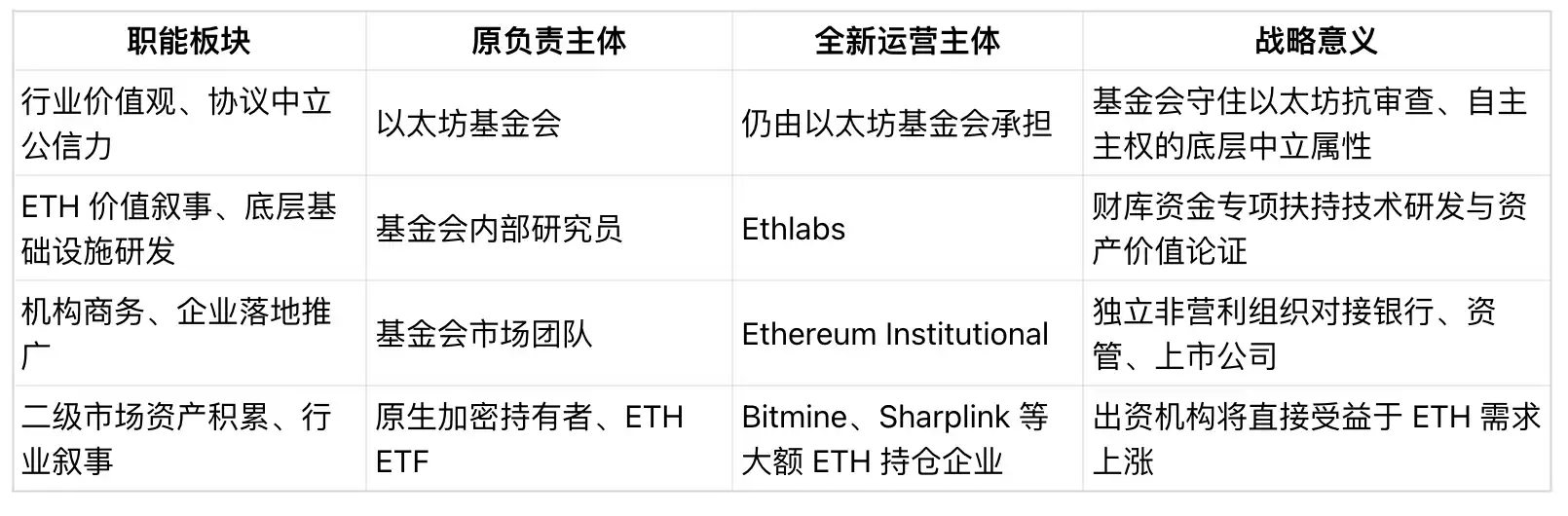
Ethereum Institutional revealed that the team has already engaged with over 500 tier-1 banks, global asset managers, sovereign wealth funds, custodians, and market infrastructure service providers. Its hosted Ethereum Institutional Summit gathers over 150 financial executives from institutions managing a total of $250 trillion in assets. This massive scale of industry resources is also a key reason for the official split of operations and the establishment of independent entities rather than housing them as auxiliary Foundation businesses.

Delegating corporate business and ETH value promotion to external organizations solves the execution disconnect at the Foundation level, but it also means that giants holding vast amounts of ETH and sitting on massive balance sheets control the communication channels pitching to Wall Street. Convenience and independence are opposite directions, and Ethereum has chosen convenience.

Supporting Ethereum's Wall Street Push are Companies Holding Massive Amounts of ETH

Bitmine currently holds 5.7 million ETH, accounting for 4.7% of ETH's total circulating supply. Combined with cash and marketable securities, its total asset size reaches $9.8 billion. Sharplink holds 886,725 ETH and added 10,000 ETH on June 28th at an average price of $1,611.

The two institutions collectively hold 6.59 million ETH, representing 5.46% of the 120.7 million circulating supply, with a total holding value of nearly $10.6 billion at current prices. Bitmine itself has a market cap of $6.55 billion, while Sharplink's market cap exceeds $1 billion.
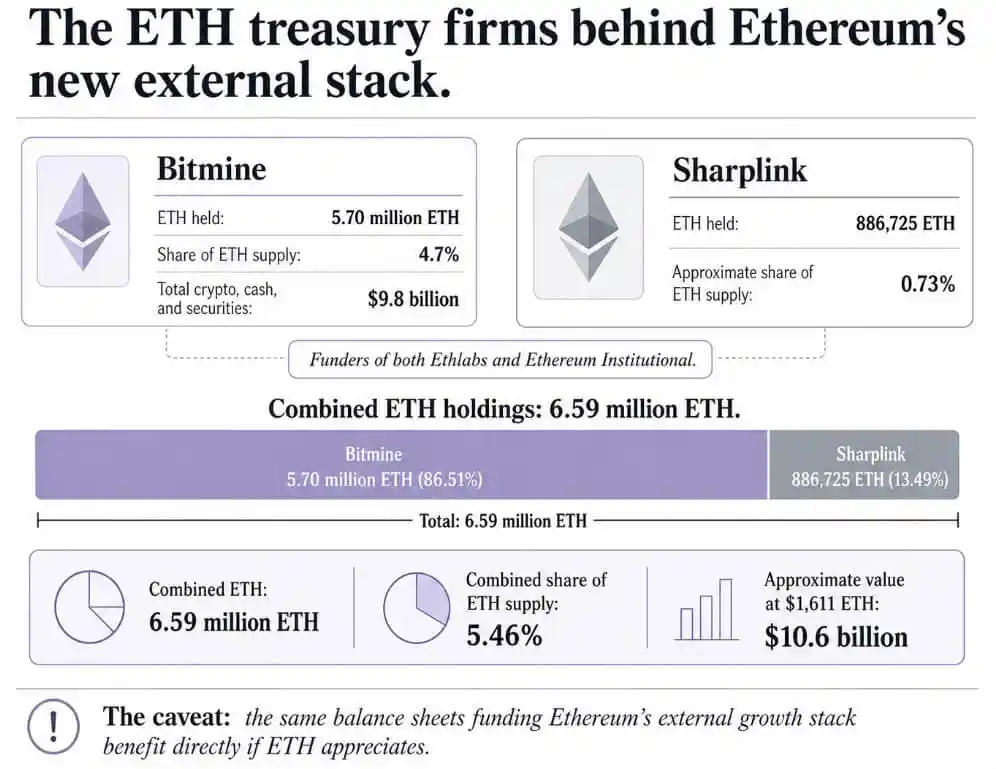
If this operational split model proves successful, the two funding companies will directly benefit: improved underlying infrastructure and more mature institutional business will increase demand for ETH. Given their massive holdings, even minor ETH price fluctuations can translate into hundreds of millions of dollars in asset value changes. Ethereum co-founder Joe Lubin, supporting both non-profits, sits at the core of this interest system, with Bitmine and Sharplink's financial gains deeply tied to Ethereum's ecosystem development.

PeerDAS has already launched, potentially increasing Layer 2 data availability capacity about tenfold, while Glamsterdam, planned for the second half of 2026, aims to achieve base-layer scaling, parallel transaction processing, and larger block payloads.

An academic report from June 2026 shows that transaction throughput on the mainnet and Layer 2 networks has doubled; median mainnet fees have dropped from over $2 to below $0.02, while Layer 2 fees have fallen by over 95%, as low as $0.0015.

The report also provides long-term performance predictions: before 2034, Ethereum mainnet transaction processing capacity will remain under 100 transactions per second; not until March 2029 will Layer 2 throughput surpass Solana's, but by then Layer 2 fees will be far lower than competitors. Ethereum's ability to attract institutions relies almost entirely on Layer 2 scaling and industry standard adoption, which is precisely the core domain of Ethlabs.

Two Potential ETH Price Trajectories Will Determine the Ultimate Direction of This Structure

The bullish case is that Ethereum already possesses considerable scale. Ethereum currently hosts $157 billion in stablecoin market cap, representing over half of the global stablecoin total; DeFi locked value stands at $37.2 billion, accounting for 62% of the industry. RWA.xyz data shows Ethereum's tokenized real-world asset (RWA) size at $15.8 billion, with the entire sector totaling $31.52 billion, firmly holding the top position among public blockchains.

Citibank predicts the global tokenized real-world asset market will expand from the current $17 billion to $5.5 trillion by 2030, with a lower bound of $2.7 trillion and an upper bound of $8.2 trillion. If Ethlabs continues to iterate on infrastructure and Ethereum Institutional can convert network relationships into actual deployed capital, holding giants like Bitmine and Sharplink will become early beneficiaries, Ethereum could become the default settlement layer for compliant digital assets, and ETH asset value would rise accordingly.

The bearish case starts with price. Citibank lowered its 12-month ETH price target from $3,175 to $2,240, citing weak ETF demand and negative fund flows, and set a bear market scenario for ETH at $1,094.

Standard Chartered holds the completely opposite view, maintaining that ETH could reach $4,000 by the end of 2026. The huge divergence in expectations between the two major institutions reflects the high uncertainty in the short-term market outlook.

If ETH remains weak long-term, with Bitmine and Sharplink stock prices persistently trading at a discount relative to their held assets, the two companies' ability to fund the two non-profits will continue to shrink. Even if Ethlabs and Ethereum Institutional can maintain operations, funding stability will significantly decline. The market will continually question whether the core purpose of establishing these two institutions was to pump the ETH price rather than build genuinely usable institutional-grade infrastructure.

Regulatory tailwinds support the bull case but do not guarantee a price rise. The U.S. GENIUS Stablecoin Act of 2025 established a federal regulatory framework for stablecoins; the Visa, Mastercard, Coinbase consortium subsequently launched the Open USD stablecoin. Regulatory improvements will bring institutional settlement volume to all public chains, not a unique benefit for Ethereum. McKinsey offers a more conservative prediction, estimating the tokenized market size at around $2 trillion by 2030, forming a stark contrast with Citi's high expectations, indicating enormous disagreement on the industry's growth potential itself.

Summary

By splitting operations and establishing two independent organizations, Ethereum has resolved the inherent contradiction between the Foundation's neutrality and commercialization. However, with both institutions funded entirely by companies holding massive amounts of ETH, this structure presents both advantages and risks.

On the positive side, specialized organizations focusing on infrastructure and engaging Wall Street could position Ethereum as a universal settlement layer for tokenized finance. On the risk side, the ecosystem's expansion system is completely tied to the balance sheets of the holding giants, with ETH market performance directly determining funding supply. Both scenarios will coexist, and the ETH price a year from now will determine which trend dominates.

Трендовые криптовалюты

Связанные с этим вопросы

QWhat are the three new power centers that have formed in Ethereum according to the article?

AThe Ethereum Foundation, Ethlabs, and Ethereum Institutional.

QWhat is the primary reason the Ethereum Foundation spun off its commercial and value narrative work to external organizations?

ATo maintain its neutrality and credibility as a standards-setting body, as simultaneously acting as a promoter and sales department would damage its public trust.

QWhich two companies are major funders of Ethlabs and Ethereum Institutional, and what is their combined ETH holding?

ABitmine and Sharplink are the major funders. They hold a combined 6.59 million ETH, representing 5.46% of the circulating supply.

QWhat are the two potential future scenarios for ETH's price mentioned in the article, and how do they affect the new institutional structure?

AA bullish scenario where ETH price rises, benefiting the holding companies and strengthening the new institutions' funding. A bearish scenario where a weak ETH price strains the funders' balance sheets, potentially reducing funding and casting doubt on the institutions' motives.

QWhat key technological developments, assigned to Ethlabs, are crucial for attracting institutional adoption of Ethereum?

AScaling solutions, particularly Layer 2 rollup advancements like PeerDAS and the upcoming Glamsterdam upgrade, which aim to drastically increase throughput and reduce transaction fees.

Похожее

OUSD, из-за которого Circle обвалился на 17% за ночь, оказался в центре маркетингового скандала

30 июня компания Open Standard анонсировала запуск стейблкоина Open USD (OUSD), который обещал бесплатную эмиссию и погашение, распределение доходов от резервных активов и совместное управление через партнерство. Заявление о поддержке более чем 140 партнеров, включая крупные компании, такие как Samsung и Western Union, вызвало ажиотаж и привело к падению акций Circle на 17,55%. Однако вскоре выяснилось, что многие компании из списка, включая Samsung Electronics и Dunamu, не давали официального согласия на участие. Они заявили, что лишь рассматривали возможность сотрудничества или были введены в заблуждение. Это вызвало вопросы об этичности маркетинговой стратегии Open Standard, которую некоторые назвали «заимствованием легитимности». Сооснователь Circle Джереми Аллер подверг сомнению экономическую устойчивость модели OUSD, особенно бесплатную эмиссию и распределение почти всех доходов партнерам, что может привести к недостатку инвестиций в инфраструктуру. Несмотря на скандал, некоторые компании, такие как Stripe и Coinbase, подтвердили планы по интеграции OUSD. Тем не менее, запуск OUSD омрачен спорным маркетингом, что может подорвать доверие к еще не запущенному стейблкоину.

Foresight News1 мин. назад

OUSD, из-за которого Circle обвалился на 17% за ночь, оказался в центре маркетингового скандала

Foresight News1 мин. назад

Десять лет перемен: путь к исчезновению криптовалютных стартапов

За десять лет криптоиндустрия прошла путь от свободного творчества до строгой регуляции. В начале, в 2017 году, для запуска стартапа хватало whitepaper и кода на GitHub, а ICO позволяло быстро привлекать средства без проверок. Низкие барьеры способствовали инновациям, но также привели к мошенничеству и потерям инвесторов. К 2026 году ситуация коренным образом изменилась. Чтобы работать на рынках США, ЕС или Азии, компании должны получить лицензии, создать юридические и compliance-команды, наладить банковское сотрудничество и внедрить системы AML. Стоимость соответствия требованиям, например, в США, может достигать 1,2 млн долларов за первые три года, а в ЕС согласно MiCA установлены минимальные капитальные требования. Высокие регуляторные и финансовые барьеры формируют "естественную защиту" для первых игроков. Венчурное финансирование сконцентрировалось на поздних стадиях и крупных сделках, создав "рынок-гантелю": деньги идут либо на ранние, либо на очень поздние раунды, оставляя мало средств для роста. Альтернативой стал рост M&A-сделок, как покупка Coinbase Deribit за 2,9 млрд долларов, позволяющая быстро получить лицензии и доступ к институциональным клиентам. Сегодня ключом к успеху стали не технологии, а доступ к банкам, лицензии, партнерские каналы и репутация. Это повысило стабильность и безопасность для институциональных инвесторов, но резко усложнило путь для новых основателей без капитала и связей. Финансирование рискованных инновационных проектов сокращается. Индустрия, рожденная для борьбы с монополиями традиционных финансов, сама идет по пути консолидации и повышения входных барьеров, ставя под вопрос возможность появления действительно революционных проектов "с нуля".

Foresight News17 мин. назад

Десять лет перемен: путь к исчезновению криптовалютных стартапов

Foresight News17 мин. назад

Закончился ли рост цены Cardano? Вот почему ADA может достичь $0,30 в следующий раз

Заголовок задает вопрос: завершился ли рост цены Cardano? Статья анализирует перспективы ADA, рассматривая как медвежьи, так и бычьи сигналы. С технической стороны, после трех слабых кварталов ADA показала сильный рост в 30% в начале Q3, обогнав Ethereum. Однако цена столкнулась с сопротивлением на уровне $0.20 и откатилась на 2%, что указывает на возможную коррекцию. Фундаментальные данные также вызывают вопросы: общая заблокированная стоимость (TVL) в экосистеме Cardano за год упала почти на 68%, что говорит об отставании ликвидности от роста цены. Несмотря на это, есть и бычьи сигналы. Ончейн-данные Santiment показывают устойчивый рост числа новых непустых кошельков с июня 2023 года, даже на фоне негативных новостей. Это указывает на растущее участие пользователей и может предшествовать будущему росту цены. В целом, рынок альткойнов получает поддержку, а июль исторически является сильным месяцем. Ключевым уровнем для ADA остается $0.20. Его уверенное преодоление может открыть путь к $0.25, а затем и к цели в $0.30. Таким образом, несмотря на текущую коррекцию и слабый TVL, рост числа кошельков и общий рыночный контекст оставляют возможности для дальнейшего движения вверх, если техническое сопротивление будет пробито.

ambcrypto32 мин. назад

Закончился ли рост цены Cardano? Вот почему ADA может достичь $0,30 в следующий раз

ambcrypto32 мин. назад

Результаты первых внутренних тестов GPT-5.6 Sol: стоимость аналогичной задачи в два раза ниже, чем у Fable 5

Представлены первые результаты закрытого тестирования GPT-5.6 Sol. Модель демонстрирует высокую эффективность: по данным инженера Nvidia, она достигла эффекта ускорения CUDA за 30 часов, в то время как Opus потребовалось 64 часа. В задачах кодирования Sol генерирует более лаконичный код — примерно в 5 раз меньше строк, чем у Opus, что упрощает долгосрочную поддержку проектов. Хотя в некоторых тестах, особенно в создании сложного контента (например, 3D-игр), Sol пока немного уступает Fable 5, его ключевым преимуществом является стоимость: цена Sol примерно в два раза ниже (5$ за млн входных и 30$ за млн выходных токенов против 10$ и 50$ у Fable 5). Кроме того, пользователи отмечают, что ограничения безопасности в Sol менее строгие, чем в Fable 5. Модель оптимизирована для сложных, многоэтапных задач, требующих планирования и глубоких рассуждений. Ожидается, что GPT-5.6 Sol скоро станет доступен для всех пользователей, а не только для избранных партнеров.

marsbit1 ч. назад

Результаты первых внутренних тестов GPT-5.6 Sol: стоимость аналогичной задачи в два раза ниже, чем у Fable 5

marsbit1 ч. назад

Робот учится действиям по видео: Беркли впервые реализовал полную цепочку от интернет-видео до реального развертывания на ловких руках

**Краткое содержание:** Исследователи из Калифорнийского университета в Беркли представили сквозной конвейер «Do as I Do», который впервые позволяет напрямую преобразовывать обычные монохромные RGB-видео с действиями человека в исполняемые траектории для антропоморфных роботизированных рук с последующим развертыванием на реальном оборудовании. **Ключевая проблема:** Существует огромный объем видеоданных (YouTube, наборы данных от первого лица), но их использование для обучения роботов затруднено. Основное препятствие — преобразование зашумленных 2D-видео в чистые 4D-траектории взаимодействия «рука-объект», пригодные для управления многопалой ловкой рукой. **Решение — двухэтапный конвейер:** 1. **Стабильная 4D-реконструкция:** Метод использует управляемую диффузию для отслеживания объекта на видео, фиксируя его форму на ключевом кадре и обеспечивая временную согласованность позы. Это превосходит предыдущие методы (например, FoundationPose) по устойчивости в реалистичных условиях. 2. **Робастное перенацеливание действий:** Улучшена оптимизационная основа (на базе SPIDER) для обработки зашумленных эталонных траекторий. Добавлены: а) совместная оптимизация позы и контакта, б) терпимость к несовершенному начальному состоянию, в) адаптивный выбор ключевых кадров. Это повысило успешность перенацеливания с 25% до 71%. **Результаты:** * Создано 500 проверенных траекторий, охватывающих 20 классов сложных действий (взбивание, перемешивание, забивание, намазывание и др.). * 10 действий были успешно развернуты в реальности на платформе с двумя манипуляторами UR3e и двумя ловкими руками Sharpa Wave (22 степени свободы) с частотой управления 50 Гц. * Определены критерии фильтрации сетевых видео: только ~5% необработанных роликов пригодны для использования из-за проблем с кадрированием, движением камеры и т.д. **Значение:** Работа впервые замыкает цепочку от случайного сетевого видео до физического выполнения действия роботом, открывая путь к масштабированию обучения роботов за счет использования огромных существующих видеоархивов человеческих действий.

marsbit1 ч. назад

Робот учится действиям по видео: Беркли впервые реализовал полную цепочку от интернет-видео до реального развертывания на ловких руках

marsbit1 ч. назад

Торговля

Спот

Популярные статьи

Manyu: восходящая мем-звезда на Ethereum, готовая открыть новую эру культуры Shiba

Manyu - это мемтокен на Ethereum, который приносит децентрализованную культурную и развлекательную ценность через вирусное влияние в соцсетях и вовлечённость сообщества.

2.0k просмотров всегоОпубликовано 2025.11.27Обновлено 2025.11.27

Manyu: восходящая мем-звезда на Ethereum, готовая открыть новую эру культуры Shiba

Неделя обучения по популярным токенам 14: Glamsterdam — самое ожидаемое обновление Ethereum в 2026 году

Ordinals/Runes по-прежнему стимулируют доходы от комиссий за блоки и активность разработчиков, рассматриваются как отправная точка «нативной эмиссии активов» в сети.

1.6k просмотров всегоОпубликовано 2026.04.29Обновлено 2026.04.29

Неделя обучения по популярным токенам 14: Glamsterdam — самое ожидаемое обновление Ethereum в 2026 году

Обсуждения

Добро пожаловать в Сообщество HTX. Здесь вы сможете быть в курсе последних новостей о развитии платформы и получить доступ к профессиональной аналитической информации о рынке. Мнения пользователей о цене на ETH (ETH) представлены ниже.

活动图片