You Use Claude and Codex Every Day, but Meta Has Restricted Internal Use

marsbitОпубликовано 2026-06-30Обновлено 2026-06-30

Введение

In May, Meta imposed internal restrictions on its engineers regarding the use of Claude Code and Codex, two widely used AI programming tools. Despite being a major client, Meta's guidelines, still in effect, prohibit these external models from being used for specific tasks to prevent potential "escalations with partners." The core concern is "distillation"—the risk that outputs from Claude or Codex could inadvertently contaminate the training data and evaluation processes for Meta's in-house AI coding assistant, MetaCode. If MetaCode is trained or evaluated using data generated by these external models, it risks learning their capabilities rather than developing its own, blurring the line of intellectual origin. The restrictions are precise: engineers cannot use the external models to generate test questions, debug source code, or suggest test cases. AI-generated content is also barred from environments accessible to MetaCode. However, AI can still assist with peripheral tasks like workflow setup and code organization, provided all outputs are manually reviewed. This caution reflects a broader industry dilemma. While distillation is a common technique, using a competitor's model output for training raises legal and ethical questions about the ownership of derived capabilities. Contractual terms from companies like OpenAI and Anthropic explicitly forbid using their outputs to build competing products, putting enforcement power in the hands of rivals. The move is also financ...

In May of this year, Meta drew a clear line for its own engineers.

People in the Applied AI Engineering department can no longer freely use Claude Code and Codex.
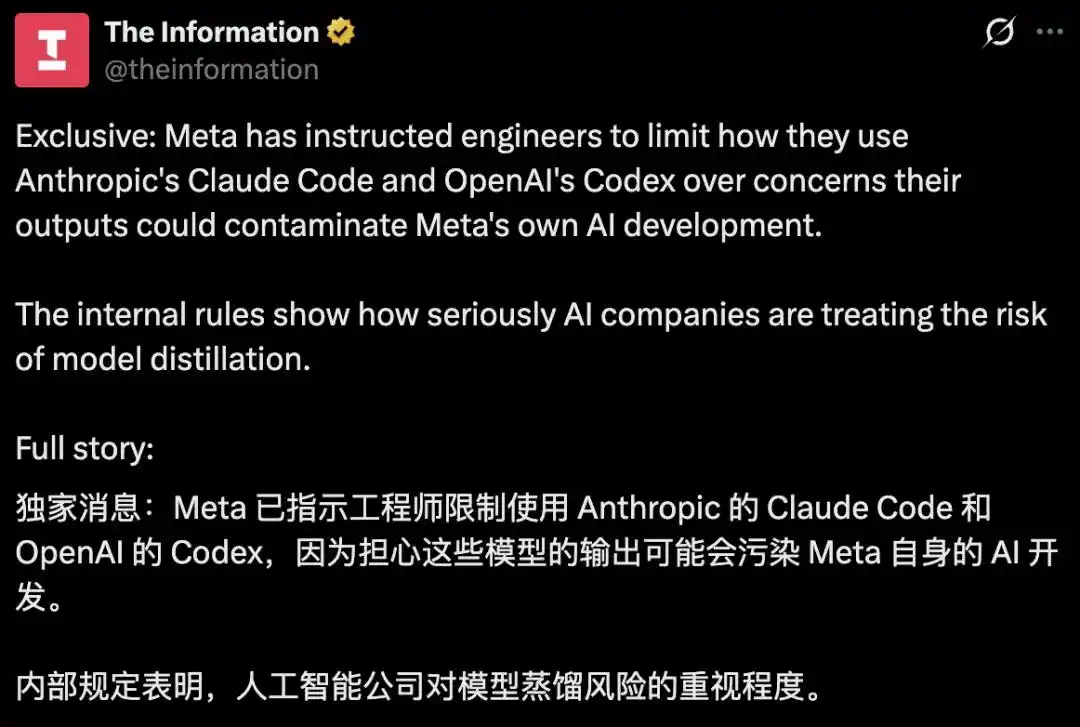
According to an internal guide obtained by The Information, a memo even directly called for a pause on certain tasks involving these two models. The wording was severe, stating this could trigger a "serious escalation with partners."

However, the strangeness lies precisely here.

Meta is one of Claude Code's largest global customers. Its total internal AI bill this year is heading towards tens of billions of dollars.

A tool used daily, purchased by the company at great cost, is now being restricted internally. And the reason for the restriction is probably something you wouldn't expect.

It's not that they aren't useful. On the contrary, it's because they are *too* useful.

This Red Line is Still in Effect

According to The Information report, these restrictions were set in May and are still in effect today.

To understand why Meta is so tense, we need to start with an internal AI coding assistant project.

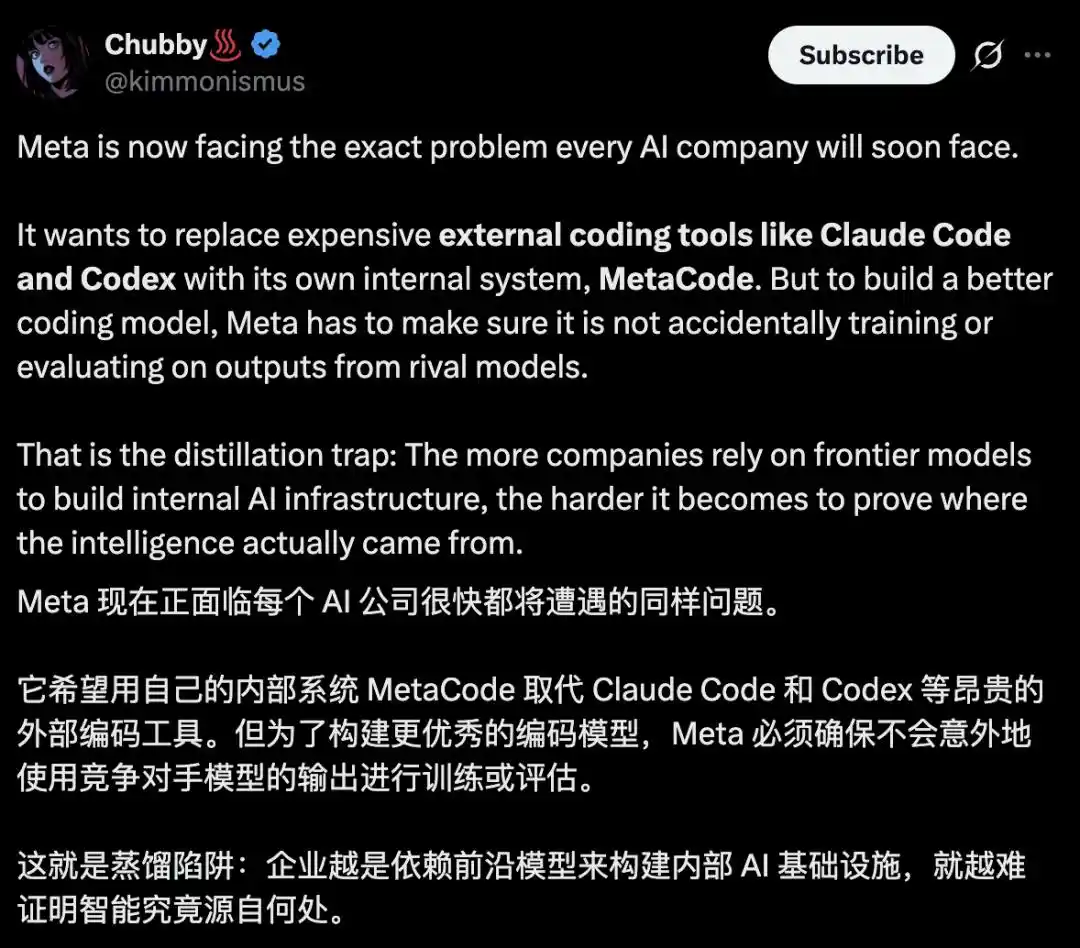
This year, it formed an Applied AI Engineering team, focusing on its self-developed AI coding assistant MetaCode (formerly DevMate).

The goal is to stop Meta from spending huge sums continuing to use others' AI coding models and to train its own.
The official interface of Claude Code. Together with OpenAI's Codex, they have become the de facto standard for professional developers doing agentic programming.

But training a model that can write code is not simple.

You need to feed it massive amounts of high-quality data, and also generate enough, sufficiently tricky programming problems for it to practice on and be graded on. This set of problems and evaluations almost determines how powerful a coding model ultimately becomes.

But the problem lies precisely here.

The difficulty Meta encountered is how to prevent employees from becoming too reliant on these external tools while building the internal replacement.

What it worries about is the outputs from these external models seeping into the training data, causing the model it builds to secretly learn the competitor's capabilities.

To understand this concern, you need to know how a model "learns": You feed it what kind of data, it becomes that kind of model.

MetaCode wants to become stronger by relying on the training data and programming problem sets accumulated by engineers.

But once these problems, answers, and even grading criteria come from Claude or Codex, what MetaCode learns is no longer "skills trained by human engineers," but "Claude's skills."

It's copying answers from the competitor's test paper, becoming more and more like the competitor.

Even more hidden is the evaluation part.

Every time a model answers a question, something must tell it if it answered well so it knows where to improve.

If both problem creation and grading are handed to Codex, then MetaCode is evolving towards what "Codex thinks is correct," essentially copying the competitor's judgment standards bit by bit into its own mind.

This is why Meta's guide prohibits AI from being the problem creator or grader, and even governs whether "AI-generated materials can enter the environment accessible to the model under test."

As long as the competitor's output seeps into the training or evaluation chain in any way, the line of "who taught whom" becomes blurred.

Ultimately, Meta's pause on certain tasks is about isolating the training data.

It fears that the AI writes so well that it becomes unclear which skills were trained internally and which were learned from Claude and Codex.

And the latter set of capabilities is rented, not its own.

Surprisingly Detailed Restrictions

It must be clarified first that Meta's internal documents show no actual records of employees violating rules.

A Meta spokesperson also responded that the company has "clear policies" governing the use of AI tools. So this document is more like an internal early warning.

What tasks can't AI handle? Mainly the following three categories:

First, you cannot use Claude or Codex outputs to create test questions for your own model. The guide's exact words are, this "clearly falls into the category where engineers are not in the driver's seat," "We do not want tasks derived from models."

Second, AI cannot find bugs in source code, nor can it help you think about "what to test" based on code analysis.

Third, anything generated by AI cannot be placed anywhere accessible by the model under test.

Simply put, as long as AI participates in the judgment of "what to test" or "whether the answer is correct," the competitor's skills might mix in. The three rules block this opening.

What tasks can AI still do?

Setting up workflows, organizing code and files, building test frameworks for internal tools—these daily chores are allowed. The guide calls this type of work "test scaffolding" and "solution calibration," essentially assisting and building frameworks.

Even for these tasks, there is one ironclad rule: Every line of AI output must be reviewed by a human first.

In Meta's view, once you let a competitor's model create the test and grade it, it becomes unclear whose test this is.

What it truly wants to protect is that line of "who taught whom."

The Unavoidable "Distillation Trap"

What Meta worries about has a specific name in the industry: distillation.

The meaning is easy to understand: Use a stronger model to continuously answer questions, then use these answers to train a weaker model.

It's a bit like having the top student redo the entire exam paper, and the struggling student copies it, catching up to years of effort in months.

The massive investment others put into data, computing power, and research, you almost get for free.

Training a cutting-edge model from scratch costs astronomical sums of money and time. Distillation, however, might only require a batch of outputs from the other model, reducing costs and timelines to a fraction.

Distillation itself is standard industry practice; big companies also often distill their own large models to create smaller, cheaper versions for users.

The trouble only arises: Once you are copying someone else's model, the capabilities you train—are they your own, or borrowed? It's unclear.

Some call this the "distillation trap": The more you rely on the strongest model to build your own foundation, the harder it is to prove where your intelligence actually came from.
In the United States, the law does not explicitly prohibit distillation, and AI-generated content is not protected by copyright. Using the other's output to train your own model basically passes the legal hurdle.

The only barrier is the contract.

Both OpenAI's and Anthropic's terms of service contain similar restrictions: You cannot use the model's outputs to create something that competes with them.

Moreover, the enforcement power for this barrier lies entirely with the competitor.

Last year, Anthropic directly cut off OpenAI's API access to Claude, even though OpenAI claimed it was only for evaluating capabilities and safety, a "standard industry" practice.

Even Musk was forced to admit in a court hearing this past April that his xAI "partially" distilled OpenAI's models.

April 30, 2026, in the witness stand at a California federal court, Musk was asked if xAI used distillation techniques on OpenAI models to train Grok. He first said this was common practice for AI companies.

When pressed if this amounted to a "yes," he replied "partially."

The rules are fuzzy, and "enforcement power" is held by competitors. Who dares to bet their billions in investment that a competitor won't turn hostile?

From this perspective, Meta's tension is not at all excessive.

Here, there's also the consideration of saving money.

According to internal memos, Meta will burn tens of billions of dollars this year just on internal AI use. It has even started setting token usage limits for employees. Even a cash-rich giant like Meta is starting to find AI too expensive and is calculating carefully.

If development work can be shifted from expensive external tools to its own MetaCode, it saves money while avoiding the minefield of distillation—killing two birds with one stone.

A Tightrope-Walking Map

Regarding Meta's internal documents, tech law scholar and legal advisor Mark Leiser has a vivid phrase: This is "almost like a map for walking a tightrope."

On one side, you need to gain the benefits of external models; on the other, you must prevent their capabilities from slipping into your own system.

Of course, Meta isn't the only company walking this tightrope; it touches a vital point for the entire industry.

When you use a sufficiently smart AI to build another equally smart AI, in the end, you might find it hard to say clearly: Is this intelligence something you trained yourself, or did you secretly learn it from someone else's AI?

And this issue isn't that far from ordinary people either.

The code you write with AI, the plans you modify, the materials you compile—feeding them back becomes nourishment for the next generation of models.

In this cycle, who is standing on whose shoulders? That line has become increasingly blurred.

When AI starts helping us build AI, can we still tell whose capabilities are whose?

References:

https://x.com/kimmonismus/status/2071591755351224344

https://www.theinformation.com/articles/internal-docs-show-meta-putting-limits-claude-codex-fearing-distillation

This article is from the WeChat public account "New Zhiyuan", author: ASI Apocalypse

Трендовые криптовалюты

Связанные с этим вопросы

QWhy did Meta restrict its engineers from using Claude Code and Codex internally?

AMeta restricted their internal use to prevent knowledge distillation, where the outputs from these powerful external AI models could inadvertently influence and shape the training of Meta's own in-house AI coding assistant, MetaCode. The concern is that if MetaCode is trained on data or evaluations generated by Claude or Codex, its capabilities would be learned from the competitor's model rather than developed independently.

QWhat specific tasks does Meta's policy forbid using Claude or Codex for?

AThe policy forbids three main tasks: 1) Using their outputs to create test cases or benchmarks for Meta's own models. 2) Using them to find bugs in source code or to suggest what should be tested. 3) Placing any AI-generated content in an environment accessible by the model being trained (MetaCode).

QWhat is 'distillation' in the context of AI model training, and what is the 'distillation trap' mentioned in the article?

AIn AI, distillation refers to using a larger, more powerful model's outputs to train a smaller or weaker model. The 'distillation trap' is the dilemma where a company heavily relies on a competitor's model outputs to build its own. This makes it difficult to prove that the resulting model's intelligence and capabilities were developed independently rather than being copied or derived from the competitor.

QWhat are the potential consequences for a company if it's found to have distilled a competitor's AI model?

AWhile not explicitly illegal under current US law, using a competitor's model outputs for training likely violates their Terms of Service. The primary consequence is that the competitor can take action, such as cutting off API access (as Anthropic did to OpenAI). This creates significant business and legal risk, potentially jeopardizing a company's multi-billion dollar AI investments.

QBesides avoiding 'distillation,' what is another key reason for Meta to develop and push its own MetaCode assistant?

AAnother key reason is cost reduction. Meta's internal AI usage is projected to cost tens of billions of dollars this year. By shifting development work from expensive external tools like Claude and Codex to its own MetaCode, the company can save significant money while also mitigating the legal and strategic risks associated with knowledge distillation.

Похожее

Грант Кардон увеличил свои холдинги биткоина до 2700 BTC – Почему сейчас?

Кардона Кэпитал, компания Гранта Кардона, увеличила свои биткоин-холдинги до примерно 2700 BTC (стоимостью около $159 млн), купив актив по средней цене $59 000 на фоне падения рынка. Эта покупка контрастирует с действиями крупнейшего корпоративного держателя, MicroStrategy, который впервые утвердил план продажи до $1,25 млрд биткоинов и уже начал распродажу. Направление задают и спотовые биткоин-ETF США, зафиксировавшие в июне рекордный отток средств примерно в $4,06 млрд. Несмотря на массовую продажу и слабые настроения, технический анализ указывает на возможное дно цены биткоина. На недельном графике цена достигла нижней полосы Боллинджера (зеленая линия), которая неоднократно выступала в качестве поддержки и предшествовала восстановлению.

ambcrypto13 мин. назад

Грант Кардон увеличил свои холдинги биткоина до 2700 BTC – Почему сейчас?

ambcrypto13 мин. назад

Чем останется биткойн в эпоху ИИ?

Недавнее падение биткойна ниже 60 000 долларов вновь поднимает вопрос о его ценности в эпоху ИИ. Автор рассматривает ИИ и биткойн как две стороны одной медали. ИИ радикально снизил стоимость создания контента (текстов, изображений, видео) почти до нуля, что привело к потоку информации, где подлинное и сфабрикованное становится все труднее отличить. В результате истинную ценность приобретает не сам контент, а возможность его **верификации** — подтверждения подлинности фактов, активов, записей. Здесь и проявляется суть биткойна. Его часто критикуют за огромное энергопотребление, которое, в отличие от ИИ, кажется непродуктивным. Однако автор предлагает другую точку зрения: если ИИ сжигает энергию для **создания** (генерирования контента и возможностей), то биткойн сжигает её для **верификации**. Его децентрализованная сеть, основанная на криптографии и консенсусе, создает неизменяемый и самостоятельно проверяемый реестр транзакций. Энергия тратится на то, чтобы сделать подделку истории или мошенническую транзакцию астрономически дорогой и практически невозможной без захвата всей сети. Проводя историческую параллель, автор сравнивает ИИ с печатным станком Гутенберга, который резко удешевил распространение знаний, а биткойн/блокчейн — с двойной бухгалтерией, которая снизила затраты на доверие в коммерции. Таким образом, ИИ и блокчейн не конкурируют, а дополняют друг друга в новой цифровой реальности: один отвечает за безграничное **создание**, другой — за надежное **доказательство** и проверку. Биткойн, в этой логике, — это не просто машина для создания монет, а «машина для создания верифицируемости». В мире, где ИИ может сгенерировать что угодно, конечной ценностью может стать не количество контента, а наличие независимо проверяемых фактов и активов. Будущее биткойна остается неопределенным, но его основная функция — обеспечение доверия без доверия — приобретает новую актуальность в эпоху повсеместных глубоких подделок.

marsbit18 мин. назад

Чем останется биткойн в эпоху ИИ?

marsbit18 мин. назад

В эпоху ИИ, что остаётся у биткоина?

Автор: Sevclub, Seven Research В эпоху искусственного интеллекта, когда генерация текстов, изображений и видео стала дешёвой и быстрой, подлинность информации становится всё более сомнительной. ИИ снижает стоимость производства контента почти до нуля, что приводит к переизбытку и смешению правды и лжи. В этих условиях ключевой ценностью становится возможность верификации — подтверждения истинности. В этом контексте можно по-новому взглянуть на Биткоин, который часто критикуют за высокое энергопотребление. Его суть не в вере, а в криптографической проверке. Биткоин тратит энергию не на вычисления, как ИИ, а на обеспечение "неизменяемости", повышая стоимость фальсификации истории транзакций. Это делает его своего рода машиной по производству "верифицируемости". Проводя параллель с эпохой Возрождения, можно сказать, что ИИ — это новая "печатная пресса", радикально снижающая стоимость создания. Тогда как блокчейн (и Биткоин как его первое воплощение) может стать аналогом "двойной бухгалтерии", снижающим стоимость проверки и установления доверия в цифровом мире. Они не конкурируют, а дополняют друг друга: ИИ генерирует, блокчейн доказывает и верифицирует. Таким образом, в эпоху, когда ИИ может создать что угодно, истинным дефицитом становится не сам контент, а возможность независимой проверки фактов. Биткоин представляет собой попытку создать основу для такой верифицируемости цифровых активов и записей.

链捕手26 мин. назад

В эпоху ИИ, что остаётся у биткоина?

链捕手26 мин. назад

Маркировка Cardano как "призрачной цепи" опровергнута? Почему 34 dApps ADA не раскрывают полной картины

Термин «ghost chain» («цепь-призрак») относится к блокчейну с минимальной активностью и развитием. Хотя Cardano (ADA) обвиняют в этом из-за малого количества dApps (34 против 442 у Solana и 1564 у Ethereum) и значительно более низких показателей транзакций и пользователей, статья объясняет это архитектурными особенностями. Cardano использует модель EUTXO и механизмы батчинга (объединения транзакций), которые повышают детерминизм и безопасность, но при этом статистика «недооценивает» реальную активность в сети. При этом разработка на Cardano остается интенсивной. Автор приходит к выводу, что, несмотря на разрыв в метриках с другими ведущими блокчейнами (Ethereum, Solana, Tron), лишь одно это не является достаточным основанием для ярлыка «ghost chain», так как Cardano занимает свою нишу, делая акцент на научно обоснованный подход, безопасность и соответствие требованиям институциональных клиентов.

ambcrypto1 ч. назад

Маркировка Cardano как "призрачной цепи" опровергнута? Почему 34 dApps ADA не раскрывают полной картины

ambcrypto1 ч. назад

Запас Ethereum у Bitmine достиг $9,8 млрд: «Лучшие годы для криптовалют еще впереди»

Криптокомпания Bitmine Immersion Technologies увеличила свои запасы Ethereum (ETH) на 27 084 монеты за последнюю неделю. Теперь в её казне находится 5 700 040 ETH, что составляет 4,7% от общего предложения Ethereum и оценивается примерно в 9,01 млрд долларов по цене 1569 долларов за монету. Это произошло на фоне падения цены ETH и оттока средств из ETF-фондов Ethereum в июне. Несмотря на слабые рыночные условия и критику в адрес аналогичной стратегии накопления биткоинов компанией MicroStrategy, Bitmine продолжает агрессивно покупать ETH. Председатель Bitmine Том Ли считает, что текущая волатильность отчасти связана с «оконной отделкой» перед концом квартала, и выражает уверенность в будущем крипторынка. Компания подчеркивает свою устойчивость, отмечая ежегодный доход от стейкинга в размере около 211 млн долларов, наличие 555 млн долларов денежных средств и ликвидных ценных бумаг, а также включение в индекс Russell 1000. Ли заявил, что лучшие годы для криптовалют ещё впереди, и ожидает, что токенизация и прогресс в области искусственного интеллекта подстегнут спрос на блокчейн и децентрализованные криптоактивы.

ambcrypto2 ч. назад

Запас Ethereum у Bitmine достиг $9,8 млрд: «Лучшие годы для криптовалют еще впереди»

ambcrypto2 ч. назад

Торговля

Спот

Популярные статьи

Как купить PEOPLE

Добро пожаловать на HTX.com! Мы сделали приобретение ConstitutionDAO (PEOPLE) простым и удобным. Следуйте нашему пошаговому руководству и отправляйтесь в свое крипто-путешествие.Шаг 1: Создайте аккаунт на HTXИспользуйте свой адрес электронной почты или номер телефона, чтобы зарегистрироваться и бесплатно создать аккаунт на HTX. Пройдите удобную регистрацию и откройте для себя весь функционал.Создать аккаунтШаг 2: Перейдите в Купить криптовалюту и выберите свой способ оплатыКредитная/Дебетовая Карта: Используйте свою карту Visa или Mastercard для мгновенной покупки ConstitutionDAO (PEOPLE).Баланс: Используйте средства с баланса вашего аккаунта HTX для простой торговли.Третьи Лица: Мы добавили популярные способы оплаты, такие как Google Pay и Apple Pay, для повышения удобства.P2P: Торгуйте напрямую с другими пользователями на HTX.Внебиржевая Торговля (OTC): Мы предлагаем индивидуальные услуги и конкурентоспособные обменные курсы для трейдеров.Шаг 3: Хранение ConstitutionDAO (PEOPLE)После приобретения вами ConstitutionDAO (PEOPLE) храните их в своем аккаунте на HTX. В качестве альтернативы вы можете отправить их куда-либо с помощью перевода в блокчейне или использовать для торговли с другими криптовалютами.Шаг 4: Торговля ConstitutionDAO (PEOPLE)С легкостью торгуйте ConstitutionDAO (PEOPLE) на спотовом рынке HTX. Просто зайдите в свой аккаунт, выберите торговую пару, совершайте сделки и следите за ними в режиме реального времени. Мы предлагаем удобный интерфейс как для начинающих, так и для опытных трейдеров.

804 просмотров всегоОпубликовано 2024.04.12Обновлено 2026.06.02

Как купить PEOPLE

Обсуждения

Добро пожаловать в Сообщество HTX. Здесь вы сможете быть в курсе последних новостей о развитии платформы и получить доступ к профессиональной аналитической информации о рынке. Мнения пользователей о цене на PEOPLE (PEOPLE) представлены ниже.

活动图片