Luxury Cars Become Targets, Families Used as Pawns: Crypto 'Wrench Attacks' Sweep Across Europe and America

marsbitОпубликовано 2026-06-10Обновлено 2026-06-10

Введение

In a significant U.S. federal case, 22-year-old Saif Faiq of Missouri pleaded guilty to conspiracy to commit Hobbs Act robbery, related to an attempted Bitcoin theft and the kidnapping of two individuals in Danbury, Connecticut. Prosecutors state the 2024 plot targeted the parents of a person involved in a separate large-scale Bitcoin theft, intending to use them as hostages to coerce the transfer of crypto assets. Faiq's role involved recruiting accomplices and surveillance. This case, involving a Lamborghini Urus carjacking, exemplifies the growing threat of "wrench attacks"—physical violence and coercion to steal cryptocurrency—where a holder's family, vehicles, and visible wealth become targets. The guilty plea, alongside that of co-conspirator Adam Iza, marks the formal entry of such crypto-related violent crimes into the U.S. federal judiciary. It highlights that while blockchain technology itself is secure, the human endpoint is vulnerable. Attackers leverage personal connections and luxury items as indicators of crypto wealth to plan kidnappings and extortion. Though this case occurred in the U.S., Europe remains the epicenter for such attacks. CertiK's 2026 report notes 34 confirmed wrench attacks in the first four months of 2026, with 82% occurring in Europe, primarily France, causing an estimated $101 million in losses. The Danbury case serves as a stark warning for crypto holders globally: operational security must now extend beyond digital threats to include ph...

Author: Liam 'Akiba' Wright

Compiled by: Saoirse, Foresight News

Quick Summary Key Points

  • A Missouri man pleaded guilty in Hartford federal court to participating in a robbery conspiracy involving an attempted Bitcoin theft and a double kidnapping in Danbury, Connecticut.
  • Prosecutors state this case highlights that holding crypto assets can make an individual's family and vehicles potential targets for physical coercion.
  • Saif Faiq is scheduled for sentencing on August 28; this 'wrench attack' crime pattern is spreading from Europe and now appearing in US court cases.

Saif Faiq, a 22-year-old man from St. Louis, Missouri, pleaded guilty on June 8th in Hartford federal court to conspiracy to commit robbery affecting interstate commerce. Prosecutors allege the case originated from a plot in August 2024 to steal Bitcoin from a family connected to another Bitcoin theft case involving hundreds of millions of dollars.

The charge carries a statutory maximum penalty of 20 years in prison. Saif Faiq's sentencing hearing is set for August 28.

According to prosecutors, the two kidnapped victims were the parents of a person involved in the Bitcoin case. Saif Faiq's role involved recruiting accomplices, coordinating with Adam Iza, and conducting surveillance on the victims' home.

The Danbury case is further evidence of the escalating threat of physical violence linked to crypto wealth. Prosecutors connected key elements: targeting relatives, prolonged surveillance, luxury vehicles, and the criminals' logic of taking hostages to coerce the transfer of Bitcoin.

Previous CryptoSlate reports indicated a surge in cases in France where crypto holders' identities were leaked, leading to violence against their families. The court documents from this Danbury case demonstrate that this same security threat has now emerged within the US federal justice system.

US Court Documents: Real Physical Violence Cases Triggered by Crypto Assets

In September 2024, Danbury police responded to a reported Lamborghini Urus carjacking and kidnapping, leading to charges against six Florida residents. Authorities stated two victims were forced from their vehicle, bound, and placed in a van before police intervened and arrested the suspects.

A June 2026 US Department of Justice announcement stated that six other individuals involved in the carjacking and kidnapping had pleaded guilty.

Saif Faiq is not the only one to plead guilty. The DOJ identified his brother, Adam Iza, as a key organizer. Adam Iza pleaded guilty on June 1st to the same Hobbs Act robbery conspiracy charge related to the attempted Bitcoin robbery and Danbury kidnapping.

Prosecutors said Adam Iza used phones and encrypted messaging apps to communicate with multiple kidnappers, coordinated logistics, and funded the criminal operation.

This federal criminal case includes several classic violent crime charges: recruitment, funding, surveillance, carjacking, kidnapping, and robbery conspiracy. The crypto connection lies in the plan to hold family members hostage to physically coerce a Bitcoin holder into surrendering assets.

This guilty plea formally categorizes crimes involving physical coercion against crypto asset holders as part of US federal violent crime prosecutions.

For cryptocurrency holders, this case delivers a stark security warning: if criminals believe someone holds Bitcoin, their family, vehicles, residence, or any public signs of wealth can become targets.

All 'wrench attack' cases operate on this logic of coercion.

The presence of a Lamborghini in the case is not incidental—prosecutors' narrative shows the luxury car served as a visual wealth indicator, signaling to criminals that the target held significant Bitcoin worth robbing.

Thus, flashy luxury vehicles can serve as a security alarm, reminding holders to be vigilant about their exposed wealth, loved ones, and access to digital assets.
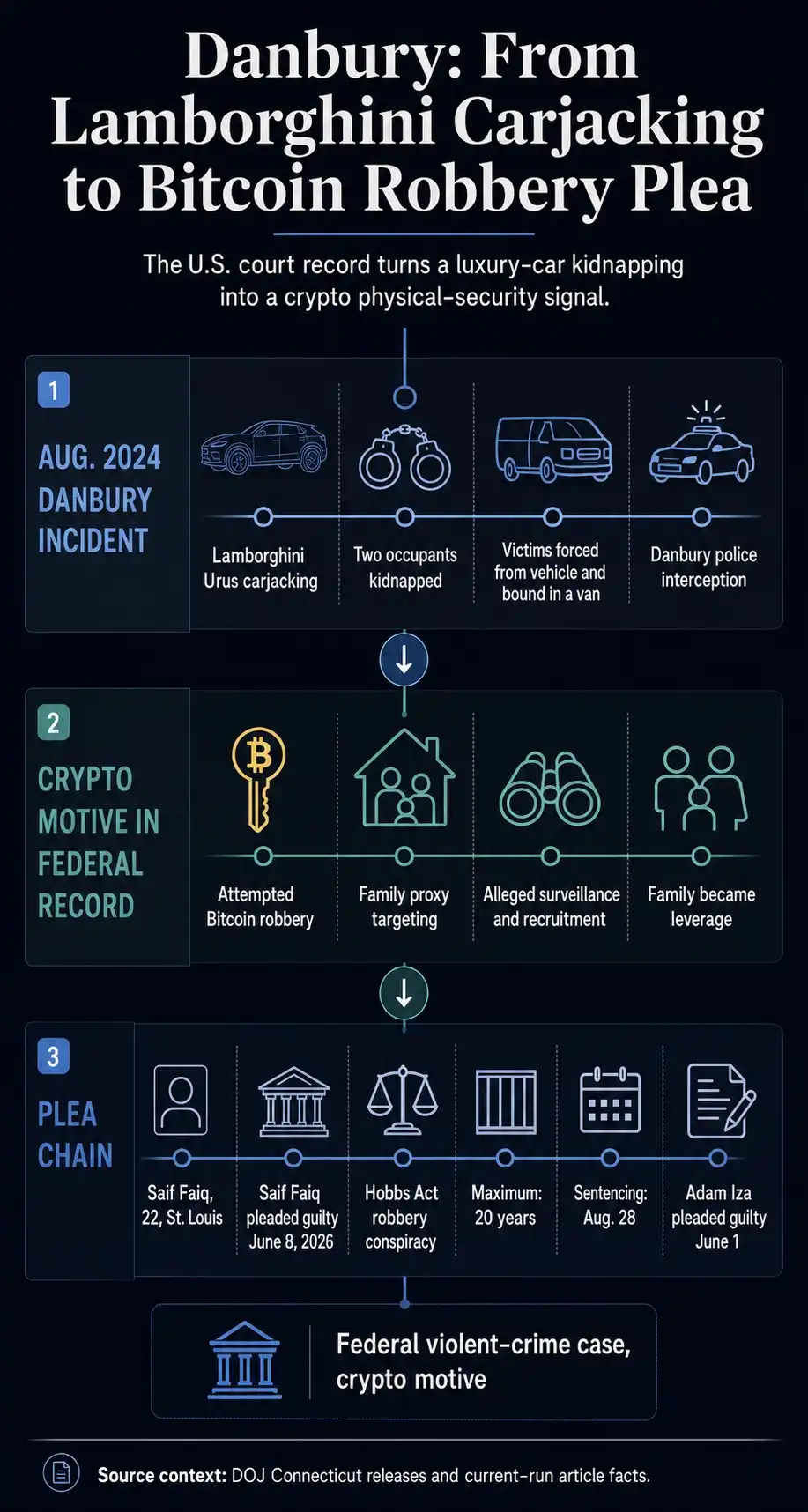
This infographic details a 2024 violent incident in Danbury, USA, involving a Lamborghini carjacking and kidnapping aimed at seizing Bitcoin, disclosing plot details and the 2026 guilty pleas and pending sentencing of two suspects.

The Attack Vector is Always the Human Element

In security research, a 'wrench attack' is defined as a crime involving physical violence or coercion to force a victim to reveal passwords, private keys, or access to digital assets.

CertiK's "2025 SkyNet Wrench Attack Report" categorizes such crimes as attacks on the 'human endpoint,' reporting 72 verified cases in 2025, a 75% year-on-year increase.

This is crucial for Bitcoin holders: the security of the blockchain protocol and the holder's personal safety are two separate systems. Even if the blockchain code is virtually unbreakable and Bitcoin cannot be stolen remotely, the individual controlling the assets is highly vulnerable to physical coercion.

Once criminals believe hardware wallets, seed phrases, exchange accounts, mobile devices, or a target's relatives can lead to transferable crypto assets, all become potential pressure points.

In the Danbury case, the pressure point was the victims' relatives. The US DOJ explicitly stated the two kidnapped parents were not involved in the Bitcoin theft.

They were targeted because their child was involved in the multi-hundred-million-dollar Bitcoin theft case. This also makes it a case of 'indirect target' hostage-taking for robbery.

Similar cases in France prove this is now a widespread personal safety hazard. A March report by this publication noted that victims of violent attacks in France are no longer limited to industry insiders or corporate executives; criminals are increasingly targeting ordinary individuals and private residences.

The Danbury case brings this established modus operandi into US court records. Conspicuous luxury cars are wealth markers, family is leverage, and the ultimate target asset is Bitcoin.

The criminals' core logic: find a person to physically coerce in order to access crypto assets.

The Danbury case clearly demonstrates that relatives can become indirect hostages in crypto-related crimes. The series of cases in France shows that as such attacks become recurrent, local public safety guidelines, travel and protection habits of industry executives, and self-protection methods for ordinary holders are all forced to adapt.
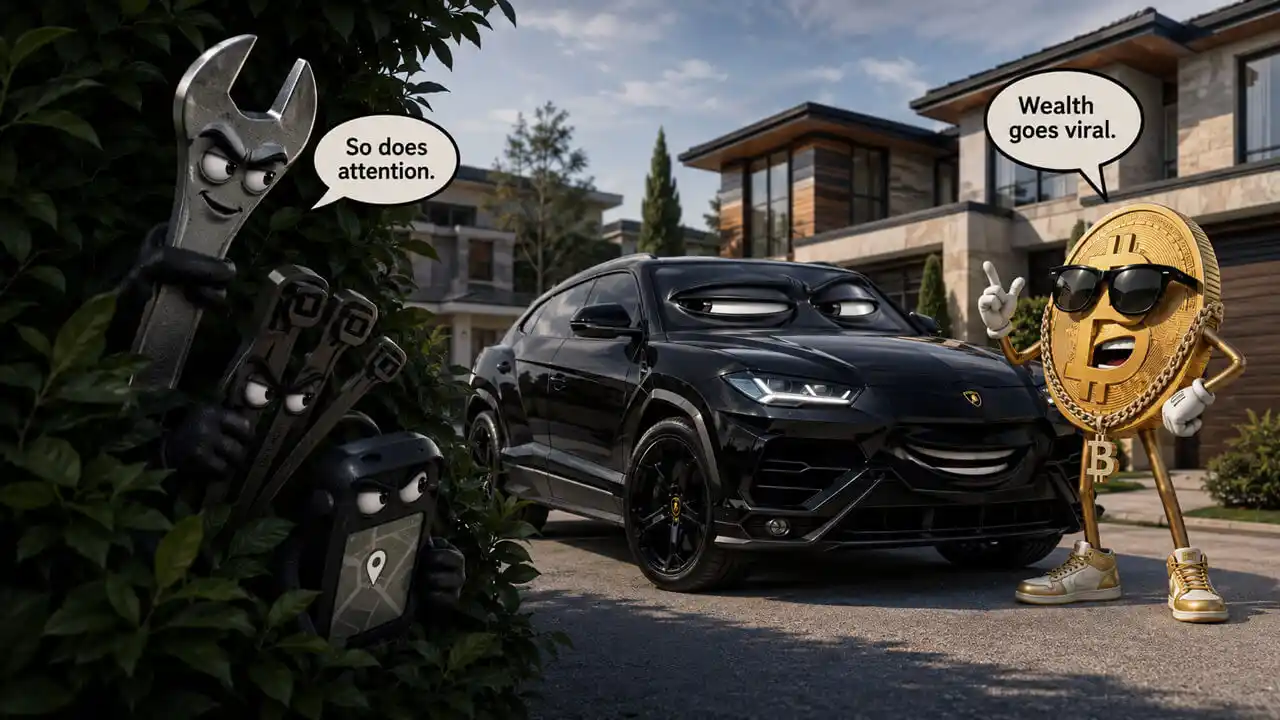
Europe Remains the Core Hotspot for Wrench Attack Cases

Apart from the Danbury guilty plea, overall case data shows Europe remains the concentrated epicenter for 'wrench attack' crimes.

CertiK's "2026 Wrench Attack Overview Report" states that 34 attack cases were verified from January to April 2026, with estimated total losses of approximately $101 million.

Of these 34 cases, 28 occurred in Europe, accounting for 82% of all recorded cases, with France having the highest number of incidents.

A May CryptoSlate special analysis on wrench attacks reached the same conclusion: the wave of offline violent extortion targeting crypto holders continues to accelerate, with the core region still being Europe, particularly France.
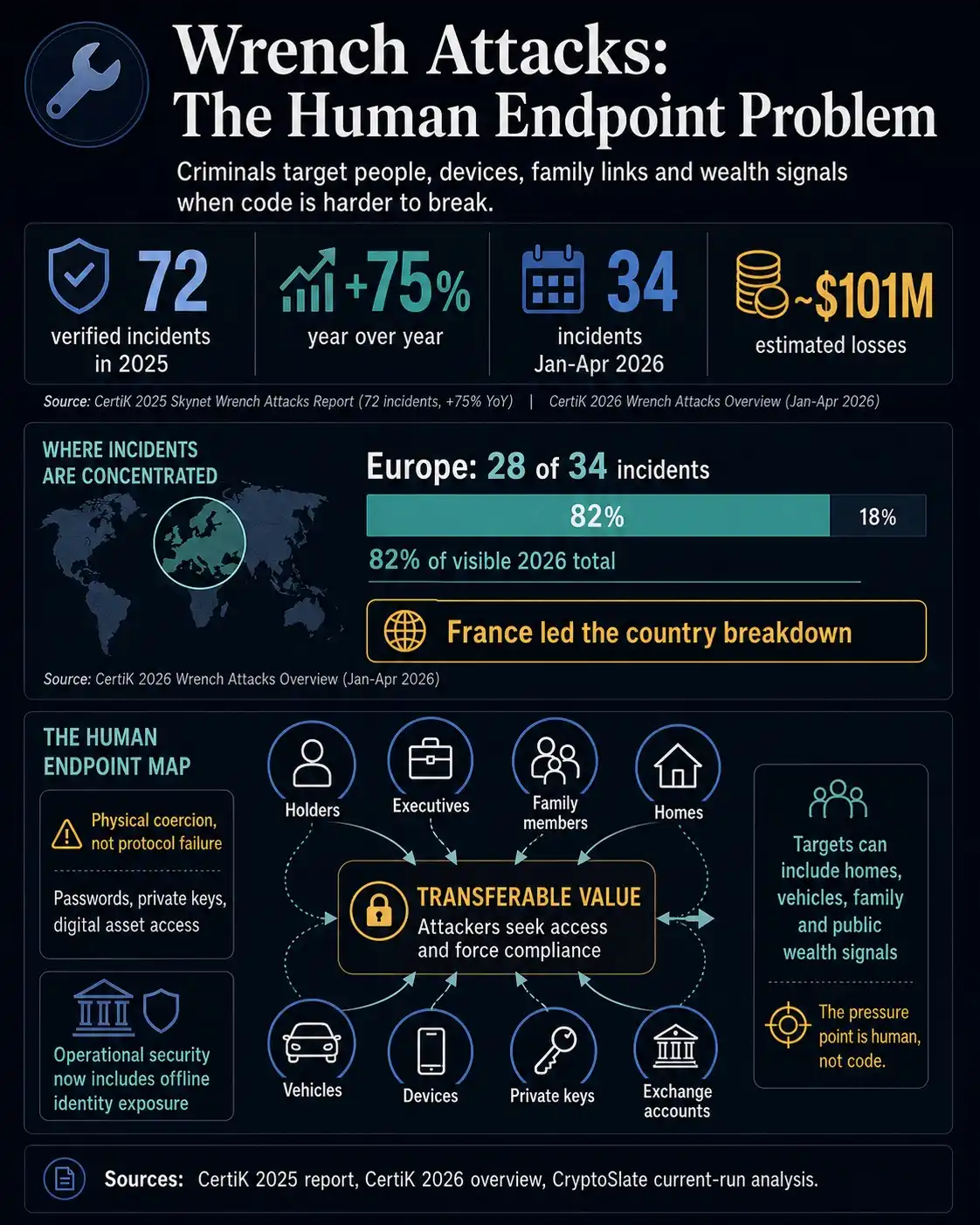
CertiK data shows that crypto 'wrench attacks' targeting holders, family, devices, and other physical endpoints confirmed 72 incidents in 2025, a 75% year-on-year increase. Of 34 cases in the first 4 months of 2026, 82% occurred in Europe, with estimated total losses of ~$101M. The core risk lies in the human/physical endpoint, not code vulnerabilities.

The Danbury case confirms that this attack model against crypto holders is now a judicial challenge for US prosecutors and federal courts.

Court records fully illustrate how the offline safety crisis sparked by crypto assets integrates into standard violent crime enforcement: gang recruitment, cross-regional operations, surveillance, hostage-taking of family, luxury car target identification, and hostage coercion for Bitcoin—the entire criminal chain is clearly documented.

For crypto asset holders and industry businesses, the scope of operational security has broadened significantly. Beyond online risks like phishing, wallet theft, exchange account breaches, and smart contract vulnerabilities, offline exposure risks related to identity, home addresses, electronic devices, and family must be seriously addressed.

The next key judicial signal will be the sentencing outcome. Saif Faiq's August 28th hearing will demonstrate how federal courts define and punish his culpability in this robbery conspiracy.

Long-term, all cases warranting close attention share a commonality: criminals identify crypto holders through offline clues like family, residences, vehicles, and public social profiles. It is precisely these cases that are transforming a safety crisis once concentrated in France into a societal issue that law enforcement across the US must confront—each court filing serves as a risk warning.


Трендовые криптовалюты

Связанные с этим вопросы

QWhat is a 'wrench attack' in the context of cryptocurrency, as described in the article?

AA 'wrench attack' is a type of crime where physical violence or coercion is used to force a victim into surrendering passwords, private keys, or access to their digital assets.

QAccording to the article, what was the primary target of the assailants in the Danbury, Connecticut case?

AThe primary target was Bitcoin. The assailants planned to kidnap the parents of an individual involved in a separate Bitcoin theft case to coerce that individual into handing over the cryptocurrency.

QBased on the data from CertiK's reports cited in the article, which region is identified as the core hotspot for 'wrench attacks'?

AEurope, specifically France, is identified as the core hotspot for 'wrench attacks'. Data shows 82% of recorded attacks in early 2026 occurred in Europe.

QWhat role did the Lamborghini Urus play in the Danbury kidnapping case, according to the prosecutors?

AThe Lamborghini Urus served as a visible marker of wealth, signaling to the criminals that the target likely held significant Bitcoin and was worth targeting for robbery.

QWhat broader security lesson does the Danbury case highlight for cryptocurrency holders?

AIt highlights that while blockchain protocols themselves may be secure, the human holders are vulnerable. Physical security is crucial, as family members, luxury possessions, and public displays of wealth can make holders and their loved ones targets for violent coercion aimed at seizing crypto assets.

Похожее

Может ли модель генерации обучаться end-to-end? В основе — простой цикл for

В статье представлен новый подход к обучению генеративных моделей под названием Explorative Modeling (XM), который позволяет осуществлять сквозное (end-to-end) обучение. Традиционные генеративные модели, такие как диффузионные или авторегрессионные, страдают от «смешения мод» (mode blurring), когда модель усредняет множество возможных правильных ответов, что приводит к размытым или нереалистичным результатам. Это также вызывает «смещение экспозиции» (exposure bias), когда ошибки накапливаются во время вывода. Ключевая идея XM проста: на каждом шаге обучения модель генерирует K кандидатов, а для обратного распространения градиента выбирает только того кандидата, который наиболее близок к реальным данным. Этот цикл, реализованный в несколько строк кода, повышает «генеративную выразительность» модели, позволяя ей охватывать несколько мод распределения данных, а не усреднять их. Авторы показывают, что «исследование» (exploration) становится третьей осью масштабирования наряду с увеличением параметров и данных. Эксперименты с изображениями, видео и текстом демонстрируют монотонное улучшение качества: при увеличении масштаба данных выгода от исследования возрастает с 7% до 36%, а эффективность использования вычислений (FLOP) повышается в 4.1 раза. В задачах управления роботами сквозная модель XM с одним проходом вперед достигает результатов, сравнимых с диффузионными моделями, требующими сотни проходов. Таким образом, Explorative Modeling предлагает путь к truly end-to-end генеративным моделям, перенося сложность с этапа вывода на этап обучения, что открывает потенциал для более эффективных и мощных систем.

marsbit5 мин. назад

Может ли модель генерации обучаться end-to-end? В основе — простой цикл for

marsbit5 мин. назад

Upbit проводит ребалансировку 864 млрд SHIB при перемещении между внутренними кошельками

Корейская биржа Upbit провела внутреннюю ребалансировку 864 миллиардов токенов SHIB между своими кошельками. Движение активов на сумму около 4 миллионов долларов произошло после роста стоимости SHIB на 36%, что привлекло внимание трейдеров. Однако анализ помеченных адресов показывает, что это была стандартная операция по перераспределению средств между "горячими" и другими внутренними кошельками биржи, а не вывод средств или подготовка к продаже. Общий объем перемещений включал 384 миллиарда SHIB, отправленных с основного горячего кошелька, и 480 миллиардов SHIB, возвращенных обратно. Этот случай подчеркивает важность проверки контекста и меток кошельков при интерпретации крупных ончейн-транзакций, чтобы избежать ошибочных выводов о продаже или давлении на рынок.

bitcoinist5 мин. назад

Upbit проводит ребалансировку 864 млрд SHIB при перемещении между внутренними кошельками

bitcoinist5 мин. назад

Максимум 20 статей на человека? Исследователи DeepMind «просят» снять ограничения ICLR

Новая политика конференции ICLR 2027 ограничивает количество подаваемых одним автором работ до 20. По мнению организаторов, это необходимо для снижения нагрузки на рецензентов, учитывая рекордный рост числа заявок — на 68% за год. В ответ на это исследователь Google DeepMind Дэн Рой иронично запустил «петицию» против лимита, заявив, что он замедлит прогресс в ИИ, особенно в эпоху, когда агенты ИИ могут генерировать множество статей, а рецензии часто пишутся с помощью больших языковых моделей (по некоторым данным, до 21% рецензий на ICLR 2026 могли быть полностью сгенерированы ИИ). Его сатирический пост поднимает серьёзный вопрос о целесообразности простого ограничения количества работ вместо решения системных проблем, связанных с массовым производством статей и автоматизацией рецензирования в современной академической среде.

marsbit10 мин. назад

Максимум 20 статей на человека? Исследователи DeepMind «просят» снять ограничения ICLR

marsbit10 мин. назад

Уязвимость Coldcard привела к краже $89 млн и вызвала самую масштабную миграцию средств в блокчейне после краха FTX

Уязвимость в аппаратном кошельке Coldcard привела к краже 1367,05 BTC (около 89 млн долларов) с 4585 адресов. Инцидент, связанный с ошибкой в генерации сид-фраз в определенной прошивке, вызвал массовую миграцию средств пользователей на новые безопасные адреса. Это привело к аномальному всплеску активности в сети Биткоин, исказив ключевые ончейн-индикаторы, такие как активность долгосрочных держателей и объем мелких транзакций. Активность и рыночные настроения достигли уровня, сравнимого с периодом после краха FTX. Расследование столкнулось с трудностями из-за ограничений коммерческих ИИ-моделей (например, в США), которые блокируют анализ вредоносных данных даже для целей защиты. Следователи были вынуждены использовать открытые модели, такие как китайский GLM 5.2, для отслеживания украденных средств. Этот случай высветил проблему асимметрии: злоумышленники используют неограниченные ИИ-инструменты, в то время как защитники сталкиваются с барьерами коммерческих систем безопасности, что критично в сфере криптовалют, где скорость отслеживания средств крайне важна.

marsbit55 мин. назад

Уязвимость Coldcard привела к краже $89 млн и вызвала самую масштабную миграцию средств в блокчейне после краха FTX

marsbit55 мин. назад

Заработок в миллион на электриках: Meta спешно открывает собственное ПТУ

Новый этап конкуренции в сфере искусственного интеллекта столкнулся с неожиданным препятствием — острой нехваткой квалифицированных технических специалистов, особенно электриков и строителей, для возведения сверхмощных центров обработки данных. В США, согласно прогнозам, к 2030 году для инфраструктуры ИИ потребуется дополнительно 130 000 электриков и 240 000 строителей, однако ежегодно остается незаполненными около 80 000 вакансий электриков. Компании, такие как OpenAI (проект "Stargate" стоимостью $160 млрд), Meta и Microsoft, сталкиваются с огромными убытками из-за задержек строительства. Например, задержка ввода центра мощностью 60 МВт может обернуться потерей $14,2 млн в месяц. Причина спроса — беспрецедентная сложность строительства ИИ-центров. Они потребляют колоссальную энергию (сотни мегаватт), требуют уникальных систем электроснабжения и охлаждения (жидкостное или иммерсионное), что делает работу высококвалифицированных монтажников, сантехников и инженеров незаменимой. Для решения проблемы кадрового голода ИИ-гиганты начали масштабные программы обучения. Meta инвестировала $115 млн в создание собственной школы строителей с бесплатным обучением и стипендией, а OpenAI сотрудничает с профсоюзами. Активная вербовка ведется даже среди старшеклассников. Потребление энергии ИИ-центрами растет экспоненциально, опережая общий рост энергопотребления в 16 раз и увеличивая счета за электричество для потребителей. Однако строительство таких объектов носит проектный характер: для возведения центра "Stargate" требуется 6400 рабочих, а для его обслуживания — всего 100-1000. Это создает риск перенасыщения рынка труда после завершения строительного бума, что может привести к падению зарплат в отрасли.

marsbit1 ч. назад

Заработок в миллион на электриках: Meta спешно открывает собственное ПТУ

marsbit1 ч. назад

Торговля

Спот

Популярные статьи

Как купить QUICK

Добро пожаловать на HTX.com! Мы сделали приобретение Quickswap (QUICK) простым и удобным. Следуйте нашему пошаговому руководству и отправляйтесь в свое крипто-путешествие.Шаг 1: Создайте аккаунт на HTXИспользуйте свой адрес электронной почты или номер телефона, чтобы зарегистрироваться и бесплатно создать аккаунт на HTX. Пройдите удобную регистрацию и откройте для себя весь функционал.Создать аккаунтШаг 2: Перейдите в Купить криптовалюту и выберите свой способ оплатыКредитная/Дебетовая Карта: Используйте свою карту Visa или Mastercard для мгновенной покупки Quickswap (QUICK).Баланс: Используйте средства с баланса вашего аккаунта HTX для простой торговли.Третьи Лица: Мы добавили популярные способы оплаты, такие как Google Pay и Apple Pay, для повышения удобства.P2P: Торгуйте напрямую с другими пользователями на HTX.Внебиржевая Торговля (OTC): Мы предлагаем индивидуальные услуги и конкурентоспособные обменные курсы для трейдеров.Шаг 3: Хранение Quickswap (QUICK)После приобретения вами Quickswap (QUICK) храните их в своем аккаунте на HTX. В качестве альтернативы вы можете отправить их куда-либо с помощью перевода в блокчейне или использовать для торговли с другими криптовалютами.Шаг 4: Торговля Quickswap (QUICK)С легкостью торгуйте Quickswap (QUICK) на спотовом рынке HTX. Просто зайдите в свой аккаунт, выберите торговую пару, совершайте сделки и следите за ними в режиме реального времени. Мы предлагаем удобный интерфейс как для начинающих, так и для опытных трейдеров.

512 просмотров всегоОпубликовано 2024.03.29Обновлено 2026.06.02

Как купить QUICK

Обсуждения

Добро пожаловать в Сообщество HTX. Здесь вы сможете быть в курсе последних новостей о развитии платформы и получить доступ к профессиональной аналитической информации о рынке. Мнения пользователей о цене на QUICK (QUICK) представлены ниже.

活动图片












