From Madison Square Garden to Kalshi: Prediction Markets Break into the NBA Finals

marsbitОпубликовано 2026-06-06Обновлено 2026-06-06

Введение

From Madison Square Garden to Kalshi: Prediction Markets Break into the NBA Finals Prediction markets are playing a significant role in the 2026 NBA Finals, particularly around the New York Knicks' unexpected 2-0 series lead. Platforms like Kalshi and Polymarket have seen massive trading volumes, exceeding hundreds of millions of dollars on championship and related markets. Their influence extends beyond online trading. Kalshi's official partnership with Madison Square Garden has given it prominent physical branding at the arena. Furthermore, local businesses like The Jeffrey bar are using prediction market contracts to hedge the risk of game-result-based promotions, turning potential losses into manageable costs—a concept similar to the famous "Mattress Mack" strategy from traditional sports betting. These markets differentiate themselves by offering a wider, more entertainment-focused range of "event contracts" beyond typical game outcomes, such as predicting celebrity attendance. They also have broader accessibility across the U.S. compared to age- and location-restricted traditional sportsbooks. However, their rapid integration into sports raises regulatory and ethical questions. The NBA is cautiously engaging, discussing integrity frameworks with regulators like the CFTC. While the league permits minor investments like Giannis Antetokounmpo's stake in Kalshi, it advocates for strict rules to prevent insider trading. Many fans express concern on platforms like Reddit,...

Author: Zen, PANews

On June 6th, the visiting New York Knicks narrowly defeated the San Antonio Spurs 105-104 in Game 2 of the NBA Finals. The Knicks, who were not favored before the series began, had already upset the Spurs 105-95 on the road in Game 1. Winning both road games to start the series was an unexpected outcome for virtually everyone.

For a franchise returning to the Finals for the first time since 1999 and last winning a championship in 1973, this dream 2-0 start, bringing the series back to their home court at Madison Square Garden, has undoubtedly pushed generations of New York fans' fervor to its peak.

According to the latest data from ticket site TickPick, after Game 2, the lowest price for a ticket to Game 3 at Madison Square Garden has exceeded $10,000, with Game 4 prices soaring above $14,000. With the first NBA championship in 52 years seemingly within reach, the frenzy in the 'World's Capital,' New York, has been completely ignited, making this Finals series one of the most expensive live sporting events in NBA history.
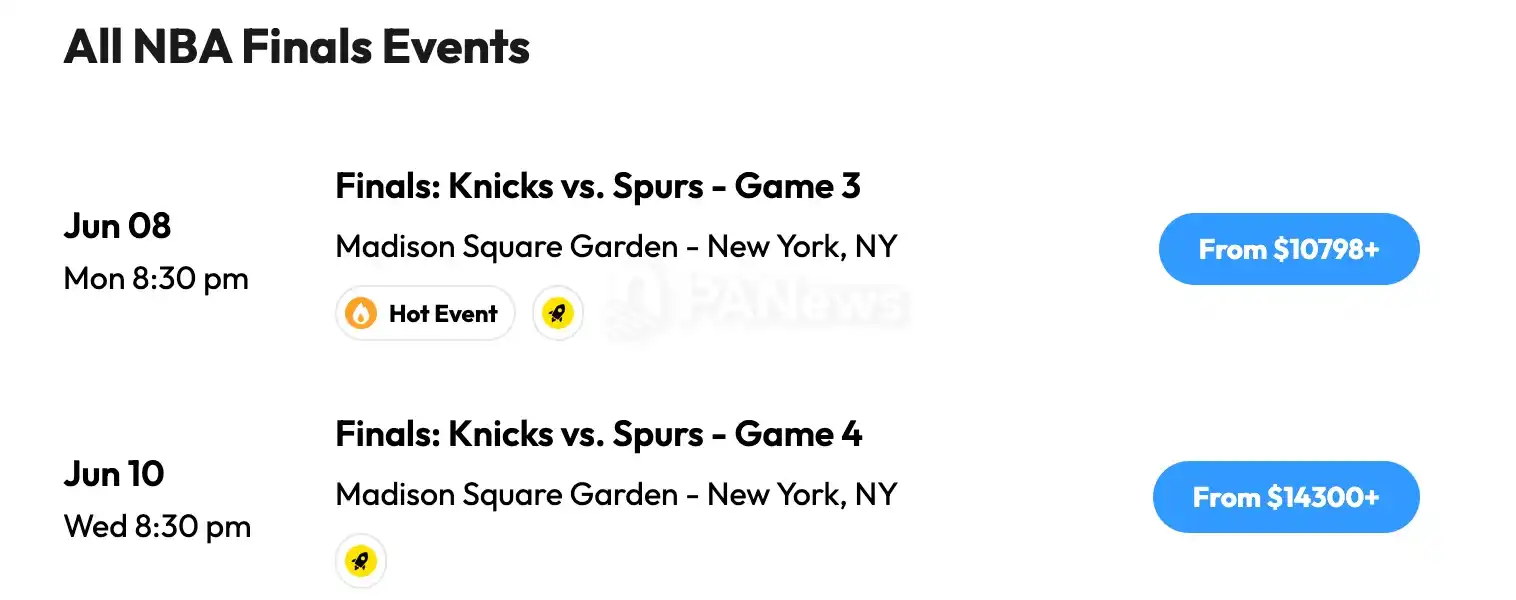
What's different this time is the increasingly visible presence of prediction markets in this New York celebration. From prediction market platform Kalshi partnering with Madison Square Garden as an official partner, gaining massive exposure, to widespread fan and merchant participation in betting around probabilities, attention, and entertainment consumption. This NBA Finals is not just a major sporting event; it's also a celebration for prediction market platforms.

Prediction Markets Enter Arenas, Bars, and Fans' Daily Lives

After the Finals began, prediction markets themselves became part of the game's hype. As of June 6th, Polymarket's '2026 NBA Champion' market page shows a cumulative trading volume exceeding $413 million, with a daily volume of around $2 million. Kalshi's trading volume for NBA Finals-related markets reached approximately $274 million. Additionally, derivative markets around Finals MVP, series score, player statistics, celebrity attendance, etc., continue to attract traders.
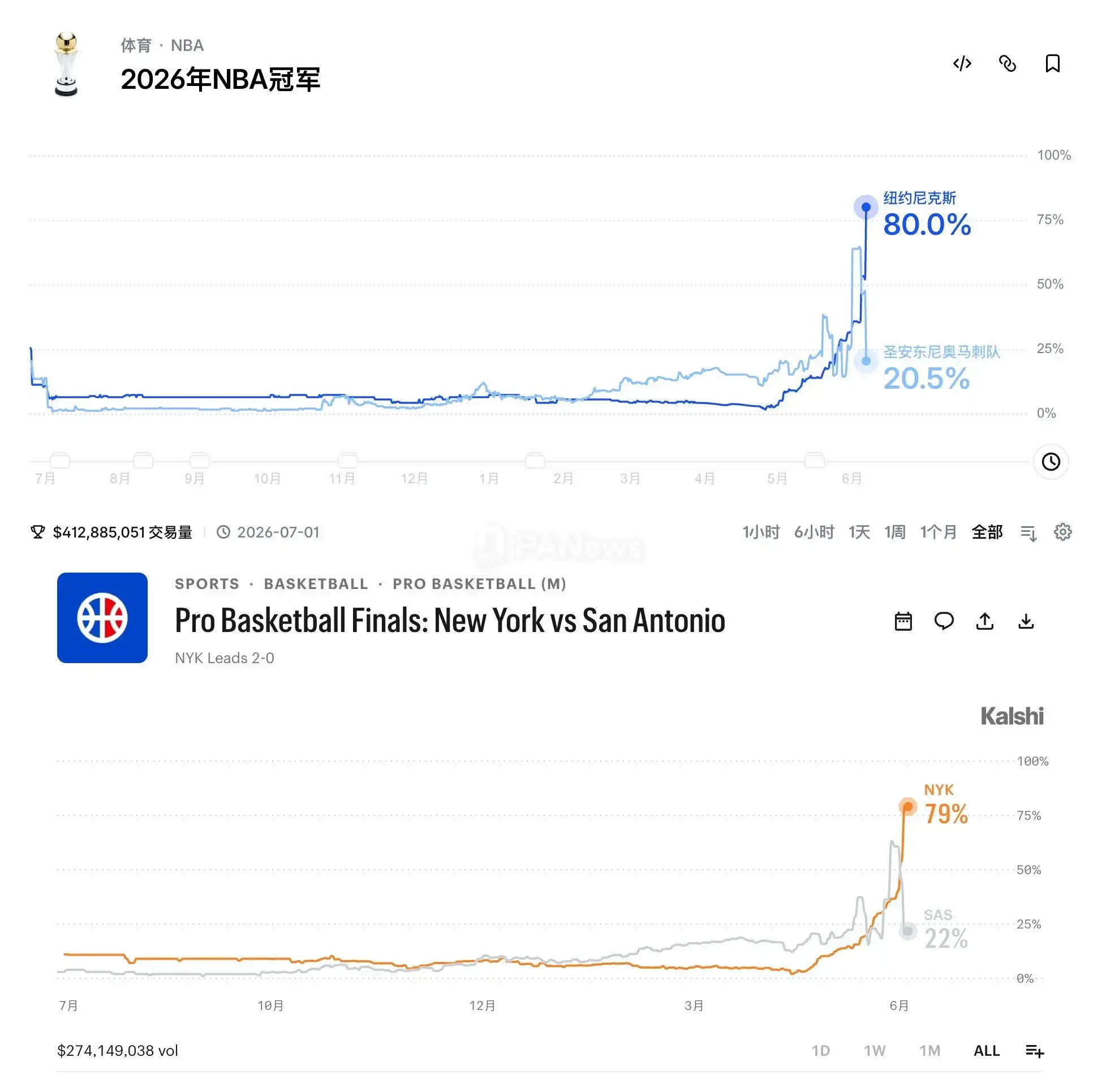
The influence of prediction markets isn't limited to online. As the Knicks' playoff run heated up, prediction markets also entered bars, arenas, and offline viewing scenarios, becoming new tools for businesses to design promotions and manage cost risks. Before Game 1 of the Finals, the Upper East Side Manhattan bar The Jeffrey launched a promotion: if the Knicks won, drinks for customers that night would be on the house.

For a small business, fulfilling such a major promotion could create significant cost pressure. The Jeffrey's approach was to buy $5,000 worth of Knicks-related contracts on Kalshi. If the Knicks won, the contract payout would cover the cost of the free drinks. Conversely, if the Knicks lost, the bar wouldn't have to provide free drinks, and the customer traffic attracted by the promotion, along with increased consumption, could offset or even cover the cost of the wager.

From an industry perspective, this case demonstrates that prediction markets aren't just tools for fans to trade on game outcomes; they can also serve as a means for businesses to manage event risk. The Jeffrey tied post-win fan enthusiasm and increased traffic to the cost of free drinks, while the Kalshi contract transformed the uncertainty of the promotion into a quantifiable, hedgeable risk. It doesn't change or rely on the game's outcome but alters how businesses design promotions around the game. It also shows the "insurance"-like utility of prediction markets.
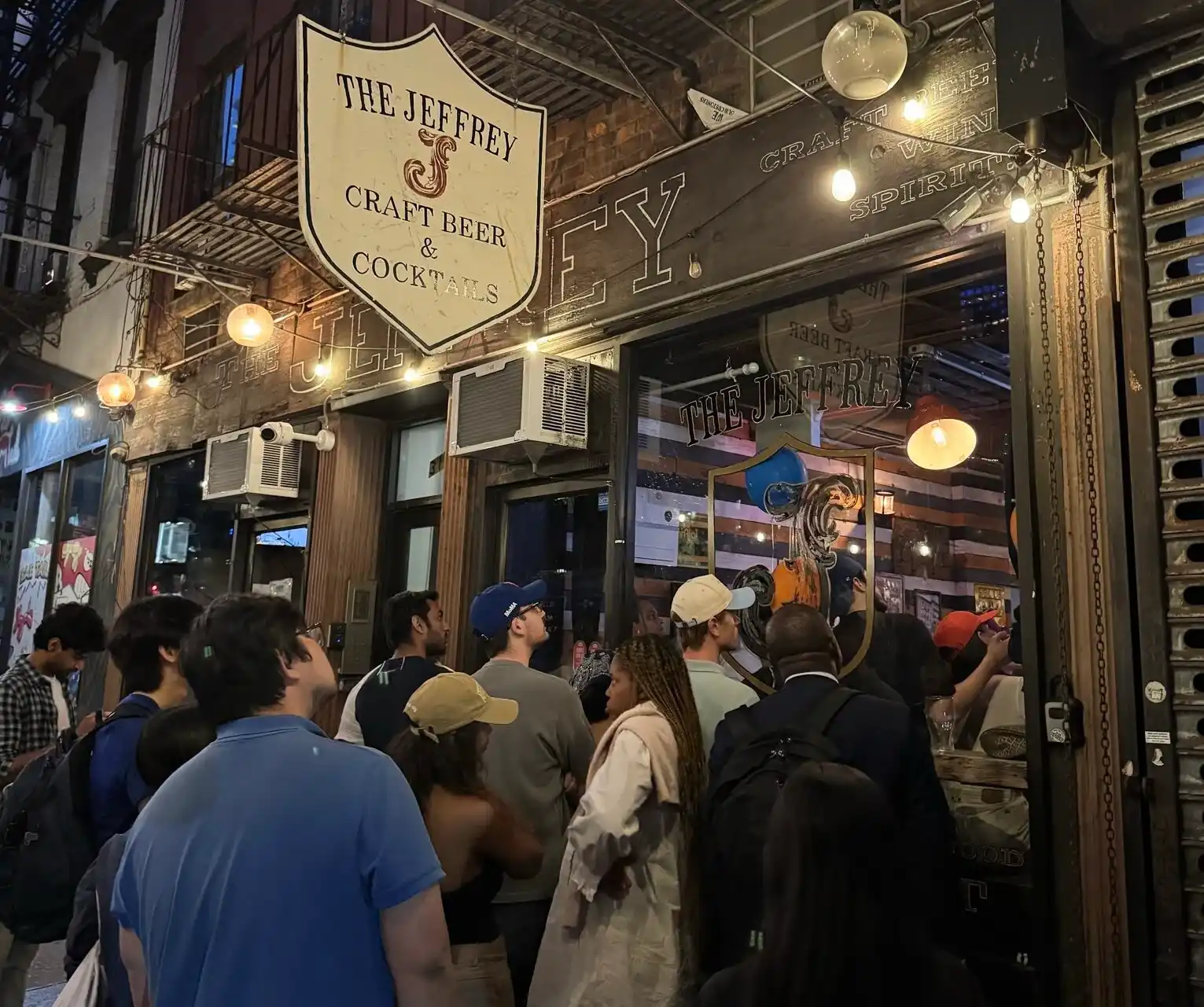
The Jeffrey's marketing strategy attracted a large number of customers

Beyond indirect marketing by small businesses, Kalshi's official partnership with Madison Square Garden has placed prediction market platforms in an even more prominent position.

In early May, Kalshi and Madison Square Garden (MSG) announced a multi-year partnership, making Kalshi the official prediction markets partner. Additionally, the MSG Concourse on the 6th floor was named the "Kalshi Concourse," and Kalshi gained exposure on in-arena and out-of-home digital screens, in-arena LEDs, MSG Networks advertising, and branded content.
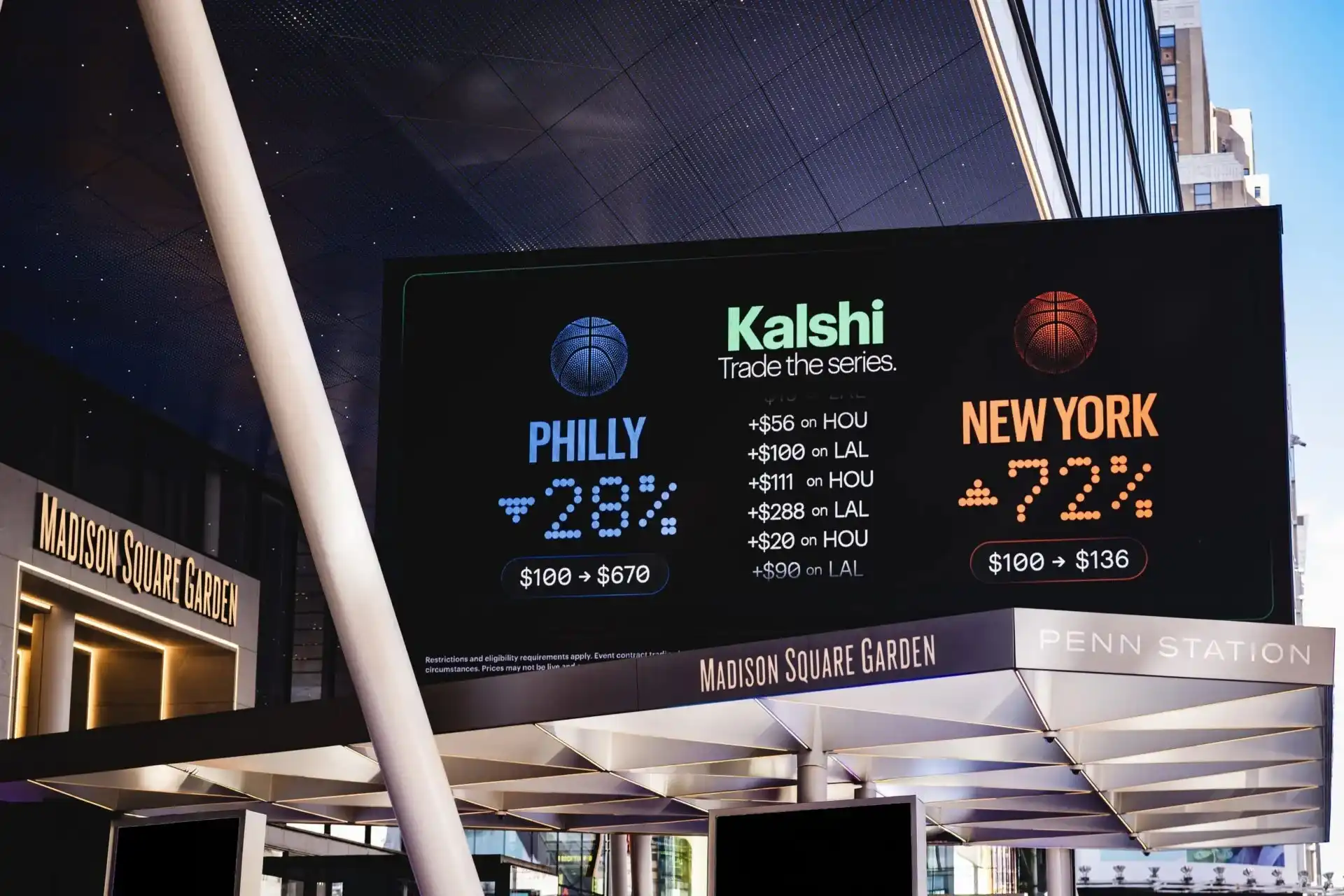
Kalshi, whose core business is predicting future events, seems to have also 'called' its own offline expansion this time. Securing the MSG partnership rights just weeks ago has now, with the Knicks reaching the Finals, rapidly become a highly representative offline branding investment. Kalshi almost perfectly timed its move. When Madison Square Garden became the focal point of national sports media and the epicenter of New York City's emotions, Kalshi had already secured a position in one of America's most iconic sports venues, moving from online trading pages to a higher-density offline exposure environment.

The Boundaries of Sports Betting Are Being Pushed Further by Prediction Markets

In reality, turning sports hype into a commercial hedging tool is not an original idea from prediction markets.

The most classic precedent is Houston furniture merchant Jim McIngvale, known as "Mattress Mack." His promotional tactic is to offer customers a refund on furniture purchases above a certain amount if a local Houston team wins a championship. Before the games, he places large bets on traditional sportsbooks supporting his hometown team.
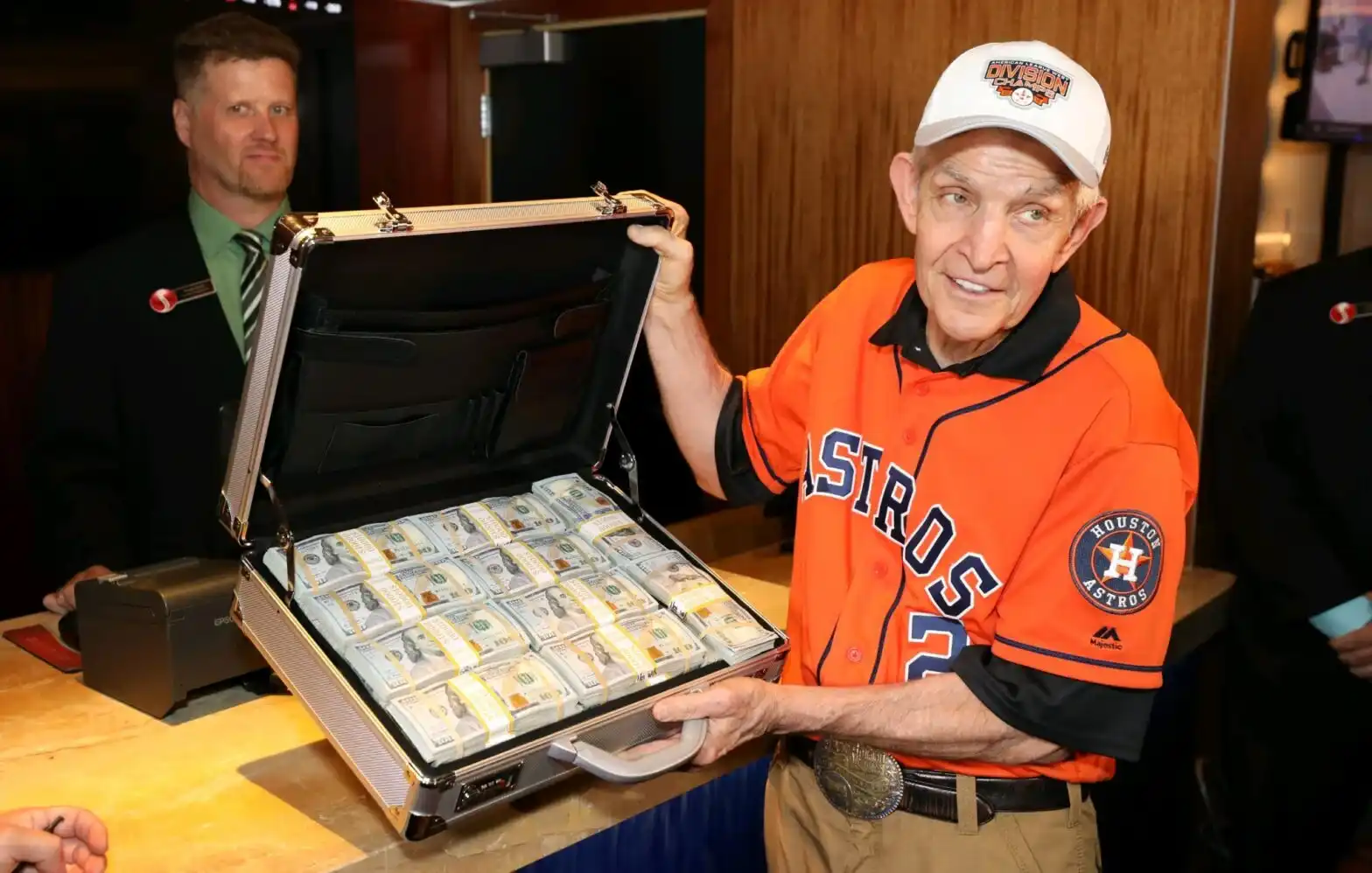
"Mattress Mack" carrying a suitcase with $3.5 million to bet on the Houston Astros

The logic behind bar The Jeffrey and Mattress Mack is essentially the same. If the team wins, Mattress Mack refunds customers, but the sportsbook payout covers that cost. If the team loses, he loses his bet, but no refunds are issued for furniture sales, and the promotion itself has already generated sales and media exposure. When the Astros won the World Series in 2022, Mattress Mack received a payout of approximately $75 million, making this model a classic case in American sports marketing.

Compared to traditional sportsbooks, prediction markets also expand the ways fans can engage with games.

Sports markets on Polymarket and Kalshi allow fans to trade around the broader narratives spilling out from a game, covering more entertaining, fragmented topics. Of course, traditional sports betting doesn't only offer win/loss markets. For example, platforms like FanDuel and DraftKings release numerous novelty bets around the Super Bowl each year, including "entertainment props" like the length of the national anthem or songs performed during the halftime show. However, restrictions on such markets vary by state, with some legal sports betting jurisdictions prohibiting them.

The difference with prediction markets is that they further expand this fun, entertainment-focused play. Traditional sportsbooks typically still revolve around the game itself and official statistics; even with novelty props, they're concentrated around a few mega-events like the Super Bowl.

Prediction markets are better at breaking down "verifiable real-world events" into contracts, making "any event priceable." For example, whether Trump will attend NBA Finals Game 3, or whether actor 'Timothee Chalamet' will attend all Knicks home games, clearly pushes the boundaries of novelty markets.
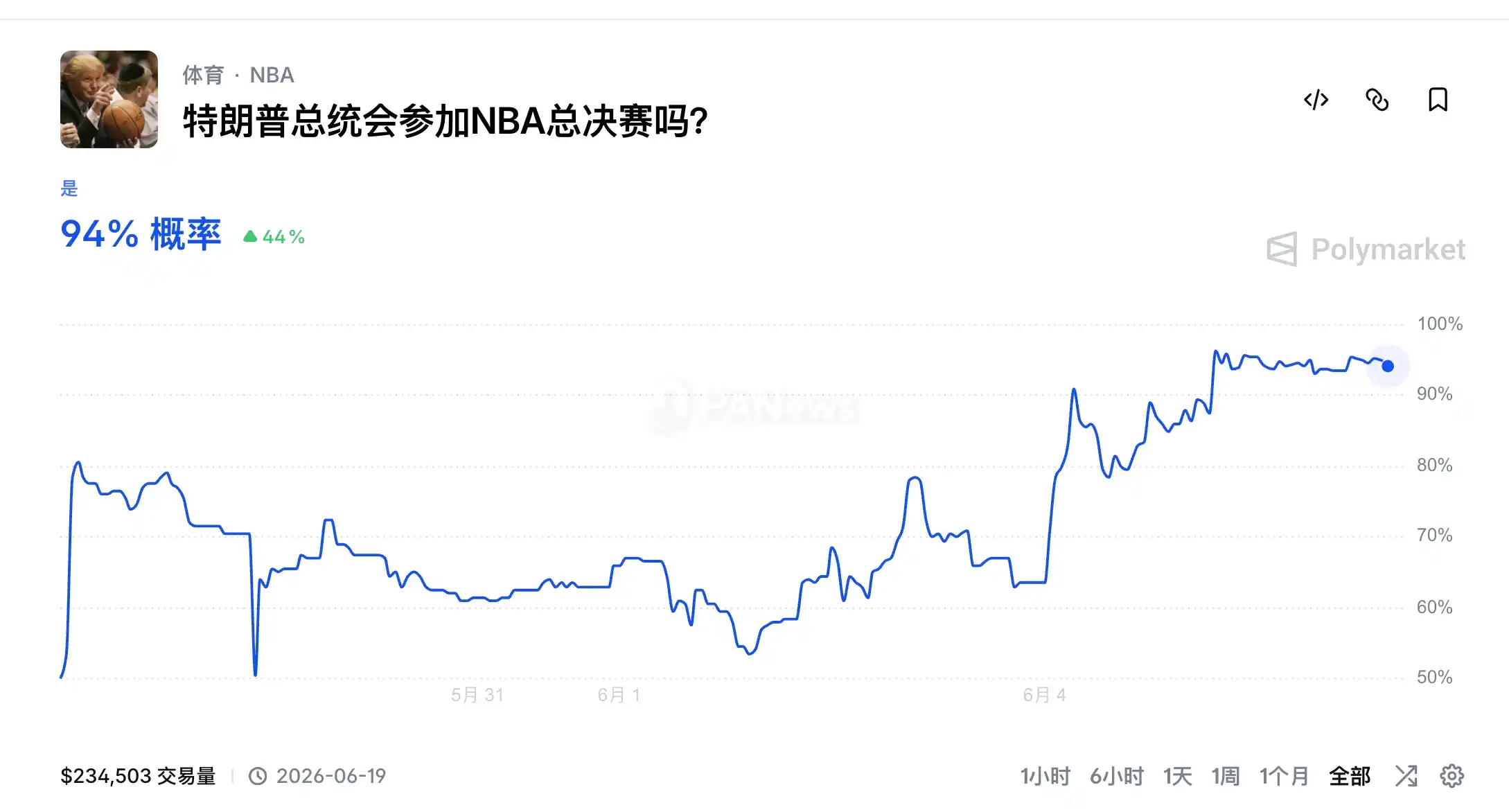
Beyond the variety of events, there are also differences in geographic and user demographic reach between the two types of platforms. Prediction markets in the U.S. can reach users 18 and older, while traditional sports betting typically requires users to be 21+. Simultaneously, prediction markets are available in all 50 states, while sports betting is currently legal in only 39 states. To some extent, the expansion of prediction markets in sports isn't just due to richer market offerings but also their ability to reach demographics and geographies that traditional sportsbooks cannot.

This is also a source of regulatory controversy. Prediction market platforms emphasize they are trading event contracts, with users buying and selling among themselves, a form closer to derivatives trading. Critics argue that when these contracts revolve around the NBA, NFL, elections, or celebrity events, the user experience is already highly similar to gambling. Especially when platforms attract younger users through social media, memes, and sports marketing, the boundaries between financial trading, entertainment, and gambling become increasingly blurred.

Players Get Involved First, NBA League Approaches Cautiously

With the rise of prediction markets, the NBA league has recognized that these platforms are becoming a new variable beyond traditional sports betting. Therefore, for the commercially-driven NBA, its attitude towards prediction markets has historically been ambiguous, characterized by cautious engagement.

At the player level, Giannis Antetokounmpo, who has become a Kalshi shareholder and will participate in the platform's marketing and offline activities, is the most representative case. This has sparked controversy. Fans worry that when an NBA superstar becomes a shareholder in a prediction market platform that can create markets around player trades, team performance, and game outcomes, even if the player themselves cannot trade NBA-related contracts, ethical boundaries are continually being nudged.

Related reading: "After $23.3 Million Bet on His Future, Why Did NBA Star Giannis Investing in Kalshi Spark Outrage?"

At the official league level, the NBA has engaged in in-depth discussions with the CFTC regarding an integrity framework for prediction markets. In its filing to the CFTC, the NBA emphasized that sports event contracts require comprehensive regulation to protect game integrity and public trust. The NBA also argued that athletes, referees, league and team personnel should be prohibited from trading contracts related to their league's games and events, that platforms should provide specific trader identities to the league during suspicious transaction investigations, and that official league data should be used for settlement.

NBA Commissioner Adam Silver's public statements reflect this stance. Discussing Giannis's investment in Kalshi during All-Star Weekend, he said the league is viewing prediction markets similarly to how it views sportsbooks. He noted that under the collective bargaining agreement, players can make minimal investment percentages in sports betting companies, and the league applies this rule to prediction markets. Silver further stated that Giannis's investment in Kalshi, being below 1%, did not violate relevant rules. However, he acknowledged that prediction markets are developing rapidly, and their ultimate permissible form may depend on courts and Congress.
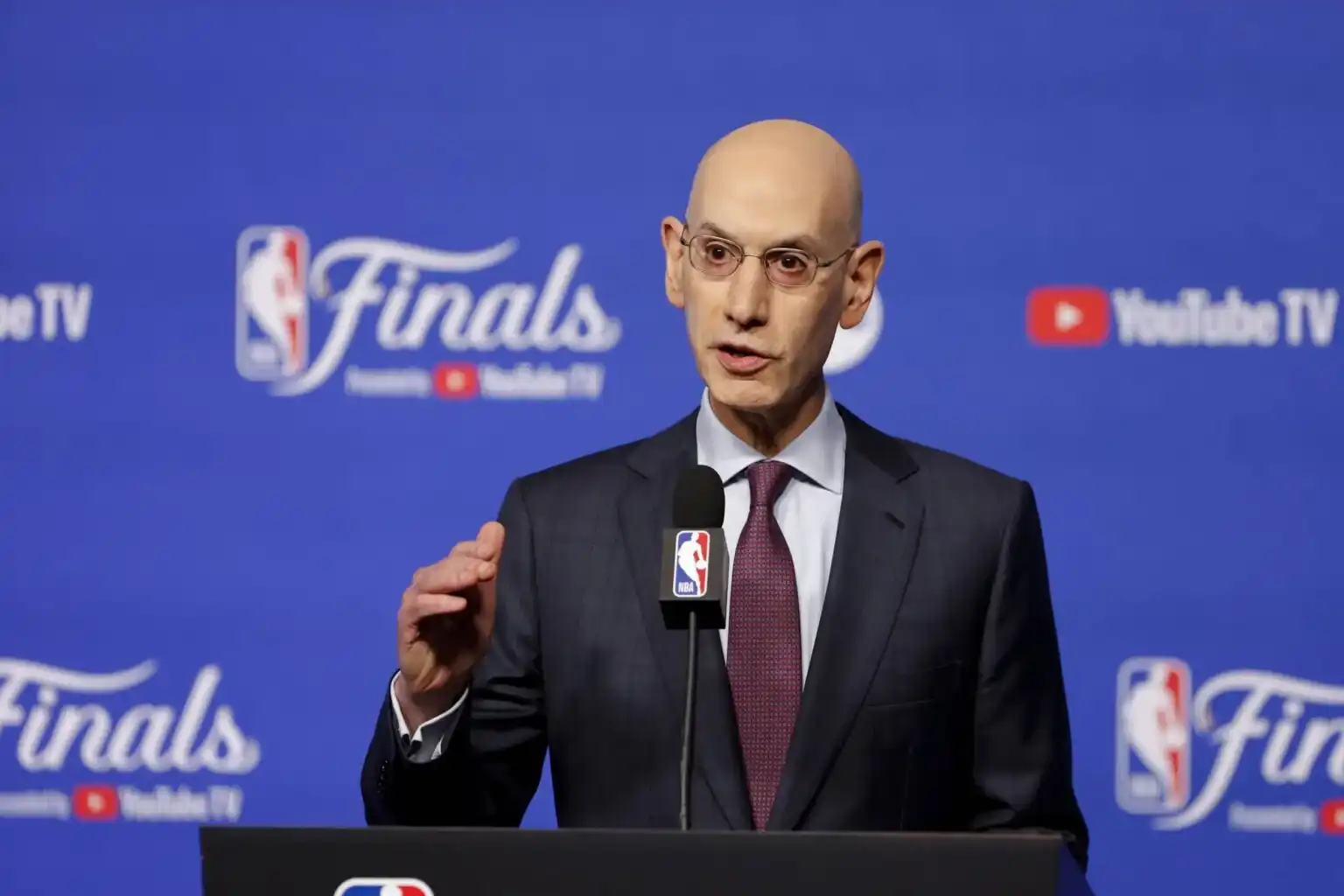
NBA Commissioner Adam Silver tried to quell controversy over Giannis becoming a Kalshi shareholder, calling the investment "minuscule"

But among fan communities, the NBA's increasingly close ties with prediction markets have drawn strong opposition. On the r/nba subreddit, numerous posts about the potential for insider trading risks involving Kalshi, Polymarket, and the NBA have sparked extensive discussion and criticism.

Many fans believe that if player investment or endorsement of prediction markets becomes normalized, future games could become "untrustworthy" due to insider trading and conflicts of interest. Many users also express concerns about league commercialization, younger user addiction, and game integrity. Comments on news about Giannis now almost invariably include fan jabs suggesting he'll participate in betting on prediction markets.
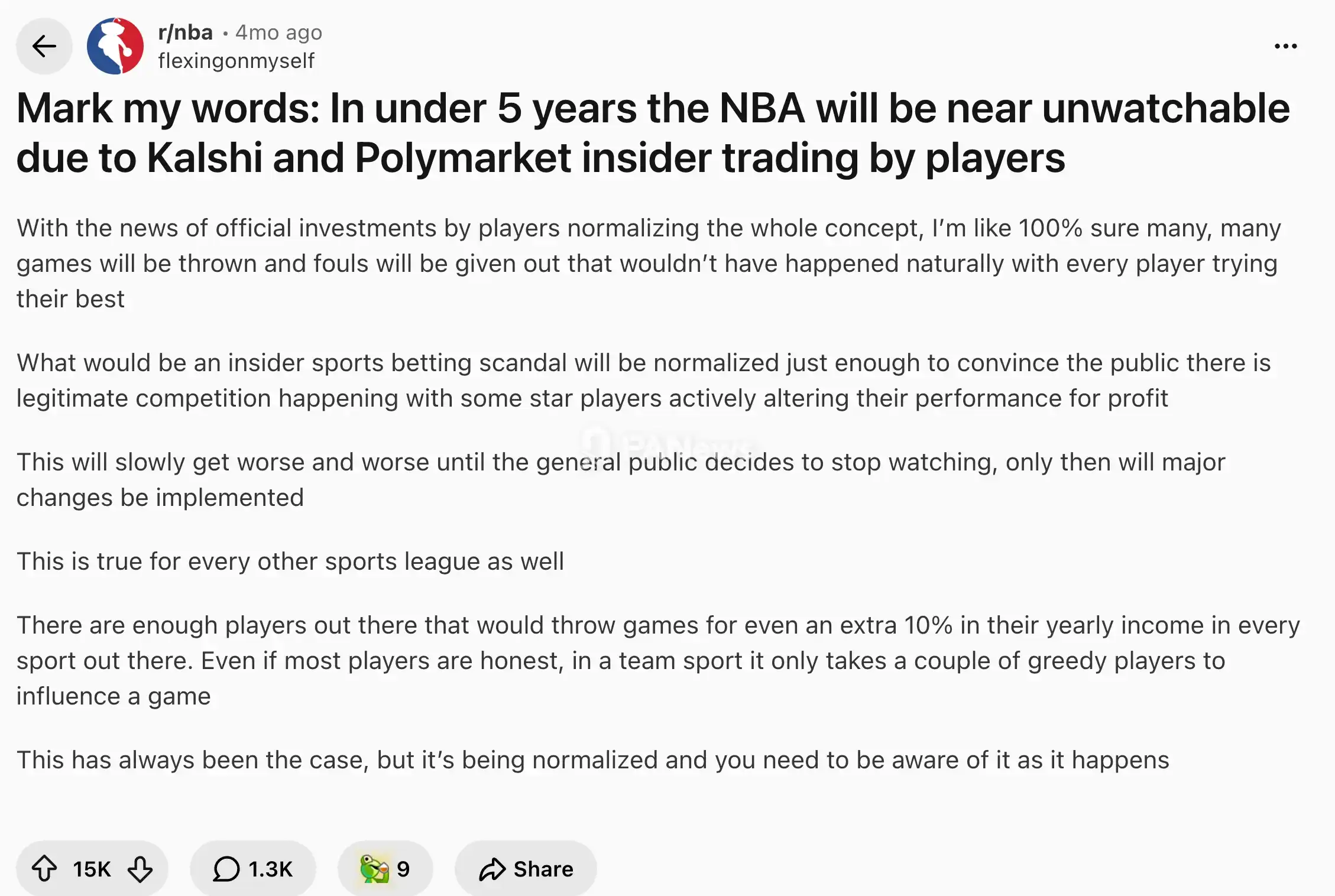
These Reddit discussions don't represent all NBA fans, but they reflect a very real sentiment. Many fans aren't just objecting to 'betting'; they worry that the NBA's official, extensive cooperation with betting companies and prediction markets might increasingly influence games and players through odds and trading contracts.

This concern isn't entirely unfounded. Recently, former U.S. Representative George Santos was investigated for allegedly engaging in suspicious trading on Kalshi related to whether he would attend the State of the Union address. While not a sports case, it highlights the most sensitive risk of prediction markets: when event outcomes can be influenced by a few insiders, market trading is no longer just 'prediction' but can become an incentive for the behavior itself.

And the NBA Finals are becoming a stress test for prediction markets entering mainstream sports. For both the platforms and the NBA, this represents both a new commercial opportunity and a new test of trust.


Связанные с этим вопросы

QWhat are the main examples of how prediction markets are being used during the 2026 NBA Finals, according to the article?

APrediction markets like Kalshi and Polymarket are being used in several ways: first, Kalshi is the official partner of Madison Square Garden, gaining major offline exposure. Second, venues like the bar The Jeffrey use prediction market contracts to hedge the financial risk of promotional offers tied to the Knicks' performance. Third, the platforms themselves have attracted billions in trading volume on outcomes like the champion and Finals MVP. Finally, prediction markets offer more diverse and accessible entertainment-focused contracts than traditional sportsbooks, such as betting on celebrity appearances at games.

QHow did the bar 'The Jeffrey' use a prediction market to manage the risk of its promotion?

ABefore Game 1, The Jeffrey offered a promotion: if the Knicks won, drinks for the night would be free. To hedge the potential cost of this promotion, the bar purchased $5,000 worth of Knicks-related contracts on Kalshi. If the Knicks won, the payout from the contracts would cover the free-drinks cost. If the Knicks lost, the bar wouldn't have to offer free drinks, and the increased traffic and sales from the promotion would likely offset the cost of the initial contract purchase.

QWhat is a key regulatory and public perception concern regarding prediction markets in sports, as mentioned in the article?

AA key concern is the blurring line between financial trading, entertainment, and gambling, especially regarding the integrity of the game. Critics argue that when contracts are based on NBA games or player-related events, it closely resembles sports betting. There is particular worry about conflicts of interest if players, like Giannis Antetokounmpo (a Kalshi investor), have a stake in these markets, even if they don't bet on NBA events directly. The article cites the case of former Congressman George Santos, whose alleged trading on his own attendance at an event shows the risk of 'insider' actions influencing market outcomes.

QWhat is the traditional marketing model that 'Mattress Mack' represents, and how does it compare to The Jeffrey's use of prediction markets?

AJim 'Mattress Mack' McIngvale represents the traditional model of using sports betting to hedge business promotions. He would offer customers refunds on furniture purchases if a local Houston team won a championship. Simultaneously, he would place large bets on that team winning with traditional sportsbooks. The payout from a win would cover the refund costs; a loss meant he lost his bet but kept the sales revenue. The Jeffrey's model is similar in concept but uses prediction market contracts instead of traditional sportsbooks to hedge its promotional risk, demonstrating a new tool for achieving the same risk management goal.

QWhat advantages do prediction markets like Kalshi and Polymarket have over traditional sports betting platforms in the US, according to the article?

APrediction markets have two main advantages over traditional sports betting platforms in the US. First, they offer greater accessibility: they are available to users 18 and older (vs. 21+ for most sports betting) and are accessible in all 50 states (vs. only 39 states where sports betting is legal). Second, they offer a wider and more granular range of event contracts. While traditional sportsbooks may offer novelty bets for mega-events like the Super Bowl, prediction markets can create contracts on virtually any verifiable real-world event, such as whether a specific celebrity will attend a game, expanding the boundary of entertainment-focused 'bets'.

Похожее

As the US and Japan Hike Interest Rates, Which Asset Class is Most at Risk?

This week, global markets face two major events: the Bank of Japan's likely interest rate hike and the US Federal Reserve's FOMC meeting. For risk assets, it is a pivotal and volatile week. In the US, expectations for rate cuts have faded dramatically. May's higher-than-expected CPI and resilient jobs data have shifted the Fed's focus from potential cuts to the possibility of future hikes. New Fed Chair Wash is unlikely to raise rates at this meeting, but any hawkish shift in communication, the dot plot, or the policy statement could lead markets to price in tighter policy, pushing up short-term Treasury yields and strengthening the dollar. High-valuation growth stocks, AI-related assets, and small-cap stocks reliant on cheap funding are most vulnerable to rising rates. In Japan, a 25 basis point hike is almost fully priced in (98.3% probability), which would bring the policy rate to 1%, its highest since 1995. The concern is not the hike itself, but its potential to unwind the massive "carry trade," where investors borrowed low-yielding yen to invest globally. Historically, Japan's rate hikes have coincided with global market stress (2000, 2007, 2024). While this well-telegraphed hike may be digested smoothly, two key factors increase uncertainty: 1) Governor Ueda's absence due to illness, putting communication in the hands of less-familiar deputies, and 2) the Fed meeting occurring just days later, creating potential for a compounded market reaction if both central banks sound hawkish. Asset implications: * **Bonds:** US short-term yields sensitive to Fed signals. Japan's rate hike could pressure its massive US Treasury holdings. * **Currencies:** Dollar likely supported by Fed; Yen's reaction hinges on BoJ's forward guidance. * **Equities:** US growth stocks, small-caps most at risk. Japanese stocks face pressure from a stronger yen. * **Crypto:** Assets like Bitcoin face headwinds from higher rates and tighter liquidity; high-beta altcoins are even more vulnerable. The convergence of these two central bank meetings amplifies market volatility risks, with potential spillovers across asset classes globally.

marsbit6 мин. назад

As the US and Japan Hike Interest Rates, Which Asset Class is Most at Risk?

marsbit6 мин. назад

Data Decrypts the BTC Cycle: Three Major Bottom Signals Illuminate Simultaneously, Q4 Could Be a Crucial Turning Point Window?

"Decoding the Bitcoin Cycle: Three Bottom Signals Flash Simultaneously, Is Q4 the Key Turning Point?" The article analyzes Bitcoin's current market position, comparing it to historical cycles. BTC has corrected over 52% from its October 2025 peak of $126,198 to around $59,100 in June 2026. While significant, this drawdown is milder than the 77-86% declines seen in past bear markets. The analysis is framed within Bitcoin's four-year halving cycle. Past cycles show a pattern: prices peak 12-18 months post-halving, bottom 12-14 months after the peak, with lows typically occurring roughly 17 months before the next halving. Following the April 2024 halving and the October 2025 peak, this pattern suggests a potential bottoming window around Q4 2026, ahead of the expected 2028 halving. Three key on-chain metrics are signaling undervaluation: The MVRV Z-Score has dropped near 0.27, approaching historic bottom zones. The market price is only about 9% above the network's average realized price of ~$53,600, a rare low premium. Bitcoin's price recently touched its 200-week moving average (~$62,200), a level that aligned with bottoms in 2015, 2018, and 2020. While US spot Bitcoin ETFs saw record outflows in May/June 2026, indicating retail panic, whale addresses (holding 100+ BTC) reached a yearly high. Entities like MicroStrategy resumed buying, and long-term holders control a near-record 78% of the supply, suggesting accumulation. A major macro overhang was partially removed with a US-Iran ceasefire agreement in mid-June 2026, which eased oil prices and triggered a sharp BTC rally. However, persistent inflation means high-interest rates remain a constraint. The conclusion notes that genuine investment opportunities often arise when confidence is lowest, amidst narratives that "this time is different." While not guaranteeing an immediate bottom, the confluence of cycle timing, undervaluation signals, and shifting macro risks suggests late 2026 may be a critical period for reassessing risk/reward and patient accumulation for long-term believers.

marsbit6 мин. назад

Data Decrypts the BTC Cycle: Three Major Bottom Signals Illuminate Simultaneously, Q4 Could Be a Crucial Turning Point Window?

marsbit6 мин. назад

The Shutdown of Claude Mythos Revealed the True Cost of Renting AI to Me

The sudden shutdown of Claude Mythos this week starkly highlights a critical, often overlooked risk for founders: when your core capability relies entirely on someone else's platform, your fate is not in your own hands. The key question becomes: who truly owns the intelligence your product depends on? For years, the debate around open-source models focused on cost. Now, the evidence is clear: fine-tuned open-source models can achieve frontier-level quality for specific, mission-critical tasks at a fraction of the cost. However, the deeper issue is control. Relying on a third-party API is like renting; it works until the landlord changes the rules, raises the rent, or asks you to leave—as Mythos experienced. The lesson is not to stop using frontier models—they are incredible infrastructure. The goal is ownership. Ownership means starting with a powerful open-source model and shaping it around what makes your company unique: your data, workflows, domain expertise, and definition of "good." Over time, the model becomes less generic and more reflective of your business, creating durable value. The optimistic conclusion is that AI's future doesn't hinge on one superior model. There is no single frontier. The frontier includes proprietary models, models fine-tuned on company-specific knowledge, specialized models for narrow problems, and intelligent routers orchestrating model ensembles. The most interesting development is not models getting smarter, but intelligence becoming increasingly customizable. The winning companies will be those that transform intelligence into a unique, owned asset. Looking ahead, the vision is not one model dominating all, but many teams owning the part of the frontier that matters most to them.

marsbit54 мин. назад

The Shutdown of Claude Mythos Revealed the True Cost of Renting AI to Me

marsbit54 мин. назад

Tiger Research: U.S. Strategic Bitcoin Reserve - Should the Market Be Happy or Disappointed?

Tiger Research analyzes the evolution of U.S. legislative efforts regarding a strategic Bitcoin reserve, concluding the market impact is limited in the short term but potentially positive long-term. The core event was a March 2025 executive order by former President Trump, which designated confiscated Bitcoin as a strategic reserve and promised not to sell existing holdings (approx. 190k BTC). As it contained no mandate to purchase new Bitcoin, the market reacted negatively, with prices dropping 5.7%. Legislative history shows a significant retreat from initial ambitions. The 2024 "BITCOIN Act" proposed mandatory purchases of 1 million BTC over five years. Reintroduced in 2025, it stalled due to high fiscal costs, concerns over dollar hegemony, and opposition from the Treasury Secretary. The current frontrunner, the 2026 "American Retirement and Monetary Advancement (ARMA) Act," is a compromise. It lacks any purchase requirement, instead focusing on consolidating existing government-held Bitcoin and legally prohibiting its sale for at least 20 years. While ARMA has higher passage odds due to bipartisan support and no purchase mandate, its immediate market effect is neutral. It eliminates potential government selling pressure but creates no new demand. The long-term significance is that formally establishing Bitcoin as a national reserve asset in law could later reignite debates on mandatory purchases. Therefore, the path to a government buyer is longer than initially priced by the market, but the directional narrative remains intact.

marsbit57 мин. назад

Tiger Research: U.S. Strategic Bitcoin Reserve - Should the Market Be Happy or Disappointed?

marsbit57 мин. назад

Торговля

Спот
Фьючерсы

Популярные статьи

Как купить ZEN

Добро пожаловать на HTX.com! Мы сделали приобретение Horizen (ZEN) простым и удобным. Следуйте нашему пошаговому руководству и отправляйтесь в свое крипто-путешествие.Шаг 1: Создайте аккаунт на HTXИспользуйте свой адрес электронной почты или номер телефона, чтобы зарегистрироваться и бесплатно создать аккаунт на HTX. Пройдите удобную регистрацию и откройте для себя весь функционал.Создать аккаунтШаг 2: Перейдите в Купить криптовалюту и выберите свой способ оплатыКредитная/Дебетовая Карта: Используйте свою карту Visa или Mastercard для мгновенной покупки Horizen (ZEN).Баланс: Используйте средства с баланса вашего аккаунта HTX для простой торговли.Третьи Лица: Мы добавили популярные способы оплаты, такие как Google Pay и Apple Pay, для повышения удобства.P2P: Торгуйте напрямую с другими пользователями на HTX.Внебиржевая Торговля (OTC): Мы предлагаем индивидуальные услуги и конкурентоспособные обменные курсы для трейдеров.Шаг 3: Хранение Horizen (ZEN)После приобретения вами Horizen (ZEN) храните их в своем аккаунте на HTX. В качестве альтернативы вы можете отправить их куда-либо с помощью перевода в блокчейне или использовать для торговли с другими криптовалютами.Шаг 4: Торговля Horizen (ZEN)С легкостью торгуйте Horizen (ZEN) на спотовом рынке HTX. Просто зайдите в свой аккаунт, выберите торговую пару, совершайте сделки и следите за ними в режиме реального времени. Мы предлагаем удобный интерфейс как для начинающих, так и для опытных трейдеров.

563 просмотров всегоОпубликовано 2024.04.02Обновлено 2026.06.02

Как купить ZEN

Обсуждения

Добро пожаловать в Сообщество HTX. Здесь вы сможете быть в курсе последних новостей о развитии платформы и получить доступ к профессиональной аналитической информации о рынке. Мнения пользователей о цене на ZEN (ZEN) представлены ниже.

活动图片