Aave weighs closing 6 V3 blockchain markets, offboarding 50 low-use reserves

cointelegraphPublished on 2026-07-31Last updated on 2026-07-31

Abstract

A governance proposal in the Aave ecosystem recommends a major consolidation. It calls for shutting down Aave V3 markets on six blockchains (Sonic, Scroll, zkSync, Metis, Soneium, and Aptos) and offboarding 50 low-use token reserves, affecting approximately $98.1 million in supplied assets and $15.6 million in debt. The move follows the adoption of a new risk framework and aims to reduce the protocol's economic and technical risk. Notably, the Aptos market would be exited just 11 months after its launch due to low liquidity and revenue. The proposal emphasizes this is not a reversal of Aave's multichain strategy but a strategic refocus, with continuous risk assessment for all deployments to continue.

An Aave governance proposal would wind down the lending protocol’s V3 markets on six blockchains and retire dozens of low-use token listings, a cleanup covering $98.1 million in supplied assets and $15.6 million in debt.

Risk service provider LlamaRisk, working with other Aave service providers, recommended offboarding 50 low-use reserves and 21 matured Pendle principal token listings across 11 deployments. It also proposed retiring all 25 reserves on Sonic, Scroll, zkSync, Metis, Soneium and Aptos. The balances were measured on July 28.

An ARFC is a detailed proposal and precursor to an Aave Improvement Proposal; it is not, by itself, proof of a completed final onchain vote or execution.

Aptos exit follows recent launch

The proposed Aptos exit comes just 11 months after Aave launched its V3 market there, with available liquidity down 94% over six months and quarterly revenue below $1,000, according to LlamaRisk.

Every reserve on Scroll, zkSync, Metis and Soneium was already frozen, whereas Sonic and Aptos remained active and are recommended for freezing. The temp check on Aave’s multichain strategy concluded on Dec. 5, 2025, with 923,400 votes in favor and under 1% against increasing the reserve factor on underperforming instances, shutting down the instances on zkSync, Metis and Soneium, and establishing a $2 million annual revenue floor for new instance deployment.

Related: Aave positioned to capture tokenized asset growth in DeFi: Standard Chartered

Scroll was then added to the affected protocols through an accelerated process in April, as LlamaRisk filed a direct-to-AIP proposal to freeze every Scroll reserve and raise selected reserve factors, describing the measure as completing Scroll’s deprecation after a rapid deterioration in network liquidity and Aave market activity. Aave also published an updated risk framework on June 9, covering asset, bridge, monitoring and chain risk and criteria for winding down reserves or deployments, and this month’s announcement indicated de facto adoption of those rules by the protocol.
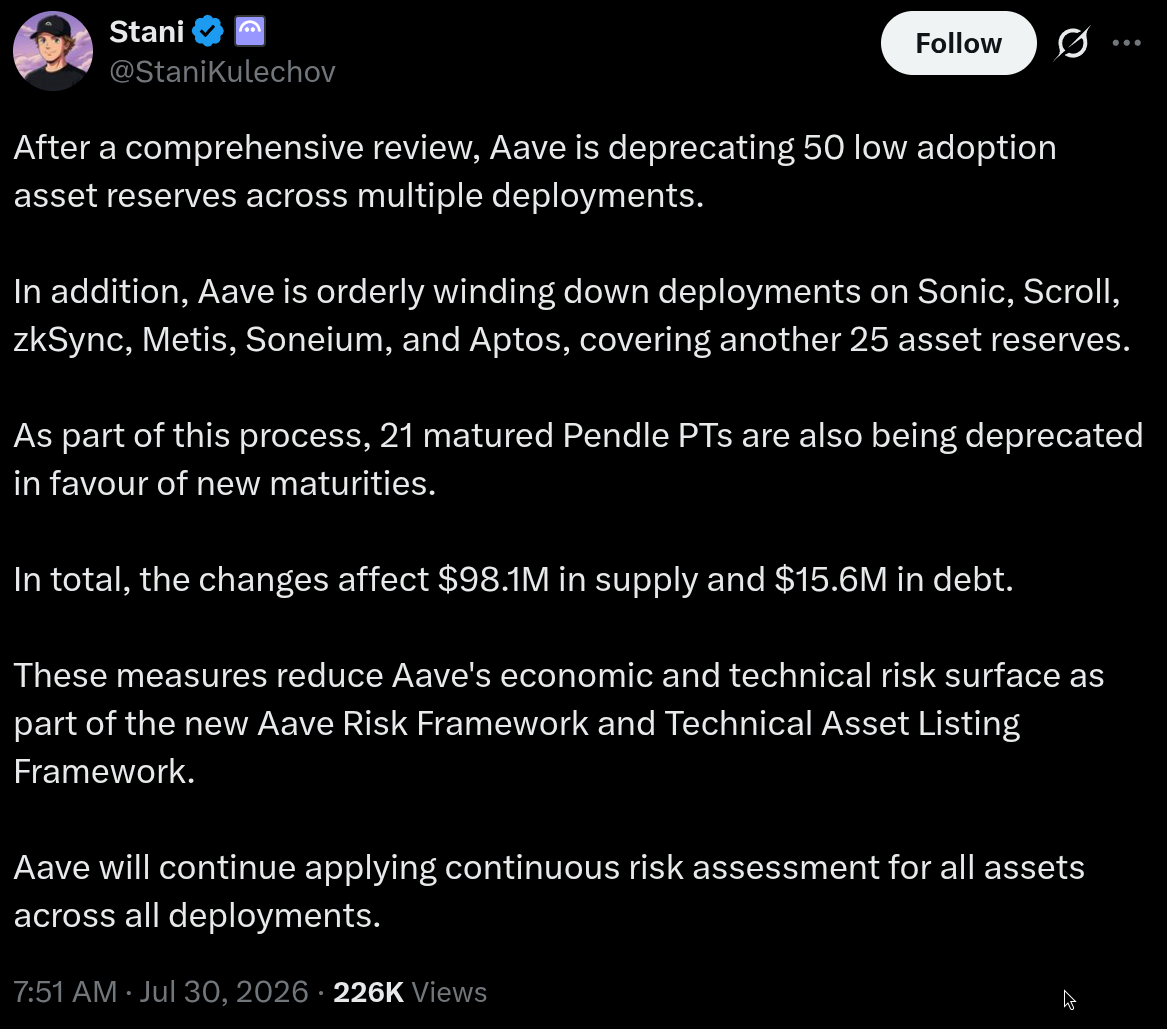
Aave founder comments on development

Source: Stani Kulechov

Aave founder Stani Kulechov said in a Thursday post that this will also “reduce Aave’s economic and technical risk surface as part of the new Aave Risk Framework and Technical Asset Listing Framework.”

Related: Aave brings V3 lending and GHO stablecoin to Monad

Still, this is not a reversal of Aave’s multichain expansion strategy, rather a strategic refocusing on select protocols. “Aave will continue applying continuous risk assessment for all assets across all deployments,” Kulechov said. The comments also follow Aave launching on Avalanche earlier this month.

Magazine: The real reason DeFi projects that survived 2022 crash are shutting down now

Related Questions

QAccording to the article, what is the total value of supplied assets and debt covered by Aave's proposed cleanup?

AThe proposed cleanup covers $98.1 million in supplied assets and $15.6 million in debt.

QHow many low-use reserves across how many deployments does LlamaRisk recommend offboarding?

ALlamaRisk, working with other Aave service providers, recommended offboarding 50 low-use reserves across 11 deployments.

QOn which six blockchains does the governance proposal recommend winding down all Aave V3 market reserves?

AThe proposal recommends retiring all reserves on the Sonic, Scroll, zkSync, Metis, Soneium, and Aptos blockchains.

QWhat was the reason given for adding Scroll to the list of affected protocols via an accelerated process?

AScroll was added due to a rapid deterioration in network liquidity and Aave market activity on the protocol.

QAccording to Aave founder Stani Kulechov, what is the primary goal of this strategic refocusing, and does it mean an end to multichain expansion?

AThe primary goal is to reduce Aave's economic and technical risk surface as part of the new risk framework. It is not a reversal of the multichain strategy but a strategic refocusing on select protocols, with continuous risk assessment continuing for all assets across all deployments.

Related Reads

Coinbase and PNC Bank Launch USDC Collection: Can Stablecoins Become the New Gateway for Enterprise Payments?

Coinbase and PNC Bank have expanded their partnership to launch a USDC collection service for enterprise and institutional clients. Eligible customers can receive USDC via the Ethereum network, which is then converted 1:1 into USD and deposited into their designated PNC bank account. The service uses Coinbase's Payment APIs integrated with PNC's existing treasury management systems, embedding the stablecoin collection process within the traditional banking framework. The collaboration highlights a complementary relationship between stablecoins and banks rather than pure competition. Banks provide client relationships, compliance, and deposit accounts, while blockchain offers round-the-clock value transfer. Coinbase supplies the stablecoin infrastructure and payment APIs, while PNC handles account and traditional financial services. For businesses, the appeal is gaining a new payment channel without overhauling their existing financial systems or managing wallets and private keys themselves. The partnership builds on earlier collaboration announced in July 2025, when the two firms began integrating crypto trading capabilities into PNC's services, followed by Bitcoin spot trading for eligible private banking clients in December. The USDC service extends the focus from wealth management into enterprise payments and treasury management. Coinbase has pursued similar integrations with Citigroup and payment technology firm Moov, signaling a strategic shift from a trading platform toward payment infrastructure. However, questions remain about fees, settlement times, compliance requirements, and actual adoption scale. The service is still in a pilot phase with limited eligibility, and full fee structures and processing times have not been disclosed. The key question is whether enterprises will adopt stablecoin collection in daily operations and whether the funds can be reliably converted, deposited, and used without adding excessive operational cost. The real competitive frontier may be integrating digital dollars into everyday corporate cash flows rather than simply accumulating on-chain assets.

marsbit13m ago

Coinbase and PNC Bank Launch USDC Collection: Can Stablecoins Become the New Gateway for Enterprise Payments?

marsbit13m ago

Crypto Stocks Weekly丨Strategy Adds 1,036 BTC but Holdings Fall Below Cost Basis; Bitmine Holds 4.97% of ETH Supply (November 10)

The article begins by noting that Democrats swept both chambers of Congress, ushering in a divided-government phase, after which markets shifted focus to AI regulation and capex payback cycles, with Anthropic's IPO seen as a bellwether for AI stocks. US equities fell sharply (Nasdaq -5.52% and Philadelphia Semiconductor Index -12.24% on Nov 5) before a Monday rebound driven by falling oil prices and oversold buying—characterized as a repair, not a new high. Macro data showed October nonfarm payrolls +165k and unemployment at 4.1%, keeping 10-year Treasury yields near 4.86% and rate-hike expectations alive. Citi cut US equities and global tech to neutral while upgrading Europe ex-UK, citing unstable AI sentiment; Goldman noted AI stocks are ~40% of the S&P 500 versus ~15% of STOXX 600. Crypto diverged from the equity rebound: US spot Bitcoin ETFs saw $1.282B in weekly net outflows (BlackRock's IBIT -$12.09B... actually $1.209B), Ethereum ETFs -$365M for a sixth straight weekly outflow, with continued outflows on Nov 9. NYSE-affiliated tokenized securities platform chose Avalanche for settlement infrastructure. Corporate treasury updates: Strategy bought 1,036 BTC at ~$79,012 (total 850,364 BTC, average cost ~$75,456, now above spot), funded partly by ATM share sales, with most proceeds used to repurchase STRC preferred shares. Strive added 29 BTC (total 43,153). Listed companies now hold over 6% of Bitcoin's supply (1.2664M BTC across 199 firms). Bitmine added 9,587 ETH, holding 6,070,092 ETH (~4.97% of supply, ~99% of its 5% goal). DeFi Development Corp's SOL rose to 2,609,829. Hyperliquid Strategies raised $911M in Q3, bought ~9.1M HYPE (holdings up to 38.5M, ~16% of circulating supply), and repurchased ~2.7M PURR shares.

marsbit33m ago

Crypto Stocks Weekly丨Strategy Adds 1,036 BTC but Holdings Fall Below Cost Basis; Bitmine Holds 4.97% of ETH Supply (November 10)

marsbit33m ago

Trading

Spot
活动图片