Crypto GPs' Midlife Crisis: No PMF, No LP's Next Check

链捕手Опубликовано 2026-06-01Обновлено 2026-06-01

Введение

The article "The Midlife Crisis of Crypto GPs: No PMF, No LP's Next Check" analyzes the shifting crypto fundraising landscape. It argues that the era of LPs funding vague "vision" is over; GPs must now offer products with clear Product-Market Fit (PMF) to secure capital. The market has matured. LPs, disillusioned by the last cycle's failures and wary of long lock-up periods, now demand tangible, near-term returns rather than speculative narratives. The proliferation of accessible crypto ETFs and other liquid products has reduced the need for VC blind pools as an entry point. The author categorizes crypto fundraising products into three types: Primary (VC funds, with blind pools or clear pipelines), Liquid (alpha/beta, directional/market-neutral strategies), and CeFi/DeFi Native Yield (crypto-specific mechanisms like staking, farming). Focusing on the Primary market, the piece details why traditional LP rationales for investing in crypto VCs have weakened: easier beta access via ETFs, diminished "access" and "judgement" premiums as LPs build internal teams, and a widespread lack of proven superior returns from GPs. Ultimately, only specific players are likely to remain at the primary VC table: large funds with access to patient endowment capital, family offices/HNWIs investing proprietary capital, the few funds with demonstrable excess returns from the last cycle, and those with clear "deal-making" or ecosystem resource advantages. For others, the path forward is to rebuil...

Author: Yi.Pineapple

LPs no longer buy dreams; GPs must sell products. This article will attempt to categorize current crypto fundraising products into three types: Primary, Liquid, and CeFi / DeFi Native Yield. The first part will focus on Primary: After VC blind pools lose their appeal, who remains at this table, and who must prove themselves anew? The answer is at the end; feel free to scroll down.

Note: This article aims to provide a landscape description of the entire crypto fundraising market. The first part mainly categorizes and explains the market status from a product perspective, while the next part will analyze it more from the LP's perspective. As the author is primarily in the Asian market, this article may have a regional bias.

Market Status

After losing the grand vision, most Crypto GPs who failed to earn excess returns this cycle must now ground themselves and launch a product with PMF (Product-Market Fit). They must either re-prove their ability to generate excess returns for LPs in niche markets or demonstrate their capacity to solve specific problems for LPs/partners to survive.

  • For most GPs, the market has long transitioned from a phase of "buying a future vision" to one of "buying a specific product."
  • LPs have lost patience and no longer want to gaze at the stars and the ocean; they want to see immediate, tangible, and relatively certain opportunities to make money.
  • Crypto LPs have lost trust in the market and are no longer willing to easily believe the "next cycle" narrative (this has been discussed too much and won't be elaborated here). Moreover, many haven't made easy money this cycle; when money becomes harder to earn, investment actions tend to become more cautious and conservative.
  • Most traditional LPs have also completed a round of learning, moving past the storytelling phase. The 2020/2021 bull market was the peak of market FOMO. Dollar funds were cheap (Treasury yield near 0), LPs were making relatively easy money (on the eve of the economic downturn), and Crypto was in an explosive growth phase (with numerous rags-to-riches stories and dreams to sell). Back then, many were willing to impulse buy into the dream even if they didn't fully understand crypto, or they entered strategically to learn.
  • AI and declining labor costs have also changed GPs' niche. The cost for LPs to learn, hire, analyze data, trade, and make small direct investments is decreasing. The trend of LPs transforming into GPs is significant. GPs who only offer vague capabilities like "I understand crypto" will find their value increasingly precarious.
  • In terms of storytelling, unless it's a strong US-based fund with a proven track record pitching visions in specific niches (like a16z leveraging its AI advantage to pitch crypto * AI, or Dragonfly pitching internet capital markets based on its investments in Ethena/Polymarket), opportunities remain. In Asia, this niche is already difficult, as both crypto projects and funds, to some extent, only get the chance to tell stories if they are "White Papers."

Product Landscape

This article divides crypto fundraising products into three main categories for discussion: Primary, Liquid, and CeFi / DeFi Native Yield (Note: This classification is not entirely precise, with some blurry areas between the three). (*This part covers Primary first)

Primary VC:

In terms of transparency, they can roughly be divided into blind pools and those with clear pipelines.

In terms of liquidity, they can roughly be divided into primary and primary-secondary markets.
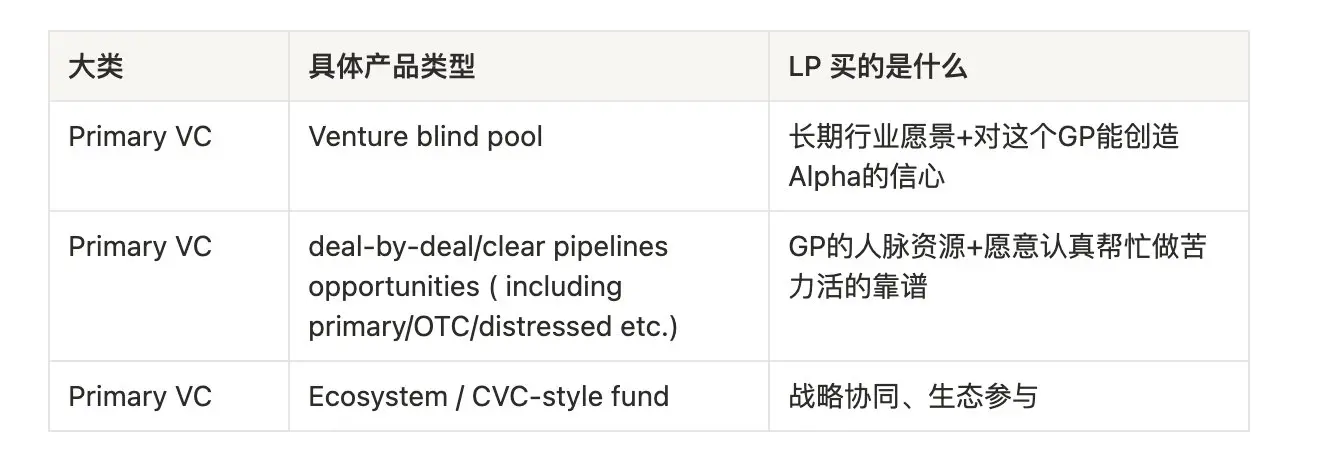
Liquid:

Divided by source of returns, roughly into alpha-focused (buying the GP's personal skill) and beta-focused (buying industry trends).

Divided by directionality, roughly into directional (buying cycle timing) and market neutral (buying market inefficiencies in immature markets).
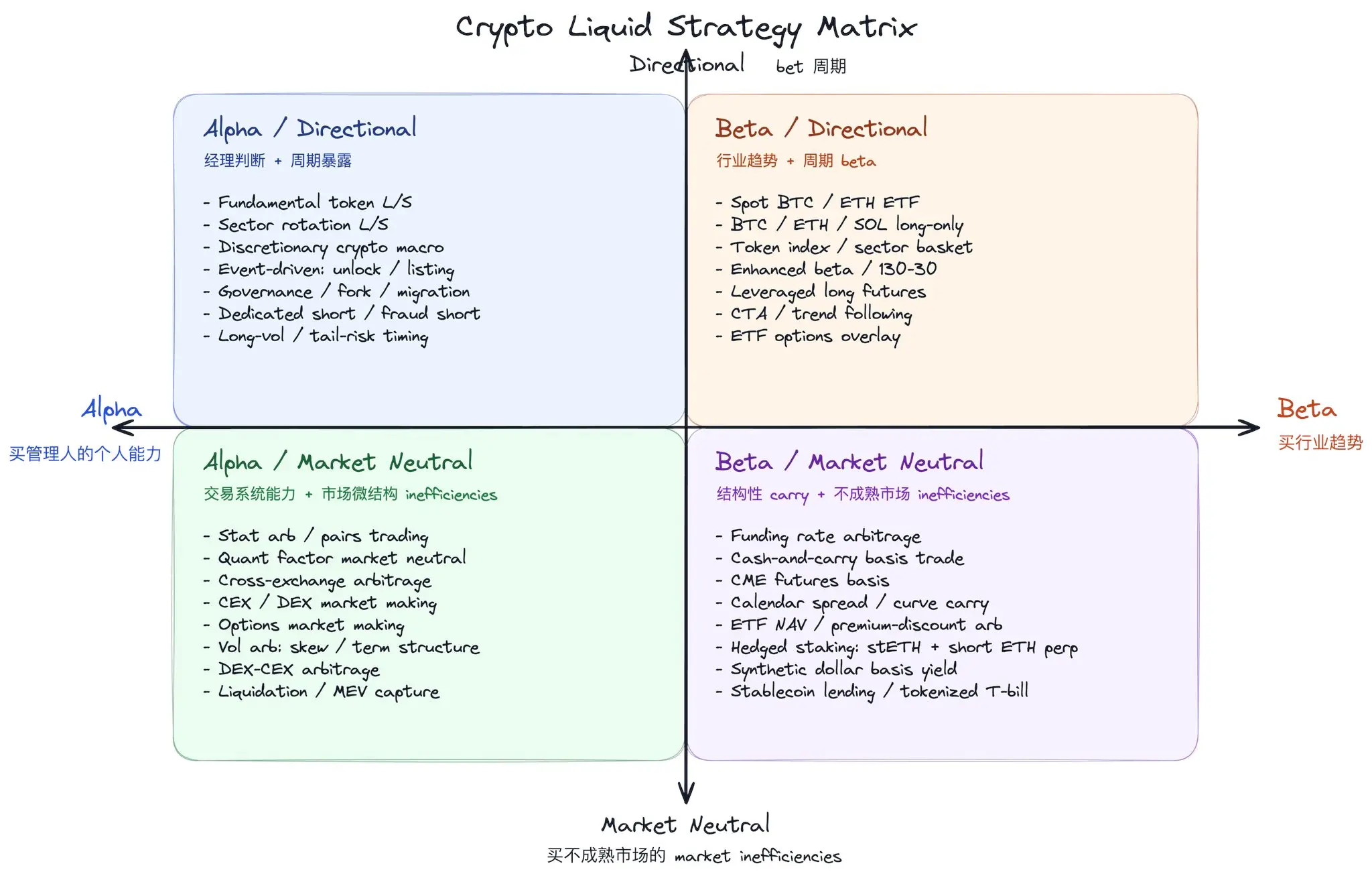
There are many ways to categorize; this is just one idea.

CeFi/DeFi Native Yield:

Theoretically, CeFi/DeFi Native Yield could be seen as a source of returns within or spanning both the crypto primary and liquid markets. The main reason for separating it is that from a TradFi investor's perspective, they usually use traditional financial frameworks to understand crypto: for example, crypto VC can be seen as a sub-sector of VC, and staking/lending yield can be analogous to fixed income or cash management products.

However, crypto does have some mechanisms and playbooks not fully mirrored in traditional finance, such as farm-and-dump, points/airdrop farming, protocol incentives, and on-chain liquidity mining. These are more like crypto-native distribution, customer acquisition, and incentive mechanisms, warranting separate discussion.

Secondly, for many Crypto Native Investors, their initial entry point to understanding financial markets was not the traditional equity/bond market, but crypto-native scenarios like exchange wealth management products, staking, DeFi lending, providing liquidity, points/airdrop farming, and basis trades. Therefore, they might not first translate this yield into TradFi terms like fixed income, cash management, or alternative yield. Instead, they more naturally understand it from angles like protocol incentives, liquidity provision, token emission, on-chain risks, counterparty risk, and capital efficiency.

For Crypto Native LPs, accessing this yield doesn't require a GP, maybe just a reliable key account manager.

For TradFi LPs, some institutions are now packaging this yield into fund products to sell to them.

Primary Market

From the perspective of the entire primary market, crypto VC is just a sub-sector under the broad VC category. 2021 was a crazy year; whether crypto or non-crypto, the real returns from that vintage are poor. As a cruel fact, LPs have learnt their lessons and are tired of any product with ultra-long lock-ups (traditional VC often 10 years, crypto VC often 5-10 years). Because without hard locks, they at least have a chance to withdraw some money if circumstances change.

In some sense, crypto is worse off than traditional VC because the grand vision has collapsed. It is not a new industrial revolution, at most a revolution in financial infrastructure. This judgment is not to disparage crypto; financial infrastructure revolution is still important, but it's not as grand as many imagined in the last bull run. Worse, the market was too immature back then; many projects were funded without sufficient due diligence and legal protection. Many failures are a combination of investment failure and founder exit. Too many articles in the industry describe the current misery, so we won't elaborate here.

Investing in VC is like VC investing in startups: it's a power-law business, a lottery-like business. As long as someone is willing to buy lottery tickets, this table won't disappear.

Why LPs invested in crypto VC back then, and why these reasons have weakened now:

1. Invest to capture the beta of the industry

This reason was particularly true for TradFi LPs. It held early on because market choices were few. For outsiders, onboarding, buying tokens, going on-chain, using CEXs, and managing wallets were difficult. They feared losing private keys and CEXs running away. Investing in VC seemed like a more reliable access point.

But today, a traditional LP entering crypto has a full suite of choices: BTC ETF, ETH ETF, crypto ETPs, DATs, custody accounts, SMAs, structured products. More importantly, these products don't require learning on-chain operations; they trade like stocks.

According to CoinShares, global digital asset investment products AUM (ETF/ETP/trust/closed-end funds, etc.) reached about $156.9B in mid-May 2026. This number isn't total industry AUM, just a tally of listed or quotable products, but it shows: gaining crypto exposure no longer requires investing in a VC blind pool.

However, for long-term capital with clear mandates (e.g., endowments, etc.), this reason still applies. For them, positioning in an industry often involves a basket of assets, so there's still likely a 1~2% allocation to Crypto VC.

2. Invest for deal accessibility

This typically applied to crypto LPs and some TradFi LPs with strategic layout visions. Many such LPs didn't have the resources/time/capability to build their own investment teams, so they gave money to GPs hoping for good deal access.

But they later found this reason unstable. When the market was good, GPs themselves had insufficient allocation, and LPs struggled to get real access. When the market was bad, competition wasn't fierce; if you were willing to reach out, getting allocation wasn't that hard.

For traditional LPs, access had another meaning: they knew nothing initially but hoped to enter the ecosystem and gain insider information by investing in crypto-native GPs. It was a form of strategic investment when there was no clear strategic target. Now the situation has changed. Many traditional LPs have either left for hotter fields like AI, or have developed their own internal teams. AI and cheap analysts have narrowed the knowledge gap. New learners still exist, but they learn faster and have more paths. Investing in the primary market with ultra-long lock-ups is not necessarily the optimal choice for them anymore.

3. Invest for superior judgment

This is the trickiest part. In a rapidly evolving market, unless a GP can continuously self-iterate, the judgment premium disappears quickly. The rules change every cycle, but people don't change easily (is this another form of "old habits die hard").

We must face a harsh reality: Most GPs did not prove to LPs they had superior judgment in the last cycle.

For traditional LPs, part of the reason for investing in crypto-native GPs was to educate themselves and learn the industry through the GP's judgment. This typically applied to two types: companies wanting to strategically enter Web3 (like internet giants, etc.), and sophisticated TradFi investors (like traditional GPs or family offices) who wanted to later do their own direct Web3 investments. The learning phase is over. Only a few GPs who have truly proven superior judgment remain on their investment lists.
For crypto LPs, they found it better to lose money themselves than to bet on a GP's judgment. Losing money yourself at least has emotional value, and you don't pay management fees.

4. Invest for deal-making ability

From an investment return perspective, deal-making ability primarily manifests as whether it can achieve good final exits for projects. Ideally, it's best to help projects achieve healthy growth for good secondary market returns. Failing that, the ability to organize the next round of financing is also important (essentially, the difference between relying on retail or large investors to take over).

However, as a form of financial innovation, Crypto sometimes resembles a large-scale capital game. Sometimes, investment is just a form of interest exchange, ensuring aligned interests to make money together relatively safely.

5. Invest for reputation

For some large LPs, money invested in a single VC might only be 1% of their overall portfolio, insignificant. Sometimes they invest in a GP just to be cool (like investing in A16Z). But most GPs aren't in this category.

Who can still stay at the primary table

From a pure capital source perspective, the players most likely to remain at the primary table are:

Funds large enough to enter the mandate of endowments/other similar long-term patient capital. These institutions buy crypto VC as lottery tickets without short-term funding pressure.

FOs, companies, and HNW individuals investing proprietary capital in primary crypto investments. FOs/HNWs are more likely to run accelerator-like, very early-stage funds; companies are more likely to make direct strategic investments/acquisitions.

The few funds that struck gold/bought BTC this cycle and genuinely delivered excess returns to LPs. LPs believe they can win next time.

Funds with clear deal-making ability, possessing ecosystem resources to exchange interests with LPs.

For other players, if trust is lost, it might be better to restart mentally and rebuild trust. Re-prove the ability to generate excess returns for investors in a niche, or provide some specific service/value, then scale based on that.


Трендовые криптовалюты

Связанные с этим вопросы

QAccording to the article, why must crypto GPs shift from selling visions to selling products with PMF?

ABecause LPs have lost patience and trust. They no longer want to buy distant 'future visions' or 'next cycle' stories, especially after many failed to achieve outsized returns in the last cycle. LPs now demand immediate, relatively certain opportunities to make money. Therefore, GPs must offer concrete products with Product-Market Fit (PMF) to survive.

QWhat are the three broad categories of crypto fundraising products mentioned in the article?

AThe three broad categories are: 1) Primary (e.g., VC blind pools, funds with clear pipelines, primary and secondary deals), 2) Liquid (e.g., funds focused on alpha/beta, directional/market-neutral strategies), and 3) CeFi / DeFi Native Yield (e.g., staking, lending, airdrop farming, protocol incentives).

QWhy is the 'CeFi/DeFi Native Yield' category discussed separately from Primary and Liquid markets?

AIt's discussed separately for two main reasons. First, from a TradFi perspective, these yields (like staking) are often analogized to fixed income, but crypto has unique mechanics (like airdrop farming) not fully present in traditional finance. Second, for Crypto Native investors, these were their first entry points into finance, so they view them through a crypto-native lens of protocol incentives and on-chain risks, not just as traditional yield products.

QWhat are two reasons mentioned for why LPs' original motivations for investing in crypto VC funds have weakened?

ATwo key reasons are: 1) **Invest to Capture Industry Beta**: This is less valid now as traditional LPs have many easier alternatives for crypto exposure (like BTC/ETH ETFs, ETPs, SMA) without the long lock-ups of VC funds. 2) **Invest for Accessibility/Judgement**: LPs found that during bull markets, good deal access wasn't guaranteed, and during bear markets, it's easier to get. Furthermore, most GPs failed to demonstrate superior investment judgement in the last cycle, and LPs can now build internal teams or learn faster using AI, reducing their reliance on GPs for access and insight.

QBased on the article, which types of players are most likely to remain active in the crypto primary (VC) market?

AThe players most likely to remain are: 1) Large funds that can secure mandates from endowments or other long-term patient capital, treating crypto VC as a lottery ticket. 2) Family offices (FOs), high-net-worth individuals (HNWIs), or companies investing their own capital, often in very early-stage or strategic investments. 3) The few funds that delivered outsized returns in this cycle (e.g., by betting on successful projects like Bitcoin), thus maintaining LP trust. 4) Funds with clear ecosystem resources and deal-making ('攒局') capabilities that can offer value exchange to LPs.

Похожее

Суперцикл искусственной памяти наступил: торгуйте DRAM, Micron и SanDisk в одном крипто-аккаунте

Цикл роста рынка памяти для ИИ начался: торгуйте DRAM, Micron и SanDisk в одной крипто-учетной записи. Все мировые ИИ-датацентры сталкиваются с одной проблемой — нехваткой памяти, а не вычислительных мощностей. Чипы памяти распроданы, а их производители стали одними из самых прибыльных активов 2026 года. На платформе WEEX всю эту тему можно торговать в едином аккаунте, расчеты в USDT, без брокеров. Ситуация уникальна: Goldman Sachs прогнозирует дефицит DRAM в 2026 году на уровне 4,9% — самый серьезный за 15 лет. Цены на DRAM выросли примерно на 90% только в первом квартале 2026 года, а на NAND — более чем вдвое за несколько месяцев. Это структурный кризис, вызванный бумом ИИ, который сейчас потребляет около 20% всего производства DRAM. Три инструмента на WEEX позволяют участвовать в этом цикле: 1. **DRAM/USDT (спот):** Прямая торговля дефицитом памяти, а не акциями конкретного производителя. 2. **Бессрочные фьючерсы MU (Micron):** Весь объем памяти высокой пропускной способности Micron на 2026 год уже продан по фиксированным контрактам. Выручка компании в центре обработки данных составляет более 56%. 3. **Бессрочные фьючерсы SNDK (SanDisk):** Более волатильная ставка на рынок NAND-памяти, который испытывает еще большее давление. Выручка SanDisk резко выросла на 97% в квартальном исчислении. Ключевое преимущество WEEX — возможность торговать всей этой макро-историей в одном аккаунте, быстро перераспределяя экспозицию между общей темой и конкретными активами без перевода средств. Дефицит памяти — главное узкое место эпохи ИИ, и теперь на нем можно торговать через крипто-аккаунт.

TheNewsCrypto19 мин. назад

Суперцикл искусственной памяти наступил: торгуйте DRAM, Micron и SanDisk в одном крипто-аккаунте

TheNewsCrypto19 мин. назад

UNI вырос вдвое за два месяца на фоне общего спада: пятилетняя задержка в восстановлении стоимости

В июне-июле 2025 года, на фоне общей волатильности крипторынка, токен UNI децентрализованной биржи Uniswap показал исключительный рост, почти удвоившись в цене с $2,3 до $4,6. Основная причина — реализация механизма сбора доли комиссий протокола (т.н. «переключатель комиссий») и их направления на выкуп и сжигание UNI, что изменило его статус с чисто управленческого токена на актив с реальным денежным потоком. Несмотря на то, что предложение было принято еще в декабре 2024 года, значимый эффект проявился только в июле 2025 года после запуска Robinhood Chain, ориентированной на токенизированные акции. Развернутые на ней пулы Uniswap резко увеличили объемы торгов и комиссий протокола. Ежедневные средства, направляемые на сжигание UNI, выросли примерно с $114 тысяч до $325 тысяч, причем более половины суммы генерировала Robinhood Chain. Ключевым фактором успеха механизма выкупа и сжигания для UNI стала зрелая и распределенная структура предложения токена, выпущенного еще в 2020 году, без крупных предстоящих разблокировок. Это отличает его от многих новых проектов, где эмиссия часто превышает объемы выкупа. Главный вопрос на будущее — сможет ли Uniswap сохранить высокие объемы торгов на Robinhood Chain после окончания 90-дневного периода субсидирования комиссий сети, или текущий рост окажется временным эффектом.

marsbit53 мин. назад

UNI вырос вдвое за два месяца на фоне общего спада: пятилетняя задержка в восстановлении стоимости

marsbit53 мин. назад

Экстренный отзыв функции генерации изображений Nano Banana 2 в Google Earth!

В Google Earth экстренно отозвали функцию генерации изображений Nano Banana 2 после того, как пользователи менее чем за день "сломали" её, создавая неподобающий или абсурдный контент (например, исторические памятники в постапокалиптическом стиле). Функция, позволявшая накладывать сгенерированные ИИ изображения на реальные спутниковые снимки и 3D-ландшафты в Google Earth, была временно отключена для усиления защитных мер. Эта технология, названная "геопространственным закреплением" (Geospatial Grounding), использует текущий спутниковый вид, данные рельефа и камеры для создания изображений, которые реалистично вписываются в реальную географию. Она открывала новые возможности: визуализацию исторических мест, создание информационных графиков и предварительный просмотр архитектурных проектов в их реальном окружении. Однако недостатки, такие как отсутствие поддержки режима Street View и неточности в генерируемой информации, а также возможность злоупотреблений, вынудили Google отозвать функцию. Этот шаг подчеркивает стратегию Google по использованию своего уникального массива географических данных для создания нового типа "правдоподобной" AI-визуализации, в отличие от конкурентов, сосредоточенных только на эстетике изображений.

marsbit2 ч. назад

Экстренный отзыв функции генерации изображений Nano Banana 2 в Google Earth!

marsbit2 ч. назад

Алтман признаёт: переоценил способность ИИ отнимать работу! Хуан Жэньсюнь: разговоры о безработице абсолютно ошибочны

Открытие OpenAI - не первая крупная компания под управлением ИИ, но Сэм Олтман изменил свою позицию. В подкасте «Invest Like the Best» он заявил, что люди «не хотят ИИ-гендиректора», поскольку им важно знать, кто принимает решения и несет ответственность. Он также признал, что переоценил скорость, с которой ИИ заменит младшие офисные должности. Дженсен Хуанг, глава NVIDIA, в свою очередь, заявил на YC Startup School, что нарратив об «ИИ, уничтожающем рабочие места», ошибочен. Он разграничил понятия «задача» и «работа»: ИИ берет на себя некоторые задачи, но не устраняет всю должность. Например, спрос на радиологов и разработчиков ПО растет, поскольку ИИ помогает быстрее обрабатывать накопленные объемы работы, позволяя расширять деятельность. Исследование Университета Мэриленда и LinkUp, охватившее 155 млн вакансий в США с 2018 года, не выявило общего снижения спроса на работу из-за ИИ. Доля вакансий для выпускников даже выросла. Молодые специалисты могут получить преимущество, используя ИИ для компенсации недостатка опыта. Однако стандартные вводные задачи (обработка данных, написание базового кода), которые раньше служили стартовой ступенькой для карьеры, теперь автоматизируются. Это сужает точку входа на рынок труда для новичков. Ключевой вывод: по мере автоматизации задач ценность человеческой работы смещается в сторону ответственности, построения доверия, принятия окончательных решений и личного взаимодействия. Эти элементы, которые ИИ не может заменить, становятся настоящим профессиональным преимуществом.

marsbit2 ч. назад

Алтман признаёт: переоценил способность ИИ отнимать работу! Хуан Жэньсюнь: разговоры о безработице абсолютно ошибочны

marsbit2 ч. назад

Крупные изменения в ФРС? Сообщается, что Ваш рассматривает возможность сокращения частоты заседаний по ставкам, нарушая 40-летнюю традицию

Председатель ФРС Уолш рассматривает возможность сокращения количества регулярных заседаний по установлению процентных ставок, проводимых Федеральным комитетом по открытым рынкам (FOMC) каждый год. Это изменение, если оно будет реализовано, станет одним из самых значительных преобразований в работе ФРС за последние десятилетия и打破ет практику, действующую с 1981 года, когда заседания проводятся восемь раз в год (примерно каждые шесть недель). Согласно информации The New York Times, Уолш вынес этот вопрос на обсуждение на заседании ФРС на этой неделе. Новый график может быть определен до следующего заседания в середине сентября, хотя конкретные изменения вступят в силу позже. Закон о банках 1935 года требует, чтобы FOMC проводил «не менее четырех заседаний в год». Сокращение количества заседаний уменьшит возможности для голосования по процентным ставкам и может ослабить способность ФРС оперативно реагировать на изменения в инфляции и на рынке труда. Это также сократит каналы получения рынком сигналов о денежно-кредитной политике и снизит прозрачность, что противоречит многолетнему тренду на ее усиление. Данный шаг соответствует общему стилю руководства Уолша, который уже сократил объем публичных заявлений и рассматривает возможность уменьшения количества пресс-конференций после заседаний. Это предложение является частью более широкой повестки Уолша по «институциональной реформе» ФРС. В истории ФРС частота заседаний менялась: до 1981 года они могли проводиться до 19 раз в год, как это было в 1956 году. Внутренняя памятная записка ФРС 1988 года признавала преимущества более частых заседаний для оперативного рассмотрения новой информации, но сочла существующий график из восьми заседаний подходящим. Реформа Уолша идет в противоположном направлении, и ее потенциальное влияние на гибкость политики и коммуникацию с рынком будет тщательно отслеживаться.

marsbit2 ч. назад

Крупные изменения в ФРС? Сообщается, что Ваш рассматривает возможность сокращения частоты заседаний по ставкам, нарушая 40-летнюю традицию

marsbit2 ч. назад

Торговля

Спот

Популярные статьи

Как купить CHECK

Добро пожаловать на HTX.com! Мы сделали приобретение Checkmate (CHECK) простым и удобным. Следуйте нашему пошаговому руководству и отправляйтесь в свое крипто-путешествие.Шаг 1: Создайте аккаунт на HTXИспользуйте свой адрес электронной почты или номер телефона, чтобы зарегистрироваться и бесплатно создать аккаунт на HTX. Пройдите удобную регистрацию и откройте для себя весь функционал.Создать аккаунтШаг 2: Перейдите в Купить криптовалюту и выберите свой способ оплатыКредитная/Дебетовая Карта: Используйте свою карту Visa или Mastercard для мгновенной покупки Checkmate (CHECK).Баланс: Используйте средства с баланса вашего аккаунта HTX для простой торговли.Третьи Лица: Мы добавили популярные способы оплаты, такие как Google Pay и Apple Pay, для повышения удобства.P2P: Торгуйте напрямую с другими пользователями на HTX.Внебиржевая Торговля (OTC): Мы предлагаем индивидуальные услуги и конкурентоспособные обменные курсы для трейдеров.Шаг 3: Хранение Checkmate (CHECK)После приобретения вами Checkmate (CHECK) храните их в своем аккаунте на HTX. В качестве альтернативы вы можете отправить их куда-либо с помощью перевода в блокчейне или использовать для торговли с другими криптовалютами.Шаг 4: Торговля Checkmate (CHECK)С легкостью торгуйте Checkmate (CHECK) на спотовом рынке HTX. Просто зайдите в свой аккаунт, выберите торговую пару, совершайте сделки и следите за ними в режиме реального времени. Мы предлагаем удобный интерфейс как для начинающих, так и для опытных трейдеров.

746 просмотров всегоОпубликовано 2026.01.19Обновлено 2026.06.02

Как купить CHECK

Обсуждения

Добро пожаловать в Сообщество HTX. Здесь вы сможете быть в курсе последних новостей о развитии платформы и получить доступ к профессиональной аналитической информации о рынке. Мнения пользователей о цене на CHECK (CHECK) представлены ниже.

活动图片