What will cryptocurrency look like in 2027? Here are 5 predictions

CointelegraphОпубликовано 2022-08-06Обновлено 2022-08-06

Введение

One year isn’t enough time to witness many fundamental changes, but five years is just enough for everything to change.

The year is 2027. It’s a time of great innovation and technological advancement, but also a time of chaos. What will the crypto market look like in 2027? (For those unfamiliar, that's a line from the 2011 video game, Deus Ex.)

Long-term predictions are notoriously difficult to make, but they are good thought experiments. One year is too short a period for fundamental changes, but five years is just enough for everything to change.

Here are the most unexpected and outrageous events that could happen over the next five years.

1. The metaverse will not rise

The metaverse is a hot topic, but most people do not have even the slightest idea of what it actually comprises. The metaverse is a holistic virtual world that exists on an ongoing basis (without pauses or resets), works in real-time, accommodates any number of users, has its own economy, is created by the participants themselves, and is characterized by unprecedented interoperability. A variety of applications could (in theory) be integrated into the metaverse, including games, video-conferencing applications, services for issuing driver’s licenses — anything.

This definition makes it clear the metaverse is not such a novel phenomenon. Games and social networks that include most of the features stated above have been around for quite some time. Granted, interoperability is a problem that needs to be addressed seriously. It would have been a very useful feature to be able to easily transfer digital assets between games — or a digital identity — without being tethered to a specific platform.

But the metaverse will never be able to cater to every need. There is no reason to include some services in the metaverse at all. Some services will remain isolated due to the unwillingness of their operators to surrender control over them.
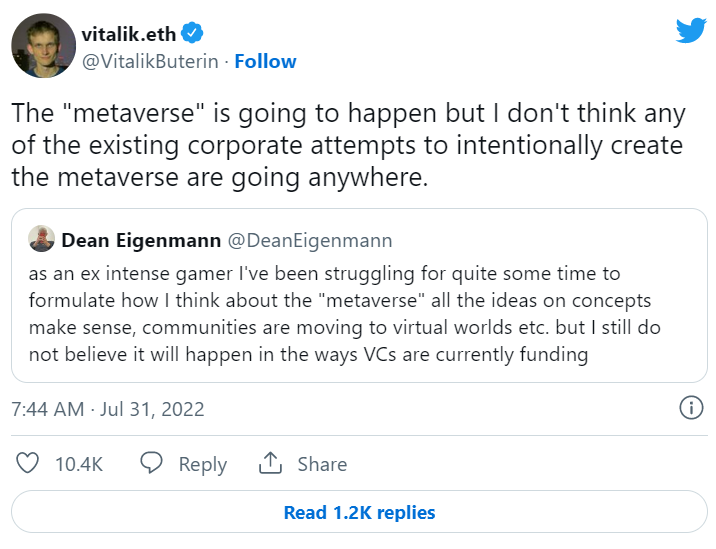
And there is also the technical aspect to take into account. The cyberpunk culture of the 1980s and 90s postulated that the metaverse meant total immersion. Such immersion is now conceived as possible only with the use of virtual reality glasses. VR hardware is getting better every year, but it’s not what we expected. VR remains a niche phenomenon even among hardcore gamers. The vast majority of ordinary people will never put on such glasses for the sake of calling their grandmother or selling some crypto on an exchange.

True immersion requires a technological breakthrough like smart contact lenses or Neuralink. It is highly unlikely those technologies will be widely used five years from now.

2. Wallets will become “super apps”

An active decentralized finance (DeFi) user is forced to deal with dozens of protocols these days. Wallets, interfaces, exchanges, bridges, loan protocols — there are hundreds of them, and they are growing daily. Having to live with such an array of technologies is inconvenient even for advanced users. As for the prospects of mass adoption, such a state of affairs is all the more unacceptable.

For the ordinary user, it is ideal when a maximum number of services can be accessed through a limited number of universal applications. The optimal choice is when they are integrated right into their wallet. Storing, exchanging, transferring to other networks, staking — why bother visiting dozens of different sites for accessing such services if all the necessary operations can be carried out using a single interface?

Users don’t care which exchange or bridge they use. They are only concerned about security, speed and low fees. A significant number of DeFi protocols will eventually turn into back-ends that cater to popular wallets and interfaces.

3. Bitcoin will become a unit of account on par with the U.S. dollar or Euro

Money has three main roles — acting as a means of payment, as a store of value and as a unit of account. Many cryptocurrencies, primarily stablecoins, are used as a means of payment. Bitcoin (BTC) and — to a much lesser extent — Ether (ETH) are used as stores of value among cryptocurrencies. But the United States dollar remains the main unit of account in the world. Everything is valued in dollars, including Bitcoin.

The real victory for sound money will be heralded when cryptocurrencies take over the role of a unit of account. Bitcoin is currently the main candidate for this role. Such a victory will signify a major mental shift.
What needs to happen in the next five years to make this a possibility?

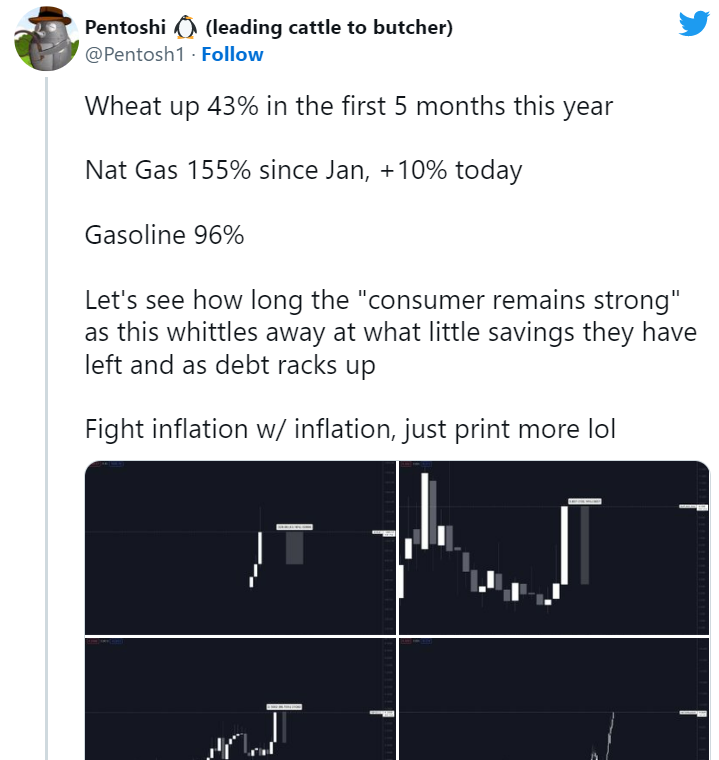
A sharp drop in the confidence vested in the U.S. dollar and euro is a prerequisite for cryptocurrencies to take on the role of a basic unit of account. Western authorities have already done a lot to undermine said confidence by printing trillions of dollars in fiat money, allowing abnormally high inflation to spiral, freezing hundreds of billions of a sovereign country’s reserves, and so on. This may be just the beginning.

What if actual inflation becomes much worse than projected? What if the economic crisis is protracted? What if a new epidemic breaks out? What if the conflict in Ukraine spills into neighboring countries? All of these are feasible scenarios. Some are extreme, of course — but they are possible.

4. At least half of the top 50 cryptocurrencies will see their standing decline

There is a high probability that the list of top cryptocurrencies will radically change. Outright zombies such as Ethereum Classic (ETC) will be ousted from the list, and projects that now seem to hold unshakable positions will not only be de-throned but may also vanish altogether.

Some stablecoins will surely sink. New ones will take their place. Cardano (ADA) will slide down the list to officially become a living corpse. The project is moving agonizingly slowly. Developers not only fail to see this as problematic but even seem to view it as a benefit.

5. The crypto market will fragment along geographic lines

Cryptocurrencies are global by default, but they are not invulnerable to the influence of individual states. The state always has an edge and an extra trick up its sleeve. A number of territories (the U.S., the European Union, China, India, Russia, etc.) have already introduced or are threatening to introduce strict regulation of cryptocurrencies.

The factor of international competition is superimposed onto internal state motivations. When Russia was heavily sanctioned, some crypto projects started restricting Russian users from accessing their services or even blocking their funds. This scenario may play out again in the future with respect to China.

It is not difficult to imagine a future in which parts of the crypto market will work in favor of some countries while closing to others. We are living in such a future already, at least to some degree.


Похожее

Bitcoin Trading Strategy Breakdown: Celebrity Predictions and Classic Models All Fail, Only These Four Indicators Remain

Analysis of Bitcoin Trading Strategies: Why Celebrity Forecasts and Classic Models Fail, Leaving Only These Four Reliable Indicators This analysis examines the failure of common Bitcoin prediction methods and identifies four reliable indicators for constructing a trading strategy. The author reviewed all major BTC prediction approaches from 2017-2025, categorizing them into three groups: celebrity price targets (consistently over-optimistic), analytical models like Stock-to-Flow (broken post-2022), and on-chain signals. The key finding is that more data often creates confusion, not clarity. The strategy discards unreliable elements: celebrity predictions (incentivized to be extreme), pure models (invalidated by post-ETF market changes), and the Fear & Greed Index used alone (too many false signals). Four reliable indicators were selected: 1. **MVRV Z-Score:** Accurately identifies cycle bottoms when entering its green zone (e.g., 2018, 2020, 2022). Note: Its ability to call tops is now ineffective post-2024. 2. **SOPR (28-day MA):** Consistently signals bottoms when below 1.0, indicating holders are selling at a loss. 3. **ETF Net Flow:** A crucial post-2024 metric showing institutional momentum (e.g., sustained inflows = buying). 4. **Macro Liquidity (Fed policy & M2):** Sets the overall directional bias (e.g., bullish during easing cycles). The core strategy involves waiting for a multi-signal共振 (resonance). For example, a bottom signal requires MVRV in the green zone + SOPR < 1.0. A top signal requires overheated on-chain data + sustained ETF outflows. Macro policy sets the overall direction. The Fear & Greed Index is only used as a weighted confirmatory signal, never alone. Action is only taken when three or more indicators align. The author automated this into a monitoring system that sends Telegram alerts only when signals trigger. As of the article's date (April 15, 2026), the system showed a strong bottom signal: extreme fear (F&G=12), MVRV in the buy zone, and SOPR < 1.0. The only contrary signal was weak ETF flows. Historically, such triple on-chain共振 has preceded 100%+ returns. The conclusion emphasizes building a personal framework over relying on external predictions, allowing for iterative improvement and customization based on individual risk tolerance.

marsbit45 мин. назад

Bitcoin Trading Strategy Breakdown: Celebrity Predictions and Classic Models All Fail, Only These Four Indicators Remain

marsbit45 мин. назад

Торговля

Спот
Фьючерсы

Популярные статьи

Тест по Bitcoin Биткоина

HTX Learn: Изучите Bitcoin halving и Заработаете Токены USDT

2.9k просмотров всегоОпубликовано 2024.04.16Обновлено 2024.04.16

Тест по Bitcoin  Биткоина

Что такое $BITCOIN

ЦИФРОВОЕ ЗОЛОТО ($BITCOIN): Комплексный анализ Введение в ЦИФРОВОЕ ЗОЛОТО ($BITCOIN) ЦИФРОВОЕ ЗОЛОТО ($BITCOIN) — это проект на основе блокчейна, работающий в сети Solana, который стремится объединить характеристики традиционных драгоценных металлов с инновациями децентрализованных технологий. Хотя он носит имя Биткойн, часто называемого “цифровым золотом” из-за его восприятия как средства хранения ценности, ЦИФРОВОЕ ЗОЛОТО является отдельным токеном, предназначенным для создания уникальной экосистемы в ландшафте Web3. Его цель — позиционировать себя как жизнеспособный альтернативный цифровой актив, хотя детали его применения и функциональности все еще развиваются. Что такое ЦИФРОВОЕ ЗОЛОТО ($BITCOIN)? ЦИФРОВОЕ ЗОЛОТО ($BITCOIN) — это токен криптовалюты, специально разработанный для использования в блокчейне Solana. В отличие от Биткойна, который выполняет широко признанную роль хранения ценности, этот токен, похоже, сосредоточен на более широких приложениях и характеристиках. Примечательные аспекты включают: Инфраструктура блокчейна: Токен построен на блокчейне Solana, известном своей способностью обрабатывать высокоскоростные и недорогие транзакции. Динамика предложения: ЦИФРОВОЕ ЗОЛОТО имеет максимальное предложение, ограниченное 100 квадриллионами токенов (100P $BITCOIN), хотя детали о его обращающемся предложении в настоящее время не раскрыты. Утилита: Хотя точные функциональные возможности не описаны, есть указания на то, что токен может быть использован для различных приложений, потенциально связанных с децентрализованными приложениями (dApps) или стратегиями токенизации активов. Кто создатель ЦИФРОВОГО ЗОЛОТА ($BITCOIN)? На данный момент личность создателей и команды разработчиков, стоящих за ЦИФРОВЫМ ЗОЛОТОМ ($BITCOIN), остается неизвестной. Эта ситуация типична для многих инновационных проектов в области блокчейна, особенно тех, которые связаны с децентрализованными финансами и феноменом мем-криптовалют. Хотя такая анонимность может способствовать культуре, ориентированной на сообщество, она усиливает опасения по поводу управления и ответственности. Кто инвесторы ЦИФРОВОГО ЗОЛОТА ($BITCOIN)? Доступная информация указывает на то, что у ЦИФРОВОГО ЗОЛОТА ($BITCOIN) нет известных институциональных спонсоров или значительных венчурных капиталовложений. Проект, похоже, функционирует по модели пирингового взаимодействия, сосредоточенной на поддержке и принятии сообществом, а не на традиционных путях финансирования. Его активность и ликвидность в основном сосредоточены на децентрализованных биржах (DEX), таких как PumpSwap, а не на устоявшихся централизованных торговых платформах, что еще больше подчеркивает его подход, ориентированный на grassroots. Как работает ЦИФРОВОЕ ЗОЛОТО ($BITCOIN) Операционные механизмы ЦИФРОВОГО ЗОЛОТА ($BITCOIN) можно подробно описать на основе его дизайна блокчейна и характеристик сети: Механизм консенсуса: Используя уникальный механизм доказательства истории (PoH) Solana в сочетании с моделью доказательства доли (PoS), проект обеспечивает эффективную валидацию транзакций, что способствует высокой производительности сети. Токеномика: Хотя конкретные дефляционные механизмы не были подробно описаны, большое максимальное предложение токенов подразумевает, что оно может быть предназначено для микротранзакций или нишевых случаев использования, которые еще предстоит определить. Интероперабельность: Существует потенциал для интеграции с более широкой экосистемой Solana, включая различные платформы децентрализованных финансов (DeFi). Однако детали относительно конкретных интеграций остаются неуточненными. Хронология ключевых событий Вот хронология, которая подчеркивает значимые вехи, касающиеся ЦИФРОВОГО ЗОЛОТА ($BITCOIN): 2023: Первоначальное развертывание токена происходит в блокчейне Solana, отмеченное его адресом контракта. 2024: ЦИФРОВОЕ ЗОЛОТО приобретает видимость, когда оно становится доступным для торговли на децентрализованных биржах, таких как PumpSwap, позволяя пользователям обменивать его на SOL. 2025: Проект наблюдает спорадическую торговую активность и потенциальный интерес к инициативам, возглавляемым сообществом, хотя на данный момент не зафиксировано никаких значительных партнерств или технических достижений. Критический анализ Сильные стороны Масштабируемость: Основная инфраструктура Solana поддерживает высокие объемы транзакций, что может повысить полезность $BITCOIN в различных сценариях транзакций. Доступность: Потенциально низкая цена торговли за токен может привлечь розничных инвесторов, способствуя более широкому участию благодаря возможностям дробного владения. Риски Отсутствие прозрачности: Отсутствие публично известных спонсоров, разработчиков или процесса аудита может вызвать скептицизм относительно устойчивости и надежности проекта. Волатильность рынка: Торговая активность сильно зависит от спекулятивного поведения, что может привести к значительной волатильности цен и неопределенности для инвесторов. Заключение ЦИФРОВОЕ ЗОЛОТО ($BITCOIN) является интригующим, но неоднозначным проектом в быстро развивающейся экосистеме Solana. Хотя он пытается использовать нарратив “цифрового золота”, его отход от установленной роли Биткойна как средства хранения ценности подчеркивает необходимость более четкого различения его предполагаемой утилиты и структуры управления. Будущее принятие и усвоение, вероятно, будут зависеть от решения текущей непрозрачности и более четкого определения его операционных и экономических стратегий. Примечание: Этот отчет охватывает синтезированную информацию, доступную на октябрь 2023 года, и с тех пор могут произойти события.

99 просмотров всегоОпубликовано 2025.05.13Обновлено 2025.05.13

Что такое $BITCOIN

Fractal Bitcoin: масштабирование Биткоина с помощью рекурсивной системы

Fractal Bitcoin — масштабное Layer-1-решнение, созданное на базе кода Биткоина, позволяющего достигать бесконечного масштабирования с помощью рекурсивного подхода.

2.2k просмотров всегоОпубликовано 2025.06.30Обновлено 2025.06.30

Fractal Bitcoin: масштабирование Биткоина с помощью рекурсивной системы

Обсуждения

Добро пожаловать в Сообщество HTX. Здесь вы сможете быть в курсе последних новостей о развитии платформы и получить доступ к профессиональной аналитической информации о рынке. Мнения пользователей о цене на BTC (BTC) представлены ниже.

活动图片