BTC Medium-Term Trend Weakens, Short-Term Volatility Fails to Mask Directional Risks | Invited Analysis

Odaily星球日报Опубликовано 2025-12-22Обновлено 2025-12-22

Введение

BTC Mid-Term Trend Weakens, Short-Term Volatility Masks Directional Risks | Guest Analysis Analyst Conaldo reviews Bitcoin market performance from Dec 15-21, noting that BTC entered a predicted consolidation phase, oscillating within the $87.5K–$89K range. The mid-term outlook remains bearish, with the long-term bullish trend line (since late 2022) and the recent descending trend line (from the Oct 2025 high) converging. A breakout above this dual resistance is needed to shift the bearish structure. Last week, four short trades were executed based on quantitative models, yielding a 2.14% return. Key supports were held around $84.5K, closely aligning with predictions. Technical analysis (weekly and daily charts) indicates BTC remains in a bear market. Momentum indicators linger below zero, and sentiment metrics are neutral, suggesting continued weakness and potential downside risk. For the week of Dec 22-28, BTC is expected to trade in a wide range. Critical resistance lies at $89.5K–$91K. A breakdown could deepen corrections, while holding may lead to limited rebounds. Key supports are at $86.5K–$87.5K and $83.5K–$84.5K. Trading strategies maintain 65% mid-term short positions and 30% short-term tactical shorts based on range breaks, with strict stop-losses and profit-taking rules. Macro factors include reduced holiday liquidity, potential Fed chair nomination announcements, U.S. Q3 GDP revisions, and BoJ policy cues, which may influence market volatility. Investors are...

Odaily Invited Market Analyst Conaldo, Master of Financial Statistics from Columbia University, USA, focused on quantitative trading of US stocks during university and gradually expanded to digital assets such as Bitcoin, building a systematic quantitative trading model and risk control system through practical experience; possesses keen data insight into market fluctuations and is committed to continuous development in the professional trading field, pursuing steady returns; will delve into BTC technical, macro, and capital changes weekly, review and display practical strategies, and preview major events worth attention in the near future for reference.
Core Summary:

• From a macro technical perspective (see Figure 3 below): In the Bitcoin daily chart, the upward trend line representing the long-term bull market (since the end of 2022) and the downward trend line defining the recent correction (since the high in October 2025) are about to converge. The market is currently in a repair and fluctuation period after breaking the long-term trend. Bitcoin price is under dual pressure. Before the price breaks through this dual pressure with strong volume, all upward movements can only be considered as rebounds in a bearish pattern. The effective breakthrough of these two key trend lines will be the ultimate basis for judging the medium-term direction of the market.

• Core View Verification: The core judgment proposed last week that "the market will most likely transition into a volatile adjustment pattern" is highly consistent with the actual market movement. The bulls and bears repeatedly contested the $87,500~$89,000 area, and the mid-week adjustment low of $84,456 had a relative error rate of about 1.18% compared to the predicted support area upper limit of $83,500.

• Strategy Execution Effectiveness Verification: Last week's trading strictly followed the established strategy, successfully completing four operations, with a cumulative return of 2.14%.

The following will review the market prediction, strategy execution, and specific trading process in detail.

I. Bitcoin Market Review Last Week (12.15~12.21)

1. Last Week's Trend Prediction and Operation Strategy Review:

Last week's forward-looking analysis clearly stated: The market will most likely transition into a volatile adjustment pattern. Among them, the $87,500~$89,000 area was defined as the key observation area. The outcome of the contest between bulls and bears here will directly determine the short-term direction of the market. Special attention should be paid: if this area is effectively broken, it will also directly affect the subsequent intensity and depth of the coin price adjustment. The following is the strategy review and analysis.

1. Market Trend Prediction Review:

• Core Pressure Level: First pressure at the $92,500~$94,500 area; second pressure at the $96,500~$98,500 area.

• Core Support Level: First support at the $87,500~$89,000 area; second support at the $80,000~$83,500 area.

2. Operation Strategy Review:

• Medium-term Strategy: Maintain a medium-term position (short) of about 65%.

• Short-term Strategy: To cope with the market trend, we initially drafted two short-term operation plans, A/B. Based on the actual evolution of the market, we ultimately executed Plan B as the core strategy.

• Open Position: If the coin price breaks below the $87,500~$89,000 area and is confirmed, establish a 30% short position.

• Risk Control: Stop loss set above $89,000.

• Close Position: When the coin price falls to the $80,000~$83,500 area and shows resistance, close all short positions to take profits.

2. Last week, four short-term operations were successfully completed according to the plan (Figure 1), achieving a cumulative return of 2.14%. Specific transaction details and review are as follows:

Bitcoin 30-minute K-line chart: (Momentum Quantitative Model + Spread Trading Model)
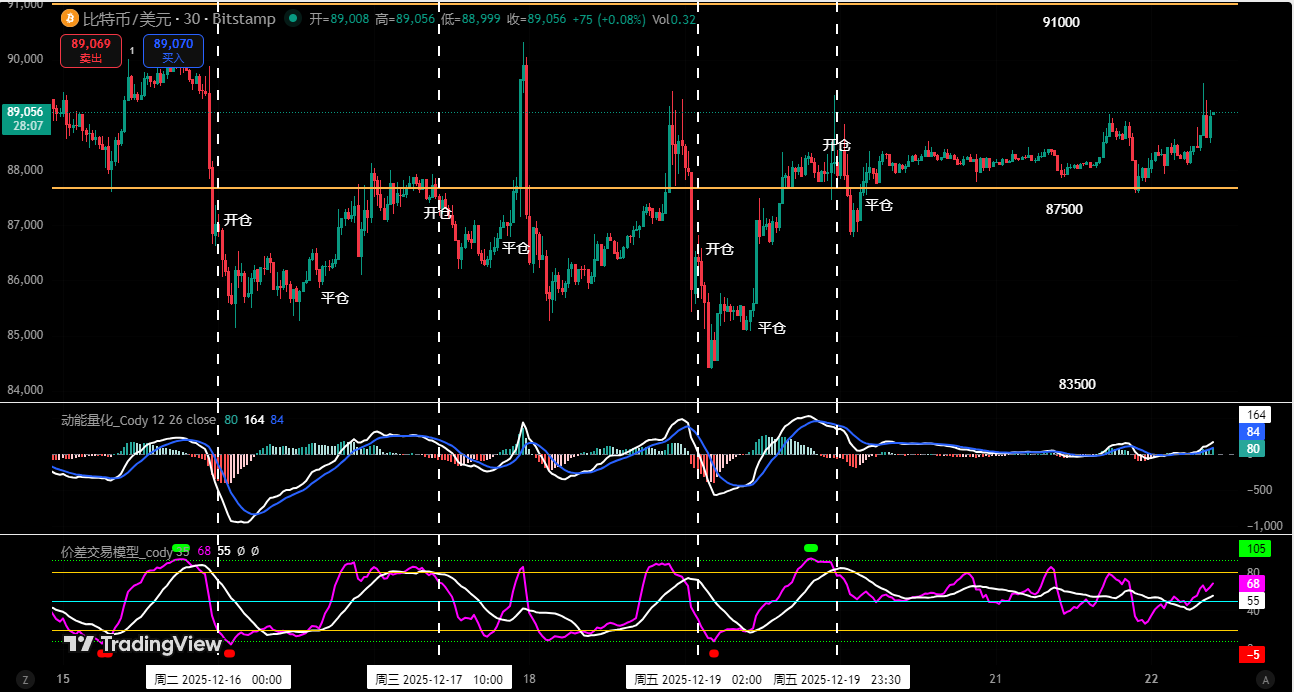
Figure 1

1. Transaction Details Summary:

2. Short-term Trading Review:

• First Transaction (Profit 0.73%): We strictly adhered to the idea of "effectively breaking through key points and going short顺势做空". When the trigger condition was met, the spread trading model simultaneously issued a top signal. Based on this, we decisively established a 30% short position and finally took profits when the price fell near the previous low area.

• Second and Third Transactions (Cumulative Profit 1.41%): Based on the operation mode of "selling short when rebounding to the core pressure area meets resistance". When the coin price hit the $87,500~$89,000 area and encountered resistance,叠加两个模型发出的共振信号, these two transactions were successfully completed.

• Fourth Transaction (Profit 0): The logic for opening this position was consistent with the previous two transactions. It must be特别强调 that in this transaction, we strictly executed the principle of "when the floating profit reaches 1%, immediately move the stop loss to the opening cost price", resulting in the transaction being closed at breakeven.

II. Quantitative Technical Analysis: Based on Multi-Model and Multi-Dimensional Operation

Combining last week's market operation, the author will conduct an in-depth analysis of the evolution of Bitcoin's internal structure using comprehensive multi-dimensional analysis models.

Bitcoin Weekly K-line chart: (Momentum Quantitative Model + Sentiment Quantitative Model)
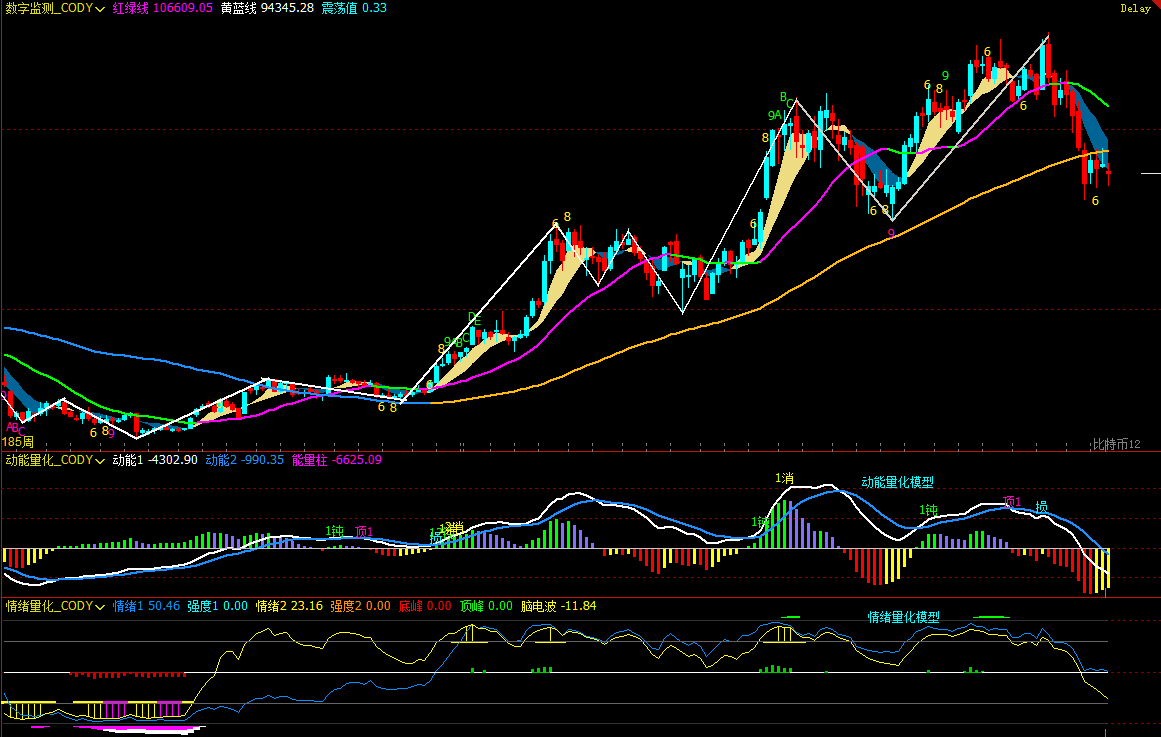
Figure 2

1. As shown in (Figure 2), analysis from the weekly chart:

Momentum Quantitative Model: After last week's adjustment, the two momentum indicator lines continue to run below the zero axis. Although the rebound in previous weeks prevented the negative momentum bars from expanding significantly, the current market structure is still weak, and we need to be警惕 of the risk of further release of adjustment pressure.

Momentum Quantitative Model Indicates: Coin price decline index: High

• Sentiment Quantitative Model: Blue sentiment line value 50.46, strength zero; yellow sentiment line value 23.16, strength zero, peak value is 0.

Sentiment Quantitative Model Indicates: Coin price pressure and support index: Neutral

• Digital Monitoring Model: The chart shows that the coin price has been below the bull-bear (yellow-blue line) dividing line for 5 weeks, increasing the probability of an effective break. Short-term bottom digital signals (above 9) have not yet appeared.

The above data预示: Bitcoin is in a downward trend, entering a bear market on the weekly level, beware of adjustment risks.

Bitcoin Daily K-line chart:
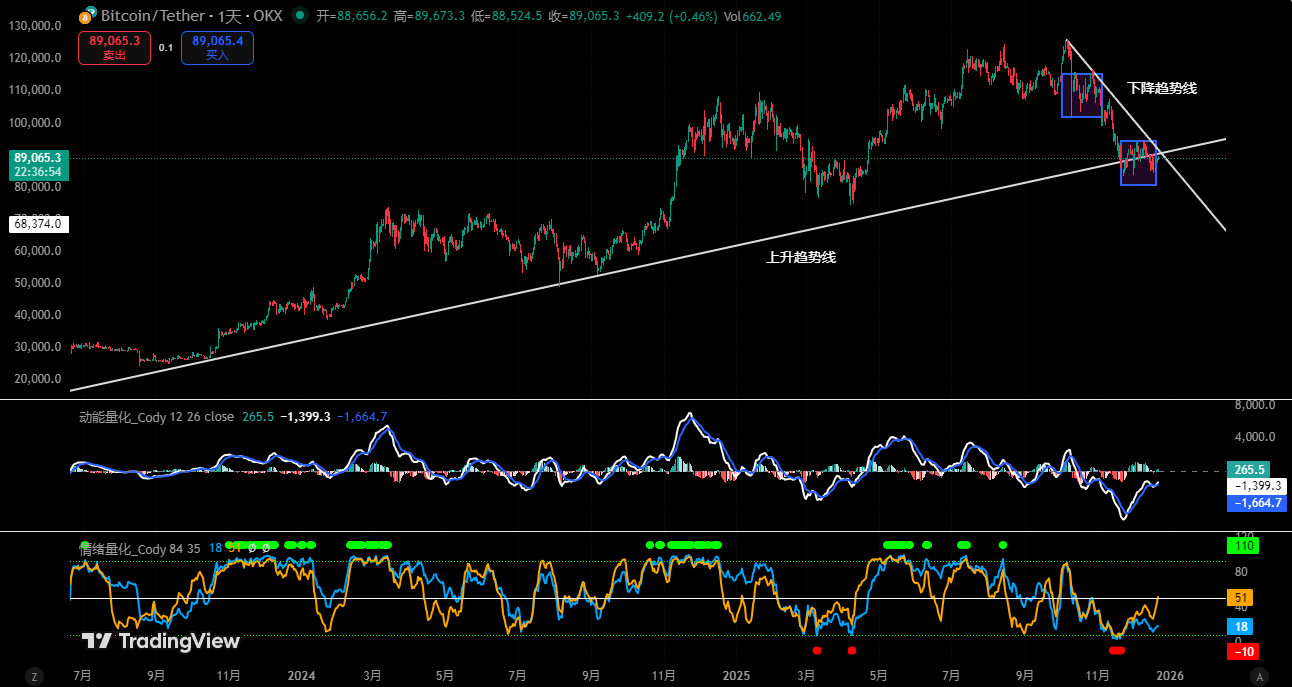
Figure 3

2. As shown in (Figure 3), analysis from the daily chart:

• Momentum Quantitative Model: In last week's行情, the two momentum lines below the zero axis went through a反复交叉 process of "golden cross—dead cross—golden cross", trading volume did not放大, positive momentum bar growth was not obvious.

Momentum Quantitative Model Indicates: Bulls and bears are fiercely contesting for market control, bullish momentum is weak.

• Sentiment Quantitative Model: After last week's daily close, blue sentiment line value 17, strength zero; yellow sentiment line value 45, strength zero.

Sentiment Quantitative Model Indicates: Pressure and support index: Neutral

The above data提示: The daily level is in a bear market, short-term market movements will still be反复.

III. This Week's Market Prediction (12.22~12.28)

1. The market is expected to mainly present a wide-range volatile pattern this week. The core observation interval is $89,500~$91,000. The outcome of the contest in this area will determine the short-term direction:

If effectively broken below: It will mean the adjustment intensity strengthens, the expected adjustment range will expand, and the cycle will相应延长.

If effectively held above: The market is expected to continue its volatile rebound, but the rebound space is expected to be relatively limited.

2. Core Pressure Levels:

• First Pressure Area: $89,500~$91,000 area

• Second Pressure Area: $93,000~$94,500 area

• Important Pressure Area: Around $97,000

3. Core Support Levels:

• First Support Level: $86,500~$87,500 area

• Second Support Level: $83,500~$84,500 area

• Important Support Level: Around $80,000.

IV. This Week's Operation Strategy (Excluding Sudden News Impact)(12.22~12.28)

1. Medium-term Strategy: Maintain a medium-term position (short) of about 65%.

2. Short-term Strategy: Use 30% of the position, set stop loss points, and look for "spread" opportunities based on support and pressure levels. (Using 30 minutes as the operation cycle).

3. Focus on observing the contest and outcome between bulls and bears over the $89,500~$91,000 area. To应对 the market行情, we have drafted two short-term operation plans, A/B:

Plan A: If this area is effectively held above:

• Open Position: If the coin price rebounds to the $93,000~$94,500 area and shows signs of resistance, establish a 30% short position.

• Risk Control: Short stop loss set above $96,000.

• Close Position: When the coin price falls to the $89,500~$91,000 area and shows resistance, close all short positions to take profits.

Plan B: If this area is effectively broken below:

• Open Position: If the coin price breaks below this area and is confirmed, establish a 30% short position.

• Risk Control: Stop loss set above $92,000.

• Close Position: When the coin price falls to the $83,500~$84,500 area and shows resistance, consider partially or fully closing the position to take profits.

V. Special Notes

1. When opening a position: Immediately set the initial stop loss level.

2. When profit reaches 1%: Move the stop loss to the opening cost price (breakeven point) to ensure principal safety.

3. When profit reaches 2%: Move the stop loss to the position of 1% profit.

4. Continuous Tracking: Thereafter, for every additional 1% profit the coin price makes, move the stop loss同步 by 1%, dynamically protecting and locking in existing profits.

(Note: The above 1% profit trigger threshold can be flexibly adjusted by investors according to their own risk preferences and标的 volatility.)

VI. This Week's Macro Outlook and Key Events (12.22~12.28|Christmas Week)

1. Christmas holiday compresses trading hours, liquidity significantly decreases

US stocks will close early on Wednesday and be closed all day Thursday this week. The holiday factor combined with year-end settlement results in overall lower market liquidity. Prices are more easily driven by sentiment and one-sided funds. Beware of "false breakouts" and amplified short-term fluctuations under low trading volume.

2. Fed Chair nomination expectations heat up, policy continuity becomes market focus

The market is watching whether Trump will announce the next Fed Chair nominee during the Christmas holiday. Currently, Kevin Hassett is seen as the领先 probability nominee, and his policy stance is considered偏向 "predictable gradual adjustment".

(If the nomination is announced, it will help stabilize interest rate expectations and risk appetite in the short term; if an unexpected candidate emerges, it may cause阶段性波动 in interest rates and the US dollar.)

3. US Q3 data finale, verifying the "soft landing" narrative

The revised US Q3 GDP, personal consumption expenditure, and core PCE data released on Tuesday will be used to confirm whether economic resilience and the inflation path are consistent with previous judgments.

(If the revisions are mild, the market can more easily maintain its pricing for next year's interest rate cut path; if there are significant upward revisions, it may重新抬升 long-term rates.)

4. Employment data as a marginal observation indicator at year-end

The initial jobless claims released on Wednesday, although not具有趋势性意义, remain an auxiliary signal for observing whether the labor market is loosening around the holidays.

(Currently more偏向 "stable rather than deteriorating", the impact on the market is expected to be limited.)

5. BOJ dynamics provide a reference for global liquidity

BOJ Governor Ueda's speech and the November unemployment rate data will continue to affect the market's judgment on the pace of Japan's monetary policy normalization.

(If yen fluctuations amplify, it may cause情绪扰动 to global risk assets, especially US stocks and crypto markets.)

Financial markets are changing rapidly, all market analysis and trading strategies need to be adjusted dynamically. All views, analysis models, and operation strategies involved in this article are derived from personal technical analysis, for personal trading log purposes only, and do not constitute any investment advice or operation basis. The market has risks, investment needs caution, DYOR.


Связанные с этим вопросы

QWhat is the core technical perspective on Bitcoin's medium-term trend according to the analyst?

AFrom a macro technical perspective, Bitcoin is in a period of repair and consolidation after breaking its long-term uptrend line (since late 2022). The price is under dual pressure from this broken long-term trendline and a recent downtrend line (from the October 2025 high). All upward moves are considered rebounds within a bearish structure until the price breaks above these two key trendlines with strong volume, which will be the ultimate basis for judging the medium-term directional choice of the market.

QWhat was the outcome of the trading strategy execution for the previous week (Dec 15-21)?

AThe trading strategy was strictly followed last week, resulting in four successful short-term operations with a cumulative realized return of 2.14%.

QWhat do the quantitative models (Momentum and Sentiment) on the weekly chart indicate about the current market structure?

AOn the weekly chart, the Momentum Quantitative Model shows both momentum indicator lines continue to run below the zero axis, indicating a high probability of further price decline. The Sentiment Quantitative Model shows neutral pressure and support indices. The Digital Monitoring Model indicates Bitcoin has been below the bull-bear dividing line for 5 weeks, increasing the probability of a valid breakdown. The data suggests Bitcoin is in a downtrend, has entered a bear market on the weekly level, and investors should be wary of adjustment risks.

QWhat are the key support and resistance levels to watch for Bitcoin's price in the upcoming week (Dec 22-28)?

AThe key resistance levels are: First resistance zone: $89,500 - $91,000; Second resistance zone: $93,000 - $94,500; Major resistance near $97,000. The key support levels are: First support zone: $86,500 - $87,500; Second support zone: $83,500 - $84,500; Major support near $80,000.

QWhat major macroeconomic events are highlighted for the upcoming week (Christmas Week, Dec 22-28) that could impact the market?

AKey events include: 1. Reduced trading hours and significantly lower liquidity due to the Christmas holiday. 2. Growing expectations for the Fed Chair nomination, with Kevin Hassett being a probable candidate, which could impact interest rate expectations and risk sentiment. 3. The release of final U.S. Q3 GDP, PCE, and core PCE data to confirm the 'soft landing' narrative. 4. U.S. initial jobless claims data as a marginal labor market indicator. 5. Speeches by the Bank of Japan Governor and Japan's unemployment rate data, which could affect global liquidity and risk asset sentiment.

Похожее

Fed's Internal Doves Flock to Hawkish Stance, Warsh's Debut "Between a Rock and a Hard Place"

U.S. Federal Reserve officials who previously advocated for rate cuts, including Governor Christopher Waller, have recently shifted their stance, with many now not ruling out the possibility of future rate hikes. This sets a challenging stage for new Fed Chair Kevin Warsh's first policy meeting. Appointed by President Trump based on his dovish views, Warsh now faces a committee where the debate has pivoted from "when to cut" to "whether to hike," driven by persistent inflation above 3%, a strong labor market, and supply-side pressures from AI infrastructure demands and geopolitical tensions. Key figures illustrate the shift. Governor Waller, once concerned about employment, now says data has pushed him toward considering rate increases. Even moderate voices like Governor Lisa Cook, while expecting inflation to ease, have indicated readiness to hike if it fails to do so. Long-time hawks such as regional Fed presidents Beth Hammack, Lorie Logan, and Neel Kashkari have grown more vocal, arguing that the real policy rate is effectively falling and that action may soon be needed. The upcoming Fed meeting is expected to keep rates steady but will likely remove the "easing bias" from its statement, signaling a neutral stance between cuts and hikes. The quarterly "dot plot" is anticipated to show most officials projecting no cuts this year, with some potentially indicating hikes. Chair Warsh, a critic of the Fed's reliance on forward guidance like the dot plot, must navigate communicating this pivot using tools he has questioned, all while steering policy in a direction counter to the preferences of the president who appointed him. The consensus suggests the Fed's next move could well be a rate increase.

marsbit56 мин. назад

Fed's Internal Doves Flock to Hawkish Stance, Warsh's Debut "Between a Rock and a Hard Place"

marsbit56 мин. назад

The Trillion-Yuan Market Cap 'Yi Zhong Tian': Who is the True Value King?

The article analyzes the three leading Chinese optical module companies, collectively nicknamed "Yi Zhong Tian": Xinyisheng, Zhongji Innolight, and TFC Optical Communication. It evaluates their "cost-performance" not by current stock price, but through three lenses: PEG ratio (growth vs. valuation), earnings quality, and premium/discount for certainty. Xinyisheng shows the most attractive PEG ratio and high profitability, but its valuation reflects discounts for risks like high customer concentration and reliance on overseas markets. Zhongji Innolight, the most expensive, commands a premium for its market leadership, dominant share in key products like 800G/1.6T modules, and higher earnings certainty, though it faces geopolitical risks. TFC Optical, as an upstream component supplier ("water seller"), has the highest gross margin and bets on the long-term CPO/NPO architecture trend, but trades at a high valuation with more stable, less explosive growth. The core argument is that while these companies dominate module assembly, the true profit pool and technological moat lie upstream in laser and switch chips, currently controlled by U.S. firms like Lumentum and Coherent. The long-term "cost-performance" for these Chinese leaders hinges on whether the domestic industry, exemplified by companies like Yuanjie Technology, can successfully move up the value chain into high-power laser chips. Otherwise, their high growth may remain confined to the lower-margin assembly segment.

marsbit1 ч. назад

The Trillion-Yuan Market Cap 'Yi Zhong Tian': Who is the True Value King?

marsbit1 ч. назад

Has the Crypto Market Bottomed? Here's What Institutions Think

The crypto market is in a period of significant debate, with leading institutions offering differing views on whether a bottom has been reached. Three prominent firms have published detailed analyses: * **Galaxy Digital** argues Bitcoin has **not yet bottomed**. Their analysis of 13 historical indicators across six dimensions (valuation, profit-taking, miner pressure, etc.) shows only four are fully met. They project a potential bottom range between $30k and $54k. * **NYDIG** states a bottom is **possible but not likely**. While metrics are close to historic bear market extremes, they note the absence of a classic panic-selling event. They also suggest increased institutional adoption may have structurally altered the market cycle, potentially leading to a shallower downturn. * **Standard Chartered Bank** asserts the **bottom has already occurred** at around $59k. They cite two key factors: potential US-Iran diplomatic progress and the anticipated SpaceX IPO, which they believe absorbed capital and caused ETF selling pressure that is now subsiding. They forecast a year-end price target of $100k. Despite the surface-level disagreement, the reports share critical common ground more valuable for long-term investors: 1. All three believe the market bottom will form **within this year**. 2. All agree the current price is **closer to the bottom than to previous highs**. 3. All maintain a **bullish long-term outlook** for Bitcoin and a new cycle. The core takeaway is that while the exact bottom price ($40k, $50k, or $60k) is debated, the consensus is that a bottom is imminent. For long-term holders, the primary focus should not be pinpointing the absolute low, but on the future potential for prices to reach $100k, $200k, or higher. The fundamental thesis for Bitcoin—sovereign debt accumulation, inflation, declining trust in centralized institutions, global digitization, and improved accessibility—remains intact and is arguably strengthening. The overall landscape is viewed as more favorable than in previous crypto winters.

marsbit1 ч. назад

Has the Crypto Market Bottomed? Here's What Institutions Think

marsbit1 ч. назад

The 'Chip' Challenge and Breakthroughs in China's Optical Industry Chain

China's Photonics Industry: Bottlenecks and Breakthroughs In the global AI race, computing chips dominate the narrative, but the underlying bottleneck increasingly defining the scale of AI clusters is light—or more specifically, optical connectivity. Optical modules, which translate electrical signals to light and vice versa, are crucial for connecting thousands of GPUs in AI data centers, preventing data congestion and ensuring efficient model training. High-speed modules (800G, 1.6T) are now standard, with performance hinging on advanced DSP (Digital Signal Processor) chips. This is where a critical dependency lies. Two US giants—Marvell and Broadcom—collectively dominate over 90% of the high-end DSP chip market. Chinese optical module leaders like Zhongji Innolight and Eoptolink rely on these chips to manufacture modules for overseas AI customers, primarily in North America. While this creates a supply chain vulnerability, complete decoupling is difficult. Marvell derives over half its revenue from Greater China, and the US firms depend on Chinese partners for chip packaging and optical components. The risk from laser chips (e.g., from Lumentum), another key component, is considered more manageable due to multiple global suppliers and faster progress in domestic alternatives from companies like YOFC and Accelink. To mitigate risks, China's industry is pursuing a multi-pronged strategy: diversifying supply chains and locking in long-term orders; fostering a domestic market ecosystem to adopt homegrown DSPs from firms like Huawei HiSilicon and CETC; accelerating R&D in high-speed DSPs and advanced packaging; and investing in next-gen technologies like silicon photonics and Co-Packaged Optics (CPO) to reduce reliance on discrete DSPs. The ultimate solution lies not in short-term博弈 but in persistent advancement of domestic high-end chip R&D and manufacturing. While challenges remain in performance, certification, and ecosystem building, China's vast domestic market and manufacturing base provide a crucial buffer, buying time for the industry to achieve greater technological independence.

marsbit1 ч. назад

The 'Chip' Challenge and Breakthroughs in China's Optical Industry Chain

marsbit1 ч. назад

Торговля

Спот
Фьючерсы

Популярные статьи

Как купить MASK

Добро пожаловать на HTX.com! Мы сделали приобретение Mask Network (MASK) простым и удобным. Следуйте нашему пошаговому руководству и отправляйтесь в свое крипто-путешествие.Шаг 1: Создайте аккаунт на HTXИспользуйте свой адрес электронной почты или номер телефона, чтобы зарегистрироваться и бесплатно создать аккаунт на HTX. Пройдите удобную регистрацию и откройте для себя весь функционал.Создать аккаунтШаг 2: Перейдите в Купить криптовалюту и выберите свой способ оплатыКредитная/Дебетовая Карта: Используйте свою карту Visa или Mastercard для мгновенной покупки Mask Network (MASK).Баланс: Используйте средства с баланса вашего аккаунта HTX для простой торговли.Третьи Лица: Мы добавили популярные способы оплаты, такие как Google Pay и Apple Pay, для повышения удобства.P2P: Торгуйте напрямую с другими пользователями на HTX.Внебиржевая Торговля (OTC): Мы предлагаем индивидуальные услуги и конкурентоспособные обменные курсы для трейдеров.Шаг 3: Хранение Mask Network (MASK)После приобретения вами Mask Network (MASK) храните их в своем аккаунте на HTX. В качестве альтернативы вы можете отправить их куда-либо с помощью перевода в блокчейне или использовать для торговли с другими криптовалютами.Шаг 4: Торговля Mask Network (MASK)С легкостью торгуйте Mask Network (MASK) на спотовом рынке HTX. Просто зайдите в свой аккаунт, выберите торговую пару, совершайте сделки и следите за ними в режиме реального времени. Мы предлагаем удобный интерфейс как для начинающих, так и для опытных трейдеров.

737 просмотров всегоОпубликовано 2024.04.09Обновлено 2026.06.02

Как купить MASK

Обсуждения

Добро пожаловать в Сообщество HTX. Здесь вы сможете быть в курсе последних новостей о развитии платформы и получить доступ к профессиональной аналитической информации о рынке. Мнения пользователей о цене на MASK (MASK) представлены ниже.

活动图片