Solana Staking ETF Moves Closer To SEC Approval After Key Filing

bitcoinistОпубликовано 2025-10-09Обновлено 2025-10-09

Введение

Bitwise Asset Management has updated its proposed Solana exchange-traded fund (ETF) to explicitly include “Staking” in the fund’s name and...

Trusted Editorial content, reviewed by leading industry experts and seasoned editors. Ad Disclosure

Bitwise Asset Management has updated its proposed Solana exchange-traded fund (ETF) to explicitly include “Staking” in the fund’s name and disclosed a 0.20% unitary sponsor fee—one of the lowest headline fees yet seen for a US crypto ETF. Bloomberg’s James Seyffart flagged the amendment late Wednesday, writing: “NEW: Bitwise files an update to their Solana ETF filing to include Staking in the name and provides the fee. Fee will be 0.20%.”

In follow-up posts, Seyffart added that “no fee for the first 3 months and for the first $1 billion in AUM [assets under management]” would apply—an aggressive launch incentive mirroring the fee-war playbook that helped turbocharge spot bitcoin ETFs at the start of the year. Eric Balchunas, his colleague at Bloomberg, underscored the move’s competitiveness: “Bitwise not playing around, plans to charge just 0.20% for their spot Solana ETF.”

Solana Staking ETF Launch Date Remains Unclear

The amendment signals that issuers and the Securities and Exchange Commission have narrowed outstanding issues on the structure of spot Solana products that incorporate staking, a feature unique to proof-of-stake assets. Earlier in the year, the SEC asked prospective Solana ETF sponsors to submit updated S-1 registration statements—widely interpreted as a pre-launch step once substantive policy questions are settled.

Timing remains the key variable. The US government shutdown that began on October 1 has forced the SEC onto skeleton staffing, slowing most non-urgent reviews and stalling a broad slate of securities registrations. With more than 90% of the SEC’s staff furloughed, routine offering and listing processes are largely paused—an overhang that could push back crypto ETF effective dates even as the paperwork advances. As Seyffart put it when asked whether a shutdown would delay approval: “Yes. I believe so.”

Even with that backdrop, Bitwise’s pricing telegraphs a confident, bare-knuckle approach to market share. A 20-basis-point fee places the proposed Solana Staking ETF at or below the lower end of the fee spectrum that helped bitcoin ETFs achieve mass adoption, and it lands amid a broader “fee-first” arms race that has repeatedly proven decisive in ETFs’ opening months. Balchunas has long argued that “low fees have an almost perfect record in attracting investors,” a pattern that crypto ETPs have closely followed.

What happens next will hinge on two tracks. Procedurally, the SEC must allow updated S-1s to go effective before trading can begin; practically, the shutdown will dictate when staff can finalize those reviews. Strategically, Bitwise’s decision to enshrine staking in the fund’s name and to lead with an ultra-low fee sets the competitive tone for rival Solana filings, and—once Washington reopens—positions the product to capitalize on pent-up demand the moment the window clears.

In parallel to Bitwise, other spot SOL issuers on the SEC’s docket include VanEck, 21Shares, and Canary—each facing final 240-day decision dates on October 16, 2025—alongside Grayscale’s proposed conversion of its Solana trust, which carries an earlier October 10, 2025 deadline. Franklin Templeton’s final date is November 14, 2025, Fidelity’s is December 5, 2025, and an Invesco Galaxy product runs to April 16, 2026. These dates reflect the SEC’s 19b-4 clock that began when Cboe first filed to list the SOL ETFs; S-1 effectiveness would still be required for trading to commence.

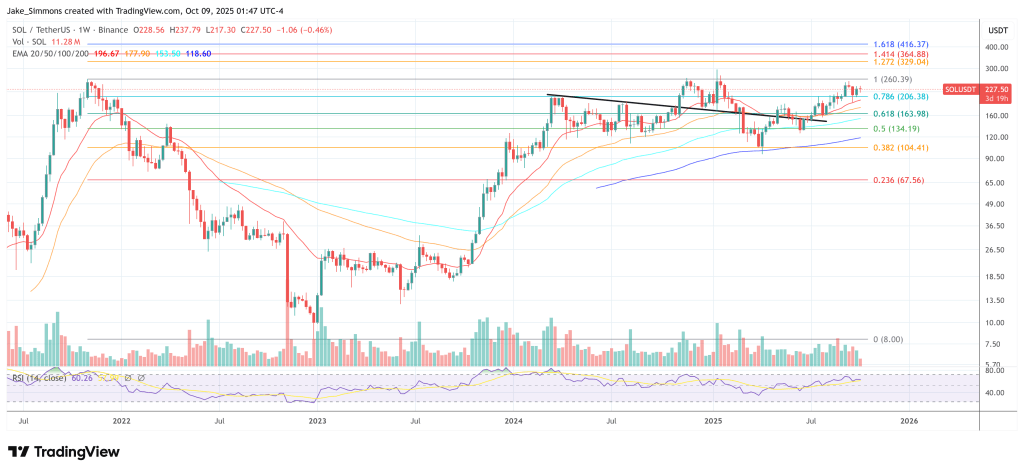
At press time, SOL traded at $227.
Solana price
SOL remains above the 0.786 Fib, 1-week chart | Source: SOLUSDT on TradingView.com
Featured image created with DALL.E, chart from TradingView.com
Editorial Process for bitcoinist is centered on delivering thoroughly researched, accurate, and unbiased content. We uphold strict sourcing standards, and each page undergoes diligent review by our team of top technology experts and seasoned editors. This process ensures the integrity, relevance, and value of our content for our readers.

Jake Simmons has been a Bitcoin enthusiast since 2016. Ever since he heard about Bitcoin, he has been studying the topic every day and trying to share his knowledge with others. His goal is to contribute to Bitcoin's financial revolution, which will replace the fiat money system. Besides BTC and crypto, Jake studied Business Informatics at a university. After graduation in 2017, he has been working in the blockchain and crypto sector. You can follow Jake on Twitter at @realJakeSimmons.

Похожее

6 Questions to Understand the Business Trends of AI

The AI industry has entered its "summer" phase, according to a six-dimensional scoring framework assessing its development cycle. Each dimension—narrative vs. delivery, system connectivity, delivery capability, ROI rationalization, common industry trends, and capital environment—scores 1 point, totaling 6 points. This places the industry firmly in summer (5-7 points), characterized by a coexistence of grand promises and tangible deliverables, with increasing pressure to demonstrate value and profitability. Key signals mark this shift. ByteDance's Doubao launched paid subscriptions, while OpenAI introduced an advertising platform. These moves are driven by dual forces: immense cost pressures from scaling user bases and massive compute requirements, and the maturation of commercial opportunities. Major players like Anthropic report explosive growth, highlighting AI's transition into core productivity infrastructure. For businesses, the path forward involves three strategic steps. First, identify a small, high-impact use case to quickly demonstrate a closed-loop value proposition, such as automating customer service or content generation. Second, systematically replicate successful pilots across the organization by standardizing processes, building shared AI capabilities, and aligning talent, incentives, and leadership. Finally, move beyond simply adding AI to existing workflows and undertake systemic reconstruction—redesigning processes for parallel AI-human collaboration, implementing real-time dashboards, and establishing automated trigger chains. The era where storytelling alone secured funding is over. The focus has shifted to delivering measurable efficiency gains, cost savings, and new revenue streams, as evidenced by real-world implementations in companies like Semir, Anta, and Midea. Success now depends on starting with a focused proof point, scaling it organization-wide, and ultimately allowing AI to redefine operational paradigms.

marsbit53 мин. назад

6 Questions to Understand the Business Trends of AI

marsbit53 мин. назад

US Government Lifts Ban on Crypto Perpetual Contracts for the First Time: What Does It Mean for the Market?

The U.S. Commodity Futures Trading Commission (CFTC) has issued guidance permitting 24/7 trading and clearing for crypto asset derivatives, effectively opening the U.S. market to crypto perpetual contracts for the first time. This move ends the previous ban and allows American individuals and institutions to trade these instruments around the clock. Direct beneficiaries include Kalshi, which received approval to list a Bitcoin perpetual contract; Coinbase, now the first CFTC-regulated futures commission merchant for U.S. clients to access global crypto derivatives; and CME, which will transition its Bitcoin futures and options to 24/7 trading. The CFTC emphasized this is a specific allowance for crypto assets, noting that traditional commodities like agriculture may not be suitable for non-stop trading. It also requires platforms to undergo case-by-case reviews for compliance and risk management. Industry leaders like Michael Saylor and Brian Armstrong praised the decision for integrating Bitcoin into capital markets and granting U.S. users access to a major global market segment. However, consumer advocacy group Better Markets criticized the CFTC for allegedly neglecting investor protection and favoring the industry it regulates. Other platforms like Kraken have announced plans to launch regulated perpetual futures for the U.S. market. The policy shift is expected to redirect significant liquidity and institutional participation to the newly accessible U.S. crypto derivatives landscape.

Odaily星球日报12 ч. назад

US Government Lifts Ban on Crypto Perpetual Contracts for the First Time: What Does It Mean for the Market?

Odaily星球日报12 ч. назад

Торговля

Спот
Фьючерсы

Популярные статьи

Обсуждения

Добро пожаловать в Сообщество HTX. Здесь вы сможете быть в курсе последних новостей о развитии платформы и получить доступ к профессиональной аналитической информации о рынке. Мнения пользователей о цене на SOL (SOL) представлены ниже.

活动图片