政府停摆、就业停滞:加密市场会否借流动性东风再次腾飞?

marsbitОпубликовано 2025-10-04Обновлено 2025-10-05

美国政府停摆的影响

Coinbase对10月份加密市场的展望在战术层面上是看涨的:我们认为美元疲软、短期全球流动性增加以及美联储倾向于谨慎降息的政策倾向,将为加密货币市场创造有利条件。除非出现意外的鹰派言论,否则我们认为这些因素将增加BTC引领上涨的可能性,直至11月,届时流动性逆风可能会发挥作用。

美国政府关门对加密货币意味着什么?美国目前处于部分政府关门状态,这可能会推迟美联储制定政策所依赖的一些关键经济统计数据的发布。由于资金短缺,美国劳工统计局 (BLS) 和经济分析局 (BEA) 等机构将暂停数据收集,并推迟发布主要数据——包括月度就业报告和消费者物价指数 (CPI)——直至资金恢复。

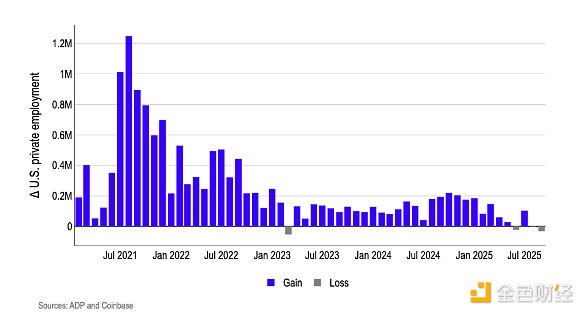
在没有官方数据发布的情况下,我们认为市场将依赖ADP私营部门就业数据等私人指标来衡量未来降息预期。ADP数据显示,在经历了多年减速(相比2021年每月新增超过百万就业岗位)之后,目前的净就业岗位新增量基本为零(图1)。我们认为,菲利普斯曲线逻辑意味着,当前就业疲软会缩短工资主导型服务业通胀的通道,滞后时间约为10个月,这降低了先发制人地放松政策的成本,相对于非线性劳动力衰退的尾部风险而言。

我们的观点:政府停摆引发的数据不确定性,叠加私人部门招聘陷入停滞,使得市场对美联储将采取限制性更低的政策路径这一预期更趋乐观。此外还需注意,近期多重因素共同作用,导致加密货币市场出现暂时性流动性缺口,具体包括:(1)美国财政部对其一般账户余额的补充(目前余额已接近目标水平,超过 8000 亿美元);(2)季度末与月末资金流动;(3)新加坡 TOKEN 2049 大会带来的 “会议效应”。随着这些影响因素的消退,短期内有望对市场价格走势起到积极推动作用。

图1. 美国私营部门就业月度变化处于2023年以来的最低水平
美国政府停摆

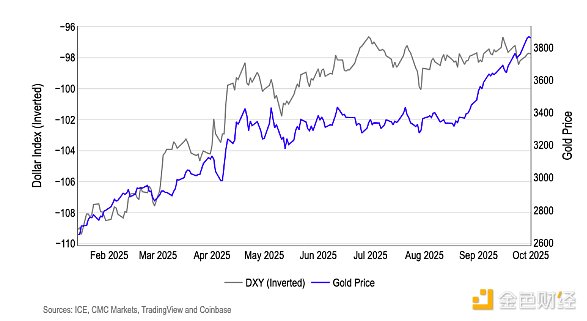
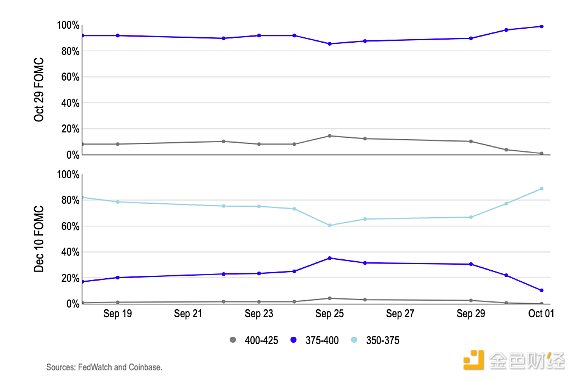
我们认为利率市场已经消化了这一转变——30天期联邦基金期货目前反映,年底前两次降息25个基点的可能性为87%——跨资产信号也证实了实际利率下调、美元走软的机制,这对加密货币有利(图表2)。目前,逐次FOMC会议定价集中在10月底3.75-4.00%的目标区间,到12月将趋向3.50-3.75%。与此同时,美元走弱,黄金价格创下历史新高——这表明实际利率预期正在缓和,以及更广泛的“保值”需求正在涌现(图表3)。我们认为,这种组合将放松美元金融环境,并降低风险资产的现金收益竞争,这应该会利好加密货币。

图 2. 年底前两次降息 25 个基点的可能性达到 87%。
美国政府停摆

图 3. 美元走软,黄金创历史新高

美国政府停摆

我们可以不要再谈论黄金了吗?

简而言之,答案是否定的,但市场似乎在费力解释为何黄金在9月份突破历史新高,而比特币的价格走势却在上个月萎靡不振。部分原因在于,尽管比特币在高通胀时期的表现并不稳定,但许多市场参与者和媒体评论员仍然执着于将比特币视为类似黄金的通胀对冲工具。事实上,比特币往往起到防范过度货币发行的作用,这与通货膨胀并不完全相同。这也解释了为什么比特币经常受益于全球流动性注入。

9月份,受全球多家央行降息以及市场担忧(1)美国政府关门和(2)美联储独立性可能受损的影响,金价飙升。(话虽如此,尽管SPDR黄金ETF上个月吸引了42亿美元的资金,但美国现货比特币ETF仍获得了35亿美元的净流入。)然而,我们认为,这种表现差异并非源于机构投资者情绪的差异,而更多的是因为比特币在7月和8月引领了价格走势。因此,比特币在技术反弹时持续面临抛售压力,而流动性则因上述原因被吸出市场。

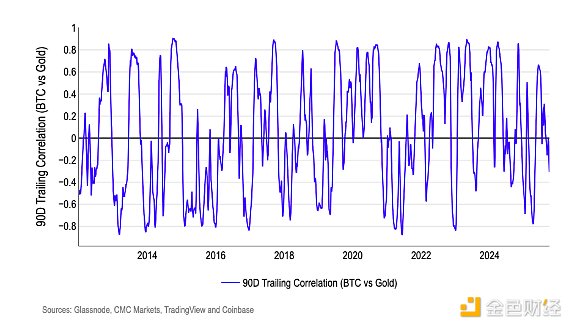
从数据角度来看,我们认为单凭黄金指标并不能成为比特币的有力指标。自2013年以来,BTC与黄金之间的90天滚动相关性已在两个极端(-0.8至+0.8)之间波动数十次,存在短期聚集性波动,但缺乏长期持续性,表明平均联动性极弱(图表4)。我们认为,正向联动的共同驱动因素是流动性增强:当实际利率下降且美元走软时,这两种资产往往会吸收市场上过剩的流动性。相反,当黄金因避险情绪上涨,而美元走强且流动性收紧(正如最近几周的情况)时,作为高贝塔风险资产的BTC通常会脱钩,甚至反向波动。

我们的观点:实际上,我们认为流动性是比特币最可靠的宏观信号,这一点已由我们定制的M2全球流动性指数与比特币在过去三年中一致的约 0.9的相关性得到证明。

图 4. 比特币与黄金过去 90 天相关性
美国政府停摆

Похожее

Tiger Research: On-Chain Risk Operators, The Market Cap Gap Between 147 Trillion and 70 Billion

This report by Tiger Research examines the evolution of risk management in decentralized finance (DeFi) lending. It highlights a power shift from protocol developers to specialized professional risk operators who manage on-chain capital. The era of protocols and community governance solely dictating DeFi lending is ending. A new professional asset management layer has emerged. While the sector is nascent, capital and distribution channels are rapidly consolidating around top risk operator teams, whose past performance is now a key criterion for institutional entry. The industry's development, accelerated by modular infrastructures like Morpho, has led to a clear division of labor mirroring traditional finance: distribution channels (e.g., exchanges), strategy/risk management (the risk operators), and product infrastructure/asset custody (smart contract protocols). This structure lowers the entry barrier for traditional institutions. Currently, the total value managed by risk operators is approximately $70 billion, dominated by a few leading teams like Steakhouse (RWA focus), Sentora (AI models), and Gauntlet (crisis management). Competition now centers on collateral standards, distribution access, and crisis response capabilities. The report outlines three primary entry paths for institutions: 1) **Distribution Model**: Leveraging external risk operators as backend service providers (common for exchanges). 2) **Asset Supply Model**: Onboarding real-world assets to DeFi as collateral. 3) **Independent Operator Model**: Building an in-house team to become a risk operator (e.g., Bitwise). The core opportunity lies in the strategy/risk management layer, where traditional financial institutions can leverage their existing expertise in due diligence and risk assessment without deep technical development. A vast opportunity gap exists: the global traditional asset management industry manages ~$147 trillion, while the entire DeFi sector is only ~$800 billion, with the risk operator niche at ~$70 billion. This disparity signifies immense growth potential. Once robust risk frameworks and clearer regulations are established, even a minor allocation from traditional markets could trigger exponential DeFi growth. Early movers who help build these foundational systems will gain significant rule-setting influence and first-mover advantages.

marsbit6 мин. назад

Tiger Research: On-Chain Risk Operators, The Market Cap Gap Between 147 Trillion and 70 Billion

marsbit6 мин. назад

Interview with Circle's Chief Economist: USDC's Entry into Hyperliquid Benefits Circle and HYPE, Stablecoins Are Becoming Marginal Buyers of U.S. Treasuries

In an interview with Circle's Chief Economist Gordon Liao, the conversation covers the strategic significance of USDC replacing USDH as the reference asset on the decentralized perpetual exchange Hyperliquid. This shift, facilitated by Coinbase as the reserve manager and Circle providing technical infrastructure, aims to capture net interest income for the platform, with 90% of reserve earnings directed back to Hyperliquid for HYPE token buybacks. Liao discusses how stablecoins like USDC, with their substantial on-chain settlement volumes (e.g., $21 trillion in Q1 2026), are emerging as marginal buyers of U.S. Treasuries, concentrating on short-term debt and effectively reducing the weighted duration of the market, which may provide underlying support for long-term rates. The dialogue also explores the evolving nature of stablecoins as both a medium of exchange and a vehicle for capital and collateral liquidity. Additionally, the panel touches on the CLARITY Act's legislative progress, noting compromises around "activity-based rewards" and remaining hurdles like ethics concerns. On AI, there's debate over value capture, with predictions that distribution and application layers, rather than foundational model companies like OpenAI, will accrue most value. Regarding the bond market, Liao attributes the rise in 30-year yields primarily to an increased term premium (around 80 bps) driven by supply-demand dynamics, including fiscal expansion and changing investor demand, rather than expectations of Fed rate hikes.

marsbit12 мин. назад

Interview with Circle's Chief Economist: USDC's Entry into Hyperliquid Benefits Circle and HYPE, Stablecoins Are Becoming Marginal Buyers of U.S. Treasuries

marsbit12 мин. назад

Gemini 3.5 is Here! Tonight, Google Overtakes Google

Gemini 3.5 Launches: Google Renders Itself Obsolete at I/O 2026 At Google I/O 2026, the company unveiled a transformative suite of AI advancements headlined by three major releases. First, **Gemini Omni**, a true "omnimodal" model, can generate high-quality, coherent videos from any combination of text, image, audio, or video inputs, maintaining character consistency and physical logic across iterative edits. Second, the new flagship **Gemini 3.5 Flash** was introduced, decisively outperforming the previous Gemini 3.1 Pro on key benchmarks for coding, agent tasks, and multimodal reasoning. It is also significantly faster than competitors. This model powers the upgraded **Antigravity 2.0**, an independent Agent development platform that demonstrated the ability to orchestrate 93 sub-agents to build a functional operating system from scratch in just 12 hours. Third, **Gemini Spark** debuted as a personal, always-on AI agent. Running 24/7 in the cloud and integrated with Google Workspace, it can autonomously execute complex multi-step tasks like drafting emails, managing schedules, and planning events by accessing apps like Gmail, Docs, and Sheets. These releases collectively mark a significant leap, moving AI beyond simple generation towards autonomous understanding, decision-making, and task execution, signaling rapid progress on the path toward more advanced AI systems.

链捕手51 мин. назад

Gemini 3.5 is Here! Tonight, Google Overtakes Google

链捕手51 мин. назад

Cryptocurrency Asset Recovery: A Lucrative, Low-Profile Business

Summary: The article explores the growing business of cryptocurrency asset recovery, highlighting it as a quiet but profitable niche. While many assume recovery involves dramatic hacking or theft cases, the most common issues are everyday operational errors: sending crypto to the wrong blockchain network, forgetting transaction memos/Tags, hardware wallet failures, incorrect seed phrase backups, and frozen centralized exchange accounts. As cryptocurrency adoption expands to less technical users, the volume of such costly mistakes increases. This creates a genuine, recurring demand for professional recovery services. The article notes a paradox: while the technology emphasizes user-controlled assets, the complexity often necessitates expert intermediaries, similar to traditional financial services. However, the field is fraught with risks, including middlemen and secondary scammers who prey on desperate users. Truly professional teams avoid promising guaranteed results, instead focusing on diagnosing the specific problem—whether it's a technical wallet issue, an exchange compliance matter, or an unsolvable private key loss. The author concludes by noting the professionalization of this market and announces a partnership with a specialized recovery team, offering readers a preliminary assessment for issues like wrong-chain deposits, lost access, or frozen accounts, while emphasizing ethical practices and realistic expectations.

marsbit59 мин. назад

Cryptocurrency Asset Recovery: A Lucrative, Low-Profile Business

marsbit59 мин. назад

Cryptocurrency Asset Recovery: A Lucrative, Under-the-Radar Business

Cryptocurrency Asset Recovery: A Lucrative, Low-Key Business The article discusses the burgeoning business of cryptocurrency asset recovery, driven by common yet often crippling user errors rather than sensational hacking incidents. Key problem areas include selecting the wrong blockchain for a deposit, omitting required memos/tags when sending to exchanges, physical wallet device failures, errors in backing up or modifying seed phrases, and issues with frozen accounts or withdrawals on centralized exchanges. As cryptocurrency adoption grows among mainstream users—including retail investors and businesses—these operational mistakes increase. The decentralized nature of crypto places full responsibility for asset security on users, who may lack the technical expertise to navigate complex chains, wallets, and protocols. Even centralized exchanges, while offering some support, often present users with cumbersome, non-intuitive processes for resolving issues. This creates a persistent and growing demand for professional recovery services. However, the field is rife with risks, including middlemen without real expertise and outright scammers who promise guaranteed recovery, request sensitive information like private keys, or charge advance "fees." Legitimate service providers typically avoid absolute guarantees, as recovery feasibility depends heavily on the specific technical or administrative circumstances of each case. The business is evolving from an informal market into a professional one requiring a combination of technical analysis, exchange/platform communication, and legal/compliance knowledge. The article concludes by noting the author's partnership with a professional recovery team, offering preliminary assessments for issues like incorrect deposits, wallet access problems, or exchange account freezes, with an emphasis on realistic evaluation over promises.

链捕手1 ч. назад

Cryptocurrency Asset Recovery: A Lucrative, Under-the-Radar Business

链捕手1 ч. назад

Торговля

Спот
Фьючерсы
活动图片