Shiba Inu Partners With Solana-Backed Arlo For Shibarium Security

bitcoinistОпубликовано 2025-10-01Обновлено 2025-10-01

Введение

Shiba Inu said it is partnering with Arlo, an AI security and token-analytics startup backed by the Solana Foundation, to...

Trusted Editorial content, reviewed by leading industry experts and seasoned editors. Ad Disclosure

Shiba Inu said it is partnering with Arlo, an AI security and token-analytics startup backed by the Solana Foundation, to bring Arlo’s “intelligence engine” to Shibarium, the project’s Layer-2 network. In an announcement on X, the official Shiba Inu account welcomed Arlo to the ecosystem, adding that the two teams are “teaming up to enhance the security of Shibarium through artificial intelligence.”

Shiba Inu Brings Solana Grant Winner To Shibarium

Arlo framed the collaboration as a retail-safety initiative that will extend its live beta—currently available on Solana and Base—to Shibarium. “ARLO has teamed up with Shiba Inu to launch our AI intelligence engine on Shibarium to bring retail safety to Shibarium,” the project wrote, describing a system that can “analyze 100+ data points for any Shibarium token, including on-chain analysis, whale movements, token audits & safety, market trends, risk signals, & influencer activity.”

The team also reiterated that “STAKE-TO-ACCESS [is] coming soon,” and clarified in a follow-up that Shibarium support is “not yet live” but “will be launching… soon,” while the tool remains in open beta on Solana and Base.

Arlo’s positioning as a Solana Foundation grant recipient is independently corroborated by recent press materials and its website, which highlight the project as “backed by the Solana Foundation” and identify Arlo as an AI token-analysis tool that has received Foundation support. A September press release noted Arlo as “the only AI token analysis tool to receive a Solana Foundation grant,” and the company’s site presents the same backing alongside its Solana contract address.

While neither party published technical documentation alongside the posts, the stated scope suggests Arlo intends to provide a machine-learning overlay for token due diligence on Shibarium—surfacing heuristics around liquidity quality, ownership distribution, trading anomalies, and cross-platform sentiment—areas where retail users frequently struggle to separate legitimate launches from high-risk deployments.

In response to a community question about coverage, Arlo said its “AI system will work on all tokens on Shibarium… including BONE,” the network’s gas token, indicating that the toolset is meant to be chain-wide rather than curated for a subset of assets.

The move comes as the Shibarium team has faced renewed scrutiny over security and validator resilience following the network’s bridge exploit via a flash-loan-enabled attack to the tune of roughly $2.4 million–an incident that amplified community calls for more robust risk monitoring and faster incident response.

For now, the partnership is framed as a phased rollout: open beta on Solana and Base is live, with Shibarium support “coming soon,” and access features tied to staking are on the roadmap.

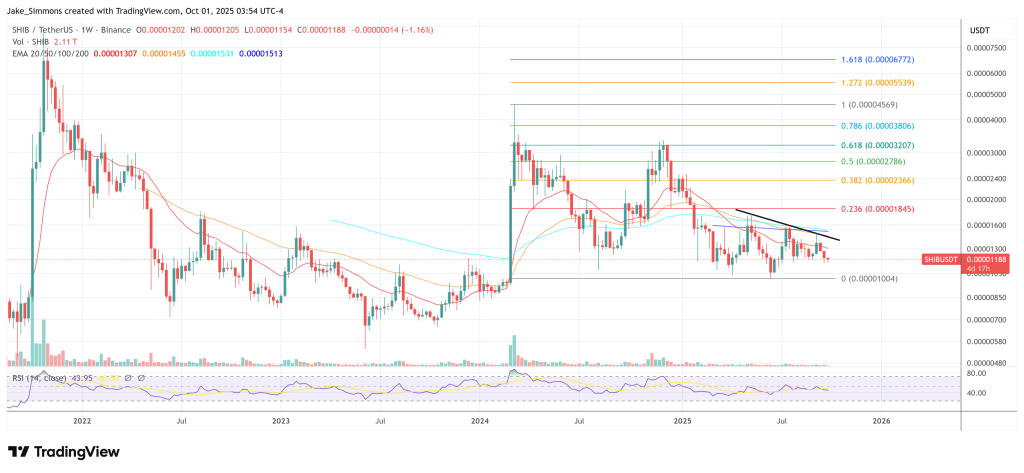
At press time, the Shiba Inu token traded at $0.00001188.
Shiba Inu price
SHIB downtrend continues, 1-week chart | Source: SHIBUSDT on TradingView.com
Featured image created with DALL.E, chart from TradingView.com
Editorial Process for bitcoinist is centered on delivering thoroughly researched, accurate, and unbiased content. We uphold strict sourcing standards, and each page undergoes diligent review by our team of top technology experts and seasoned editors. This process ensures the integrity, relevance, and value of our content for our readers.

Jake Simmons has been a Bitcoin enthusiast since 2016. Ever since he heard about Bitcoin, he has been studying the topic every day and trying to share his knowledge with others. His goal is to contribute to Bitcoin's financial revolution, which will replace the fiat money system. Besides BTC and crypto, Jake studied Business Informatics at a university. After graduation in 2017, he has been working in the blockchain and crypto sector. You can follow Jake on Twitter at @realJakeSimmons.

Похожее

Near Returns to the AI Stage: Transformation into a Public Chain Due to 'Payroll Difficulties,' Agent and Privacy Emerge as New Growth Narratives

NEAR Returns to AI Origins: From Payroll Struggles to Blockchain, Now Focusing on AI Agents and Privacy NEAR Protocol's journey began not with grand blockchain ambitions, but from a practical hurdle: its AI startup founders, including Transformer paper co-author Illia Polosukhin, couldn't efficiently pay international developers in 2017. This led them to pivot and build a high-performance, scalable blockchain. After years navigating various crypto narratives like sharding and cross-chain interoperability, NEAR is now leveraging its AI roots to re-enter the AI arena. A key driver is its "NEAR Intents" layer, which abstracts complex cross-chain transactions. Users simply state their goal (e.g., swap BTC for ETH), and a solver network finds the optimal route. This system has processed over $20B in cross-chain volume, generating significant fee revenue. A major growth area is private transactions via "Confidential Intents/Swaps," which hide trade details until settlement to protect against MEV and front-running. Remarkably, private swaps recently accounted for over 40% of NEAR's transaction volume, highlighting strong demand but also potential regulatory scrutiny. With its AI-founder pedigree, NEAR is positioning itself at the intersection of blockchain, AI agents, and privacy, aiming to become infrastructure for the emerging agent economy while navigating the challenges of its rapid adoption.

marsbit2 ч. назад

Near Returns to the AI Stage: Transformation into a Public Chain Due to 'Payroll Difficulties,' Agent and Privacy Emerge as New Growth Narratives

marsbit2 ч. назад

From Ethereum to AI's 'CROPS': What Exactly is This Set of 'Slow Variables' That Vitalik Repeatedly Emphasizes?

In recent discussions, Vitalik Buterin has frequently emphasized the concept of "CROPS," a framework defining core values for Ethereum's development. CROPS stands for Censorship Resistance, Capture Resistance, Open Source, Privacy, and Security. Initially outlined in the Ethereum Foundation's "EF Mandate," it represents a commitment to user sovereignty, ensuring that the network resists external control, remains open, protects privacy, and prioritizes security. The relevance of CROPS extends beyond Ethereum's foundational principles, becoming crucial in the context of AI integration. As AI agents begin handling wallet operations and automated transactions, the risk increases that users may cede control over their digital assets, privacy, and intentions to centralized AI service providers. A "CROPS AI" would therefore emphasize local execution where possible, privacy-preserving remote model calls (e.g., using zero-knowledge proofs), and transparent, verifiable processes to maintain user agency. Vitalik highlights a significant convergence between "CROPS Ethereum access layer" and "CROPS AI." Both address the same fundamental challenge: how users can access powerful services—be it blockchain data via RPCs or AI models—without exposing sensitive information or relinquishing ultimate control. This intersection points toward a future digital entry point that is more private, secure, and user-controlled. Ultimately, CROPS is not merely an abstract ideal but a practical guidepost. It steers development—from protocol resilience and wallet design to AI agent safety—towards a future where users retain self-sovereignty even as digital systems grow more complex and powerful. In an era of accelerating AI adoption, these "slow variables" of censorship resistance, openness, privacy, and security may define Ethereum's enduring value.

marsbit2 ч. назад

From Ethereum to AI's 'CROPS': What Exactly is This Set of 'Slow Variables' That Vitalik Repeatedly Emphasizes?

marsbit2 ч. назад

Silicon Valley 'Startup Guru' Steve Hoffman: Web3 + AI Could Be a Trap

Silicon Valley investor and "Godfather of Startups" Steve Hoffman warns that combining Web3 with AI is likely a trap, not a promising venture. In an interview, Hoffman argues that while AI is a foundational technology touching all industries, Web3 adds complexity, friction, and regulatory risk without solving mainstream consumer or business needs. He advises founders to focus on deep, specialized applications where startups can out-iterate giants, rather than on generic features easily replicated by large tech companies. Hoffman observes that Silicon Valley will lead foundational AI research, while China excels at rapid, large-scale application and commercialization, particularly in robotics. He stresses that AI-driven autonomous agents capable of collaborative, multi-step tasks are 2-4 years away, which will cause significant job displacement. The solution is not to slow AI but to redesign business models around human-AI collaboration and reform social systems like education and retraining. For startups, Hoffman recommends focusing on vertical, expertise-heavy domains to build defensibility. He sees major opportunities in AI fraud detection and cybersecurity. Key founder mindsets include systemic thinking over feature-focus, relentless customer centricity, building adaptive teams, and deeply understanding AI's capabilities and limits. Hoffman is also leading a non-profit initiative to establish university centers aimed at training future leaders in responsible, human-value-aligned AI innovation.

marsbit4 ч. назад

Silicon Valley 'Startup Guru' Steve Hoffman: Web3 + AI Could Be a Trap

marsbit4 ч. назад

Торговля

Спот
Фьючерсы

Популярные статьи

Обсуждения

Добро пожаловать в Сообщество HTX. Здесь вы сможете быть в курсе последних новостей о развитии платформы и получить доступ к профессиональной аналитической информации о рынке. Мнения пользователей о цене на SOL (SOL) представлены ниже.

活动图片