观点:L2 由以太坊提供安全保障,已经名不副实

深潮Опубликовано 2025-09-03Обновлено 2025-09-04

三分之二 L2 资产已脱离以太坊安全保障。

作者:Ishita

编译:深潮TechFlow

以太坊过去十年的发展围绕着一个简单的承诺:在不牺牲去中心化的前提下扩展网络。而根据其路线图,答案是一个以 Rollup 为核心的未来。在这种架构中,Layer 2 网络(L2或“Rollups”)通过链下执行交易,实现更低的成本和更高的吞吐量,同时仍然从以太坊作为基础层(Layer 1)获取核心安全保障。

几乎所有主要的 Rollup 项目,包括 Arbitrum、Optimism、Base、zkSync 和 Scroll,都以“由以太坊提供安全保障”为品牌核心。这句口号强而有力,是其营销叙事的核心,但这是否真的符合实际?深入研究这些 Rollup 的实际运作方式以及资产在其中的流动后,这一主张显得模糊不清。

本文将剖析口号与现实之间的差距,从桥接(用户资金所在之处)开始,到排序器(负责交易排序的角色),再到治理(规则制定者),逐一展开讨论。

Rollup Bridge 的现实

Rollup 声称“由以太坊提供安全保障”,但这一说法掩盖了用户与这些系统实际交互的方式。

要使用 Rollup,无论是用于 DeFi、支付还是应用程序,首先需要将资产转移到 Rollup 上。然而,以太坊并没有内置直接转入或转出的功能——你无法简单地“传送” ETH 到 Rollup。这就需要桥接(Bridge)。桥接是以太坊和 Rollup 之间的入口和出口,它决定了用户实际体验到的安全性。

桥接的工作原理

存款

当你将 ETH 存入 rollup 时,你实际上是将它发送到以太坊上的桥接合约(Bridge Contract)。该合约会锁定你的 ETH,并指示 rollup 在你的 L2 钱包中创建相同数量的 ETH。例如,如果你存入 1 ETH,桥接合约会将这 1 ETH 安全地保存在以太坊上,而你的 rollup 账户中也会显示 1 ETH。由于 ETH 被锁定在以太坊上,因此这笔存款实现了信任最小化。

提现

提现则复杂得多。退出的过程与存款相反:

  1. 你在 Rollup 上销毁(或锁定)代币。

  2. 你向以太坊的桥接合约发送消息:我在 L2 上销毁了代币,请释放我锁定的 ETH。

  3. 问题在于:以太坊无法看到 Rollup 内部发生了什么,它对 L2 的计算是视而不见的。

因此,以太坊只有在桥接提供证明提现合法的情况下才会释放你的资金。这种证明可能包括:

  • 欺诈证明(Fraud Proofs,乐观方案):默认假设交易合法,除非在争议窗口内被挑战。

  • 有效性证明(Validity Proofs,零知识方案):通过加密证明提前展示所有交易遵循规则,以太坊可以立即信任结果。

  • 多签或委员会(Multisigs or Committees):依赖可信方进行认证。

桥接是用户访问 Rollup 的关键。可以把它比作进入房子的窗户。即使窗户(Bridge)坏了,房子(Rollup)依然屹立不倒。但如果窗户碎了,你就无法再安全地进出。同样,桥接的故障会切断用户的访问,即使 Rollup 的核心机制仍在运行。

因此,桥接层才是 Rollup 安全性的真正视角。资产是否真正“由以太坊提供安全保障”,取决于你使用的桥接以及其信任模型,而非 Rollup 本身。

桥接模型及其假设

  • 官方桥接(Canonical Bridges)官方桥接是与以太坊直接绑定的“每个 Rollup 的官方桥接”。当用户在这里锁定资产时,以太坊验证者保证即使 L2 停止运行,用户也能最终提现回到 Layer 1。这是唯一直接继承以太坊安全属性的桥接方式。

  • 外部桥接(External Bridges)如 Wormhole、LayerZero 和 Axelar 等外部桥接,通过快速的链对链转移优化用户体验,但依赖于自己的验证者委员会或多签机制。这些桥接并不受以太坊共识的强制执行。如果这些链下运营者被黑客攻击或串通作恶,即使以太坊本身运行良好,用户仍可能损失资金。

  • 原生发行(Native Issuance)指直接在 Rollup 上铸造的代币,例如 Base 上的 USDC 或 Optimism 上的 OP。这些资产从未通过官方桥接,并且无法在 Layer 1 上赎回。它们的安全性来自 Rollup 的治理和基础设施,而非以太坊。

Rollup资产的实际分布

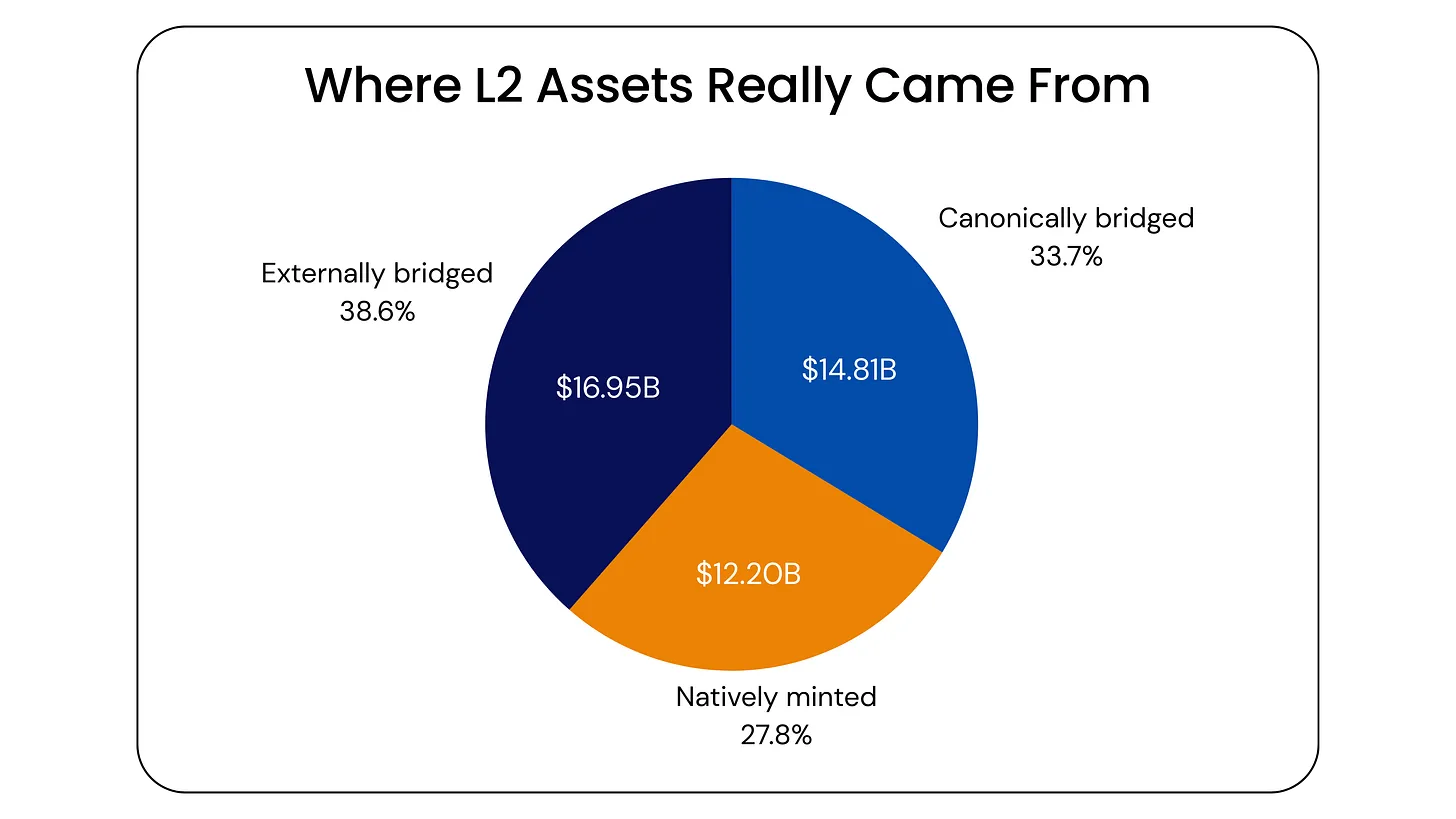
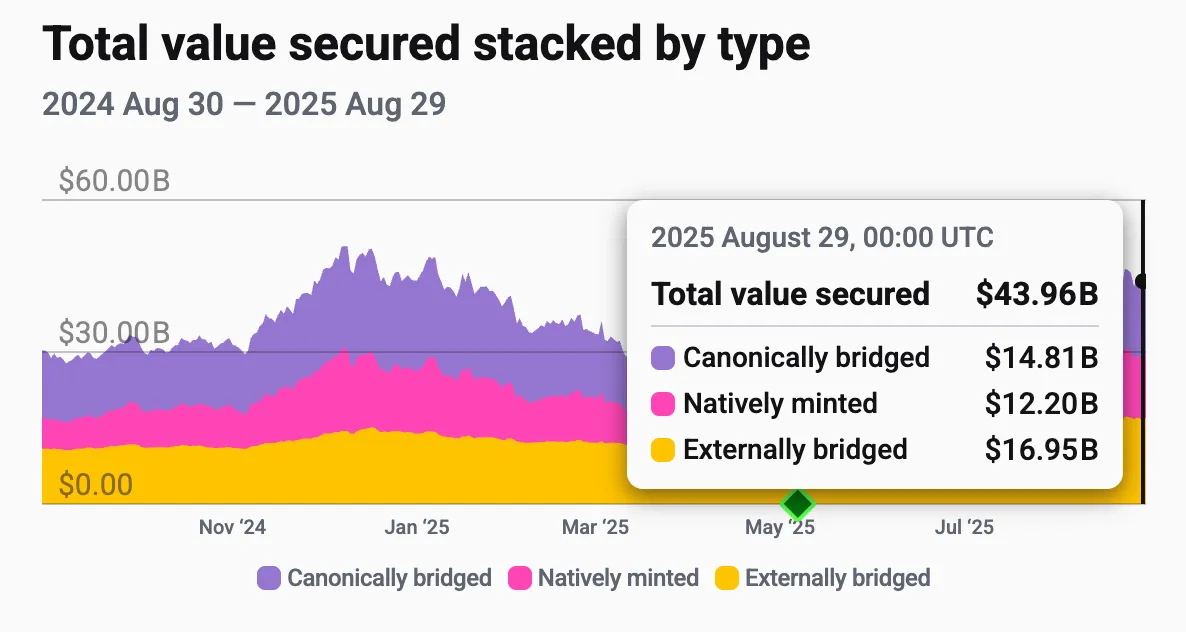
截至 2025 年 8 月 29 日,以太坊 Rollup 总共保护了约 439.6 亿美元的资产,其分布如下:

  • 外部桥接:169.5 亿美元(39%)——占比最大

  • 官方桥接:148.1 亿美元(34%)——以太坊保障的资产

  • 原生发行:122.0 亿美元(27%)——Rollup 原生资产

历史趋势分析

回顾 2019-2022 年,官方桥接是 Rollup 采用的主要驱动力。几乎所有早期增长都通过官方桥接实现,保持以太坊作为核心。
然而,从 2023 年底开始,情况开始发生变化:

  • 官方桥接继续增长,但市场份额开始减少,2024 年达到峰值。

  • 原生发行逐步扩展,尤其是在 2024–2025 年间。

  • 外部桥接从 2023 年后期开始急剧增长,到 2025 年初超越官方桥接,标志着以太坊失去 Rollup 资产的多数份额。

  • 如今,Rollup 的三分之二资产(外部+原生)已脱离以太坊的直接安全保障。

Rollup 生态的细分情况

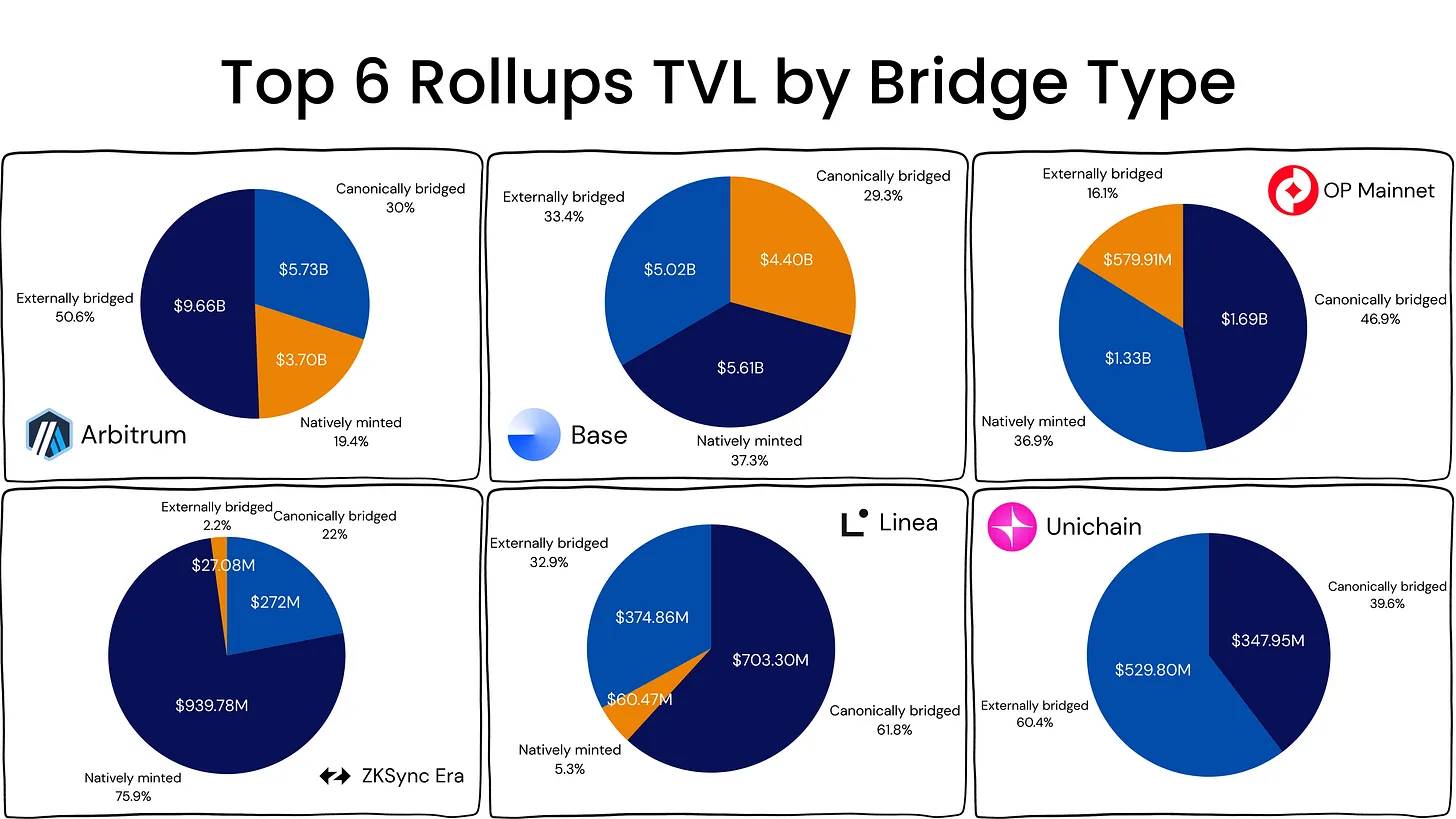
市场集中度极高:前六大 Rollup 占总锁仓量(TVL)的 93.3%。各生态系统的资产分布如下:

  • 官方桥接:32.0%

  • 原生发行:28.8%

  • 外部桥接:39.2%

饼图总体模式分析

  • 外部桥接占主导:如 Arbitrum 和 Unichain,用户追求快速退出与流动性,偏好第三方桥接。

  • 官方桥接占主导:如 Linea(以及次优的 OP Mainnet),更多 L1 来源的抵押物通过官方桥接。

  • 原生发行占主导:如 zkSync Era 和 Base,直接在 L2 上铸造资产(如 Base 上的原生 USDC)并通过直接入口流入。

关键点:大型 Rollup 的大部分资产已超出以太坊的直接安全保障范围。用户实际获得的安全性取决于每种桥接模型背后的信任机制,而非 Rollup 本身。
桥接之外:还存在哪些风险?

桥接模型决定了资产的归属,但即便所有资产都通过官方桥接,用户仍然面临其他信任与安全漏洞。以下三个领域尤为重要:交易排序机制、治理结构,以及可组合性对用户体验的影响。

1. 排序器:中心化的控制点

排序器负责决定交易的排序及打包方式。目前,绝大多数 Rollup 都使用中心化排序器,这种设计既高效又盈利,但也带来了以下风险:

  • 交易审查:排序器可以拒绝包含某些交易,从而实现审查。

  • 阻止提现:排序器决定何时将退出交易批量发送到以太坊,因此可以无限期阻止提现。

  • 完全离线:排序器宕机会导致 Rollup 活动暂停,直到它重新上线。(例如,Arbitrum曾出现过78分钟的停机时间)

以太坊提供了“强制包含”(Force Inclusion)机制,允许用户直接向 Layer 1 提交交易以绕过排序器。然而,这种机制并不能保证公平性,因为排序器仍然控制区块的排序,而这足以破坏用户体验。例如:

  • 假设你尝试从 L2 上的 Aave提现资金。

  • 并通过以太坊提交了强制包含的提现请求,这意味着排序器无法忽视你的交易。

  • 然而,排序器可以在你的交易之前插入自己的交易——例如,从同一资金池借出更多资金。

  • 等到你的提现交易执行时,资金池已无足够流动性,导致提现失败。

  • 虽然你的交易被“包含”了,但结果却遭到破坏。

此外,强制包含还存在实际问题:等待时间可能长达数小时(有时超过12小时),吞吐量有限,即便提交后仍可能被重新排序。因此,此机制更像是一个缓慢的安全阀,而非公平执行的保障。

去中心化排序器正在逐渐受到关注。例如,EspressoAstria 等项目正在构建共享排序器网络,以提高弹性和互操作性。

其中一个核心理念是“预确认”(Pre-Confirmations):排序器或共享网络可提前承诺交易将被包含,即使尚未在以太坊上最终确认。这能减少去中心化带来的延迟问题,为用户提供更快的保障,同时保持中立性。

尽管如此,中心化排序器仍占主导地位,因为它们简单、盈利且对机构更具吸引力——至少在竞争或用户需求迫使其改变之前。

2. 治理与激励风险:企业化的L2

Rollup 的运营方是谁至关重要。许多领先的 Rollup 由公司或风投支持的团队运营,例如 Coinbase 的 Base、Offchain Labs 的 Arbitrum、OP Labs 的 Optimism。

这些团队的首要义务是对股东和投资者负责,而非以太坊的社会契约。

  • 股东责任 → 盈利压力:初期费用较低以吸引用户,随后随着流动性和应用锁定,费用开始上升(典型的“平台税”模式)。未来可能出现更高的排序器费用、优先集成,或有利于运营方整体业务的规则。

  • 锁定效应 → 杠杆:随着数十亿美元的锁仓量和用户积累,退出成本变高,运营方可以在有限的迁移风险下改变经济或政策。

  • 文化错位:以太坊依赖公开开发会议、多客户端多样性和开放治理(如 EIPs)。而企业化的 Rollup 更倾向于自上而下的管理,通常拥有管理员密钥或多签权限,可以暂停、升级或冻结系统——优先考虑合规性或盈利性,而非中立性。随着时间推移,这些 Rollup 可能更像“围墙花园”,而非以太坊的开放生态。

其结果是,以太坊的开放精神与塑造企业 Rollup 的激励机制之间的差距越来越大。这种差距不仅影响治理,还蔓延到应用程序的交互方式以及用户的系统体验。

3. 可组合性与用户体验

以太坊的“魔力”在于原子可组合性:智能合约可以在单笔交易中同步读写(例如:通过 Uniswap 交换资产,同时偿还 Aave 债务并触发 Maker 的操作)。然而,L2 打破了这种可组合性:

  • 异步性:跨 Rollup 消息存在延迟,官方提现可能需要数天,第三方桥接增加了信任假设。

  • 孤岛化:流动性和状态在不同 L2 中分散,削弱了以太坊无缝的 DeFi 用户体验。

解决方案是什么?

以太坊原生的 rollup(按照 Layer-1 标准设计和治理)可以实现 L2→L1 的同步读取、L1→L2 的同步写入,以及原子性的跨 rollup 写入,从而在扩展区块空间的同时,恢复 Layer-1 的大部分可组合性。如果没有这些功能,用户体验 (UX) 将会不断向非以太坊安全的便利层靠拢。

Rollups 的未来

如果“以太坊安全保障”要超越一句口号,其核心的安全性必须依托 Layer 1,而非依赖链下委员会或单一公司的排序器。以下三种设计理念展示了这一趋势的可能性:

原生 Rollup:将验证完全移至以太坊

  • 与要求用户信任独立的欺诈证明系统、无法审计的零知识证明(zk prover)或安全委员会不同,Rollup 提供了一个交易轨迹(Transaction Trace),以太坊可以自行重新执行这些交易。

  • 实际上,这使得提现和状态正确性成为 Layer 1 的权利,而非承诺:如果 Rollup 声称你的余额是 X,以太坊可以直接验证这一声明。

  • 这种设计缩小了桥接的攻击面,减少了对暂停密钥的需求,并使 Rollup 与以太坊未来的升级保持一致。

  • 这种设计的权衡是 Layer 1 上更高的成本,但回报很简单:当发生争议时,由 Layer 1 决定。

  • 目前尚无原生 Rollup 上线。

基于以太坊验证者的排序 Rollup

  • 如今,单一排序器可以重新排序或延迟交易,这足以在实践中破坏“强制包含”(force inclusion)机制。

  • 通过基于排序的设计,交易的规范顺序由 Layer 1 共识决定,从而使审查和最后时刻的重新排序变得更加困难。

  • 强制包含成为一种正常路径,而不是缓慢的安全阀。项目可以加入“预确认”(pre-confirmations),以保持用户体验的流畅,同时让 Layer 1 成为最终的排序裁定者。

  • 这种设计需要牺牲部分 Layer 2 的收入和灵活性,但消除了当前架构中最大的单点控制问题。

  • 目前正在研究基于排序的 Rollup 设计的核心团队包括 Taiko、Spire 和 Puffer。

密钥存储 Rollup:解决密钥与升级风险

  • 与每个 Rollup 和应用独立处理账户恢复、会话密钥和密钥轮换不同,最小化的“密钥存储”Rollup标准化了这些逻辑,并将其同步到所有地方。

  • 用户可以在一个地方旋转或恢复密钥,变更会传播到所有 Layer 2。运营方需要更少的紧急密钥,管理员需要更少的“超级权限”(god-mode)开关。

  • 最终结果是更少的被攻破钱包、更少的事故后紧急升级,以及账户安全与应用逻辑之间更清晰的分离。

  • 密钥存储 Rollup 的设计目前仅停留在理论阶段,尚未上线。

总之,这些设计理念共同解决了用户实际面临的问题:依赖信任的提现机制、由单一公司控制的交易排序以及脆弱的密钥与升级路径。

将验证、排序和账户安全纳入以太坊的体系内,是 Rollup 实现“由以太坊提供安全保障”的方式,而不仅仅是宣传口号。

Похожее

The Evolution Path of Physical Bitcoin

The Evolution of Physical Bitcoin Bitcoin's digital nature is its core strength, enabling self-custody and rapid global transfers. However, its intangibility also hinders mainstream adoption. For over a decade, creators have attempted to materialize Bitcoin while preserving its cash-like properties, yielding notable results. Casascius Coins, launched in 2011, were the first and most iconic physical Bitcoin. Creator Mike Caldwell generated private keys offline, printed them on coins, and sealed them with tamper-evident holograms. This model relied on user trust in the centralized issuer. Production ceased in 2013 due to regulatory pressure from FinCEN. RavenBit Coins emerged in 2014 aiming to decentralize minting by letting users generate and apply their own keys. However, this led to trust issues with numerous untrusted minters and insecure key generation methods. In 2016, Coinkite introduced Opendimes—a breakthrough in bearer asset technology. These USB-shaped devices generate and store keys internally. Funds can be received by checking the public key, but spending requires physically breaking the device to extract the private key. While innovative and open-source, its cost (~$20) and form factor limit its use for small, everyday transactions. Satochip's Satodime, a card-shaped device using similar secure chip technology, followed. It supports NFC interaction and comes in various forms. While potentially cheaper in bulk (~13€), it remains a high-security hardware wallet, not a low-cost cash substitute. A fundamental cost barrier exists. For physical Bitcoin to achieve widespread commercial use, hardware costs must drop below $1 to match the production cost of fiat banknotes. Current secure chips capable of running Bitcoin's cryptographic algorithms (like secp256k1) are too expensive. Chips like NXP's NTAG X DNA (~$3) show cost-reduction potential but lack native Bitcoin curve support. Projects like OfflineCash embed chips in banknote-like paper, but face challenges with durability, the need for custom Bitcoin-enabled chips, and the inherent requirement for users to verify balances online—which conflicts with Bitcoin's trustless ideal. Coinkite's Tapsigner, a ~$20 card with a proprietary Bitcoin NFC chip, is seen as a more practical step forward. It functions as a reloadable hardware wallet for contactless payments, solving the "change" problem and focusing on real-world retail integration, a direction also pursued by companies like Cash App and Square. In summary, the journey to physical Bitcoin has progressed from trusted centralized mints (Casascius) to user-generated keys (RavenBit) and finally to self-contained secure hardware (Opendimes, Satodime, Tapsigner). The core challenge remains developing a sufficiently low-cost, durable, and truly trustless physical bearer asset that can function like cash in daily transactions. Current solutions are either too expensive or introduce new trust assumptions, keeping the ideal of ubiquitous physical Bitcoin just out of reach for now.

marsbit10 мин. назад

The Evolution Path of Physical Bitcoin

marsbit10 мин. назад

Samsung Relies on Technology Cycles, SK Hynix on HBM, How Did Micron Win a Trillion-Dollar Market Cap?

Micron Technology, the third-largest memory chip maker alongside Samsung and SK Hynix, recently saw its market cap surpass $1 trillion. Founded in 1978 in Boise, Idaho, Micron survived brutal industry cycles while American peers and Japan's memory sector faltered. Its survival is attributed to a dual strategy: leveraging political and legal avenues for critical breathing room, coupled with relentless manufacturing cost control. Historically, Micron sought U.S. government intervention three times. In 1985, it filed an anti-dumping complaint against Japanese firms, leading to the U.S.-Japan Semiconductor Agreement. Ironically, this created an opening for Samsung, which later became its toughest competitor. In 2002, Micron turned "whistleblower" in a DRAM price-fixing investigation, escaping penalties while rivals were fined. In 2017, it sued China's Fujian Jinhua, contributing to its placement on a U.S. entity list, stifling a nascent competitor. However, a major strategic misstep occurred in 2013 with the acquisition of bankrupt Japanese firm Elpida. Integrating Elpida's mobile-DRAM-focused technology diverted resources, causing Micron to miss the critical early decade of development for High Bandwidth Memory (HBM)—the high-performance memory essential for AI chips like NVIDIA GPUs. By the time AI demand exploded in 2022, SK Hynix, which launched the first HBM in 2013, held about 85% of the HBM3 market, leaving Micron with roughly 3%. Micron now faces a triple squeeze. In the high-end HBM market, it lags significantly behind SK Hynix and Samsung. In the mid-to-low end DRAM market, it faces aggressive price competition from China's CXMT. Furthermore, a 2023 Chinese cybersecurity ban on its products slashed its revenue from China, a once-core market, from over 10% to just 7.1% by FY2025, causing it to exit China's data center server business. Beneath its political maneuvering lies Micron's core strength: exceptional manufacturing efficiency and cost control. Decades of engineering have yielded DRAM chips with a smaller cell area than rivals, meaning more chips per wafer and lower unit costs. This efficiency, not subsidies, has allowed it to withstand price wars. While political leverage bought time, Micron is now paying a "time debt" in the HBM race. It is racing to ramp up HBM3E production and develop HBM4, but catching up to competitors who started a decade earlier is a monumental challenge. Its future hinges on whether its expertise in cost control and political strategy can compensate for the lost time in a technology race where early-mover advantage is decisive.

链捕手43 мин. назад

Samsung Relies on Technology Cycles, SK Hynix on HBM, How Did Micron Win a Trillion-Dollar Market Cap?

链捕手43 мин. назад

New AMD Paper Overturns Conventional Wisdom: FP4 Training Instability's Cause Is Not Insufficient Randomness

AMD's new research challenges the conventional understanding of FP4 training instability. While reducing precision from FP8 to FP4 promises doubled computational throughput and is supported by new hardware like NVIDIA Blackwell and AMD MI350 series, training large language models natively with FP4 has been notoriously unstable, often attributed to insufficient stochasticity. The paper "Pretraining large language models with MXFP4 on Native FP4 Hardware" demonstrates successful end-to-end FP4 pre-training of Llama 3.1-8B on AMD MI355X GPUs using the MXFP4 format, achieving a 9-10% overall speedup over FP8. Crucially, it identifies the root cause of instability: not randomness, but the accumulation of *structural micro-scaling errors* along the sensitive weight gradient (Wgrad) path. Through controlled experiments, researchers found that quantizing the Wgrad operation to FP4 caused significant convergence degradation. Counterintuitively, common stochasticity-based mitigation techniques like stochastic rounding and randomized Hadamard transforms worsened performance. In contrast, applying a *deterministic* Hadamard transform successfully stabilized training by ensuring consistent error patterns, reducing the extra token cost from 26-27% to just 8-9%. This work has significant implications: 1) It provides a clear diagnostic for low-precision training instability, steering focus towards structural errors. 2) It pushes FP4 from a primarily inference-focused format into the realm of viable training. 3) It leverages the open OCP Microscaling (MX) standard, promoting cross-vendor compatibility. The research marks a critical step towards more economical large model training by further pushing the boundaries of low-precision computation.

marsbit1 ч. назад

New AMD Paper Overturns Conventional Wisdom: FP4 Training Instability's Cause Is Not Insufficient Randomness

marsbit1 ч. назад

Торговля

Спот
Фьючерсы

Популярные статьи

Manyu: восходящая мем-звезда на Ethereum, готовая открыть новую эру культуры Shiba

Manyu - это мемтокен на Ethereum, который приносит децентрализованную культурную и развлекательную ценность через вирусное влияние в соцсетях и вовлечённость сообщества.

1.9k просмотров всегоОпубликовано 2025.11.27Обновлено 2025.11.27

Manyu: восходящая мем-звезда на Ethereum, готовая открыть новую эру культуры Shiba

Неделя обучения по популярным токенам 14: Glamsterdam — самое ожидаемое обновление Ethereum в 2026 году

Ordinals/Runes по-прежнему стимулируют доходы от комиссий за блоки и активность разработчиков, рассматриваются как отправная точка «нативной эмиссии активов» в сети.

1.4k просмотров всегоОпубликовано 2026.04.29Обновлено 2026.04.29

Неделя обучения по популярным токенам 14: Glamsterdam — самое ожидаемое обновление Ethereum в 2026 году

Обсуждения

Добро пожаловать в Сообщество HTX. Здесь вы сможете быть в курсе последних новостей о развитии платформы и получить доступ к профессиональной аналитической информации о рынке. Мнения пользователей о цене на ETH (ETH) представлены ниже.

活动图片