Wormhole强行抬价横插一脚,LayerZero收购Stargate还能推进吗?

Odaily星球日报Опубликовано 2025-08-21Обновлено 2025-08-21

原创 | Odaily 星球日报(@OdailyChina

作者|Azuma(@azuma_eth

已进入正式投票流程的“LayerZero 收购 Stargate”提案突然生变。

8 月 21 日,LayerZero 的直接竞争对手 Wormhole 基金会于 X 公开宣布,LdayerZero 对 Stargate 提出的约 1.1 亿美元收购报价低估了 Stargate 的协议资产及增长,因此 Wormhole 计划提交更高报价,并请求暂停当前 Snapshot 投票 5 个工作日,以便完善竞标流程,保障 STG 持有者利益。

背景提要:LayerZero 发起收购

关于 LayerZero 对 Stargate 的收购提案,可追溯至 8 月 11 日 —— 参考阅读《LayerZero 提议收购 Stargate:代币双双暴涨 20%+,但这一群体却强烈反对》。

当日凌晨,LayerZero 基金会在 Stargate 的治理论坛内发布了一则草案,提议以 1.1 亿美元的总价格对 Stargate 进行收购。

具体而言,LayerZero 基金会提议按照发文时每 STG 0.1675 美元(实际上略高于当时的市场价格)和每 ZRO 1.94 美元的价格,将所有流通中的 STG(包括处于质押/投票状态的 STG)以 1 STG : 0.08634 ZRO 的比例兑换为 ZRO。收购完成后,Stargate 将更深入地融入 LayerZero 生态系统,Stargate DAO 将解散,Stargate 未来产生的所有超额收入将通过回购计划用于减少 ZRO 的流通供应。
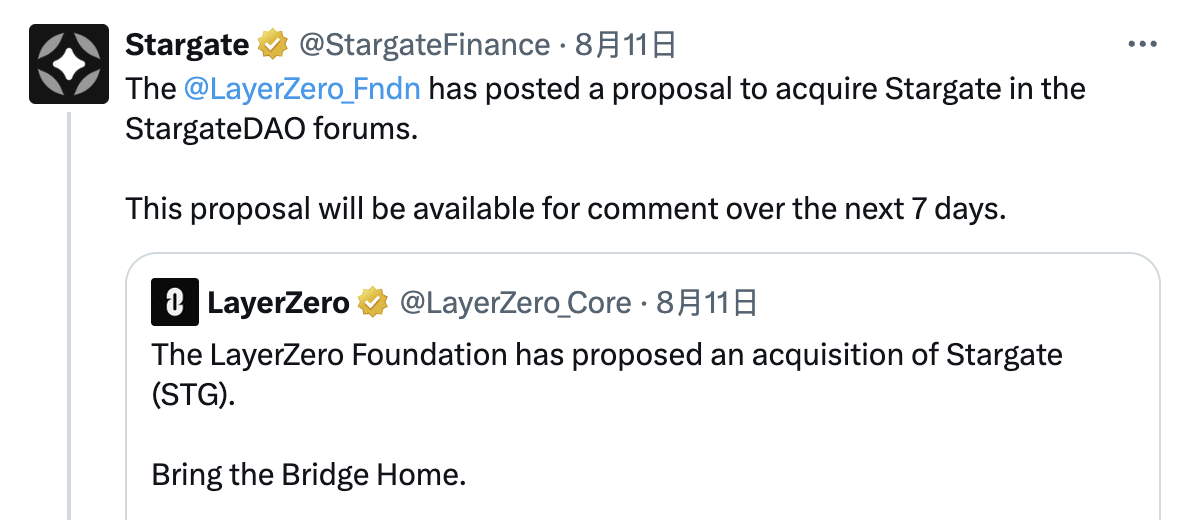
提案公布后,LayerZero 和 Stargate 的官推频频互动,双方大谈“合作共赢”,受此影响当日 ZRO 和 STG 也双双暴涨,但细看 Stargate 的治理论坛讨论内容,绝大多数 Stargate 均对该收购提案持反对态度,认为 LayerZero 的报价过于低估

前期进展:投票启动,大户碾压

8 月 18 日,该提案正式在 Snapshot 上启动投票,STG 持有者将共同决定是否接受该收购要约。相较于最初的提案,LayerZero 并未提高收购报价,而是宣称将向 veSTG 的持有者(即直接投票的用户)分享 Stargate 接下来六个月内总收入 50% 的分成。

投票启动后,不但快速突破了最低票数要求,支持率更是一度上冲至 97% 以上(根据规则,结束时超过 70% 即通过)。LayerZero 联合创始人 Bryan Pellegrino 在参与 CounterParty 的播客时甚至还骄傲地大谈:“这是 Stargate 历史上参与票数最多的投票。”
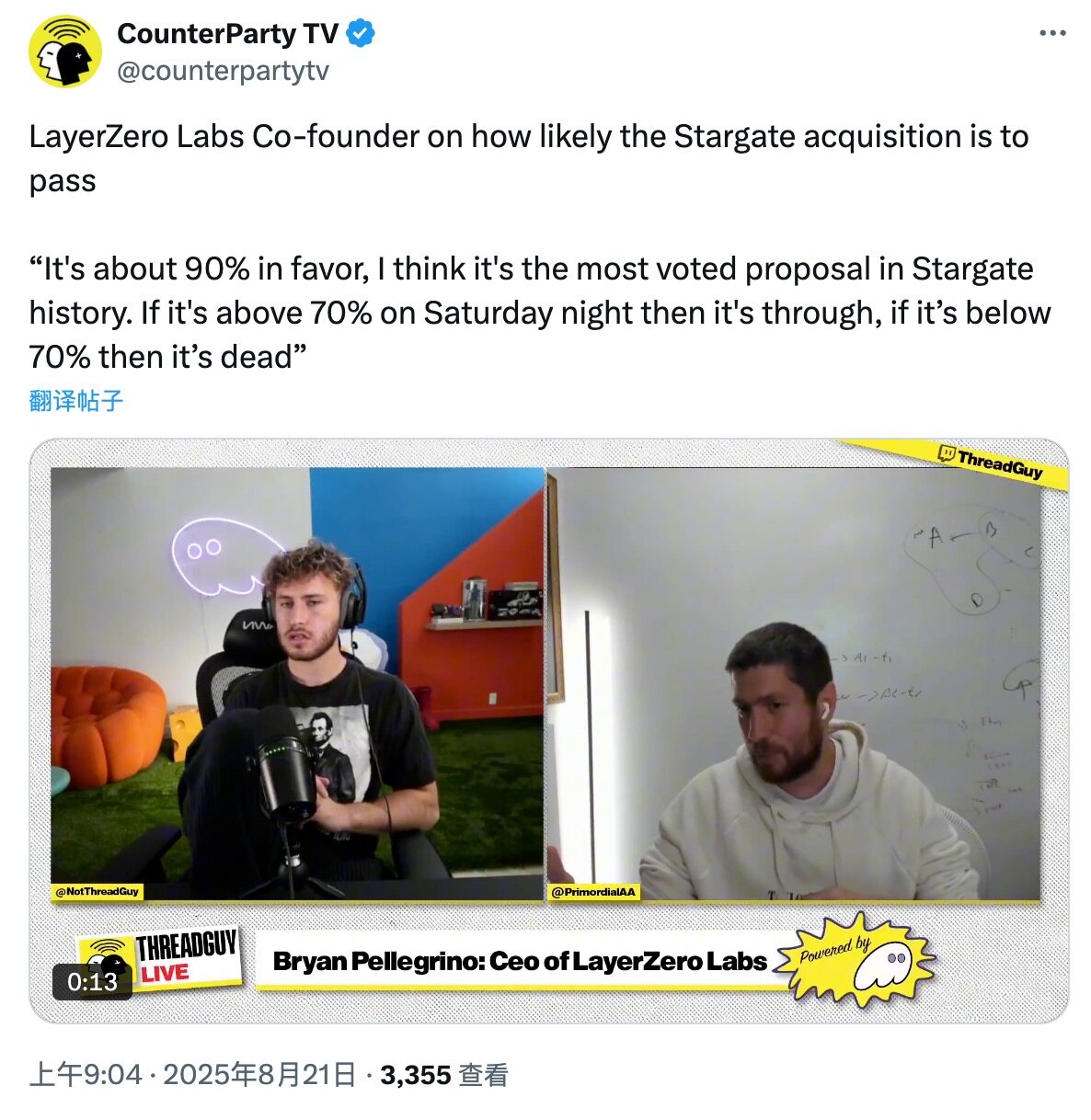
如此一边倒的票型并不令人意外,虽然许多 Stargate 社区成员对报价持反对态度,但 LayerZero 和 Stargate 作为完全绑定的后端协议与前端产品,两家项目本就很难作为两个独立实体看待,甚至于 Stargate 基金会一半的董事会成员都由 LayerZero 方面出任……再结合 LayerZero 和 Stargate 的互动话术来看,不难想象双边的利益相关方本就控制着足够的票权,说白了这就是一场“注定会通过,但需要有个过场”的投票

Wormhole 的阳谋:即便抢不动,也得恶心你一下

可能就连 LayerZero 和 Stargate 双方都没想到,Wormhole 会在如此关键的时刻横插一脚。

截至发文,有别于 LayerZero 提出收购后双方频频互动的“和谐景象”,在 Wormhole 提出有意收购后,Stargate 官方推特没有发布任何一条相关动态,而 LayerZero 方面也仅有联合创始人 Bryan 疑似回应了一句:“这不可能发生。”

截至发文,Wormhole 方面尚未提出正式报价,而原因也让人哭笑不得 —— Wormhole 声称需要更多时间对 Stargate 的估值进行尽调,因为他们不像 LayerZero 那样熟悉 Stargate,熟悉到占了后者半数的基金会董事席位……
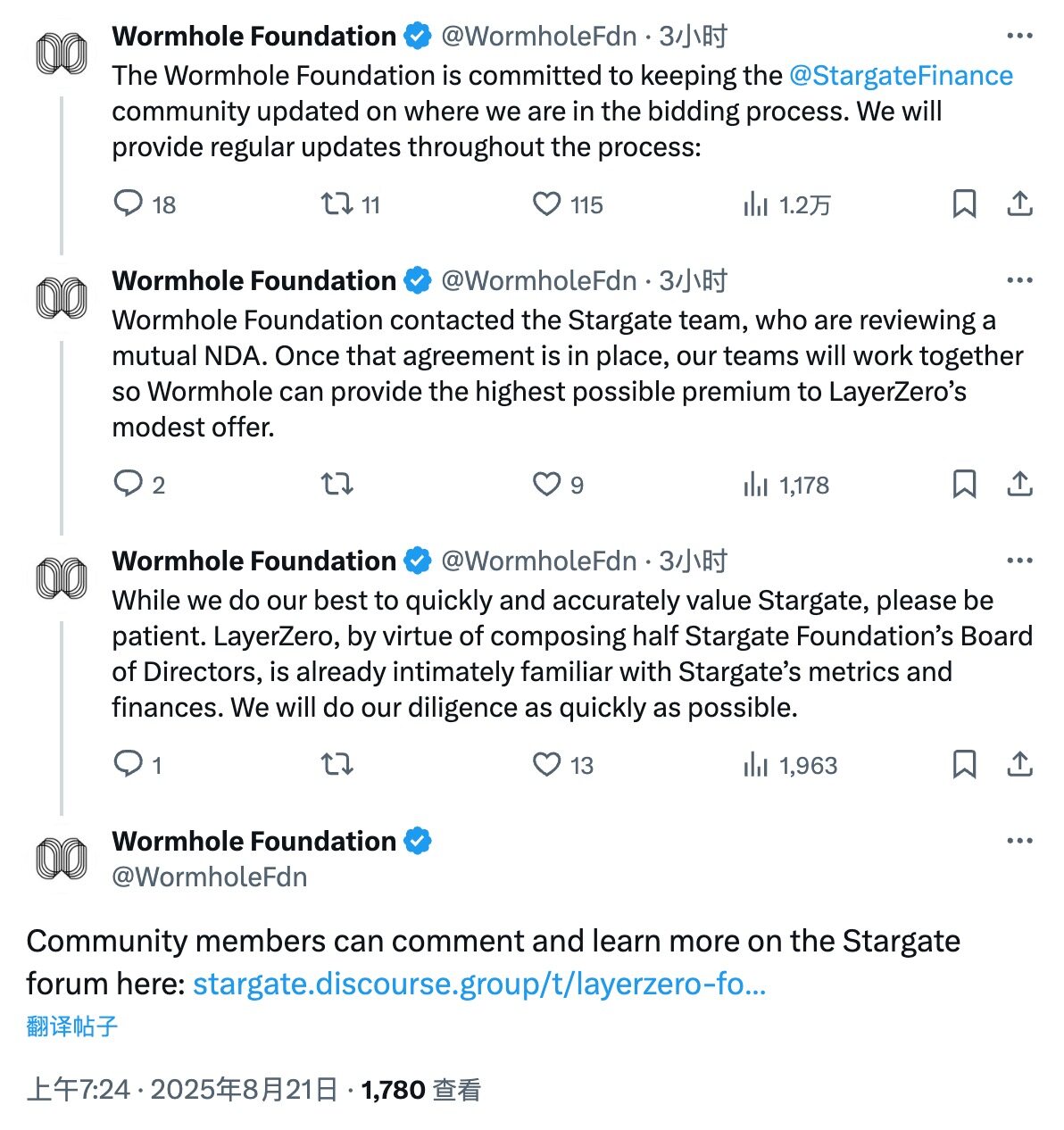
综合目前的情况看来,该起事件后续的发展无非以下四种情况,而无论哪种情况,Wormhole 都会乐见其成。

  • 第一种情况是 Stargate 方面暂停投票,继而进入 Wormhole 和 LayerZero 的竞价,最终假设 Wormhole 获胜。如此一来,Wormhole 将直接夺走最大竞争对手的核心产品,从而抢占更多的市场份额。
  • 第二种情况则是假设 LayerZero 竞价获胜,或是 LayerZero 单方面提高报价并推进提案,如此一来 LayerZero 将支付给多资金给予 STG 持币用户,Wormhole 一分钱不出也能看着对手消耗更多。
  • 第三种情况则是 Stargate 方面以流程已启动为由无视 Wormhole 的报价,提案将以原状况继续推进(目前支持率仍超),如此一来假设 LayerZero 完成了收购,利益上错失更高报价的 STG 必然会因此而恼怒,Wormhole 很乐于看到 LayerZero 方面的社区分裂。
  • 第四种情况也是 Stargate 强行推进投票,假设提案最终以 Stargate 社区反对而失败(目前支持率仍超 88%,失败可能性极低),Wormhole 阻挠计划成功。

综合来看,我个人会更倾向第二种和第三种剧本,毕竟 Stargate 作为 LayerZero 的核心产品,后者绝对不愿意承担损失该产品的后果。

Fluid 首席运行官 DMH 很精炼地概括了当下的状况:“显然 Stargate 和 LayerZero 在提案之前就已经达成一致;Wormhole 很生气,LayerZero 竟然用一袋米买了新加坡;因此 Wormhole 选择抬价,试图扰乱 LayerZero 的收购计划;但 Stargate 最终一定会被 LayerZero 吸收,这一点市场都心知肚明,所以不会有出现任何戏剧情况。”

Wormhole 可能在报价之前也已知道最终的结果早就注定,但动动嘴皮子就能让最大的竞争对手极度恶心,且自己毫无损失,这波简直是顶级阳谋。
Похожее

Who Will Define the Rules of the AI Era? Anthropic Discusses the 2028 US-China AI Landscape

This article, based on Anthropic's analysis, outlines the intensifying systemic competition between the U.S./allies and China for AI leadership by 2028. It argues that access to advanced computing power ("compute") is the critical bottleneck, where the U.S. currently holds a significant advantage through chip export controls and allied innovation. However, China's AI labs remain competitive by exploiting policy loopholes—via chip smuggling, overseas data center access, and "model distillation" attacks to copy U.S. model capabilities—keeping them close to the frontier. The piece presents two contrasting scenarios for 2028. In the first, decisive U.S. action to tighten compute controls and curb distillation locks in a 12-24 month AI capability lead, cementing democratic influence over global AI norms, security, and economic infrastructure. In the second, policy inaction allows China to achieve near-parity through continued access to U.S. technology, enabling Beijing to promote its AI stack globally and integrate advanced AI into its military and governance systems, altering the strategic balance. Anthropic contends that maintaining a decisive U.S. lead is essential for shaping safe AI development and governance. The core recommendation is for U.S. policymakers to urgently close compute and model access loopholes while promoting global adoption of the U.S. AI technology stack to secure a lasting strategic advantage.

marsbit1 ч. назад

Who Will Define the Rules of the AI Era? Anthropic Discusses the 2028 US-China AI Landscape

marsbit1 ч. назад

“Why Didn’t You Buy 2x Long SK Hynix?”

The article discusses the immense popularity of the "2x Long SK Hynix ETF" (07709.HK) in Hong Kong, which became the world's largest single-stock leveraged ETF by May 2026. Launched in October 2025, the ETF's net value soared over 1000% in seven months, significantly outperforming the 324% gain of SK Hynix's underlying stock, driven by the AI boom and a critical shift in industry demand from computing power to memory. It highlights the mechanics and risks of daily-rebalanced leveraged ETFs. In a smooth bullish market, they generate amplified returns, but during volatile periods—exemplified by market swings during geopolitical tensions in the Strait of Hormuz in March-April 2026—they suffer severe "volatility decay," where choppy price action can cause losses far exceeding twice the drop of the underlying asset. The piece frames SK Hynix, as NVIDIA's primary HBM supplier, within the classic cycle of the memory chip industry—a commoditized sector prone to boom-and-bust cycles of shortage, price hikes, overcapacity, and crashes. While current AI-driven demand and high margins (Q1 2026毛利率~79%) create a "super cycle," the article questions its sustainability. It warns that extreme profits will inevitably tempt competitors like Samsung and Micron to ramp up HBM production, potentially eroding scarcity. Furthermore, the entire narrative remains tethered to the massive AI capital expenditure of tech giants. In conclusion, the ETF's trajectory symbolizes the accelerated, all-in nature of the current AI revolution, where timeframes are compressed and market moves are extreme. However, it also underscores that while industry trends define ultimate returns, macro-geopolitical risks dictate the volatile and uncertain path to get there.

marsbit1 ч. назад

“Why Didn’t You Buy 2x Long SK Hynix?”

marsbit1 ч. назад

a16z Crypto: A Guide to the CLARITY Act for Crypto Entrepreneurs

The CLARITY Act, a bipartisan crypto market structure bill, has advanced through the Senate Banking Committee, marking a potential historic shift in U.S. digital asset regulation. For years, a lack of clear rules has stifled innovation, pushed development overseas, and exposed consumers to risk. This bill aims to establish a comprehensive framework, providing long-needed regulatory clarity for blockchain networks and digital assets. It builds upon previous legislative efforts like FIT21 and the House version of CLARITY, which gained strong bipartisan support. CLARITY is crucial because it recognizes that blockchain networks are fundamentally different from traditional companies. Networks operate through decentralized, shared rules rather than centralized control. Applying corporate legal frameworks to networks forces them into a centralized model, concentrating power and value. In contrast, decentralized blockchain networks can function as user-owned public infrastructure, distributing value more equitably among participants. The bill seeks to enable the safe launch of networks in the U.S., clarify regulatory jurisdiction between the SEC and CFTC, oversee crypto exchanges, and enhance consumer protections. Its passage would align U.S. law with the nature of decentralized technology, allowing builders to operate transparently and fund projects domestically without structural compromises due to regulatory uncertainty. Similar to the positive impact seen after the stablecoin-focused GENIUS Act, CLARITY could unlock a new wave of innovation, helping the U.S. reclaim leadership in the crypto space while combating fraud and abuse.

链捕手2 ч. назад

a16z Crypto: A Guide to the CLARITY Act for Crypto Entrepreneurs

链捕手2 ч. назад

Торговля

Спот
Фьючерсы
活动图片