LDO单周大涨60%+,ETH系“太子”终于要价值发现了?

Odaily星球日报Опубликовано 2025-08-11Обновлено 2025-08-11

Введение

在当前宏观及微观的双重刺激下,LDO 终于有了一些趋势扭转的迹象,这会是这位 ETH “太子”价格发现的开始吗?当前下判断还太早,但多少是看到了一些希望。


原创 | Odaily 星球日报(@OdailyChina
作者|Azuma(@azuma_eth


流动性质押赛道的龙头 Lido(LDO)近期终于硬起来了。OKX 行情显示,截至北京时间 8 月 11 日 10:00,LDO 暂报 1.52 USDT,24 小时涨幅 14.21%,过去一周涨幅更是高达 64.5%。


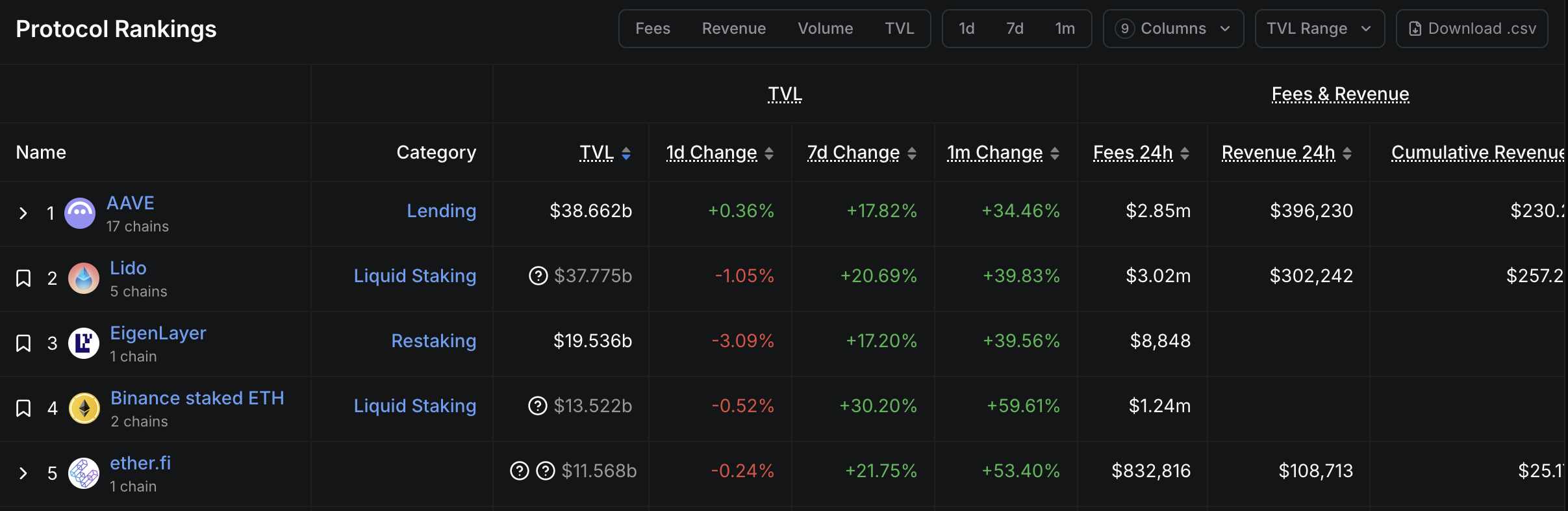
作为以太坊生态规模最大的流动性质押协议,Lido 曾长期霸占以太坊生态乃至整个链上生态的总锁仓价值(TVL)榜首之位,尽管近期已被借 USDe 系资产循环贷之势高速增长的 Aave 反超,但 Lido 依旧是整个以太坊生态话语权最重的协议之一。

关于 LDO 近期的上涨逻辑,大体上可以归因为宏观及微观两个层面。


宏观:监管明确属性,质押型 ETF 推进


首先是宏观层面,8 月 6 日,美国证券交易委员会正式发布关于流动性质押活动声明《Statement on Certain Liquid Staking Activities》,其中明确指出:与协议质押相关的“流动性质押活动”不涉及证券发行和出售,除非存入的涵盖加密资产是投资合同的一部分或受投资合同的约束。流动性质押活动的参与者无需根据《证券法》向美国证券交易委员会注册交易,也无需符合《证券法》关于这些流动性质押活动的注册豁免规定。


2024 年 6 月,彼时仍是 Gary Gensler 掌舵的 SEC 曾指控 Lido 及 Rocket Pool 等流动性质押项目属于证券,当日 LDO 受此利空影响曾大跌超 10%,并在随后较长一段时间内持续处于颓势。而仅仅一年之后,新一届 SEC 的此项声明则明确了其业务模式不涉及证券属性,等于是在监管层面为此类项目的后续运营及发展松了绑。


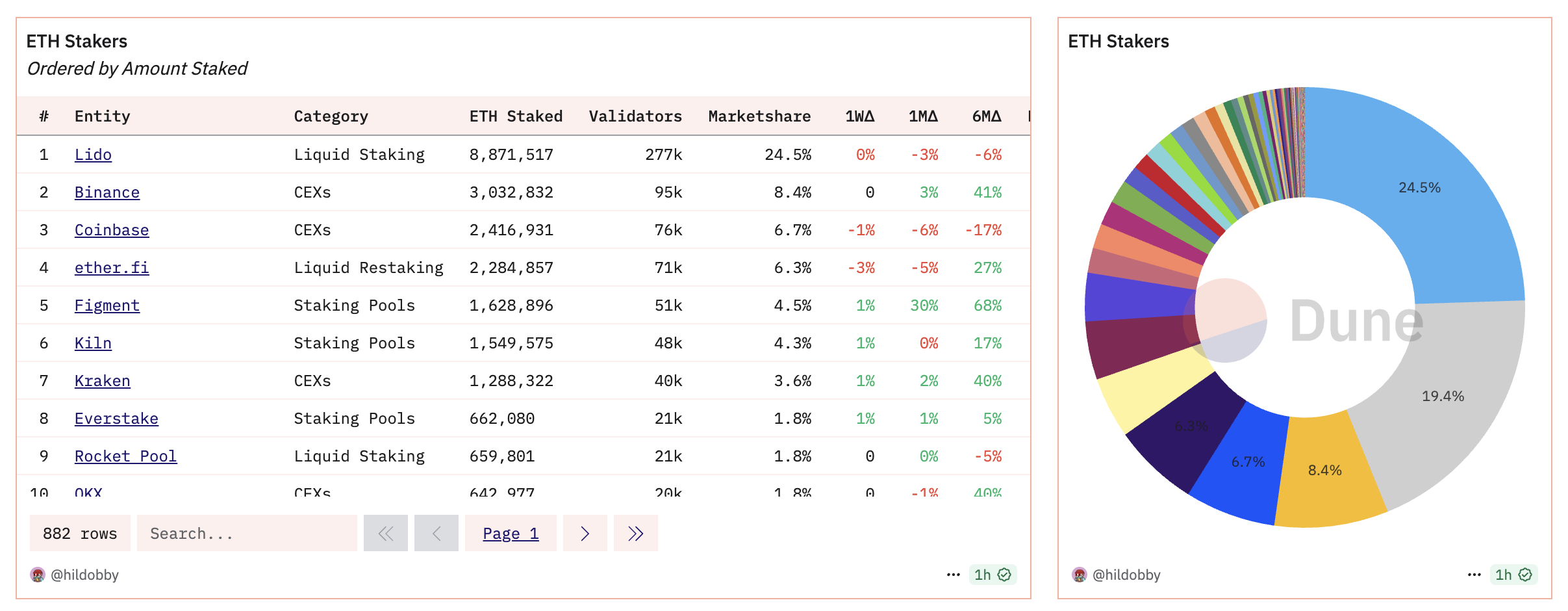
除了监管层面的转向外,近期围绕着质押赛道的另一项关键进展是贝莱德已向 SEC 提交在其现货以太坊 ETF 中引入质押机制的申请,虽然此申请仍在审议之中,但结合 SEC 的态度来看预期获批并不会太困难。市场已普遍预期随着质押 ETF 的通过,当前在以太坊质押份额中占比近 25% 的 Lido 有望获得一定的业务提振及资金追逐。

微观:LDO 回购计划终于摆上台了


相较于宏观层面的间接影响,近期关于 LDO 回购计划的讨论或许才是短期内影响币价走势的直接因素。


8 月 7 日,Lido 社区成员 Kuzmich 于治理论坛提交了一份关于“LDO 回购计划”的草案。草案提到,Lido 财库目前持有价值 1.45 亿美元的流动性资产(1700 万 USDC、1190 万 USDT、1220 DAI、28640 stETH),但这些资产并未为协议创造收益。
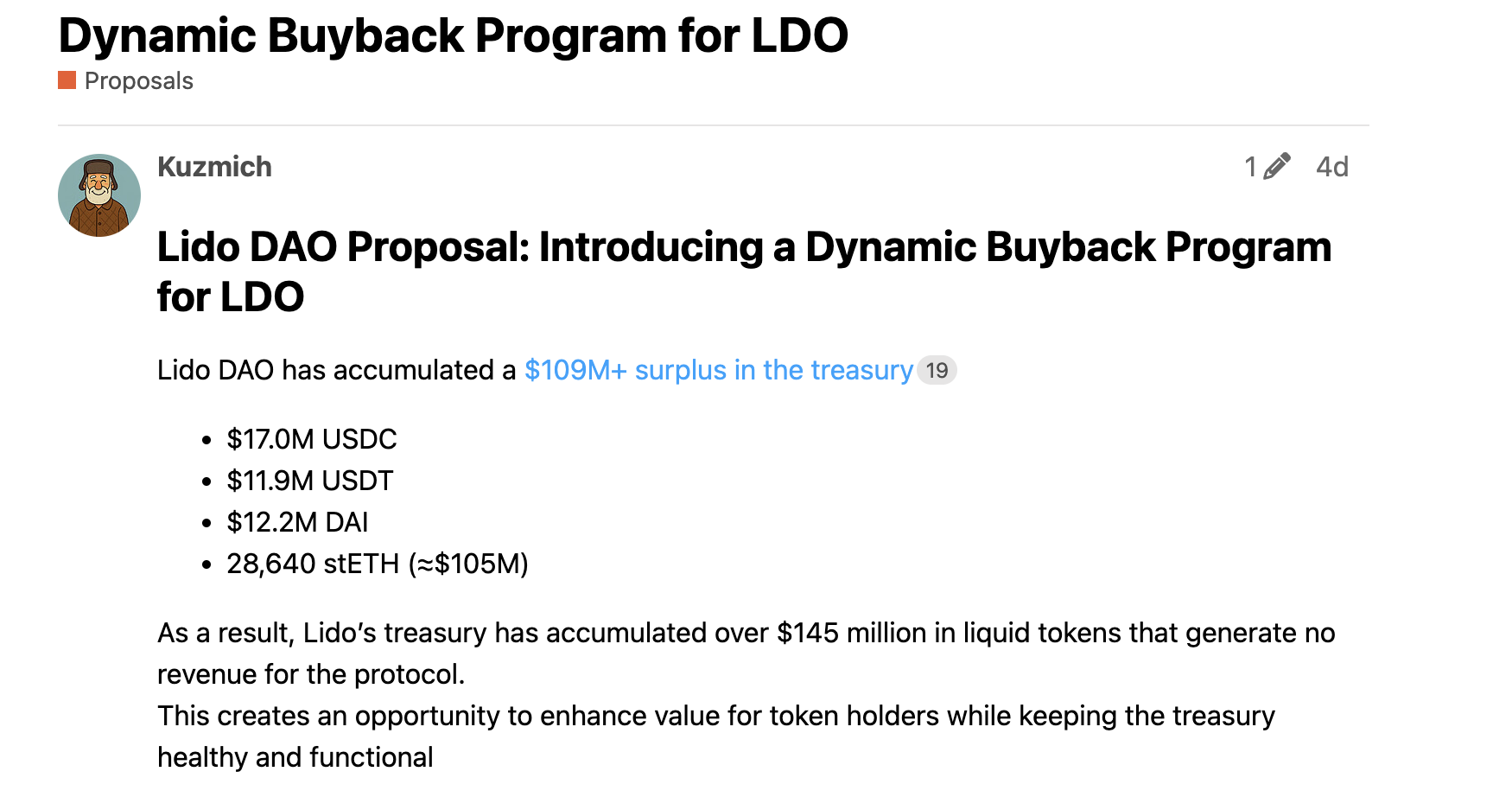

草案建议,Lido 应基于财库余额动态执行 LDO 回购,从而改善协议资金利用模式,提振 LDO 价格,进而恢复市场对 LDO 价值的信心。具体而言,草案建议在当前的财库储备规模下,70% 的流动性资产用于定期 LDO 回购,30% 则留存国库,用于运营和战略需求;当财库流动性资产降低至 5000 万至 8500 万美元之间,比例将调整为 50% 回购 / 50% 留存;当财库流动性资产低于 5000 万美元时,比例将调整为 0% 回购 / 100% 留存(暂停回购直至恢复阈值)。


根据 Lido 治理论坛的规划,如若顺利,该草案将在 8 月 7 日至 14 日期间在论坛内收集社区反馈;之后在 8 月 14 日的 Lido 代币持有者电话会议中讨论;再然后于 8 月 15 日至 24 日期间根据反馈修订提案;最终在 8 月 25 日提交 Snapshot 进行投票。


虽然当前在社区论坛内部存在着一定的反对声音,但除了少部分坚持认为“回购只是短期游戏”的社区成员之外,多数用户质疑的点都集中在该计划的具体细节之上,比如未明确回购之后的代币是否销毁,再比如回购的开启方式及执行方式仍不够明确等等。


考虑到当前该草案仍处于早期阶段,预计后期还会在电话会议讨论后进一步修改细节,再加之近期 LDO 价格罕见地出现了较强势的上行,乐观预期该草案或是基于该草案讨论衍生出的其他回购计划将会得到一定规模的社区支持。


ETH 系“太子”,终于要价值发现了吗?


作为公认为 ETH 系 Beta 之一,LDO 过往较长一段时间的表现可以说是很难让人满意。
在 AAVE 借回购之势快速上冲至 300 美元上方;ENA 借业务飞轮及财库计划狂飙突进(详见《一周上涨近 50%,ENA 会是 ETH 最大的 Beta 吗?》);PENDLE 凭借 Boros 打开了新的想象力空间之际(详见《资金费率终成可交易资产,Pendle 子平台 Boros 如何颠覆套利市场?》),LDO 却长期处于一个相对疲软的状态之中,即便“质押型 ETF”的预期喊了许久,但始终未能在一个相对较长的周期内推动 LDO 的价格表现。


在当前宏观及微观的双重刺激下,LDO 终于有了一些趋势扭转的迹象,这会是这位 ETH “太子”价格发现的开始吗?当前下判断还太早,但多少是看到了一些希望。

Похожее

AI Bubble Warning: AI Investments Are Negative Returns for Most Tech Giants

The article issues a stark warning about a potential AI investment bubble. It notes that while the AI boom shares similarities with the TMT bubble of the late 1990s, its scale is vastly larger, currently driving 93% of U.S. GDP growth. Major hyperscale cloud providers like Microsoft, Alphabet, Amazon, Meta, and Oracle are planning to invest trillions in AI data centers over the coming years. However, calculations based on analyst projections for 2025-2030 reveal a concerning math problem: expected capital expenditure growth far outpaces projected revenue growth. Even under an extremely optimistic scenario of zero costs, the implied return on investment for most of these tech giants (except Amazon) is deeply negative. This suggests that the current trajectory could lead to one of history's largest shareholder value destruction events. The piece outlines two potential escapes: AI generating vastly more revenue than currently anticipated—a near-impossible task—or a significant cutback in the planned investment splurge. The latter scenario could trigger a domino effect, severely impacting the entire tech supply chain (from Nvidia to TSMC), potentially pushing the U.S. economy into recession, and causing a major stock market downturn. The author suggests upcoming high-profile IPOs by companies like OpenAI and Anthropic might represent a transfer of risk from early investors to public market participants. While the peak of the hype cycle might sustain investment through 2026, the fundamental financial dilemma remains unresolved, setting the stage for a potential market correction in 2027 or 2028, similar to the years following Alan Greenspan's "irrational exuberance" warning.

marsbit31 мин. назад

AI Bubble Warning: AI Investments Are Negative Returns for Most Tech Giants

marsbit31 мин. назад

From Tokens to Machine Labor: AI is Shifting from Tool to "Worker"

The article "From Token to Machine Labor: AI is Evolving from Tool to 'Worker'" argues that the business model for AI is shifting beyond simply selling computational resources (tokens, GPU hours) or model access. Instead, a new "machine labor market" is emerging, where the core economic transaction is the purchase of economically useful work directly performed by software. The central thesis is that AI pricing will evolve through four stages: 1) raw tokens, 2) standardized LLM capabilities (e.g., text generation), 3) industry-specific labor markets (e.g., legal review, radiology), and finally 4) a programmable results market where tasks like resolving a support ticket are bid on and priced based on outcome. In this future, buyers will care less about *which* model or GPU completes a task and more about whether the work meets specified standards for accuracy, latency, and cost. This transition reframes the impact of AI on human labor. Rather than simple replacement, it suggests a re-coordination where machines handle standardized, verifiable work, freeing humans for roles involving oversight, context management, responsibility, and final judgment. In some cases, this "last 1%" of human input becomes more valuable as it enables the other 99% to be automated. Furthermore, as AI reduces the cost of work, demand may expand, creating larger markets (e.g., 24/7 customer service) rather than just cheaper versions of existing ones. The article concludes that while infrastructure (GPUs, models, tokens) remains crucial upstream, the market is converging on a simpler, tradeable unit: machine labor that can be defined, measured, priced, and procured based on contractible specifications.

marsbit41 мин. назад

From Tokens to Machine Labor: AI is Shifting from Tool to "Worker"

marsbit41 мин. назад

Xiaomi MiMo's 99% Price Cut is Not Marketing! Luo Fuli Posts on X to Refute Critics

The price of Xiaomi's MiMo-V2.5 series API has been permanently reduced by up to 99%, specifically for the "Input (Cache Hit)" cost, which covers users re-reading historical context in long conversations. MiMo's head, Luo Fuli, published a detailed technical blog to clarify that this drastic price cut stems from genuine engineering breakthroughs, not a marketing stunt or a simple price war. The core of the achievement lies in six key engineering optimizations. First, the model architecture adopts a Hybrid Sliding Window Attention (SWA), reducing the memory footprint (KVCache) to 1/7th of a traditional model. Second, a dual-pool memory management system actually utilizes these savings, allowing a single GPU to handle over 5 times more concurrent users. Third, an upgraded prefix caching mechanism achieves a cache hit rate of 93-95% for repeated reads, meaning most such requests bypass GPU computation entirely. Fourth, a self-developed distributed cache (GCache) utilizes idle SSD space on existing GPU servers, eliminating additional storage costs. Fifth, an intelligent scheduling system (LLM-Router) efficiently routes requests to maximize cache reuse and performance. Sixth, Multi-Token Prediction (MTP) accelerates the model's text generation ("output") side. Together, these systemic optimizations dramatically lower the real computational cost per request, enabling the 99% price reduction for cached inputs while reportedly maintaining positive gross margins. Luo Fuli's disclosure aims to shift the narrative from "price war" to a demonstration of substantive AI engineering progress.

marsbit2 ч. назад

Xiaomi MiMo's 99% Price Cut is Not Marketing! Luo Fuli Posts on X to Refute Critics

marsbit2 ч. назад

$26 Billion: An 'All-Chinese Team' Backs the World's Highest-Valued AI Programming Company

Cognition AI, the company behind the AI programmer "Devin," has raised over $1 billion in new funding at a valuation of $26 billion, just eight months after reaching a $10.2 billion valuation. The round was led by Lux Capital, General Catalyst, and 8VC. Founded by three young Chinese entrepreneurs with strong competitive programming backgrounds, Cognition initially gained fame with Devin, marketed as the world's first AI software engineer capable of handling tasks from start to finish. While its early demos were impressive, real-world usage revealed reliability and cost-effectiveness issues, leading to a significant price cut for Devin in 2025. A pivotal moment came when Cognition acquired the assets of AI IDE company Windsurf after a failed acquisition by OpenAI. This move gave Cognition a crucial developer-facing tool, allowing it to pursue a two-pronged strategy: Devin for autonomous task execution and Windsurf for integrated, collaborative coding within an IDE. This shift helped the company move away from the controversial "AI replacement" narrative towards a model of augmenting human engineers, particularly for repetitive or maintenance tasks. This strategic pivot is backed by strong commercial metrics. The company reports a 10x increase in enterprise usage this year, with an annual revenue run-rate of $492 million and a 50% month-over-month growth in enterprise Devin usage over the past six months. Its client list now includes major corporations like Goldman Sachs and Mercedes-Benz, as well as government agencies like NASA and the U.S. Army. Investors are betting on Cognition becoming a foundational piece of next-generation software engineering infrastructure, positioning it at the center of a hybrid future where AI agents and human developers work in tandem.

marsbit2 ч. назад

$26 Billion: An 'All-Chinese Team' Backs the World's Highest-Valued AI Programming Company

marsbit2 ч. назад

The Hottest 00s Generation on Wall Street

"Wall Street's Hottest '00s Phenom: The 25-Year-Old Fund Manager Who Bet on AI's 'Boring' Backbone" At just 25, Leopold Aschenbrenner, once fired by OpenAI, now runs a hedge fund worth $13.7 billion. His strategy? Betting against the consensus. While others chased AI chips, he invested early in the physical infrastructure powering the AI boom: electricity, data centers, and energy. Expelled from OpenAI's safety team in 2024, Aschenbrenner foresaw the coming bottleneck. He argued that AI progress would be limited not by algorithms, but by power, chip capacity, and space. Acting on this, he founded Situational Awareness LP to go long on these "old economy" assets. His bets have paid off spectacularly. His fund's assets soared from $255 million in late 2024 to $13.7 billion by Q1 2026. His portfolio is a direct reflection of his thesis: major long positions in fuel cell company Bloom Energy and data center/bitcoin mining firms like CleanSpark and Riot Platforms, which control critical land and power resources. Conversely, he holds massive put options against overheated semiconductor giants like NVIDIA and AMD. A notable exception was his bullish bet on storage company SanDisk, which surged ~160% in Q2. Aschenbrenner's vision is materializing. Tech giants like Amazon, Alphabet, and Meta are ramping up colossal capital expenditure on data centers. Global data center power consumption is projected to skyrocket, with AI accounting for over half by 2030. The demand for enabling technologies like optical fiber and modules is also exploding. His story underscores a fundamental truth of the AI era: the ethereal intelligence of algorithms rests on a very physical, heavy, and power-hungry foundation. The future is being built not just in code, but in concrete, copper, and kilowatts.

marsbit5 ч. назад

The Hottest 00s Generation on Wall Street

marsbit5 ч. назад

Торговля

Спот
Фьючерсы

Популярные статьи

Как купить LDO

Добро пожаловать на HTX.com! Мы сделали приобретение Lido (LDO) простым и удобным. Следуйте нашему пошаговому руководству и отправляйтесь в свое крипто-путешествие.Шаг 1: Создайте аккаунт на HTXИспользуйте свой адрес электронной почты или номер телефона, чтобы зарегистрироваться и бесплатно создать аккаунт на HTX. Пройдите удобную регистрацию и откройте для себя весь функционал.Создать аккаунтШаг 2: Перейдите в Купить криптовалюту и выберите свой способ оплатыКредитная/Дебетовая Карта: Используйте свою карту Visa или Mastercard для мгновенной покупки Lido (LDO).Баланс: Используйте средства с баланса вашего аккаунта HTX для простой торговли.Третьи Лица: Мы добавили популярные способы оплаты, такие как Google Pay и Apple Pay, для повышения удобства.P2P: Торгуйте напрямую с другими пользователями на HTX.Внебиржевая Торговля (OTC): Мы предлагаем индивидуальные услуги и конкурентоспособные обменные курсы для трейдеров.Шаг 3: Хранение Lido (LDO)После приобретения вами Lido (LDO) храните их в своем аккаунте на HTX. В качестве альтернативы вы можете отправить их куда-либо с помощью перевода в блокчейне или использовать для торговли с другими криптовалютами.Шаг 4: Торговля Lido (LDO)С легкостью торгуйте Lido (LDO) на спотовом рынке HTX. Просто зайдите в свой аккаунт, выберите торговую пару, совершайте сделки и следите за ними в режиме реального времени. Мы предлагаем удобный интерфейс как для начинающих, так и для опытных трейдеров.

557 просмотров всегоОпубликовано 2024.03.29Обновлено 2025.03.21

Как купить LDO

Обсуждения

Добро пожаловать в Сообщество HTX. Здесь вы сможете быть в курсе последних новостей о развитии платформы и получить доступ к профессиональной аналитической информации о рынке. Мнения пользователей о цене на LDO (LDO) представлены ниже.

活动图片