英伟达财报再超预期,哪些加密AI项目涨得更猛?

Odaily星球日报Опубликовано 2024-08-29Обновлено 2024-08-29

Введение

英伟达的股价自年初以来已累计上涨约160% ,稳居市场翘楚之位。

原文作者:思维怪怪

周三美股盘后,英伟达发布了备受瞩目的 2025 财年 Q2 财报。

报告显示,二季度公司实现营收 300 亿美元,高于市场预期的 288.6 亿美元,同比增长 122% ;净利润为 165.9 亿美元,也超出市场预期的 146.4 亿美元,同比增长 168% 。尽管业绩再次超出预期,但在市场对英伟达的高期望下,这次的「超预期」幅度显得略有不足,导致股价盘后一度大跌 8% 。

虽然短期前景存在一定不确定性,但从全年表现来看,英伟达的股价自年初以来已累计上涨约 160% ,稳居市场翘楚之位。无论凭借在人工智能领域的绝对领先地位,还是在数据中心和高性能计算市场的持续扩张,英伟达的基本面依然稳固。可以说,炒作 AI 是生成式 AI 浪潮下的普遍共识,而炒作英伟达则是「共识中的共识」。只要 AI 淘金热潮不退,作为「卖铲人」的英伟达就可以躺着挣钱。

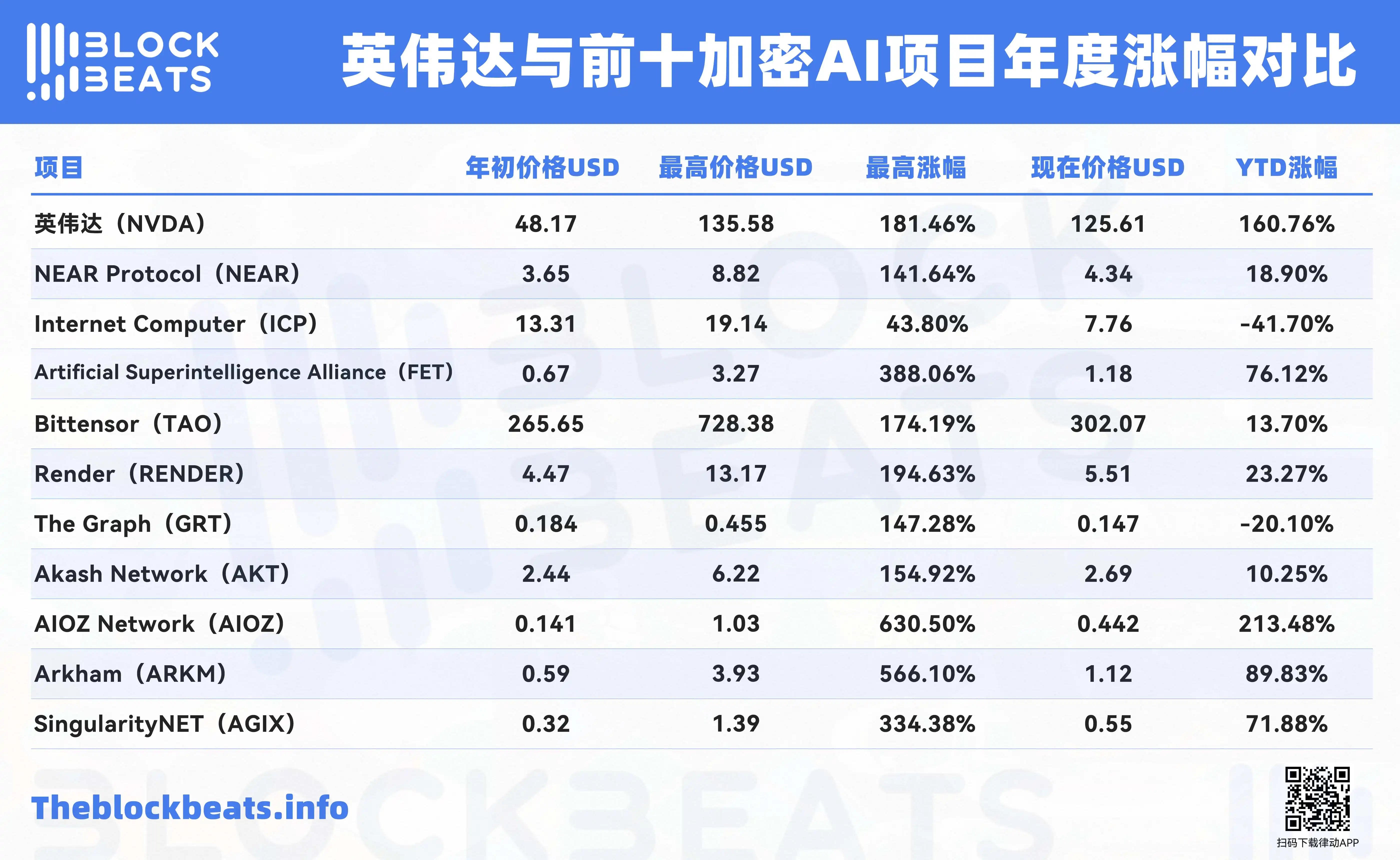
英伟达的成功,也带动了今年加密 AI 项目的繁荣。这些市值较小的项目,常被视为英伟达行情的「信号放大器」,市场普遍认为它们能为投资者带来更高的回报。但这些加密 AI 项目的表现是否真如预期?BlockBeats 对市值前十的加密 AI 项目与英伟达的年内涨幅进行了详细对比,试图厘清其中的真实情况。(很多小市值的加密 AI 概念项目并没有做对比,鉴于英伟达的全球第二大科技公司,还是用大市值项目做对比相对更有参考。)
英伟达财报再超预期,哪些加密AI项目涨得更猛?

可以发现,尽管今年以来有 5 个加密 AI 项目的最高涨幅超过了英伟达,似乎验证了它们在市场炒作最疯狂时的「信号放大器」作用。然而,将时间拉长来看年初至今(YTD)的表现时,我们发现只有 AIOZ Network 一个项目的涨幅超过了英伟达,其余大部分项目在经历了巨幅回撤后,已经无法望英伟达项背。

Internet Computer 甚至下跌了 41.7%,名不虚传。这也说明并非所有蹭上 AI 叙事的项目都能从中获得持久的助力。再牛逼哄哄的项目如果缺乏持续的运营和发展,也难以长期获得投资者的青睐。在项目方发币就开摆的大背景下,「炒新不炒旧」几乎成了加密市场的一个铁律。

相比之下,英伟达的股价走势始终相对稳健,几乎未经历什么显著的回撤。除了因为行业龙头的地位无人撼动,也说明其背后一直有着强劲的基本面支撑,与许多加密 AI 项目依靠叙事和市场热度驱动的短期上涨形成鲜明对比。

这一对比再次揭示了币圈项目的痼疾:当某个叙事热潮逐渐消退,市场重新聚焦项目的实际价值和基本面时,许多加密项目的真实表现往往捉襟见肘差强人意。加密 AI 项目的涨幅高度依赖市场情绪,但只有持续的技术创新和强有力的团队执行才能支撑项目的长期生存。

许多在炒作高峰期涨得惊人的项目,实际上并没有什么特别的技术创新或者产品优势,甚至连真正的用户都没有,因为一开始做的时候就没打算让人用。当市场情绪回归理性,这些项目的「裸泳」状态暴露无遗,投机客也会很快弃之而去,重新寻找下一个可供炒作的叙事标的。

所以,对于加密投资者来说,选择项目时不能只看短期涨幅和热点,而是要深挖项目的技术、团队、生态建设和社区参与度。英伟达的稳健表现给投资者提供了一个很好的对标——追逐新兴机会没错,但别忽视那些基本面扎实、具备长期增长潜力的标的。真正的好项目,应该经得起时间的考验。
原文链接

Похожее

Those Who Rushed into SpaceX's Private Secondary Market Are Bewildered in the Greatest Wealth Creation Wave Ever

Investors are rushing into SpaceX’s private secondary market ahead of its historic IPO, but many are finding confusion instead of clarity. While early backers like Darsana Capital are poised for astronomical returns—turning a $600M bet into roughly $150B—other buyers face uncertainty about whether they actually own SpaceX shares at all. The frenzy stems from AI-driven FOMO, as soaring valuations for private companies like OpenAI and SpaceX create intense demand for pre-IPO exposure. This has fueled a booming but opaque secondary market, where special purpose vehicles (SPVs) layer investments, adding fees and obscuring ownership. Some investors are three or four layers removed from the actual stock, unable to verify their holdings. With companies staying private longer—SpaceX for 24 years—secondary trading has grown complex and risky. Platforms have faced fraud, bankruptcy, and regulatory scrutiny. Now, firms like Anthropic and OpenAI are publicly rejecting unauthorized transfers, warning that shares sold through certain platforms may be invalid. SpaceX’s IPO filing in June will finally reveal the official shareholder list, resolving these uncertainties. Until then, buying into SpaceX through secondary channels remains a high-stakes gamble—a blind box in a market overflowing with capital and complexity.

marsbit12 мин. назад

Those Who Rushed into SpaceX's Private Secondary Market Are Bewildered in the Greatest Wealth Creation Wave Ever

marsbit12 мин. назад

Warsh's First Conundrum: Rate Cuts, Inflation, and a Fractured Fed

Walsh's First Dilemma: Rate Cuts, Inflation, and a Divided Fed Kevin Warsh officially assumed the Fed Chairmanship on May 15th, inheriting a central bank deeply divided over inflation. Contrary to market expectations of a dovish stance due to his appointment by President Trump, Warsh's historical record shows early and consistent hawkish concerns about inflation. The Fed he leads is fractured, with three FOMC members recently dissenting against even hinting at future rate cuts. The immediate challenge is surging inflation. While the Iran-related oil shock is a temporary factor, core CPI and services inflation are accelerating, showing signs of becoming entrenched—echoing the Fed's 2022 "transitory" misstep. Warsh faces the task of building consensus within a committee where several members believe policy may not be restrictive enough, especially if the neutral interest rate (r-star) is higher than currently estimated. Politically, Warsh is caught between Trump's desire for rate cuts and the economic reality of persistent price pressures. Any move perceived as bowing to political pressure could undermine Fed independence. Market implications are significant. Long-term Treasury yields (e.g., 30-year at 5.19%) could rise further, especially if the June FOMC statement hints at possible tightening. Tech stocks face continued valuation pressure from higher rates. The key variable is progress in Iran negotiations; a breakthrough before the June meeting could temporarily ease oil-driven inflation, but stubborn services inflation would remain. All eyes are on Warsh's first post-FOMC press conference on June 17th. His wording on inflation and policy will reveal how much the market has mispriced his stance and the Fed's likely path forward.

marsbit22 мин. назад

Warsh's First Conundrum: Rate Cuts, Inflation, and a Fractured Fed

marsbit22 мин. назад

Harvard and Others Exit, Six Core Talents Depart in a Month: What's Happening to Ethereum?

Ethereum faces significant internal and external pressures, marked by a wave of high-profile departures from its core development team and a loss of confidence from major institutional investors. Within four months, at least seven key figures—including researchers, protocol leads, and a former executive director—have left the Ethereum Foundation. This exodus, partly triggered by controversy over a new "mission statement" requiring employee sign-off, risks derailing critical roadmap upgrades like PeerDAS and Verkle trees, and has already contributed to delays in the planned Glamsterdam upgrade. Compounding the internal instability, major institutions are reducing their exposure. Goldman Sachs slashed its iShares Ethereum Trust holdings by approximately 70%, and Harvard's endowment fund completely exited its $87 million Ethereum ETF position. Concurrently, the Ethereum Foundation itself has been unstaking and selling ETH for "treasury rebalancing," further unsettling the market. These challenges emerge as Ethereum's competitive dominance erodes. Its share of the total DeFi market has fallen to around 54%, with rivals like Solana and Base gaining ground. In fee revenue, it was recently outpaced by newer chains like Hyperliquid. Furthermore, a trend of institutions exploring proprietary or hybrid blockchains (exemplified by Circle's Arc) threatens Ethereum's position as the premier settlement layer for institutional assets. While founder Vitalik Buterin's vision for Ethereum as a secure, decentralized "technical sanctuary" and "world computer" remains clear, its realization is threatened by the concurrent loss of execution capability, institutional patience, and market share during a critical competitive phase.

链捕手1 ч. назад

Harvard and Others Exit, Six Core Talents Depart in a Month: What's Happening to Ethereum?

链捕手1 ч. назад

IOSG | After the Halving of Developer Count: Crypto Isn't Dead, It's Just Handing Over Talent to AI

IOSG Report: Crypto's Developer Exodus Masks a "Talent Deleveraging" and Migration to AI The number of monthly active crypto developers on GitHub has roughly halved from its 2022 peak to around 23,000. This decline is not a sign of industry collapse but a "talent deleveraging." The exodus consists largely of newcomers who entered during the bull market, while the cohort of established developers (2+ years of experience) has grown to a record high, now contributing about 70% of the code. These core builders are consolidating in ecosystems with real users and activity, like Bitcoin and Solana. The crypto industry has forged a unique skill set: building operational, trusted systems from scratch in environments with no external authority, near-zero tolerance for error, and missing rules. This involves creating trust through pure code/mechanisms and making judgments under profound technical and economic uncertainty. This capability is finding new, high-value applications in the AI era, which faces structurally similar problems: trust in opaque autonomous systems, a lack of governance frameworks, and coordination among self-interested AI agents. Key migration patterns include: 1. **Direct Hardware/Infrastructure Translation:** Projects like CoreWeave pivoted from GPU mining to AI compute supply. 2. **Mechanism Design & Trust Engineering:** Crypto's experience in decentralized coordination and incentive design (e.g., via tokenomics, staking/slashing) is being applied to critical AI challenges: * **Compute Aggregation & Verification:** Solving trust and efficiency problems in decentralized GPU networks (e.g., Hyperbolic). * **AI Agent Governance:** Using cryptoeconomic mechanisms to align the behavior of multiple autonomous AI agents (e.g., EigenLayer's approach). * **Autonomous Agent Payments:** Leveraging stablecoins and programmable money for fast, permissionless micro-transactions between AI agents (e.g., x402 protocol). The builder's role is evolving from "writing smart contracts" to "designing trust mechanisms for autonomous AI systems." This convergence is reflected in hiring trends at major firms and significant capital allocation from top venture funds like Paradigm and a16z into the crypto-AI intersection. While regional approaches differ—with the US focusing more on foundational protocol innovation and Asia on application-layer integration—the core thesis remains: the systemic skills honed in crypto's trustless environments are becoming a scarce and critical asset for scaling AI.

marsbit1 ч. назад

IOSG | After the Halving of Developer Count: Crypto Isn't Dead, It's Just Handing Over Talent to AI

marsbit1 ч. назад

Торговля

Спот
Фьючерсы

Популярные статьи

Неделя обучения по популярным токенам (2): 2026 может стать годом приложений реального времени, сектор AI продолжает оставаться в тренде

2025 год — год институциональных инвесторов, в будущем он будет доминировать в приложениях реального времени.

1.8k просмотров всегоОпубликовано 2025.12.16Обновлено 2025.12.16

Неделя обучения по популярным токенам (2): 2026 может стать годом приложений реального времени, сектор AI продолжает оставаться в тренде

Обсуждения

Добро пожаловать в Сообщество HTX. Здесь вы сможете быть в курсе последних новостей о развитии платформы и получить доступ к профессиональной аналитической информации о рынке. Мнения пользователей о цене на AI (AI) представлены ниже.

活动图片