Weekly Token Unlocks: STRK Unlocks 4% of Circulating Supply but Price Surges

marsbitPublished on 2026-05-10Last updated on 2026-05-10

Abstract

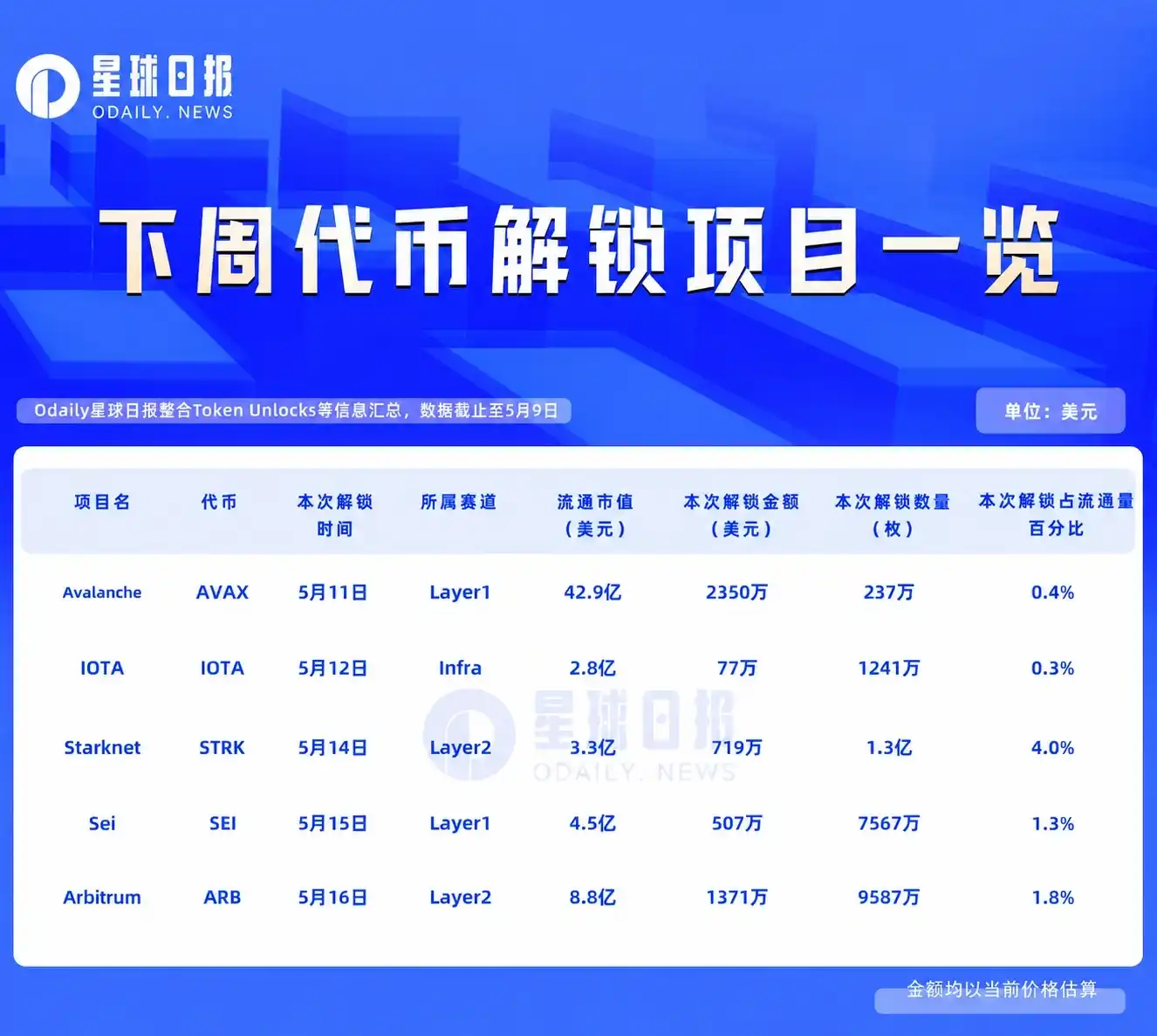
Weekly Token Unlock Recap: STRK's 4% Supply Release Sees Price Rally This week's major token unlocks featured two prominent Ethereum scaling solutions: **Starknet (STRK):** Approximately 130 million STRK tokens (4% of circulating supply), valued at roughly $7.19 million, were unlocked. Starknet is an Ethereum Layer 2 network utilizing zk-STARKs technology to enable faster and cheaper transactions. Despite the significant supply increase, the token's price experienced an upward movement. **Arbitrum (ARB):** Around 95.87 million ARB tokens, worth approximately $13.71 million, were released. Arbitrum is another leading Ethereum Layer 2 solution that processes transactions off-chain before bundling them for Ethereum mainnet settlement, offering improved scalability and lower costs. The ARB token grants holders governance rights within the ecosystem. Both projects continue to play significant roles in scaling the Ethereum network.

Starknet

Project Twitter: https://twitter.com/Starknet

Project Website: https://starknet.io/

Tokens Unlocked This Round: 130 million

Value of Unlocked Tokens: Approximately $7.19 million USD

Starknet is a Layer 2 for Ethereum, utilizing zk-STARKs technology to make Ethereum transactions faster and cheaper. Its parent company, StarkWare, was founded in 2018 and is headquartered in Israel. StarkWare's main products include Starknet and StarkEx. By using STARKs, Starknet verifies transactions and computations without requiring every network node to validate each operation. This significantly reduces the computational load and increases the throughput of the blockchain network.

Arbitrum

Project Twitter: https://twitter.com/arbitrum

Project Website: https://arbitrum.io/

Tokens Unlocked This Round: 95.87 million

Value of Unlocked Tokens: Approximately $13.71 million USD

Arbitrum is an Ethereum Rollup designed to enhance Ethereum's scalability. It aggregates and processes transactions off-chain before submitting a single transaction to the Ethereum mainnet. This means users can enjoy faster and cheaper transactions while still benefiting from the security and decentralization of the Ethereum network. The native token of Arbitrum is ARB. ARB holders can participate in the decision-making process, such as proposing and voting on protocol upgrades or changes.


Related Questions

QAccording to the article, which project will unlock 1.3 billion tokens this week?

AAccording to the article, Starknet (STRK) will unlock 1.3 billion tokens this week.

QWhat is the approximate USD value of Arbitrum's (ARB) token unlock mentioned in the article?

AThe approximate USD value of Arbitrum's token unlock mentioned in the article is $13.71 million.

QWhat core technology does Starknet use to scale Ethereum transactions?

AStarknet uses zk-STARKs technology to scale Ethereum transactions, making them faster and cheaper.

QWhat is the primary purpose of the Arbitrum network as described in the text?

AThe primary purpose of the Arbitrum network is to increase Ethereum's scalability by aggregating and processing transactions off-chain before submitting them to the Ethereum mainnet.

QWhat role do ARB token holders have within the Arbitrum ecosystem?

AARB token holders can participate in governance, such as proposing and voting on protocol upgrades or changes within the Arbitrum ecosystem.

Related Reads

Five Core Forms of AI Agent in YC's Eyes

The article outlines five core architectural patterns for effective AI Agents, emerging from tools like Codex and Claude, that move beyond simple prompts towards reusable, process-based capabilities. 1. **Skills**: Reusable, parameterized workflows that function like method calls, allowing a single process (e.g., "/investigate") to handle various tasks based on input parameters. 2. **Thin Harness**: A lightweight execution framework (~200 lines) that manages the AI model's "hands and feet"—handling loops, file I/O, and context—without becoming bloated. 3. **Resolvers**: Routing tables that map tasks to specific Skills, preventing "context corruption" when managing dozens of Skills and ensuring outputs go to the correct locations. 4. **Latent vs. Deterministic Layer**: A critical separation where LLMs handle judgment, synthesis, and pattern recognition, while deterministic code handles tasks requiring precision, consistency, and low cost (like calculations). 5. **Memory**: A persistent, accumulating knowledge base (e.g., a markdown folder) with a "current trusted conclusion" section and an append-only timeline, enabling the system to learn and retain context over time. Together, these patterns create a "process power"—a durable competitive advantage. Unlike one-off prompt-based applications whose value quickly commoditizes, a well-designed AI Agent system encodes experience into reusable, parameterized workflows, offloads stable rules to code, and continuously learns through memory. This creates a structured, hard-to-replicate capability that can provide sustained value for individuals or businesses, such as an accountant automating client reviews while preserving privacy and accumulating expertise.

marsbit1h ago

Five Core Forms of AI Agent in YC's Eyes

marsbit1h ago

Tiger Research: On-Chain Risk Operators, The Market Cap Gap Between 147 Trillion and 70 Billion

This report by Tiger Research examines the evolution of risk management in decentralized finance (DeFi) lending. It highlights a power shift from protocol developers to specialized professional risk operators who manage on-chain capital. The era of protocols and community governance solely dictating DeFi lending is ending. A new professional asset management layer has emerged. While the sector is nascent, capital and distribution channels are rapidly consolidating around top risk operator teams, whose past performance is now a key criterion for institutional entry. The industry's development, accelerated by modular infrastructures like Morpho, has led to a clear division of labor mirroring traditional finance: distribution channels (e.g., exchanges), strategy/risk management (the risk operators), and product infrastructure/asset custody (smart contract protocols). This structure lowers the entry barrier for traditional institutions. Currently, the total value managed by risk operators is approximately $70 billion, dominated by a few leading teams like Steakhouse (RWA focus), Sentora (AI models), and Gauntlet (crisis management). Competition now centers on collateral standards, distribution access, and crisis response capabilities. The report outlines three primary entry paths for institutions: 1) **Distribution Model**: Leveraging external risk operators as backend service providers (common for exchanges). 2) **Asset Supply Model**: Onboarding real-world assets to DeFi as collateral. 3) **Independent Operator Model**: Building an in-house team to become a risk operator (e.g., Bitwise). The core opportunity lies in the strategy/risk management layer, where traditional financial institutions can leverage their existing expertise in due diligence and risk assessment without deep technical development. A vast opportunity gap exists: the global traditional asset management industry manages ~$147 trillion, while the entire DeFi sector is only ~$800 billion, with the risk operator niche at ~$70 billion. This disparity signifies immense growth potential. Once robust risk frameworks and clearer regulations are established, even a minor allocation from traditional markets could trigger exponential DeFi growth. Early movers who help build these foundational systems will gain significant rule-setting influence and first-mover advantages.

marsbit1h ago

Tiger Research: On-Chain Risk Operators, The Market Cap Gap Between 147 Trillion and 70 Billion

marsbit1h ago

Trading

Spot
Futures

Hot Articles

How to Buy 4

Welcome to HTX.com! We've made purchasing 4 (4) simple and convenient. Follow our step-by-step guide to embark on your crypto journey.Step 1: Create Your HTX AccountUse your email or phone number to sign up for a free account on HTX. Experience a hassle-free registration journey and unlock all features.Get My AccountStep 2: Go to Buy Crypto and Choose Your Payment MethodCredit/Debit Card: Use your Visa or Mastercard to buy 4 (4) instantly.Balance: Use funds from your HTX account balance to trade seamlessly.Third Parties: We've added popular payment methods such as Google Pay and Apple Pay to enhance convenience.P2P: Trade directly with other users on HTX.Over-the-Counter (OTC): We offer tailor-made services and competitive exchange rates for traders.Step 3: Store Your 4 (4)After purchasing your 4 (4), store it in your HTX account. Alternatively, you can send it elsewhere via blockchain transfer or use it to trade other cryptocurrencies.Step 4: Trade 4 (4)Easily trade 4 (4) on HTX's spot market. Simply access your account, select your trading pair, execute your trades, and monitor in real-time. We offer a user-friendly experience for both beginners and seasoned traders.

4.0k Total ViewsPublished 2025.10.20Updated 2025.10.29

How to Buy 4

Discussions

Welcome to the HTX Community. Here, you can stay informed about the latest platform developments and gain access to professional market insights. Users' opinions on the price of 4 (4) are presented below.

活动图片