With $950 Million in Revenue, How Does Pump.fun Use $3 Million to 'Vote' for the Next Viral Meme?

比推Published on 2026-01-20Last updated on 2026-01-20

Abstract

Pump.fun, a leading platform in the Meme token space with over $950 million in historical revenue, has launched an investment division called Pump Fund. The fund will invest $3 million in total across 12 new tokens launched on its platform, allocating $250,000 per token at a valuation of $10 million each. In addition to financial support, selected projects will receive mentorship from Pump.fun’s founders and other resources. The initiative is part of a new "Build in Public (BiP)" hackathon, which encourages founders to publicly develop products after launching a token on Pump.fun. Participants must hold at least 10% of their token supply and are encouraged to actively engage with the community via social media and live streams. The selection process prioritizes organic growth and long-term sustainability over marketing hype. The application period opened on January 19 and will run for 30 days, with the first winners announced by February 18. The program is designed to identify and support promising Meme tokens with real utility and community backing, offering a new path for early-stage projects to gain traction.

Author: Azuma

Original Title: Pump.fun Launches Direct Investment, Spending $3 Million to Buy 12 New Memes


On the morning of January 20, Pump.fun officially announced the launch of its investment division, Pump Fund. Pump Fund will initiate its first project, the Build in Public (BiP) Hackathon, this month, investing $3 million in 12 new tokens issued through the platform, with $250,000 allocated to each token at a valuation of $10 million. In addition to financial support, Pump.fun will also provide professional guidance from its founders and other substantial resources.

As the project with the strongest revenue-generating capability in the entire Meme sector, this is the first time Pump.fun has openly expressed its support for specific Meme tokens through official channels, using real money (the attitude may be more important than the scale of funding). Therefore, the selected tokens are highly likely to become the frontrunners in the Meme sector in the coming period.

Pump.fun's Revenue-Generating Capability

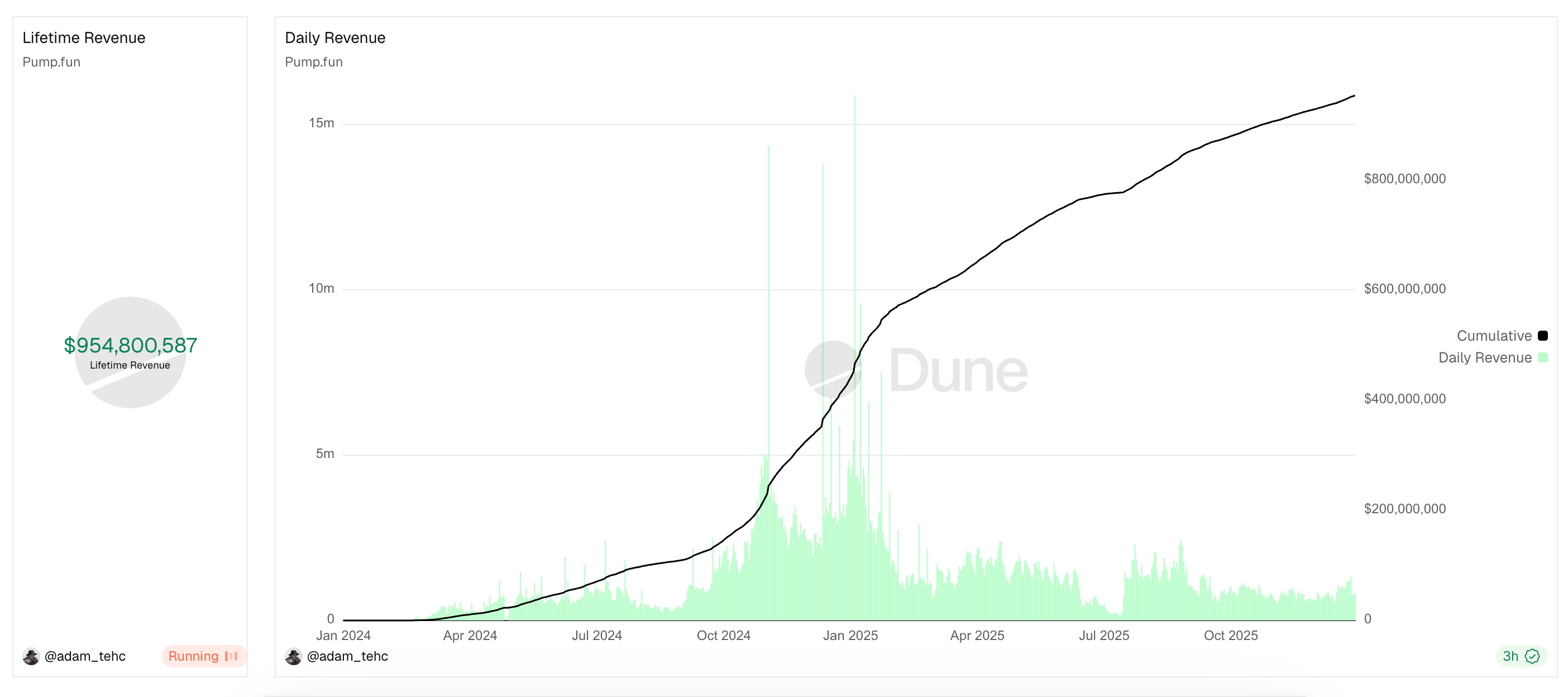
Pump.fun's staggering revenue-generating ability is no secret. Data compiled by analyst Adam (@Adam_Tehc) on Dune shows that Pump.fun's historical total revenue has reached $954.8 million. Although daily revenue has significantly declined as the Meme hype cooled down, it still amounts to hundreds of thousands of dollars per day.

With massive real money at hand, Pump.fun is exploring other ways to give back to the ecosystem beyond PUMP token buybacks. Pump Fund and its affiliated BiP Hackathon are Pump.fun's latest attempts.

BiP Hackathon Details

According to the description on the BiP Hackathon's dedicated page, the project aims to support founders who issue tokens on Pump.fun and publicly build products. Unlike traditional hackathons where participants rely on VCs or judges for evaluation to compete for prizes, the BiP Hackathon intends to introduce token performance as a variable, allowing the market to determine whether a project is worth advancing, while enabling users to become the earliest investors.

When discussing this key difference, Pump.fun founder Alon stated in an X post: "Before Pump.fun, my co-founder and I tried many different ideas. Consumer finance, DeFi, SocialFi, NFTs—but all failed. One of the biggest problems we encountered was how difficult it was to get our products in front of users. Trying to reach the right audience was an extremely tedious task..."

Specifically, the BiP Hackathon requires:

  • Participants must issue a token on Pump.fun and then publicly build a product;

  • Participants must also hold at least 10% of the token supply to align interests;

  • Finally, the event strongly encourages founders to speak publicly on social media like X or livestream on Pump.fun to maintain effective communication with the community.

As for the types of projects, Pump.fun has not set any restrictions; they are not even limited to cryptocurrency-related products. Projects from different market stages and various verticals can participate.

Regarding how the 12 winning projects will ultimately be selected, Pump.fun did not provide specific rules but highlighted two key principles: first, organic user growth and genuine appeal are preferred over connections and flashy promotions; second, in addition to the appeal of the product itself/social media presence, the event will also assess the long-term sustainability of the projects.

Key Timelines to Watch

According to the BiP Hackathon's schedule, the application process opened on January 19. Participants are required to launch their tokens at the time of application and begin public building (including livestreaming development progress, regularly sharing updates, and maintaining community interaction). The application window will remain open for 30 days. On February 18, Pump.fun will announce the first batch of winning projects and provide funding (at least one will be announced). Considering that some projects may require more time to gain market attention and demonstrate appeal, the program will continue to operate long-term.

So the timeline is clear: if you want to spot potential opportunities among this batch of Meme tokens, you need to start paying attention to newly issued tokens on Pump.fun from now on, especially those with the Pump Fund or BiP labels. Although the first batch of winning tokens won't be announced until 30 days later, tokens likely to be selected by Pump.fun will undoubtedly show competitiveness well before that.

Overall, while Pump.fun's event may not be enough to drive a collective rebound in Meme market sentiment, it can at least contribute some new tokens with clearer evaluation dimensions.


Twitter:https://twitter.com/BitpushNewsCN

Bitpush TG Discussion Group:https://t.me/BitPushCommunity

Bitpush TG Subscription: https://t.me/bitpush

Original link:https://www.bitpush.news/articles/7604435

Related Questions

QWhat is the total historical revenue of Pump.fun as mentioned in the article?

AThe total historical revenue of Pump.fun is $954.8 million.

QWhat is the name of the new investment department launched by Pump.fun and what is its first project?

AThe new investment department is called Pump Fund, and its first project is the Build in Public (BiP) hackathon.

QHow much funding will Pump.fun provide to each of the 12 selected tokens in the BiP hackathon, and what valuation does this correspond to?

APump.fun will invest $250,000 in each of the 12 selected tokens, corresponding to a valuation of $10 million per token.

QAccording to the article, what are the two main principles Pump.fun will use to select the winning projects for the BiP hackathon?

AThe two main principles are: 1) Natural user growth and genuine appeal are favored over connections and flashy marketing. 2) The long-term sustainability of the project will be evaluated in addition to the product's appeal and social media presence.

QWhen did the application window for the BiP hackathon open, and when will the first batch of winning projects be announced?

AThe application window opened on January 19th and will be open for 30 days. The first batch of winning projects will be announced on February 18th.

Related Reads

Farewell to Traditional Bulls and Bears: The Market Has Entered an Era of Rotating Bubbles

Farewell to traditional bull and bear markets; we have entered an era of rolling bubbles. This article uses a meteorological analogy to explain the modern market's shift from slow-moving, long-term trends to a chain of rapid, successive speculative frenzies. The old market resembled "stratiform" weather—slow, broad cycles lasting years. Today's market is like a "mesoscale convective system," where isolated storms (bubbles in sectors like AI, GLP-1 drugs, or crypto) form in sequence. Each is triggered by the outflow of capital and sentiment from the previous one, creating a self-perpetuating chain of booms and busts. This structural change is driven by eight permanent shifts: the democratization of speculation (zero-commission trading, retail options activity), perpetual buying from defined-contribution retirement plans, the dominance of passive investing (creating price-insensitive flows), the rise of multi-strategy funds and high-frequency trading (weakening price discovery), suppressed volatility that erupts violently, an index composition now dominated by long-duration, narrative-driven tech stocks, the elimination of information delays, and a permissive fiscal/monetary backdrop. These conditions ensure that rolling bubbles are the new normal. To navigate this environment, investors should either become deep-sector experts who understand the underlying technologies and business models or become adept observers of trends and capital flows. While chaotic from within each "storm," a higher-altitude view reveals a predictable pattern of serial booms. The key is to avoid being emotionally swept up in any single narrative and to recognize the market's new, permanent structure.

marsbit26m ago

Farewell to Traditional Bulls and Bears: The Market Has Entered an Era of Rotating Bubbles

marsbit26m ago

The Right Way to Use Skills: 5 Reflections After Anthropic Publicly Shared Its Internal Methodology

A deep dive into Anthropic's internal methodology for building effective AI "Skills" reveals five key insights for maximizing their value. First, Skills should focus on capturing "Gotchas" and tacit organizational knowledge—like common pitfalls and undocumented rules—rather than restating general information the AI already knows. Second, think of Skills as a form of "Context Engineering"; they are best structured as folders, not monolithic documents. A core `SKILL.md` file should act as a navigational index, progressively pulling in detailed references, examples, and assets only as needed to avoid overwhelming the model's context window. Third, whenever possible, automate repetitive tasks with scripts. This preserves the model's reasoning capacity for judgment and analysis, while scripts reliably handle the execution, saving tokens and improving accuracy. Instructions within a Skill provide the "why" and the expert judgment, while scripts provide the concrete "how." Fourth, a Skill's description is critical and often misunderstood. It should not be a list of features but a routing rule that clearly signals *when* the Skill should be triggered based on user intent and common phrasing. Finally, as Skills scale from personal tools to team-wide assets, management is crucial. Anthropic advocates for a lightweight, organic approach: let new Skills spread organically within small groups first. Those that prove genuinely useful through adoption naturally graduate to a formal marketplace, ensuring the curated library contains only high-value, battle-tested tools.

marsbit43m ago

The Right Way to Use Skills: 5 Reflections After Anthropic Publicly Shared Its Internal Methodology

marsbit43m ago

Trading

Spot
Futures

Hot Articles

Discussions

Welcome to the HTX Community. Here, you can stay informed about the latest platform developments and gain access to professional market insights. Users' opinions on the price of MEME (MEME) are presented below.

活动图片