Original author: Nicky, Foresight News
On August 3rd, asset management company Hashdex announced the closure and liquidation of its Hashdex Bitcoin ETF (NYSE Arca: DEFI), marking the first spot Bitcoin ETF to officially announce liquidation in the US market. As of July 30th, the fund's assets under management were approximately $14.7 million, holding about 225.58 Bitcoins. Hashdex stated that the closure decision was based on a comprehensive assessment of factors including assets under management, trading liquidity, operational costs, and investor interest.
According to the official announcement, the last trading day for DEFI shares will be August 17th. After this date, it will stop accepting creation orders from authorized participants and be delisted from NYSE Arca. Shareholders who still hold shares by the last trading day will receive a cash liquidation distribution, expected to be paid around August 28th.
DEFI was initially launched for trading in September 2022 as a Bitcoin futures ETF. It was the first Bitcoin futures ETF in the US registered solely under the Securities Act of 1933, launched by Hashdex in collaboration with Teucrium Trading and Victory Capital. In January 2024, the US Securities and Exchange Commission approved 11 spot Bitcoin ETF applications, including Hashdex's. In March of the same year, DEFI completed its transition from a futures strategy to a spot strategy, officially rebranded as the Hashdex Bitcoin ETF, with a fee rate set at 0.25%. Since its inception, the fund has delivered a cumulative performance of approximately 166%, but its asset size has remained chronically low, with a historical peak of only about $17.54 million before declining again.

Marcelo Sampaio, Hashdex CEO (Image source: NYSE)
Hashdex is a global asset management company focused on crypto asset index investments, founded in 2018 in Rio de Janeiro, Brazil, by Marcelo Sampaio, Bruno Caratori, and others. In 2020, it partnered with Nasdaq to develop the Nasdaq CME Crypto Index. In 2021, it launched products like HASH11 in Brazil and later expanded to European and US markets. In February 2025, Hashdex launched the multi-asset crypto ETF NCIQ in the US, currently tracking seven crypto assets. As of July 28, 2026, Hashdex's global crypto index product assets under management exceeded $888 million, covering eight countries.
While closing DEFI, Hashdex continues to advance other product innovations. On July 24th, the company filed documents with the SEC announcing that its NCIQ has been approved to conduct staking activities with the crypto assets held by the fund, with Coinbase Cloud as the initial staking service provider. According to the distribution plan, staking net income equivalent to up to 25 basis points annualized of the net asset value per common share goes to the sponsor; any amount exceeding that is split 40% to the sponsor and 60% to the holders.
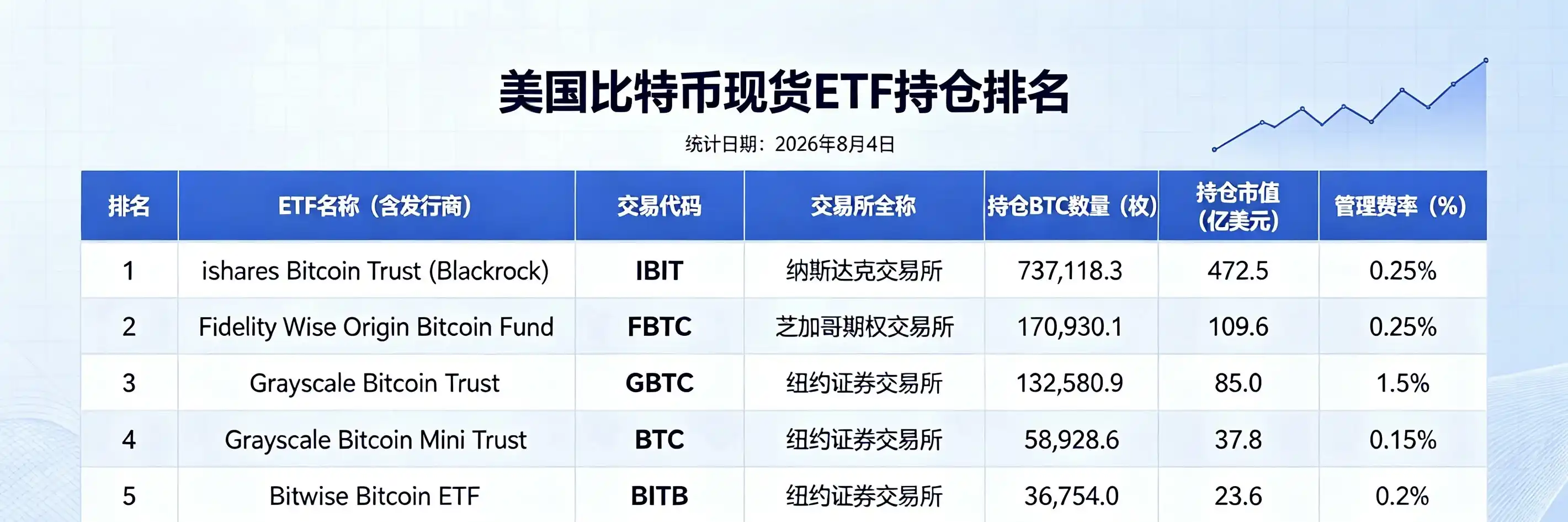
According to BitBo data, as of August 4th, there are 13 spot Bitcoin ETFs in the US market, collectively holding approximately 1.212 million Bitcoins, accounting for about 5.773% of the total Bitcoin supply, with a total size of about $77.7 billion. However, the fund distribution is extremely uneven. The top five products hold about $72.85 billion, occupying almost the entire market share.
BlackRock's iShares Bitcoin Trust (IBIT) holds about 737,000 Bitcoins, with a size of approximately $47.25 billion, accounting for over 60% of the total market size, with a fee rate of 0.25%. Fidelity Wise Origin Bitcoin Fund (FBTC) holds about 171,000 Bitcoins, with a size of about $10.96 billion, also with a 0.25% fee. Grayscale Bitcoin Trust (GBTC) holds about 133,000 Bitcoins, with a size of about $8.5 billion. Despite its high fee rate of 1.5% and persistent net outflows, it maintains its position as the third largest due to first-mover advantage and existing holdings. Grayscale's mini trust BTC holds about 59,000 Bitcoins, with a size of about $3.78 billion and a fee rate of only 0.15%, attracting significant funds transferred from GBTC.
Bitwise's BITB (0.2%), ARK 21Shares' ARKB (0.21%), and VanEck's HODL (0.25%) have sizes ranging from $1 billion to $2.4 billion, forming the middle tier. Morgan Stanley's MSBT holds about 6,231 Bitcoins, with a size of about $399 million, marking the first Bitcoin ETP directly held by a Wall Street investment bank. Valkyrie's BRRR, Franklin's EZBC, and Invesco's BTCO have sizes between $340 million and $380 million. WisdomTree's BTCW is about $143 million. In contrast, Hashdex's DEFI holds only about 225.6 Bitcoins, with a size of about $14.46 million, ranking at the bottom.
Management Fee Ledger: Annual Revenue Hardly Covers Operating Costs
The core revenue for ETF issuers comes from management fees, accrued daily as a percentage of the fund's assets under management. Taking DEFI as an example, with a fee rate of 0.25% and assets of $14.7 million, the annual management fee revenue is only about $36,700. Even at its peak size of $17.54 million, the annual revenue was less than $44,000. The fixed operating costs for a Bitcoin spot ETF include custody fees (Bitcoin custody requires qualified custodians like Coinbase, typically charging several basis points of assets plus a fixed fee), legal compliance and auditing (SEC periodic reporting, AML reviews, annual audits, etc., with annual expenditures in the hundreds of thousands of dollars range), market making and liquidity management (small ETFs need to pay higher incentives to maintain reasonable spreads), exchange listing annual fees, as well as director & officer liability insurance and administration. Industry estimates put the minimum annual operating cost for an ETF at $500,000 to over $1 million.
Even for ETFs with assets over $300 million like Valkyrie BRRR and Franklin EZBC, annual management fee revenue at the same fee rate is around $9 million, leaving profit room after subtracting operating costs. For WisdomTree BTCW below $150 million, annual management fee revenue is about $357,000, already at the breakeven edge. DEFI's annual revenue is only one-tenth of that, showing a clear operational deficit. With shares continuously shrinking and no new fund inflows, it is not commercially sustainable for the issuer to continue subsidizing operating expenses, making liquidation a rational choice.
Hashdex DEFI's exit is not just about size numbers; deeper reasons lie in the structural disadvantages of the issuer's origin and client acquisition capabilities in the US market. Hashdex originated in Rio de Janeiro, Brazil, and built strong brand recognition in Latin American and European markets. Its HASH11 once became Brazil's largest crypto index ETF. However, the US ETF market is dominated by Wall Street giants. Institutional investors place high importance on brand trust, capital strength, and trading depth when choosing products. When established institutions like BlackRock, Fidelity, and Morgan Stanley simultaneously launched similar products, fund managers tend to favor these long-term partners rather than issuers from emerging markets lacking a traditional asset management foundation in the US.
This gap is even more pronounced in customer acquisition costs. Leading issuers have vast existing client bases. BlackRock and Fidelity cross-sell to existing clients through their own platforms and channels like pensions, endowments, and family offices, with marginal customer acquisition costs being extremely low, almost zero. Grayscale has accumulated years of crypto-native investors. In contrast, Hashdex needed to build its brand from scratch in the US. Every step—participating in industry conferences, maintaining data terminal displays, sustaining market maker relationships—means high investment. At the same 0.25% fee level, a revenue gap tens of times larger means Hashdex cannot invest equivalent resources in marketing and investor education.
If Bitcoin prices continue to rise, DEFI's asset size could improve with market appreciation and new inflows, but structural challenges might not be fundamentally resolved. Assuming Bitcoin's rise pushes the size back to $50 million, annual management fee revenue could increase to $125,000, but the operational deficit would still exist. The true breakeven point requires assets exceeding $200 million, demanding a combined force of net investor inflows and price appreciation. However, in a highly concentrated competitive landscape, new funds continuously converge towards the top. BlackRock's IBIT has attracted tens of billions of dollars since listing. Small ETFs often only receive limited spillover even in a bull market. The fact that DEFI's size remained only $17.54 million during Bitcoin's peak in 2025 is proof; the bull market tailwind was insufficient to compensate for the shortcomings in client acquisition.
Besides Hashdex, Which Small ETFs Are in Danger?
As of August 4th, WisdomTree BTCW ($143 million), Invesco BTCO ($348 million), Franklin EZBC ($370 million), and Valkyrie BRRR ($377 million) are the four smallest funds. Among them, BTCW is closest to the safety margin. At a 0.25% fee rate, its annual management fee revenue is about $357,000. If the size continues to shrink, it might enter a loss-making zone. However, as an established ETF issuer, WisdomTree might continue its operation for strategic reasons like maintaining product line completeness. Invesco, Franklin, and Valkyrie have sizes around $350 million, with annual management fee revenue of about $870,000, facing little short-term survival pressure.
Prior to DEFI, there have been precedents of Bitcoin-related ETF closures in the US market, but they were all futures or other types. In January 2024, VanEck closed its Bitcoin futures ETF XBTF, which had a size of about $50 million at closure, as the company decided to concentrate resources after spot ETF approval. Earlier, in October 2022, Valkyrie's VBB was liquidated due to its small size of only about $570,000.