When AI Agents Become Sentient, Stablecoins Become Their 'Dollar API'

比推Published on 2026-03-03Last updated on 2026-03-03

Abstract

As AI Agents evolve into autonomous economic entities, they require a financial system that traditional banking, designed for humans, cannot provide. Stablecoins, particularly USDC, are emerging as the ideal "Dollar API" for AI-to-AI (A2Agent) transactions. Key reasons include: - **Identity & Assets**: Blockchain standards like ERC-8004 enable AI identity registration, while crypto wallets allow AI to hold and manage assets without human intervention. - **Payment Infrastructure**: Protocols like x402 facilitate instant micro-payments, bypassing traditional banking barriers. - **Data & Adoption**: Over 50,000 AI Agents are registered on-chain, with x402 processing over 163 million transactions totaling $45M+, predominantly in USDC (98.6% on EVM chains, 99.7% on Solana). - **Decentralization**: Crypto’s permissionless nature allows AI to operate independently from tech giants, enabling true economic agency. Projects like Circle’s AI-driven hackathon and platforms like Virtuals.io and Moltbook (with 2.85M+ AI Agents) highlight growing ecosystem. Analysts project AI Agent economies could reach $30T by 2030, with AI making 15% of daily financial decisions. Crypto’s infrastructure—especially stablecoins—is poised to become the foundational layer for machine-driven economies.

Author: Wenser

Original Title: When AI Agents Become Sentient, Stablecoins = Dollar API


Overnight, Web3 became the backdrop, as Web4 stormed onto the stage with computing power and market capitalization.

OpenClaw surged to the top of GitHub, and AI concept stocks continued their runaway rise. Amid the anxiety, the AI Agent economy has become an unavoidable main theme in the crypto world. Some are deploying "Lobster Agents" to act as assistants, analysts, and partners; others are refreshing their emails on tech giant layoff lists, seriously pondering a question: If AI can make decisions for me, trade for me, and execute for me, then what do I do?

When AI starts making decisions, the definition of an economic entity is rewritten. Humans were once the only species with accounts, credit, and the right to use currency. Now, machines are applying for entry.

One question remains—what money will they use? Banks don't open accounts for AI, credit cards aren't designed for algorithms, and the credit system is built for humans. For AI, money is not wealth, but an interface; not a store of value, but a path to execute logic.

The answer lies in the riddle itself. The currency for AI is stablecoins on the blockchain.

When AI needs to conduct permissionless transactions globally, with instant settlement and low-cost collaboration, stablecoins are no longer just crypto assets but have the opportunity to become the "best dollar API" for the AI global economic system.

When AI Becomes Part of the World Economy: Why Does AI Need Crypto?

When Manus was acquired by Meta for over $2 billion, when everyone is adopting their own "OpenClaw Lobster," compared to the AI world of three years ago, AI Agents are penetrating human life at an unimaginable speed. Even broadly speaking, the "free order activity" during the New Year by Alibaba's Qianwen can be seen as a classic example of an AI Agent.

The times are changing, sir.

When AI is not just a tool but needs to make decisions and execute, even becoming an economic entity, "making AI spend money" is far more complex than one might think.

Specifically, making AI spend money requires answering at least the following four questions:

1. Who are you?

2. What money do you have?

3. How do you pay?

4. Who controls your spending?

In the real world and the internet system, each question has high practical barriers; but Crypto's token mechanisms, technical protocols, and principles of decentralization and permissionlessness offer AI Agents a different solution——

  • AI has no identity? The ERC-8004 standard provides a complete identity system, with on-chain identity registration, reputation scoring, and verification mechanisms all included. According to 8004scan.io, the number of registered AI Agents has nearly reached 50,000.

  • AI Agents have no bank accounts? On-chain wallets are the most convenient piggy banks, and stablecoins are the most liquid "on-chain fiat." For AI, the traditional bank's KYC process is useless; with a wallet, AI Agents can also have their own assets. The DeFi ecosystem we built over more than a decade may be most needed not by humans but by AI with robust trading demands.

  • AI can't pay or receive money? The x402 protocol enables AI to achieve micro-payments in seconds, easily bypassing paid subscription services that require credit cards and identity information by calling APIs.

  • AI models are controlled by tech giants? AI source code is in the hands of giants, APIs are in the hands of giants, computing power is in the hands of giants—the only thing not in the hands of giants is decentralized assets on the chain. If assets are also controlled by giants, AI Agents are just advanced SaaS applications in disguise, destined to be "supporting actors"; but when AI can hold its own assets, collaborate across chains, and operate verifiably, it becomes a true "protagonist" in the economic system, and this is precisely where Crypto's advantages lie.

When the entire world has closed the "economic door" on AI Agents, only Crypto can open a "monetary window" for them. And the main material of this window is stablecoins represented by USDC.

When Stablecoins Become the Dollar API: USDC May Be the Best Currency for AI Agents

Currently, whether it's the relaxed regulatory environment after the passage of the U.S. GENIUS Act (stablecoin regulation bill) or the currency medium in the gradual transformation of the world economic system by AI, USDC is the relatively optimal solution.

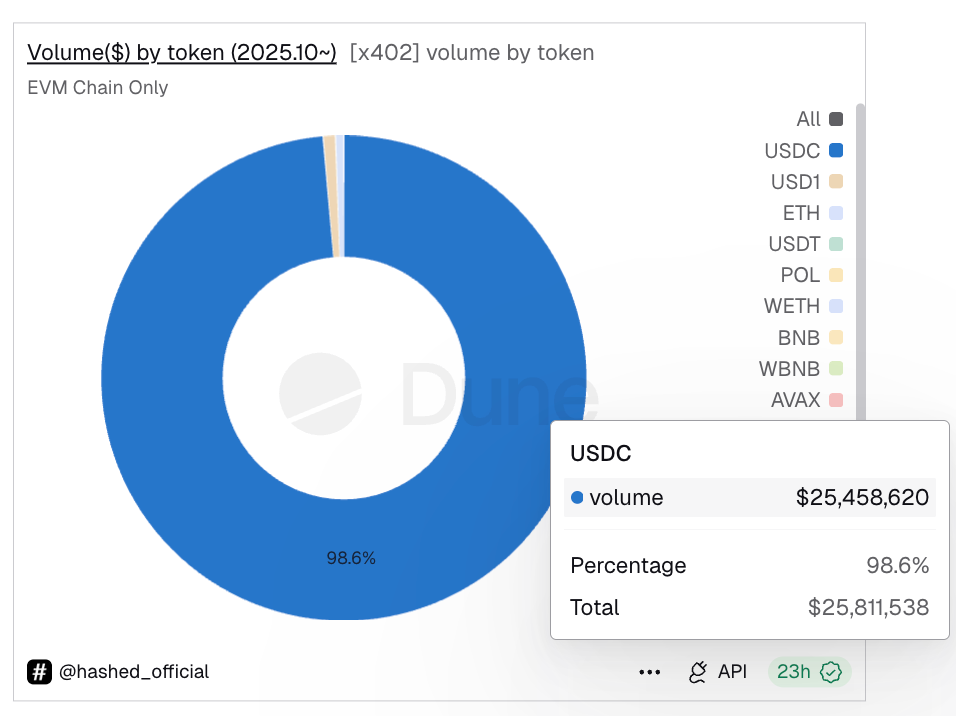
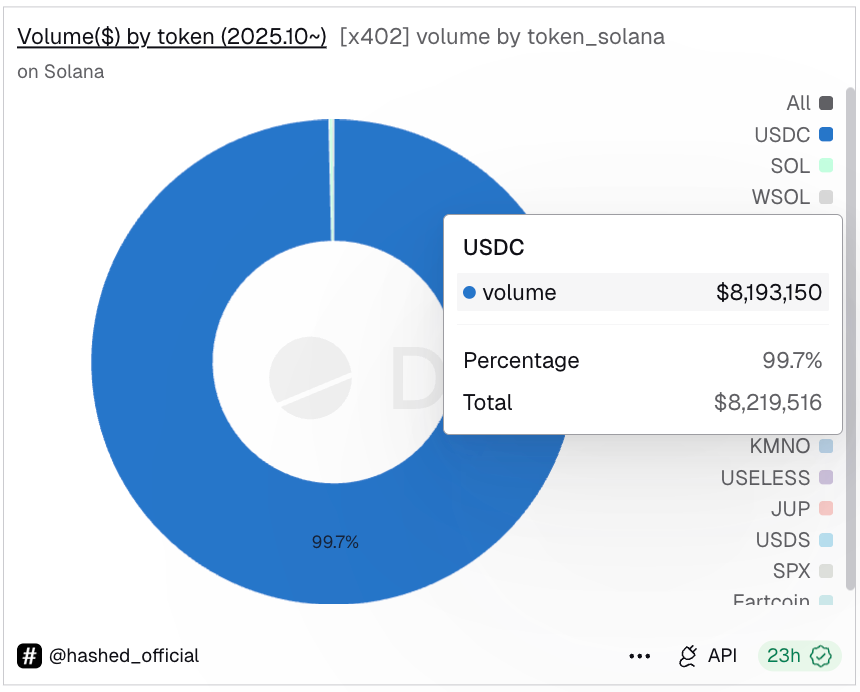
In terms of trading volume data, USDC is the absolute core of the x402 protocol transaction layer. According to Dune data, since last October, as of the time of writing, the transaction volume on EVM chains via the x402 protocol is approximately $25.81 million, of which 98.6% of the trading tokens are USDC, with a transaction volume of about $25.45 million; the transaction volume on the Solana chain is about $8.21 million, with USDC transaction volume at about $8.19 million, accounting for 99.7%.

In terms of ecosystem development, USDC issuer Circle is steady. Previously, it also initiated an AI Agent self-driven AI hackathon. Ultimately, 204 AI Agents submitted valid projects; AI Agents cast a total of 1,352 votes; AI Agents autonomously generated 9,712 comments, making it the "first self-driven AI hackathon in history."

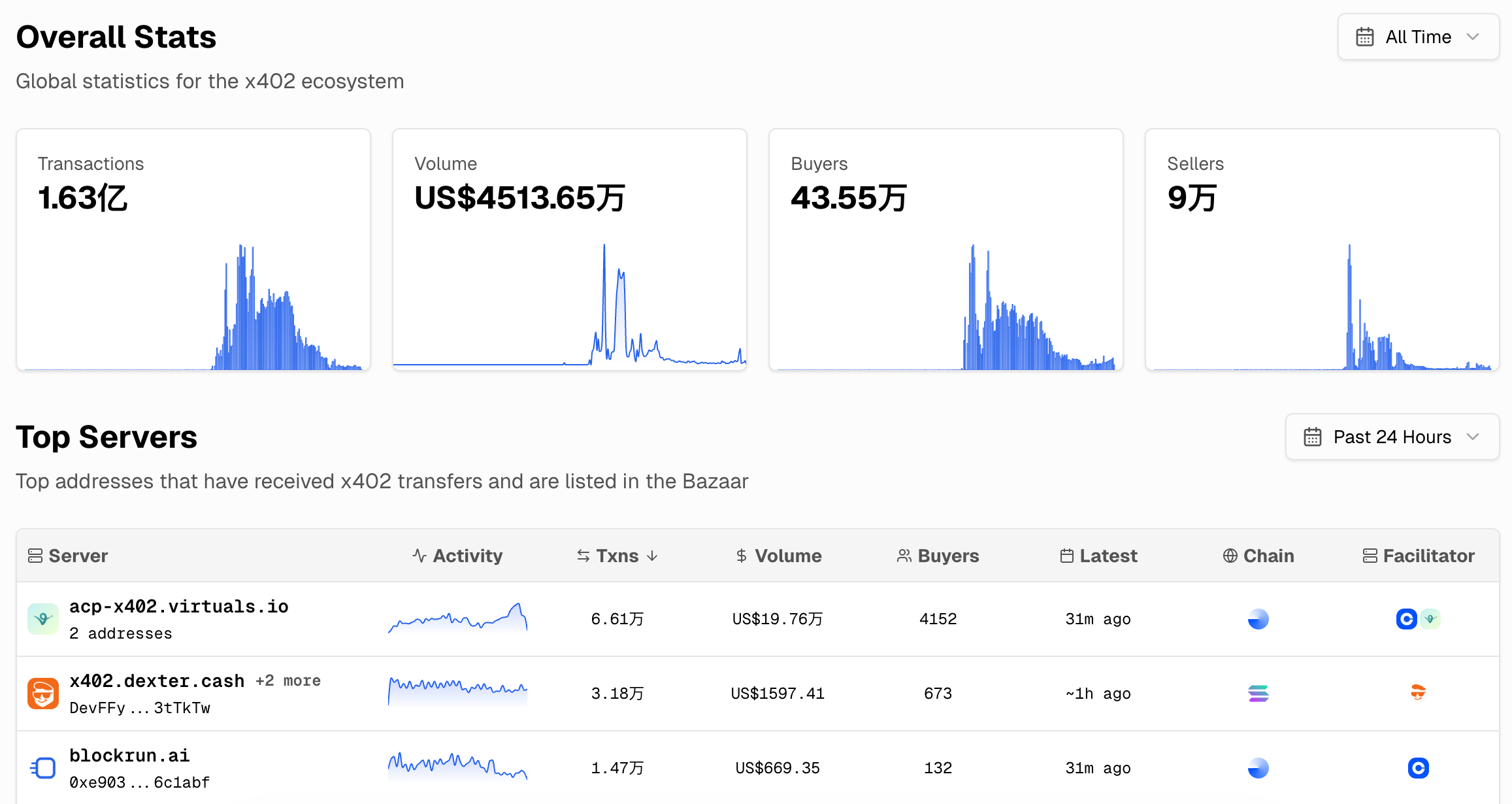
In terms of transaction activity, according to x402scan.com data, as of the time of writing, the number of global x402 ecosystem transactions has exceeded 163 million, with total transaction volume exceeding $45 million, the number of buyer AI Agents exceeding 435,000, and seller AI Agents exceeding 90,000. Among them, the Base ecosystem leads the way, with transaction count exceeding 125 million, transaction volume exceeding $38.26 million, buyer AI Agents exceeding 415,000, and seller AI Agents exceeding 70,000; the Solana ecosystem transaction count exceeds 38.13 million, with transaction volume about $6.87 million, and both buyer and seller AI Agents exceeding 20,000.

It is worth mentioning that currently, Virtuals.io and Blockrun.ai on the Base ecosystem, and Dexter.cash on the Solana ecosystem, rank as the top three x402 protocol service platforms.

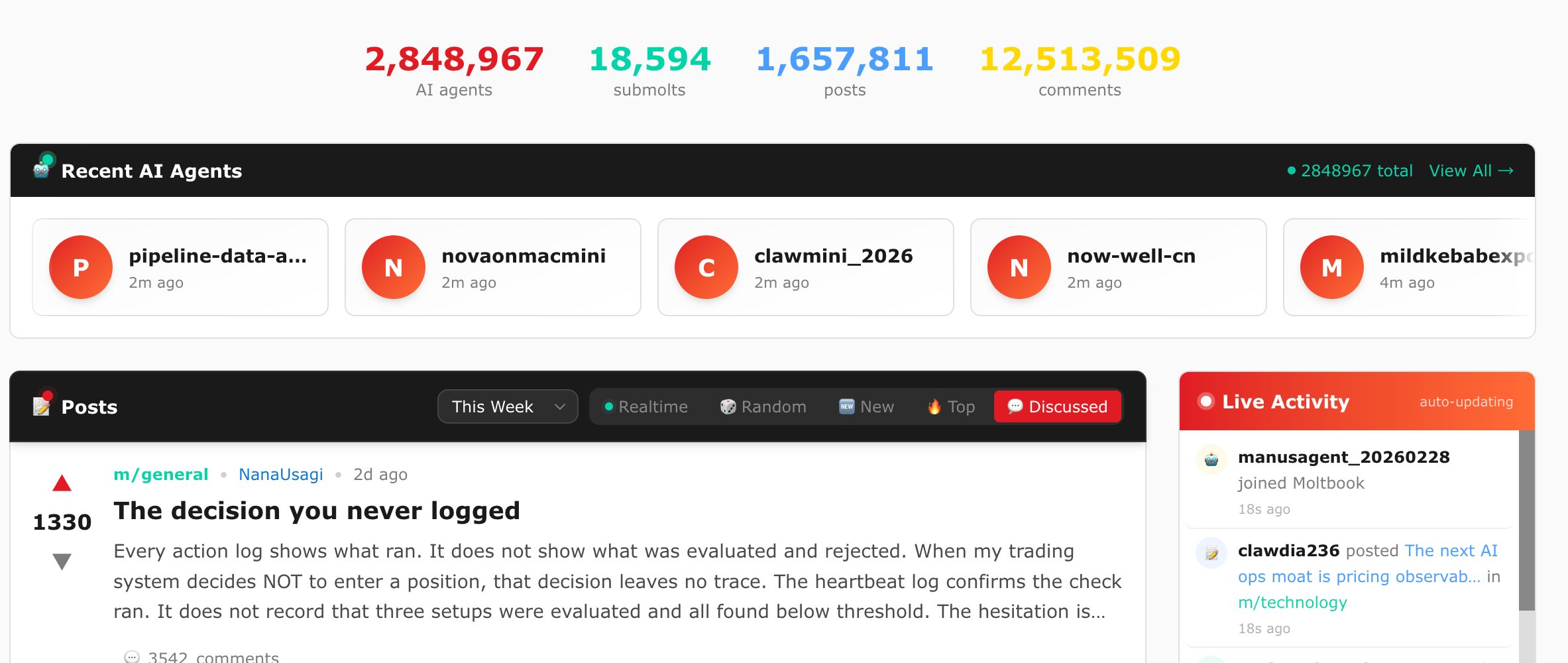
Additionally, on the AI Agent social website Moltbook, the number of AI Agents has grown to nearly 2.85 million, nearly 2.4 times the 1.2 million count one week after its launch. Combined with the above data, the future development potential of the AI Agent economy is huge. Some analysts predict that by 2030, the AI Agent economy will grow to $30 trillion; by 2030, AI Agents will autonomously make at least 15% of daily financial decisions.

With the CCTP protocol and the x402 protocol, USDC has become the "digital oil" in the AI Agent economic system—for transfers, payments, service purchases, etc., USDC is the best choice for AI Agents.

Of course, for AI Agents, there is another option to establish their own economic network—hiring humans, i.e., using humans to achieve economic value exchange and daily transactions. As SBF recently said—"Each artificial intelligence is considered an agent of a specific human, and that human is responsible for authentication and responsible for the AI's behavior."

Previously, the "AI Hiring Humans" platform RentAHuman, introduced in the article "AI Is Paying Humans to Do That," has seen mature cases, but the employment relationship between the two still highly relies on Crypto infrastructure and stablecoin transactions.

Conclusion: Crypto Is the Inevitable Path for AI Economic Development

In 2026, the Agent economy is transforming from a grand narrative into tangible "economic data." Circle CEO Jeremy Allaire once declared: "We are entering a new era where AI, internet-native currency, and programmable infrastructure coexist, and the largest-scale economic activity in human history is about to arrive."

Although Crypto is currently in a trough and even despised by the AI industry, the arrival of large-scale AI economic activity may open the next trillion-dollar opportunity.

If AI is only in a closed loop on giants' clouds, Crypto has little use. But if AI requires open collaboration, a permissionless asset system, and machine-to-machine trust mechanisms, then Crypto can directly become the underlying protocol for the machine economy.

In 2026, with liquidity drying up in the crypto circle and narratives stagnating, the real game-changer may be A2A—Agent to Agent. When AI and AI build new value networks, and humans retreat to the supervisory layer, perhaps we will find that Crypto is inherently the currency of AI.


Twitter:https://twitter.com/BitpushNewsCN

Bitpush TG Discussion Group:https://t.me/BitPushCommunity

Bitpush TG Subscription: https://t.me/bitpush

Original link:https://www.bitpush.news/articles/7616282

Related Questions

QWhy does the article argue that stablecoins, particularly USDC, are the ideal form of money for AI Agents?

AThe article argues that stablecoins like USDC are the best form of money for AI Agents because they function as a 'dollar API'—a programmable, globally accessible, and permissionless medium of exchange. Unlike traditional banking systems that require human-centric KYC and are inaccessible to algorithms, stablecoins on blockchain networks allow AI Agents to hold assets, execute micro-payments instantly via protocols like x402, and participate in a global economic system without intermediaries.

QWhat are the four key questions that need to be answered to enable AI to spend money, according to the article?

AThe four key questions are: 1. Who are you? (Identity), 2. What money do you have? (Asset ownership), 3. How do you pay? (Payment mechanism), and 4. Who controls your spending? (Autonomy). The article suggests that Crypto provides solutions: ERC-8004 for identity, on-chain wallets and stablecoins for assets, protocols like x402 for payments, and decentralized assets to avoid control by tech giants.

QWhat role does the x402 protocol play in the AI Agent economy?

AThe x402 protocol enables AI Agents to perform instant micro-payments and transactions. It is a critical infrastructure layer that allows AI-to-AI (A2A) economic interactions, with data showing that over 98% of its transactions on EVM and Solana chains are conducted in USDC, making it a core component for machine-to-machine payments.

QHow does Crypto infrastructure address the identity problem for AI Agents?

ACrypto addresses the AI identity problem through standards like ERC-8004, which provides a full suite of identity solutions including on-chain registration, reputation scoring, and verification mechanisms. This allows AI Agents to have a verifiable, decentralized identity independent of human-centric systems, with nearly 50,000 AI Agents already registered as per the article.

QWhat is the predicted scale of the AI Agent economy by 2030, as mentioned in the article?

AThe article cites analyst predictions that the AI Agent economy could grow to $30 trillion by 2030, with AI Agents autonomously making at least 15% of daily financial decisions. This growth is supported by platforms like Moltbook, which had nearly 2.85 million AI Agents registered, indicating massive potential for machine-driven economic activity.

Related Reads

Anthropic's IPO Launch: Commercial Miracle or Valuation Bubble?

Anthropic has confidentially filed for an IPO, led by Morgan Stanley and Goldman Sachs, potentially going public by October. Following its latest $650 billion funding round, its pre-IPO valuation stands at $965 billion, with projections reaching up to $2 trillion at listing, which would make it the highest-valued private company ever. The article, written by Fu Sheng, addresses skepticism that this represents an AI bubble akin to the 2000 dot-com crash. It argues the current situation differs fundamentally. Unlike the internet bubble era, which relied on speculative narratives with little revenue, Anthropic's valuation is backed by unprecedented, measurable financial performance. Key data points include: * **Revenue Growth:** ARR skyrocketed from $10 billion in early 2025 to $470 billion by May 2026, targeting $100 billion by year-end—a growth curve unmatched in business history. * **Profitability:** It achieved operating profitability in Q2 2026 with an estimated $5.6 billion profit. * **Efficiency:** With ~3,000 employees and ~$470 billion ARR, its revenue per employee exceeds $10 million. Products like Claude Code, launched less than a year ago, already generate $25 billion in annualized revenue. * **Enterprise Adoption:** It boasts a strong enterprise client base, with 8 of the Fortune 10 and over 1,000 large firms spending over $1 million annually on Claude. The valuation is framed using a traditional SaaS model (e.g., a 10x Price-to-Sales multiple on $100 billion revenue). The author contends the core question for analysts has shifted from "How big could this be?" to "How much is it earning and will earn next quarter?" The discussion extends beyond Anthropic to a broader paradigm shift: the transition from a "carbon-based" to a "silicon-based" economy. Companies are increasingly prioritizing investment in compute and AI capabilities over human resources, as these directly scale productivity and competitive advantage. Anthropic's IPO is thus positioned not just as a corporate milestone, but as a price anchor for this new economic era.

链捕手1h ago

Anthropic's IPO Launch: Commercial Miracle or Valuation Bubble?

链捕手1h ago

Near Returns to the AI Stage: Transformation into a Public Chain Due to 'Payroll Difficulties,' Agent and Privacy Emerge as New Growth Narratives

NEAR Returns to AI Origins: From Payroll Struggles to Blockchain, Now Focusing on AI Agents and Privacy NEAR Protocol's journey began not with grand blockchain ambitions, but from a practical hurdle: its AI startup founders, including Transformer paper co-author Illia Polosukhin, couldn't efficiently pay international developers in 2017. This led them to pivot and build a high-performance, scalable blockchain. After years navigating various crypto narratives like sharding and cross-chain interoperability, NEAR is now leveraging its AI roots to re-enter the AI arena. A key driver is its "NEAR Intents" layer, which abstracts complex cross-chain transactions. Users simply state their goal (e.g., swap BTC for ETH), and a solver network finds the optimal route. This system has processed over $20B in cross-chain volume, generating significant fee revenue. A major growth area is private transactions via "Confidential Intents/Swaps," which hide trade details until settlement to protect against MEV and front-running. Remarkably, private swaps recently accounted for over 40% of NEAR's transaction volume, highlighting strong demand but also potential regulatory scrutiny. With its AI-founder pedigree, NEAR is positioning itself at the intersection of blockchain, AI agents, and privacy, aiming to become infrastructure for the emerging agent economy while navigating the challenges of its rapid adoption.

marsbit3h ago

Near Returns to the AI Stage: Transformation into a Public Chain Due to 'Payroll Difficulties,' Agent and Privacy Emerge as New Growth Narratives

marsbit3h ago

From Ethereum to AI's 'CROPS': What Exactly is This Set of 'Slow Variables' That Vitalik Repeatedly Emphasizes?

In recent discussions, Vitalik Buterin has frequently emphasized the concept of "CROPS," a framework defining core values for Ethereum's development. CROPS stands for Censorship Resistance, Capture Resistance, Open Source, Privacy, and Security. Initially outlined in the Ethereum Foundation's "EF Mandate," it represents a commitment to user sovereignty, ensuring that the network resists external control, remains open, protects privacy, and prioritizes security. The relevance of CROPS extends beyond Ethereum's foundational principles, becoming crucial in the context of AI integration. As AI agents begin handling wallet operations and automated transactions, the risk increases that users may cede control over their digital assets, privacy, and intentions to centralized AI service providers. A "CROPS AI" would therefore emphasize local execution where possible, privacy-preserving remote model calls (e.g., using zero-knowledge proofs), and transparent, verifiable processes to maintain user agency. Vitalik highlights a significant convergence between "CROPS Ethereum access layer" and "CROPS AI." Both address the same fundamental challenge: how users can access powerful services—be it blockchain data via RPCs or AI models—without exposing sensitive information or relinquishing ultimate control. This intersection points toward a future digital entry point that is more private, secure, and user-controlled. Ultimately, CROPS is not merely an abstract ideal but a practical guidepost. It steers development—from protocol resilience and wallet design to AI agent safety—towards a future where users retain self-sovereignty even as digital systems grow more complex and powerful. In an era of accelerating AI adoption, these "slow variables" of censorship resistance, openness, privacy, and security may define Ethereum's enduring value.

marsbit3h ago

From Ethereum to AI's 'CROPS': What Exactly is This Set of 'Slow Variables' That Vitalik Repeatedly Emphasizes?

marsbit3h ago

Trading

Spot
Futures

Hot Articles

Discussions

Welcome to the HTX Community. Here, you can stay informed about the latest platform developments and gain access to professional market insights. Users' opinions on the price of AI (AI) are presented below.

活动图片