US Senate confirms pro-crypto Selig to lead CFTC, Hill for FDIC

cointelegraphPublished on 2025-12-19Last updated on 2025-12-19

Abstract

The US Senate confirmed crypto-friendly lawyer Mike Selig as the new chair of the CFTC and elevated Travis Hill to lead the FDIC as part of a broader nomination package. Selig, who has prior regulatory experience, pledged to prioritize crypto oversight. Hill, who had been acting FDIC chair, has also expressed support for the industry. The CFTC may gain more direct authority over crypto markets through pending legislation, while the FDIC will play a key role in stablecoin regulation and banking access. Selig will serve until 2029, and Hill until 2030. Industry representatives from Coinbase and the Digital Chamber welcomed the appointments, expecting fair and clear regulation.

The US Senate has confirmed crypto-friendly lawyer Mike Selig as the new chair of the Commodity Futures Trading Commission and has elevated Travis Hill to chair the Federal Deposit Insurance Corp (FDIC).

The two confirmations were in a package of nearly 100 other nominees that the Trump administration had picked for various roles across the government, which passed the Senate in a 53-43 vote on Thursday.

Selig, who has previous experience at the CFTC and the Securities and Exchange Commission, pledged to make crypto a priority when he was nominated in October after he was picked to take over from the previous nominee Brian Quintenz.

Meanwhile, Hill has already been running the FDIC as the acting chairman and has also expressed a friendly crypto stance.

He has also spoken out at Congressional hearings about the alleged debanking of companies due to crypto ties.
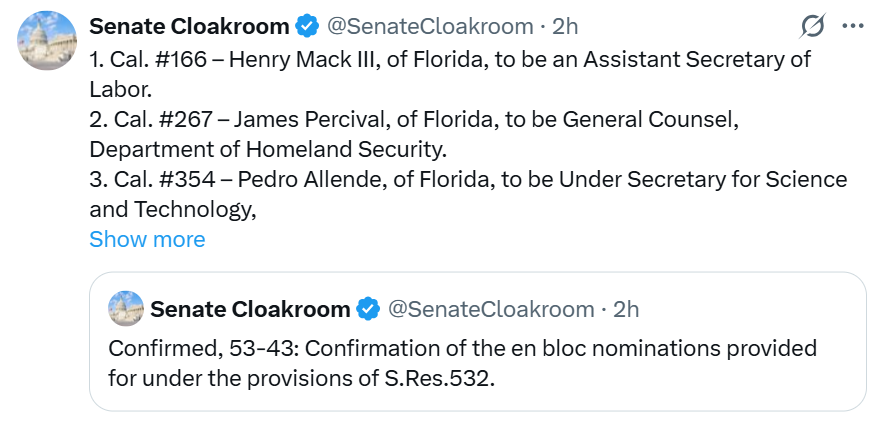
Source: Senate Cloakroom

The CFTC could soon receive more specific crypto authority, with measures like the bipartisan Senate bill introduced in November, which hopes to shift primary crypto market oversight to the CFTC.

The FDIC is poised to regulate stablecoin issuers and will have a hand in how the crypto industry is banked.

Selig in charge until 2029, Hill until 2030

Selig’s term will expire in April 2029. Once sworn in, he will take over from CFTC acting chair Caroline Pham, who planned to leave when a new chair was confirmed and join crypto infrastructure provider MoonPay.

Selig will remain as the sole commissioner of the normally five-member commission, after a series of resignations earlier in the year left Pham as the only commissioner still serving on the CFTC.

Related: Former SEC counsel explains what it takes to make RWAs compliant

Hill will lead the agency for the next five years. Martin Gruenberg, the previous Senate-confirmed FDIC chair, resigned in January as part of the outgoing administration of former President Joe Biden.

Industry positive about crypto’s future regulation

The news of crypto-friendly leaders at the helm of two major regulators has been met with positivity in the industry.

Faryar Shirzad, the chief policy officer at crypto exchange Coinbase, said in an X post that Selig’s “experience in crypto and as a federal regulator will ensure that America’s crypto market is governed with fairness, clarity and an abiding commitment to the law.”
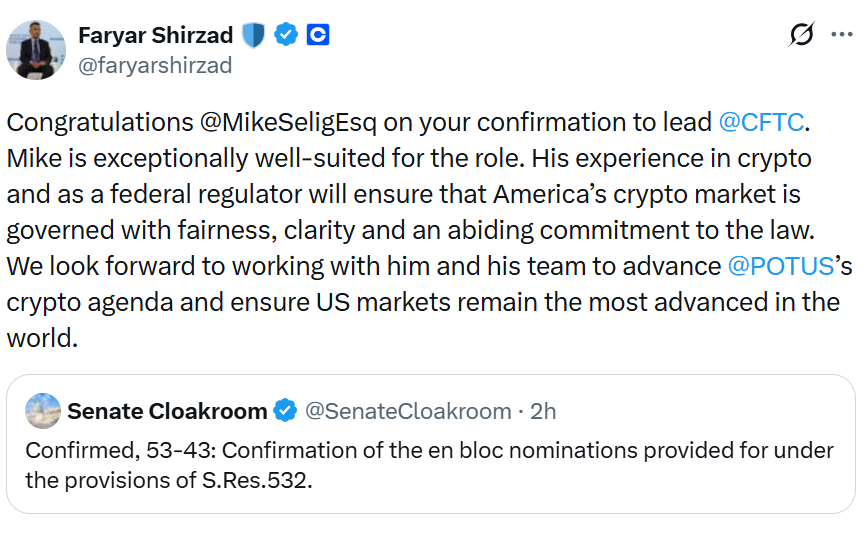
Source: Faryar Shirzad

Cody Carbone, CEO of crypto industry advocacy group Digital Chamber, said the US Senate’s confirmation of Selig is an exciting new chapter, given “his track record as a member and a lawyer digging into the complex, technical issues around digital assets.”

Magazine: Big questions: Would Bitcoin survive a 10-year power outage?

Related Questions

QWho has been confirmed as the new chair of the CFTC and what is his stance on cryptocurrency?

AMike Selig, a crypto-friendly lawyer, has been confirmed as the new chair of the Commodity Futures Trading Commission (CFTC).

QWhat role was Travis Hill elevated to and which agency does he now lead?

ATravis Hill was elevated to chair the Federal Deposit Insurance Corp (FDIC), where he had already been serving as the acting chairman.

QWhat is the potential new authority the CFTC might receive regarding cryptocurrency?

AThe CFTC could soon receive more specific crypto authority, potentially shifting primary crypto market oversight to the agency through measures like a bipartisan Senate bill introduced in November.

QHow long will Mike Selig's term as CFTC chair last?

AMike Selig’s term as CFTC chair will expire in April 2029.

QHow has the crypto industry reacted to the confirmations of Selig and Hill?

AThe industry has reacted positively, with leaders like Coinbase's Faryar Shirzad expressing confidence that Selig's experience will ensure the market is governed with fairness and clarity.

Related Reads

Warsh's First Day in Office, Markets Deliver a 'Wake-up Call': Rate Hike Expected This Year

On his first day in office, newly inaugurated Federal Reserve Chairman Warsh received a stark market warning, with expectations now fully pricing in a 25-basis-point interest rate hike this year. The shift was triggered by hawkish remarks from Fed Governor Waller, who stated that inflation is now the key policy "driver" and that the odds of a hike or cut are evenly split. This sent short-term Treasury yields higher. Waller signaled a significant pivot in his stance, citing disappointing inflation and labor data. He suggested removing "easing bias" language from Fed statements and did not rule out future rate increases if inflation fails to recede, though he noted immediate action isn't warranted without signs of unanchored inflation expectations. Chairman Warsh faces immediate pressure at his first FOMC meeting in June. With the preferred inflation gauge at a three-year high, analysts warn that failing to hike could be interpreted as an implicit easing of policy. The geopolitical situation in the Middle East is adding to existing price pressures. The market's expectation for a hike contrasts sharply with earlier forecasts for multiple cuts. While long-term Treasury yields have been contained by lower energy prices recently, analysts note they remain under structural upward pressure. Warsh's swearing-in at the White House highlights political scrutiny over Fed independence. However, the market has made it clear that inflation is the most urgent challenge, leaving the new chairman little time to settle in.

marsbit10h ago

Warsh's First Day in Office, Markets Deliver a 'Wake-up Call': Rate Hike Expected This Year

marsbit10h ago

Has Microsoft Lost Its Way in the AI Race, and Can Copilot Bring It Back on Track?

Microsoft, once seen as an early AI frontrunner due to its investment in OpenAI, is navigating a strategic shift amid increased competition. Its initial reliance on OpenAI’s GPT models has been complicated by OpenAI’s growing ambitions as a direct competitor, rapid advancements from rivals like Claude and Gemini, and the disruptive rise of AI agents, which challenge its traditional SaaS business model. These factors contributed to stock declines and slower-than-expected adoption of its flagship Copilot products. In response, CEO Satya Nadella has taken a hands-on role in product development, signaling the urgency of change. Microsoft is pivoting from a model-centric strategy to a "model-agnostic" enterprise platform approach. It aims to become the foundational layer connecting various AI models—from OpenAI, Anthropic, or its own new "Superintelligence" team—with enterprise workflows, data, security, and cloud services. Recent organizational changes merged consumer and enterprise Copilot teams to accelerate innovation, exemplified by new products like Copilot Tasks and Copilot Cowork. However, this transformation comes at a high cost. Microsoft faces massive capital expenditures, potentially reaching ~$190 billion by 2026, to support AI infrastructure. While its platform strategy shows early signs of traction with growing Azure AI revenue, it must balance startup-like agility with the reliability expected by enterprise clients. The core challenge is no longer being the sole AI winner but defending its position as the essential enterprise software entry point amidst rapid technological commoditization and the shift towards always-on AI agents.

marsbit11h ago

Has Microsoft Lost Its Way in the AI Race, and Can Copilot Bring It Back on Track?

marsbit11h ago

Trading

Spot
Futures

Hot Articles

How to Buy US

Welcome to HTX.com! We've made purchasing Talus Network (US) simple and convenient. Follow our step-by-step guide to embark on your crypto journey.Step 1: Create Your HTX AccountUse your email or phone number to sign up for a free account on HTX. Experience a hassle-free registration journey and unlock all features.Get My AccountStep 2: Go to Buy Crypto and Choose Your Payment MethodCredit/Debit Card: Use your Visa or Mastercard to buy Talus Network (US) instantly.Balance: Use funds from your HTX account balance to trade seamlessly.Third Parties: We've added popular payment methods such as Google Pay and Apple Pay to enhance convenience.P2P: Trade directly with other users on HTX.Over-the-Counter (OTC): We offer tailor-made services and competitive exchange rates for traders.Step 3: Store Your Talus Network (US)After purchasing your Talus Network (US), store it in your HTX account. Alternatively, you can send it elsewhere via blockchain transfer or use it to trade other cryptocurrencies.Step 4: Trade Talus Network (US)Easily trade Talus Network (US) on HTX's spot market. Simply access your account, select your trading pair, execute your trades, and monitor in real-time. We offer a user-friendly experience for both beginners and seasoned traders.

4.7k Total ViewsPublished 2025.12.11Updated 2025.12.11

How to Buy US

Discussions

Welcome to the HTX Community. Here, you can stay informed about the latest platform developments and gain access to professional market insights. Users' opinions on the price of US (US) are presented below.

活动图片