Understanding the New Economic Model of Tokenization

marsbitPublished on 2026-05-19Last updated on 2026-05-19

Abstract

Understanding the New Token Economics Model The commercialization of AI applications is evolving from selling software and subscriptions to selling token call capacity. Tokens, the fundamental unit of information processing for large language models (LLMs), have become the basis for API billing and consumption. With call volumes exploding, tokens themselves are now being traded—procured, routed, split, and resold—forming a new intermediary market. This layer connects upstream LLM providers with downstream developers and enterprises, acting as a global wholesale-to-retail liquidity network. The rise of this business is fueled by a massive surge in China's daily token call volume—growing over a thousandfold from 100 billion in early 2024 to over 140 trillion by March 2026—and significant improvements in domestic LLM capabilities, which are now competitive globally. The core value of token distribution platforms extends beyond simple arbitrage. Key functions include aggregating multiple models (like GPT, Claude, and domestic models such as Kimi and DeepSeek) under a unified API, lowering network and payment barriers, and providing enterprise services like model selection, prompt engineering, and system integration. Profit models are diversifying: (1) resale margins; (2) technical premiums from proprietary inference acceleration (e.g., reducing costs to 1/10 of the industry standard); and (3) enterprise value-added services. High-consumption scenarios like marketing, short-f...

Author: Zhao Ying

Source: Wall Street News

The commercialization of AI applications is extending from selling software and memberships to selling token-calling capabilities. Here, Tokens refer to the smallest units of information processed by large models, serving as the basis for API billing, settlement, and consumption. As the volume of calls increases, Tokens themselves are beginning to be procured, routed, split, and resold like a form of "inventory."

Chen Liangdong, an analyst at Huayuan Securities, summarized the core change in a recent media industry report: "Token operations are forming a new intermediary market, which involves exploring token distribution models to connect upstream large model providers with downstream developers, enterprises, and individuals. The essence is the liquidity infrastructure for a global network of token wholesale to retail."

The background for this business is not complex: On one hand, China's daily token call volume has surged rapidly, rising from 100 billion tokens per day at the beginning of 2024 to 100 trillion by the end of 2025, surpassing 140 trillion by March 2026. On the other hand, domestic large models have improved significantly, entering the global top tier in certain rankings and call volumes. With increasing demand and a growing number of models, the real barriers to transactions have become payment, network access, interfaces, compliance, distribution channels, and scenario implementation.

However, token distribution cannot be simply understood as "reselling API quotas." The thinnest layer of profit comes from resale margins, while the thicker portion comes from inference acceleration, unified interfaces, enterprise-level prompt engineering, Agent orchestration, model selection, and integration with business systems. Precisely because the entry barrier is not high, the risks in this market are equally direct: intensified competition, funding requirements for upfront payments, bad debts, and policy changes from upstream model providers can all squeeze the profits of the intermediary layer.

Tokens Now Have "Wholesalers" and "Retailers"

The basic chain of token distribution includes three types of roles.

Upstream are the model providers, including ByteDance's Seedance series, Alibaba's Qwen series, Zhipu's GLM series, Moonshot AI's Kimi series, DeepSeek series, etc. They are the original suppliers of tokens.

In the middle are agency platforms responsible for procuring resources from upstream model providers and distributing them to end-users. Their work is not just about reselling quotas; they also convert the interface protocols of different models into a unified API format, enabling downstream users to access multiple models through a single API Key.

Downstream are the actual consumers of tokens, including individual users, developers, enterprise clients, and possibly lower-tier distributors.
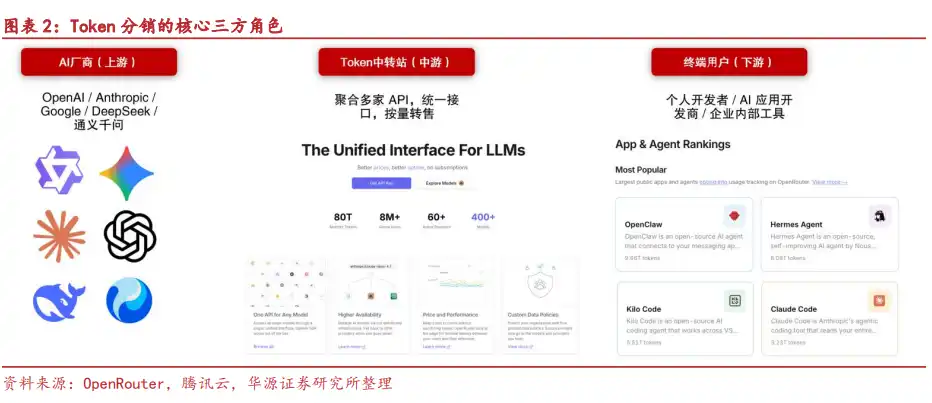
The value of this intermediary layer focuses on several areas: reducing network barriers through domestic direct connections; enabling a single codebase to adapt to multiple models; supporting both personal and corporate payments; potentially obtaining lower costs through bulk procurement; and aggregating models like GPT, Claude, DeepSeek, and Kimi on one platform to reduce the cost of repeated integration for developers.

Thus, token distribution appears to be asset-light, requiring neither the training of large models nor massive server clusters. The core assets become the API routing and scheduling system, upstream model resources, channel clients, and service capabilities.

The Surge in Call Volume is the Most Direct Fuel for This Business

For the token operation model to succeed, there must first be a sufficiently large consumption volume.

China's daily token call volume increased more than a thousandfold in two years, from 100 billion to over 140 trillion tokens. This expansion stems from the deployment of various vertical Agents and the embedding of generative AI into more business processes by enterprises.

IDC data presents an even more aggressive trajectory: the number of active intelligent agents in Chinese enterprises is expected to exceed 350 million by 2031, with a compound annual growth rate (CAGR) exceeding 135%. As the density and complexity of agent tasks increase, the annual growth rate in token consumption by agents is projected to exceed 30-fold.

This change is already visible in execution-oriented agents. The weekly token consumption of OpenClaw on the OpenRouter platform increased from 0.81T between February 2 and March 16, 2026, to 4.97T, with its share rising from 8.31% to 24.36%.

Once tokens become a mass-consumed commodity, their procurement, pricing, routing, and settlement naturally stratify. Model providers may not directly serve every client, and end customers may not be willing to integrate with each model individually, creating space for the intermediary layer.

The Cost-Effectiveness of Domestic Models Opens the Door for Token Export

The improvement in domestic large model capabilities is a key variable enabling token distribution to expand from domestic to cross-border markets.

Data from SuperCLUE shows that domestic models like ByteDance's Doubao and the DeepSeek series have achieved overall scores exceeding 70 points, narrowing the gap with leading overseas models like GPT-5.4 and Gemini. Models like Tongyi Qianwen, Kimi, and Zhipu GLM have also formed a relatively clear tiered structure.

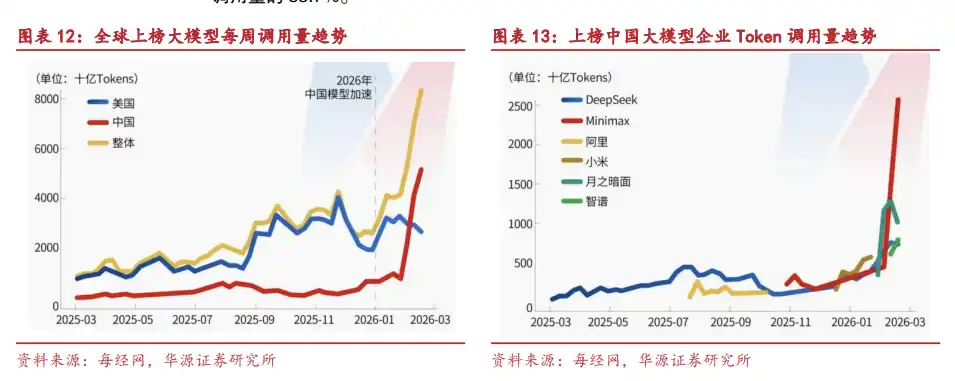
According to OpenRouter data, for the week ending May 10, 2026, Tencent's Hy3 preview (free) topped the call volume list. Among the top 5, top 10, and top 20 models, there were 2, 6, and 9 domestic large models, respectively.

A more significant change occurred in Q1 2026. From February 9 to 15, the call volume of Chinese models on OpenRouter reached 4.12 trillion tokens, surpassing the 2.94 trillion tokens of US models for the first time in the same period. From February 16 to 22, the weekly call volume of Chinese models further increased to 5.16 trillion tokens. Among the top five models on the platform by call volume, four were from Chinese providers: MiniMax M2.5, Kimi K2.5, Zhipu GLM-5, and DeepSeek V3.2, collectively accounting for 85.7% of the total call volume of the top five.
The price advantage is also prominent. The input price for both MiniMax M2.5 and GLM-5 is $0.3 per million tokens, compared to $5 for Claude Opus 4.6. For output, MiniMax M2.5 is $1.1, GLM-5 is $2.55, and Claude Opus 4.6 is $25. The cost-effectiveness of domestic models becomes more pronounced in high-token-consumption scenarios like AI Agents and code development.

Global AI Resource Imbalance Makes Routing Platforms the "Transit Hubs"

Token distribution doesn't just solve price issues; it also addresses resource mismatches.

Leading overseas large models face barriers like regional access restrictions, compliance rules, and payment hurdles, preventing them from directly reaching certain user groups, including developers in mainland China. Similarly, high-quality domestic models expanding overseas encounter challenges in localization, channel development, and user acquisition.

This imbalance fuels the demand for cross-border flow, aggregated routing, and layered distribution.

OpenRouter is already a typical example. The volume of tokens processed on its platform increased from 5-7 trillion per week in 2025 to over 20 trillion per week by April 2026. Its annualized revenue in 2026 exceeded $50 million, a roughly fivefold increase from the over $10 million annualized revenue disclosed in October 2025.

Similar platforms exist domestically. Silicon Flow is a one-stop large model cloud service platform based on its self-developed inference engine for efficient inference acceleration, while also providing enterprise-grade large model services. As of December 2025, the platform had over 9 million registered users, more than 10,000 enterprise users, and over 150 models available.

Even politically connected capital in the US has entered this field. On May 5, 2026, WLFI, a cryptocurrency company closely linked to Trump and his family, partnered with WorldClaw to launch WorldRouter, integrating over 300 models including Claude, GPT, and Gemini. Settled in USD, its pricing is approximately 30% lower than official public rates.

Real Profits May Not Lie in "Resale Margins"

There are three ways to profit from token distribution.

The first is resale margins. Platforms purchase API quotas in bulk from upstream model providers and resell them at a markup to downstream clients. OpenRouter, which adds about a 5.5% premium to supplier costs, exemplifies this model.

The second is technological premium. Platforms use self-developed inference acceleration engines to reduce the cost per token. Even when selling at prices close to or lower than official rates, they can generate gross profit through computational efficiency advantages. Silicon Flow's SiliconLLM and OneDiff technologies improve language model inference speeds by 10 times and text-to-image efficiency by 3 times, reducing the cost of large model API calls to as low as 1/10th of the industry average.

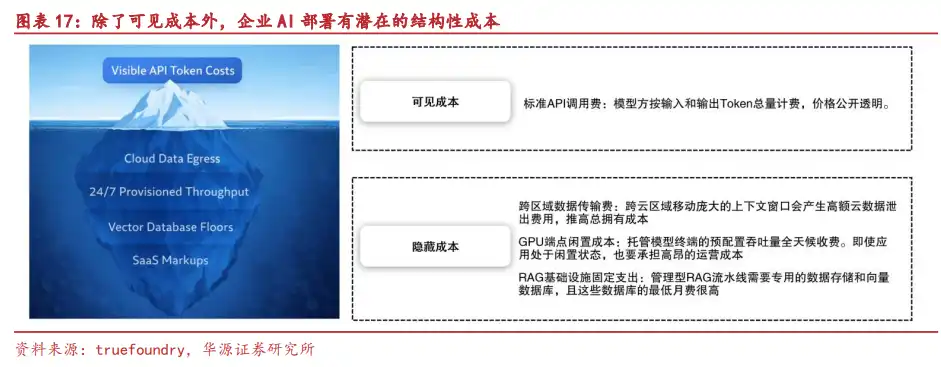
The third is enterprise value-added services. The cost of deploying AI for enterprises isn't just in token unit prices; it also includes prompt engineering, multi-model selection, business system integration, workflow orchestration, operational scheduling, and employee AI skills development. As basic token prices decline, these hidden costs become more likely points for monetization.
Silicon Flow's enterprise-level MaaS platform follows this direction: providing enterprise users with capabilities across three layers—model training and fine-tuning, deployment and inference, and application development support—covering data processing, model fine-tuning, prompt engineering, and RAG, ultimately delivered in the form of standardized APIs to industries like energy, finance, and government.

Marketing, Short Videos, Gaming, and E-commerce Are Scenarios That Consume Tokens More Easily

To be profitable, token distribution must ultimately land in real-world scenarios.

Generative AI applications are entering industries like healthcare, transportation, and industrial manufacturing and are starting to participate in core processes like corporate decision support and strategic management. However, many enterprises have weak foundations for digital transformation, insufficient data asset accumulation, and limited computing power investment, making direct AI deployment challenging.

In contrast, marketing and advertising companies already possess clients and scenarios, especially in short videos, webtoons, gaming, and e-commerce. Their token consumption demand is more direct and sustained. For such companies, the opportunity isn't just about reselling model capabilities but embedding tokens into client workflows for content generation, ad placement, asset production, and video creation.

Investment leads also unfold along two main lines:

One category includes companies with strong model capabilities, such as Alibaba, Tencent Holdings, Kuaishou, Kunlun Tech, Zhipu, MiniMax, etc.

The other category includes companies with strong token consumption scenarios and quality client sources, especially those with overseas client resources and marketing scenarios, and a willingness to actively invest in AI marketing and AI videoization. Examples include EasyClick and BlueFocus.

Risks Are Also Concrete: Low Barriers, Upfront Funding Requirements, Upstream Dependence

The token distribution business model is asset-light, but its moat is not inherently deep.

Peer competition is the first risk. The technical barrier for distribution is relatively low. Once leading distributors with capital, client, and channel advantages enter, they can quickly replicate the model, compressing profit margins.

Upfront funding requirements and bad debts are the second risk. Distributors often offer monthly or quarterly settlements to downstream clients but need to fund the upfront purchase of API quotas from upstream providers. The larger the token consumption scale, the greater the funding pressure. If clients delay payment, bad debt risks amplify simultaneously.

Policy changes by upstream model providers are the third risk. Large model providers control API pricing and access rules and may adjust prices or tighten policies for third-party access. For the intermediary layer, this is the most difficult factor to control.


Related Questions

QWhat is the core change in the commercialization of AI applications as described in the article?

AThe core change is that AI application commercialization is extending from selling software and memberships to selling Token-calling capability. A new middle-layer market for Token distribution is forming, connecting upstream large model vendors with downstream developers, enterprises, and individuals, essentially creating a liquidity infrastructure for the wholesale-to-retail network of global Tokens.

QWhat are the three key roles involved in the Token distribution chain?

AThe three key roles are: 1) Upstream Model Providers (like ByteDance Seedance, Alibaba Qwen, etc.), who are the source of Tokens. 2) Middle-layer Agent Platforms, responsible for distributing resources to end-users and providing unified APIs. 3) Downstream Consumers, including individual users, developers, enterprise clients, and possibly sub-distributors.

QWhat are the three main profit models for Token distribution platforms mentioned in the article?

AThe three main profit models are: 1) Resale Margin: Buying API quotas in bulk from vendors and selling at a markup. 2) Technical Premium: Using proprietary inference acceleration engines to lower per-Token costs and profit from efficiency gains. 3) Enterprise Value-added Services: Offering services like Prompt engineering, multi-model selection, system integration, and workflow orchestration.

QAccording to the article, what is a key factor that has enabled the expansion of Token distribution from domestic to cross-border markets?

AThe key factor is the significant improvement in the capabilities and cost-effectiveness of domestic Chinese large models. Their performance scores have closed the gap with top overseas models, and their lower prices (e.g., $0.3 per million input Tokens for some Chinese models vs. $5 for Claude Opus) create a strong value proposition for high-Token consumption scenarios in the global market.

QWhat are the primary risks associated with the Token distribution business model?

AThe primary risks are: 1) Intensifying Competition due to low entry barriers. 2) Capital Commitment and Bad Debt risk, as distributors must prepay upstream vendors while offering credit terms to downstream clients. 3) Policy Changes by Upstream Model Vendors, who control API pricing and access rules, making this an uncontrollable variable for the middle layer.

Related Reads

Robots Begin to 'Consume Data': The Hidden Production Chain from Indian Data Factories to Billion-Dollar Humanoid Robots

Robots have started to 'consume data,' driving the formation of a new industrial supply chain focused on producing training data for embodied AI. Unlike large language models, which are trained on vast internet text corpora, embodied AI models face a 'data desert' in the physical world. This has created a massive demand for first-person perspective video data (Ego Data), captured by workers wearing cameras in places like Indian garment factories. Companies like Neocambrian AI are establishing 'data factories' where workers perform standardized tasks (e.g., sorting clothes, kitchen organization) to generate thousands of hours of video. Research, such as NVIDIA's EgoScale, demonstrates that scaling this human demonstration data predictably improves robot performance, particularly for dexterous manipulation. This has validated a training path combining large-scale human data for pre-training with smaller amounts of robot-specific data for fine-tuning. The value of different data types varies significantly, forming a 'data pyramid.' The base consists of low-cost, large-scale internet and Ego Data. Higher layers include more expensive motion-capture data (e.g., from data gloves), simulation/synthetic data, and the most costly and scarce layer: real robot teleoperation data. This demand has spawned a layered ecosystem of data suppliers: low-cost data factories, motion capture and alignment specialists, robot-native teleoperation service providers, simulation data companies, and platforms aiming for data standardization. Robot companies themselves are adopting a 'layered procurement' strategy: outsourcing generic Ego Data while building in-house capabilities for robot-specific adaptation data and the critical deployment/failure data generated in real-world applications. The industry is shifting focus from hardware and basic mobility to the data pipelines required for general-purpose capability. While parallels exist to data labeling companies like Scale AI in the LLM boom, the physical complexity of robot data—involving action success ambiguity and sim-to-real gaps—requires more integrated solutions for data collection, annotation, and a continuous feedback loop. The race is on to build the data engines that will teach robots to operate reliably in the unstructured real world.

marsbit2h ago

Robots Begin to 'Consume Data': The Hidden Production Chain from Indian Data Factories to Billion-Dollar Humanoid Robots

marsbit2h ago

Spicy Commentary | Michael Saylor's 'Player Talk'; 60-Year-Old Aunt Liquidated After 'Scamming a Young Man'

**"Spicy Commentary": Three Tales of Crypto's Wild Week** This week's "Spicy Commentary" column highlights three dramatic stories from the cryptocurrency world. First, **MicroStrategy's Michael Saylor** addressed the controversy over his company potentially selling Bitcoin. At the BTC Prague event, he clarified, "I never said the company can't sell Bitcoin. I told *you* never to sell *your* Bitcoin." This "do as I say, not as I do" stance was criticized by netizens as peak linguistic gymnastics, noting a history of him previously stating the company would "never" sell. Second, a **bizarre fraud case** emerged from Beijing. A 60-year-old woman, obsessed with getting rich from crypto but unwilling to risk her own savings, posed online as the 20-something "god-daughter" of a high-ranking official. She catfished a young man, convincing him to give her over 200,000 yuan for fabricated emergencies. She then invested all the stolen money into cryptocurrency with 10x leverage, only to lose everything in a market crash. The woman was sentenced to four years in prison for fraud. Finally, a **sobering trader's tale** surfaced on Reddit. A user posted "Tale of a crypto trader," confessing their net worth had plummeted from a peak of $45 million to roughly $17,200, primarily due to holding meme coins too long. The post, described as a crypto "book of confessions," sparked reactions ranging from sympathy to critique about greed, poor risk management, and the perils of treating meme coins as long-term investments instead of taking profits. The column concludes that this week featured masterful rhetoric, elaborate scams, and extreme financial volatility, stitching together another chapter in crypto's unpredictable theater.

Foresight News2h ago

Spicy Commentary | Michael Saylor's 'Player Talk'; 60-Year-Old Aunt Liquidated After 'Scamming a Young Man'

Foresight News2h ago

Tremble Humans, AI Continues Its Accelerated Sprint

Trembling, Humans: AI Continues Its Accelerated Sprint Yes, AI is still rapidly accelerating. While deep learning seemed to stall quickly in its early years, large models after years of development show no sign of hitting their ceiling. At the Zhiyuan Conference 2026, the focus is on enabling AI to move from the digital world into the physical world. Scaling Law remains effective, continuing to drive advancements in both large language models and multimodal models. The industry is now entering a phase of pursuing World Models, though unresolved technical paths and data issues mean this exploration may take 3-5 more years. Concurrently, breakthroughs in Agents are accelerating AI's real-world application in fields like healthcare and meetings. Making Agents truly useful requires key hardware-software co-design, evident from the strong presence of chip vendors at the conference. We stand at a new historical threshold where AI is becoming a foundational force reshaping the world. The first day of the conference highlighted AI's evolution from "knowing how to chat" to "knowing how to work." Scaling Law persists, World Models are the next key battleground, and Agents are transitioning from usable to好用 (user-friendly). Scaling Law is not ending but diversifying. New models like Anthropic's Fable 5 demonstrate scaling through parameter size, synthetic data, and reinforcement learning. Advancements in AI Coding and Agent deployment are enabling a trend of AI self-evolution, potentially allowing AI to take over digital world iterations. World Models represent the next frontier for large models extending into the physical realm, but no current model is truly impressive at solving real-world problems. Technical consensus is lacking, with debates on data sources (video, simulation, real-world). Different approaches are emerging: language-centric, pixel-centric, 3D-structure-centric, and visual-representation-centric models. Zhiyuan Institute is exploring a fifth path: unified latent space modeling fusing language and visual representations, and introduced its own under-development World Model, Physis-v0.1. On the product side, Agents are key to bringing AI into daily life. Since 2025, the "Year of the Agent," products have become more proactive and capable of complex tasks. Zhiyuan showcased four vertical Agents for cardiac diagnosis, autonomous research, meeting summarization, and protein risk discovery. However, technical challenges remain, particularly in context engineering like memory and orchestration. "Harness" – the engineering framework around an Agent – is crucial for maximizing its capabilities by clarifying intent, designing workflows, and incorporating validation and feedback. In summary, AI's breakneck pace continues on multiple fronts: foundational model scaling, the ambitious pursuit of World Models for physical understanding, and the ongoing refinement of practical Agents. The journey from capable to truly reliable and useful AI systems is well underway.

marsbit3h ago

Tremble Humans, AI Continues Its Accelerated Sprint

marsbit3h ago

The Backside of Musk's Trillion-Dollar Fortune: 85% Can't Be Sold

Elon Musk becomes the world's first trillionaire, driven by SpaceX's IPO valuing the company at $1.77 trillion. However, his vast wealth is largely illiquid: he holds over 85% voting control, likely through super-voting shares that are subject to lock-ups and selling restrictions. While his net worth surpasses $1 trillion across SpaceX, Tesla, and private holdings, only a tiny fraction (potentially under 2% annually) could be converted to cash without jeopardizing control and market confidence. SpaceX's IPO also creates paper millionaires for roughly 4,400 employees, but their holdings face lock-up periods, exercise costs, and taxes, delaying and reducing actual cash proceeds. Only 4.2% of total shares are initially available for public trading, making the stock price highly sensitive to limited net buying or selling pressure. A major test will come when lock-ups expire for the remaining 96% of shares. The article contrasts SpaceX's wealth distribution with potential AI IPOs. Anthropic and OpenAI could generate employee wealth pools 20 times larger than SpaceX's in paper value, due to their higher valuations relative to revenue and potentially more distributed ownership. However, sustaining those high price-to-sales multiples post-IPO is uncertain. A key financial puzzle for SpaceX investors is its xAI unit. While it has locked in an estimated $26 billion in annual compute revenue from clients like Anthropic and Google, the unit reported a $6.4 billion loss in 2025. More critically, estimated annual capital expenditures of ~$30.8 billion exceed that revenue. The long-term viability of SpaceX's AI narrative hinges on whether this compute income can eventually cover the unit's massive ongoing investments and losses.

链捕手3h ago

The Backside of Musk's Trillion-Dollar Fortune: 85% Can't Be Sold

链捕手3h ago

Trading

Spot
Futures

Hot Articles

Discussions

Welcome to the HTX Community. Here, you can stay informed about the latest platform developments and gain access to professional market insights. Users' opinions on the price of AI (AI) are presented below.

活动图片