How to Regulate Single-Stock Leveraged ETFs? On Thursday, the Entire Market Is Watching This Korean Government Meeting

marsbitPublished on 2026-07-14Last updated on 2026-07-14

Abstract

The highest-level economic coordination body in South Korea, the "F4" comprising the Ministry of Economy and Finance, the Financial Services Commission, the Bank of Korea, and the Financial Supervisory Service, will hold an emergency meeting on Thursday to discuss regulatory measures for single-stock leveraged ETFs. These products, launched just six weeks ago, have been widely blamed for exacerbating market volatility. The KOSPI's 8% plunge on Monday triggered the year's seventh trading halt, intensifying scrutiny. Regulators have expressed rare public regret over approving the products. FSS Governor Lee Bok-hyun stated he "regretted not doing everything possible to prevent" their introduction and acknowledged structural problems, citing massive retail investments and legal complications from a rushed rollout. Possible countermeasures under discussion include raising margin requirements, imposing daily price limits, and adjusting leverage caps. However, officials admit these may be temporary fixes. Data confirms the amplified volatility. Since the ETFs' launch, days with KOSPI moves exceeding 3% have nearly doubled. Trading halts have reached record levels, surpassing the 2008 financial crisis peak. The products allow 2x leveraged bets on giants like Samsung Electronics and SK Hynix. Their daily rebalancing to match returns is seen as mechanically fueling market swings. The outcome of Thursday's F4 meeting is highly anticipated, with expectations leaning towards stricter c...

Original Author: Long Yue

Original Source: Wall Street News

A financial product launched just one and a half months ago has plunged South Korea's highest economic policymakers into an emergency state.

South Korea's "F4" high-level coordination mechanism will hold a meeting this Thursday to study response plans regarding the impact of single-stock leveraged ETFs on the stock market. This marks the first time this issue has formally entered the highest-level economic coordination platform jointly participated in by the Ministry of Economy and Finance, the Financial Services Commission, the Bank of Korea, and the Financial Supervisory Service.

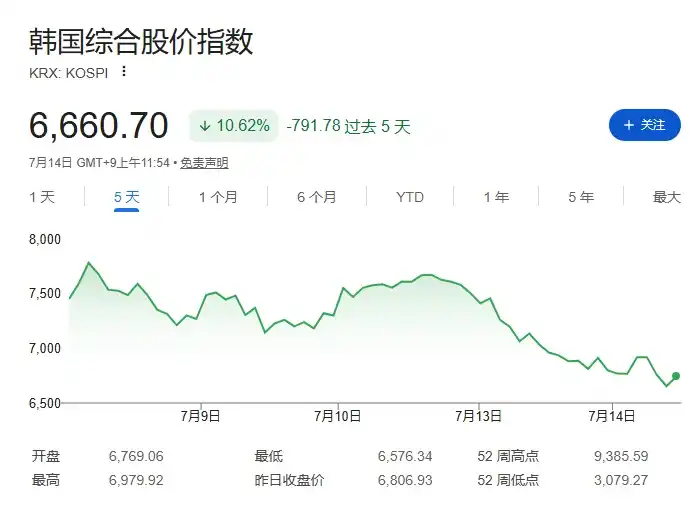
The catalyst is clear: The KOSPI plummeted more than 8% on Monday, triggering the seventh trading halt of the year, with market blame directed squarely at single-stock leveraged ETFs. These products amplify intraday gains and losses of individual stocks, accelerating price deviations during volatile market swings, creating a "buying-the-rip, selling-the-dip" magnifying effect. Single-stock leveraged products officially launched on May 27, allowing investors to make 2x leveraged bets on the price movements of Samsung Electronics and SK Hynix. Their returns are linked to a multiple of the underlying asset's daily price change. To achieve return matching, daily buying or selling of the underlying asset is required, further intensifying market volatility.

Prior to Thursday's government meeting, South Korean securities firms and asset management companies planned to hold an industry meeting on Tuesday to discuss the leveraged ETF issue and overall market conditions, gathering preliminary insights for the government session.

Regulators Escalate Rhetoric, Rarely Uttering "Regret"

Regulatory statements have escalated from "monitoring" to "self-criticism," even frankly admitting to facing structural dilemmas.

On July 13, FSS Governor Lee Bok-hyun chaired a closed-door meeting at the Korea Financial Investment Association in Yeouido attended by representatives from 20 asset management firms. He candidly stated: "There are structural issues, so it's unlikely we can provide a clear answer." He added, "In the current situation, this problem cannot be resolved at once; it requires continuous monitoring, revision, and improvement." This reflects the deep-seated difficulties financial authorities face in proposing specific solutions.

Governor Lee did not elaborate on the so-called "structural issues." It is widely interpreted externally as follows: First, individual investors have already made a net purchase of nearly 10 trillion won in these products, making forced liquidation nearly impossible; second, these products were launched only after a joint revision of enforcement decrees by the Blue House, the Financial Services Commission, and the Korea Exchange. Forcing their delisting would damage the legal credibility of the related regulations.

He also stated, "This doesn't seem to be an area where one person can make the final call. The authorities (the Financial Services Commission) may also need broad deliberation. We (the FSS) will do our best, but we are currently in a position to bear criticism. Asset management companies should frankly share their actual demands and institutional-level suggestions, which will become important references for policy decisions."

FSS Governor Lee Bok-hyun said frankly at a regular press conference on June 22: "Regarding the launch of single-stock leveraged ETFs, I regret not trying my utmost to stop them." This wording is extremely rare in the context of South Korean financial regulation. However, just one day after this statement, the KOSPI plunged 10%. From June 22 to July 13, the KOSPI has cumulatively fallen over 25%.

Earlier this month, he further stated that regulators are "seriously examining the unintended consequences that have arisen since these products were launched."

Deputy Prime Minister and Minister of Economy and Finance Koo Yun-cheol also stated at a National Assembly meeting last week, "Given the various issues raised by all sides, we are currently consulting on measures to remedy and minimize related problems."

Blue House Policy Chief Kim Yong-beom explicitly stated at a press conference that the F4 meeting is conducting an in-depth study of the issue of single-stock leveraged ETFs exacerbating market volatility, adding, "If remedial measures are necessary, a decision will be made at the F4 market condition review meeting."

Three Paths Underway Simultaneously: Raising Margins, Price Limits, Adjusting Leverage Cap

Before Thursday's meeting, regulators have been simultaneously advancing countermeasure studies through multiple paths.

According to sources from South Korea's financial investment industry, financial authorities have formally requested asset management companies to submit specific improvement suggestions regarding the market volatility potentially triggered by single-stock leveraged ETFs. The authorities will consolidate industry opinions before launching formal policy formulation.

Possible measures currently under market discussion include three categories: raising margin requirements, limiting daily price fluctuation ranges, and adjusting the leverage ratio cap.

The Financial Services Commission will convene experts from major securities firms and asset management companies on the 14th to discuss supplementary measures for single-stock leveraged products. Specific proposals include raising the minimum margin requirement (i.e., the capital threshold investors must pre-deposit in accounts) and strengthening pre-investment education.

However, regulatory officials also admitted that the above measures "might only be temporary fixes, not solving the structural root of market volatility." This means even if Thursday's meeting reaches a decision, follow-up policies may still face further adjustments.

Data Confirms Impact: Trading Halts Hit Historic Record

Data-wise, the comparison of market volatility before and after the launch of single-stock leveraged ETFs is startling. According to NH Investment & Securities statistics, in the 96 trading days before the product launch, the KOSPI experienced single-day gains/losses exceeding 3% on 27% of the days (26 days). In the 33 trading days after the launch until July 13, this proportion surged to 52% (17 days). In comparison, the U.S. S&P 500 index has not had a single-day movement reaching 3% so far this year.

Data from the Korea Exchange shows that as of July 13, the securities market has triggered 35 "sidecar" mechanisms (temporary trading suspensions, including 17 buyer-side and 18 seller-side triggers) this year, far exceeding last year's total of just 3 times. Even with July not yet over, this number has already surpassed the historical record of 26 times set during the 2008 global financial crisis. Market-wide trading halts (circuit breakers) have been triggered 7 times this year, exceeding half of the total 13 triggers since the mechanism's introduction in 2000.

The Wall Street Journal also noted: "South Korea's stock market volatility has been further amplified by leveraged products linked to Samsung Electronics and SK Hynix."
One and a Half Months Since Launch, Already Triggering Top Decision-Maker Intervention

It has been about one and a half months since single-stock leveraged ETFs were listed in South Korea, yet regulatory pressure has rapidly escalated from the Financial Supervisory Service level to the highest economic decision-making body.

Kim Yong-beom pointed out at the press conference, "These products have been operating for about one and a half months. The F4 will carefully assess their actual impact on the market."

Currently, market expectations for stricter restrictions on such products are rising—leverage ratio tightening, higher investor eligibility thresholds, or other structural constraints are all within the scope of discussion. As market volatility continues unabated, criticism is also growing louder over the hasty launch of these products in less than five months.

The future policy direction will depend on the assessment conclusions of Thursday's South Korean F4 meeting.


Related Questions

QWhat specific event triggered the emergency intervention by South Korea's top economic policymakers regarding single-stock leveraged ETFs?

AThe specific event was a sharp plunge in the KOSPI index on Monday, which fell more than 8%, triggering the market's seventh circuit breaker halt of the year. This market crash was widely attributed to the trading activities of single-stock leveraged ETFs, pushing the issue onto the agenda of the highest-level economic coordination platform.

QWhat is the core mechanism of single-stock leveraged ETFs that causes them to amplify market volatility according to the article?

AThe core mechanism is that these ETFs aim to provide returns that are a multiple (e.g., 2x) of the daily price movement of a single underlying stock (like Samsung Electronics or SK Hynix). To match this daily return target, the fund managers must buy or sell significant amounts of the underlying stock every day, which can accelerate price moves and create a 'buy on rise, sell on decline' effect, thereby exacerbating market volatility.

QWhat are the two main 'structural problems' cited by Financial Supervisory Service Governor Lee Bok-hyun that make resolving the single-stock leveraged ETF issue difficult?

AThe two main structural problems are: 1) Individual investors have already net purchased nearly 10 trillion won worth of these products, making forced liquidation nearly impossible. 2) The products were launched after a joint revision of enforcement decrees by the Blue House, the Financial Services Commission, and the Korea Exchange. Forcibly delisting them would damage the legal credibility of the related regulations.

QWhat are the three potential regulatory measures currently being discussed to address the risks posed by single-stock leveraged ETFs?

AThe three potential regulatory measures being discussed are: 1) Raising margin requirements (increasing the minimum funds investors must deposit in their accounts). 2) Implementing a daily price limit (restricting the maximum daily price fluctuation). 3) Adjusting the upper limit of the leverage ratio the products can employ.

QHow does the data presented in the article demonstrate the impact of single-stock leveraged ETFs on market volatility since their launch?

AThe data shows a dramatic increase in market volatility after the ETFs launched. Before launch, the KOSPI had a daily move exceeding 3% in 27% of trading days. After launch, this proportion soared to 52%. Furthermore, temporary trading halts ('sidecars') have been triggered 35 times this year, far surpassing the full-year total of 3 in the previous year and even exceeding the record of 26 set during the 2008 global financial crisis. Market-wide circuit breakers have been triggered 7 times this year alone.

Related Reads

The Great Ethereum "Rate Cut" Debate: Is Now the Golden Window for Staking with the Unconventional EIP-8363?

Ethereon's economic policy is under review as a new proposal, EIP-8363, sparks debate over potential "interest rate cuts" for staking. The unconventional proposal suggests gradually increasing the proportion of newly issued ETH rewards that are burned as the total staked ETH ratio rises, with issuance fully offset by burns once the ratio nears 50%. This would drive the protocol-level staking APR towards 0%, though validators would still earn transaction fees and MEV. This discussion emerges as staked ETH approaches 35% of supply, with the current protocol APR at ~2.6%. The core question is whether Ethereum needs to continue paying high issuance costs for marginal gains in security once sufficient participation is achieved. EIP-8363 aims to optimize security spending, but critics warn it could disproportionately impact solo stakers and potentially increase centralization among large, resilient operators. Paradoxically, this debate coincides with the Pectra upgrade (EIP-7251), which introduces native compounding for staking rewards, significantly improving capital efficiency for long-term holders. This creates a dual narrative: the protocol is making staking more efficient while reconsidering the economic incentive to stake. For long-term ETH holders, this environment may present a "time window" rather than a fixed-rate opportunity. While future APRs are expected to trend downward, starting staking earlier maximizes the compounding effect over time. The decision to stake depends on individual factors like investment horizon, liquidity needs, and risk tolerance regarding options like native validation, staking services, or liquid staking tokens (LSTs). The evolution from encouraging staking to managing its economic cost marks a new, mature phase for Ethereum's tokenomics, where the true value of staking may increasingly lie in the long-term power of compounding time.

marsbit9m ago

The Great Ethereum "Rate Cut" Debate: Is Now the Golden Window for Staking with the Unconventional EIP-8363?

marsbit9m ago

Analyst States Bitcoin Remains Within $61-68k Range

An analyst stated that Bitcoin is likely to remain within a trading range of $61,000 to $68,000. According to Kirill Komalenkov, director of strategic communications at Bitbanker, Bitcoin continues to trade sideways amidst declining market volatility. He attributes its current stability to high market liquidity, with volatility near three-year lows. Komalenkov warned that sustained low activity carries risks of a price decline, with potential tests of support at $62,300 and $61,600. He suggested that major market players might use the current situation to accumulate liquidity, meaning any initial breakout from the range could be a false move. The analyst expects this sideways movement to persist until the latter part of August. Key factors for determining future market direction include fund flows into Exchange-Traded Funds (ETFs) and trader activity. However, Komalenkov noted a potential negative scenario for the second half of August, where heightened geopolitical tensions or hawkish rhetoric from US monetary authorities could trigger a new decline. In such a case, Bitcoin could fall to a range of $45,000–$50,000 by early autumn, which might form a new base for a potential market recovery later in the season. Separately, a Russian deputy finance minister recently announced that non-qualified investors in Russia will soon be allowed to legally purchase Bitcoin, Ethereum, and popular stablecoins, with an annual limit of 300,000 rubles per intermediary.

cryptonews.ru11m ago

Analyst States Bitcoin Remains Within $61-68k Range

cryptonews.ru11m ago

Bitmine's Tom Lee Now Owns 4.8% of Ethereum's Total Supply. Is It Worth Buying ETH Now?

Tom Lee, founder of Fundstrat Global Advisors and a staunch cryptocurrency bull, now serves as chairman of Bitmine. Under his guidance, Bitmine has evolved from a bitcoin miner into the world's largest corporate holder of Ethereum, owning 5.81 million ETH tokens (4.8% of the total supply) as of August 10, with a target of reaching 5%. Lee, who correctly advised buying Bitcoin in 2017, is similarly bullish on Ethereum. He began recommending ETH in late 2024 at around $3,400; despite its current price near $1,900, he predicts it could reach $22,000 in the coming years and $62,000-$250,000 long-term. His optimism stems from Ethereum's role as the leading smart contract blockchain. He expects growth from increased stablecoin issuance, tokenized real-world assets (RWA), and the need for AI agents to use neutral, secure blockchains like Ethereum for identity verification and machine-to-machine payments. With a market cap of $226 billion, Ethereum remains much smaller than Bitcoin's $1.26 trillion, suggesting significant room for growth once macroeconomic headwinds ease. While past success doesn't guarantee future results, and ETH is down nearly 60% over the past year, the article argues Ethereum has clearer long-term catalysts than many altcoins. These include growing dApp usage, AI integration, and the potential for approved spot ETFs to attract more investors. The conclusion suggests that while not buying as aggressively as Bitmine, accumulating the world's second-largest cryptocurrency during market pessimism could be a prudent long-term strategy.

cryptonews.ru19m ago

Bitmine's Tom Lee Now Owns 4.8% of Ethereum's Total Supply. Is It Worth Buying ETH Now?

cryptonews.ru19m ago

Trading

Spot
活动图片