AI Overhauled Terence Tao's 30-Year-Old Website, Uncovering Two Bugs Hidden for Over Two Decades in the Process

marsbitPublished on 2026-07-14Last updated on 2026-07-14

Abstract

AI Revamps Terence Tao's 30-Year-Old Website, Unearthing Two 20-Year-Old Bugs in His Code Terence Tao, a renowned mathematician, has enlisted an AI agent to overhaul his personal academic website, which was built in 1997 with a static HTML, manually-maintained "Web 1.0" architecture. In just one day, the agent migrated 560 papers and preprints, 374 travel logs, 68 courses, 19 books, and 29 old math applets to a new system on GitHub Pages. The new site is structured around YAML files as the "single source of truth," with static HTML pages automatically generated from this data—a fundamental shift from maintaining individual documents to managing a centralized database. During the migration, the AI uncovered inconsistencies, outdated entries, and broken links that had accumulated over nearly three decades of manual updates. It also successfully ported a set of small educational Java 1.0 applets to JavaScript. Notably, while reviewing this translation, Tao found only one new bug introduced by the AI. Conversely, the AI identified two subtle bugs in his original Java code that he was previously unaware of. Tao emphasizes the project highlights AI's potential for automating tedious "digital housekeeping"—routine tasks like data migration and website maintenance that are costly and error-prone when done manually. He also revived a 27-year-old stalled project: a special relativity visualizer or "Minkowskian Inkscape." With AI assistance, a working alpha version was built in two h...

Everyone thought AI should first help mathematicians prove theorems, but Terence Tao had it migrate his 30-year-old web pages. In one day, it moved 560 papers and preprints, 374 travel records, 68 courses, 19 books, and 29 math applets, even finding two bugs in code he wrote over twenty years ago that he was unaware of.

The website was built in 1997. Changing a single line meant opening a terminal and manually editing HTML, a maintenance task that persisted for nearly thirty years.

Recently, Terence Tao handed over his personal homepage to an AI agent.

In just one day, 560 papers and preprints, 374 travel logs, 68 courses, 19 books, and 29 small math programs were migrated en masse from a nearly 30-year-old architecture and given a new home on GitHub Pages.

More interesting than the migration itself were the discoveries along the way.

The AI sifted through the nearly three-decade-old site, uncovering a pile of contradictory information, outdated entries, and broken links. These were errors he himself had introduced piecemeal over the thirty years.

It also casually ported those old applets written in Java 1.0 to JavaScript and found two bugs in the code Tao wrote over two decades ago that he himself never knew existed.

This time, AI didn't go off to prove theorems. What it did for the mathematician was the "digital housekeeping" they least want to touch.

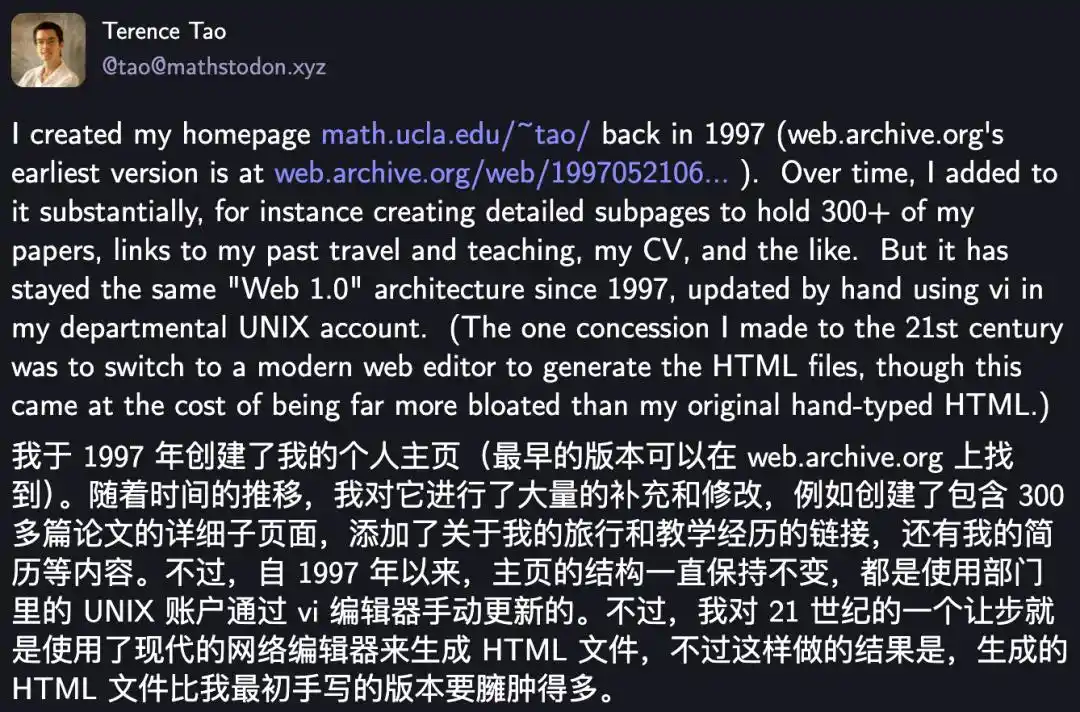
A Nearly 30-Year-Old Architecture, He Kept It Going Until 2026

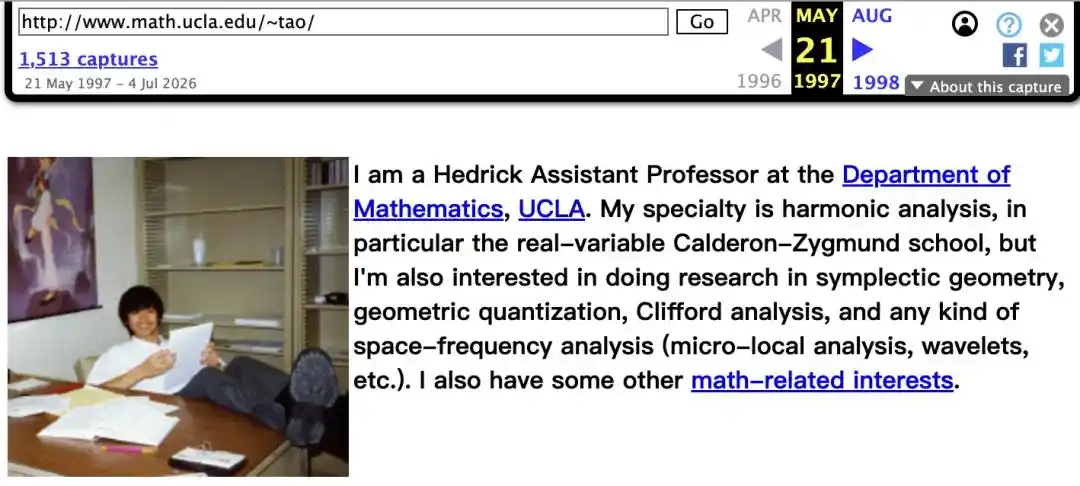
Tao's homepage was built in 1997 when he was still a Hedrick Assistant Professor at UCLA. The page featured a long list of manually curated external links, ranging from the sci.math newsgroup to his favorite series, *The Wheel of Time*.

It was standard Web 1.0. One page per topic, a screen full of text links, all maintained manually.

May 21, 1997: Terence Tao, then an assistant professor, and his newly built homepage.

For nearly thirty years, this architecture never changed.

Tao kept adding to it: detailed subpages for over three hundred papers, teaching records, travel schedules, CV, book errata. The method was always to edit page by page and upload manually, using vi in a Unix account in the early days.

His only concession to the 21st century was switching to a modern web editor to generate HTML, at the cost of code that was much more bloated than his original hand-typed version.

Content grew linearly, but maintenance costs grew exponentially. At one point, he moved book pages and career advice to a blog, offering some relief, but it was still cumbersome.

When content piled up and the cost of making changes soared past a certain threshold, you start to let those errors stay put.

Those Java applets died a more definitive death. Browsers abandoned Java 1.0, and he alone didn't have the energy to port over twenty programs to a new language, so the pages just hung there, for a decade.

YAML is the Truth; The Webpage is Just a 'Printout'

Tao said he only recently realized: with AI agents, migrating this nearly 30-year-old system should have been a routine matter.

So, he tried. The process was "fairly painless," he said.

The key was that he didn't ask the AI to rewrite a bunch of HTML. Instead, he had the AI rebuild a data pipeline.

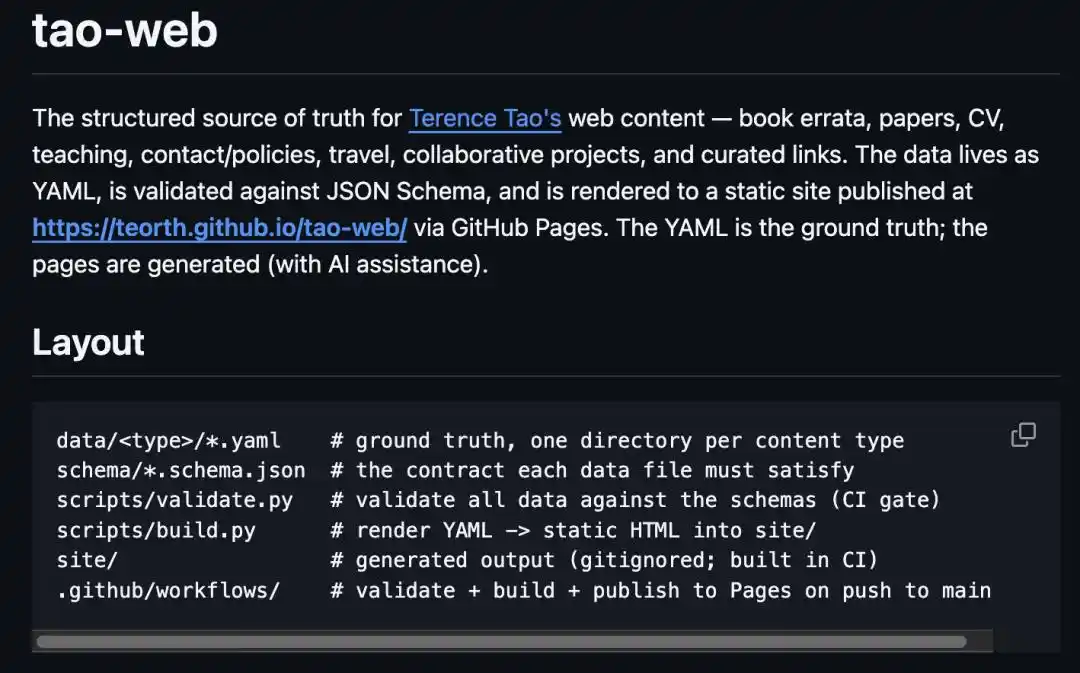
This new repository is called tao-web, and its logic resembles a printing house.

The master copy is the YAML files in the data directory, with one folder for each of the eight content types; schema manages the format, dictating what each field should look like.

Two Python scripts: one for validation, one for printing. If validation fails, the code can't even be pushed. The printed webpages go into the site directory, not the version control.

A final push to the main branch triggers GitHub Actions to automatically validate, print, and deploy.

The tao-web repository. The README clearly states: YAML is the single source of truth; webpages are generated from it. (Image source: GitHub teorth/tao-web)

A line in the repository's README underpins the entire architecture: YAML is the single source of truth; webpages are generated from it.

It's followed by an operational rule: modify data, never modify the generated HTML in the site directory.

In the old system, each page was an independent fact. The same piece of information scattered across five pages; miss one when updating, and they start "fighting."

In the new system, a fact exists only in one place. Webpages are demoted to a display layer, like a sheet of paper that can be reprinted at any time.

Thus, a personal knowledge base transforms from a collection of documents into a database.

AI Found Two Bugs in His Old Code

After moving the data, Tao conducted a second experiment.

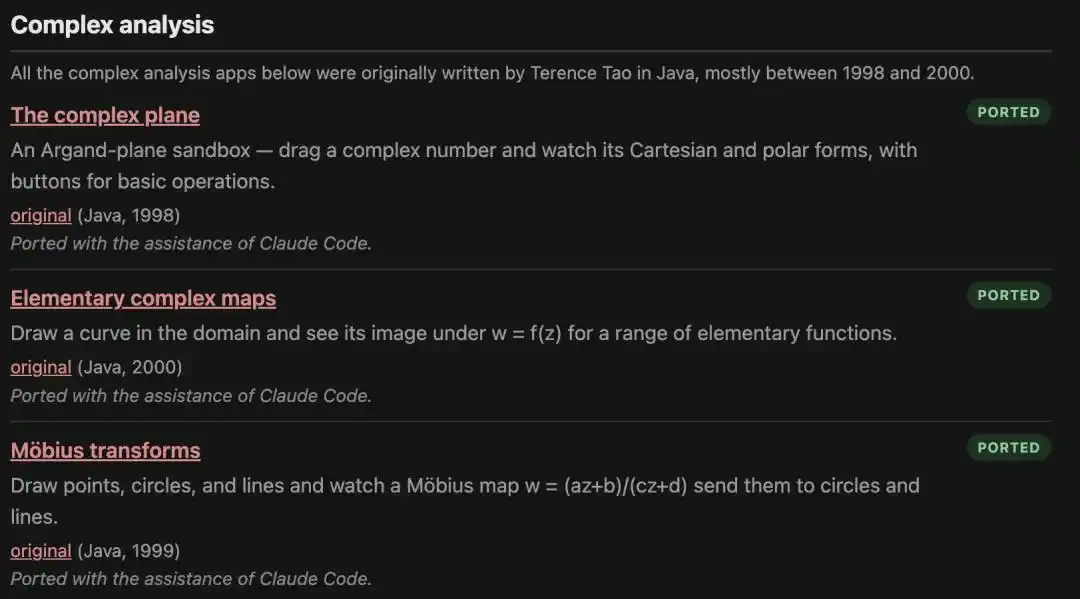
Starting in 1999, to visualize topics for his complex analysis and linear algebra classes, he wrote a series of small programs in Java 1.0. They were well-received back then.

Later, browsers stopped supporting that version of Java, rendering the whole collection obsolete.

Now, he had the agent port them to JavaScript. Around 20 small programs were revived in a few hours.

Large language models can introduce various obvious or subtle bugs when writing code. In this porting effort, Tao only found one: a complex analysis applet behaved oddly when dragged outside the main display frame.

Conversely, the agent found two bugs in his original code that he had never been aware of.

Weighing the gains and losses, his judgment was: net zero change in code quality.

A Fields Medalist had two errors pointed out by AI in code he wrote over two decades ago.

He immediately drew a boundary around this conclusion: these applets are auxiliary visual aids, not critical components of mathematical proofs, so the risk of bugs was inherently low.

Drag outside the box, and the user notices. Get a proof wrong, and that's a professional accident.

This boundary is precisely the key to Tao's methodology.

The complex analysis programs were originally written by Tao in Java between 1998 and 2000. Now, each is labeled: Ported with assistance from Claude Code. (Image source: teorth.github.io/tao-web)

Errors Aren't Scary; Being Unable to Fix Them Is

Tao didn't avoid the hallucination issue.

He explicitly stated that modern AI still has a tendency to hallucinate, potentially introducing new errors during the migration.

But after his personal review, the error rate "does indeed seem lower than before." More importantly, large-scale error correction has become much easier.

Of course, this is his impression after manual review, not a figure derived from running evaluations.

Tao isn't comparing AI to "perfection." He's comparing "AI plus human review" to his own "pure manual maintenance over thirty years."

Manual maintenance itself is a continuous error-generating machine; it's just that it's been generating errors for thirty years, and no one had the energy to check.

Most debates about AI get stuck on the single question of "will it make mistakes?" Tao's focus is on comparing which has a lower error rate and which has a smaller cost for correction.

Existing errors aren't terrifying; what's terrifying is being unable to fix them. In the old site, changing one piece of info required checking five pages. In the new site, change one line of YAML, and the entire site rebuilds automatically.

An Idea Shelved for 27 Years, Completed in Two Hours

After porting the old programs, he decided to take another step.

In 1999, he had an ambitious idea: create a visualization tool for special relativity.

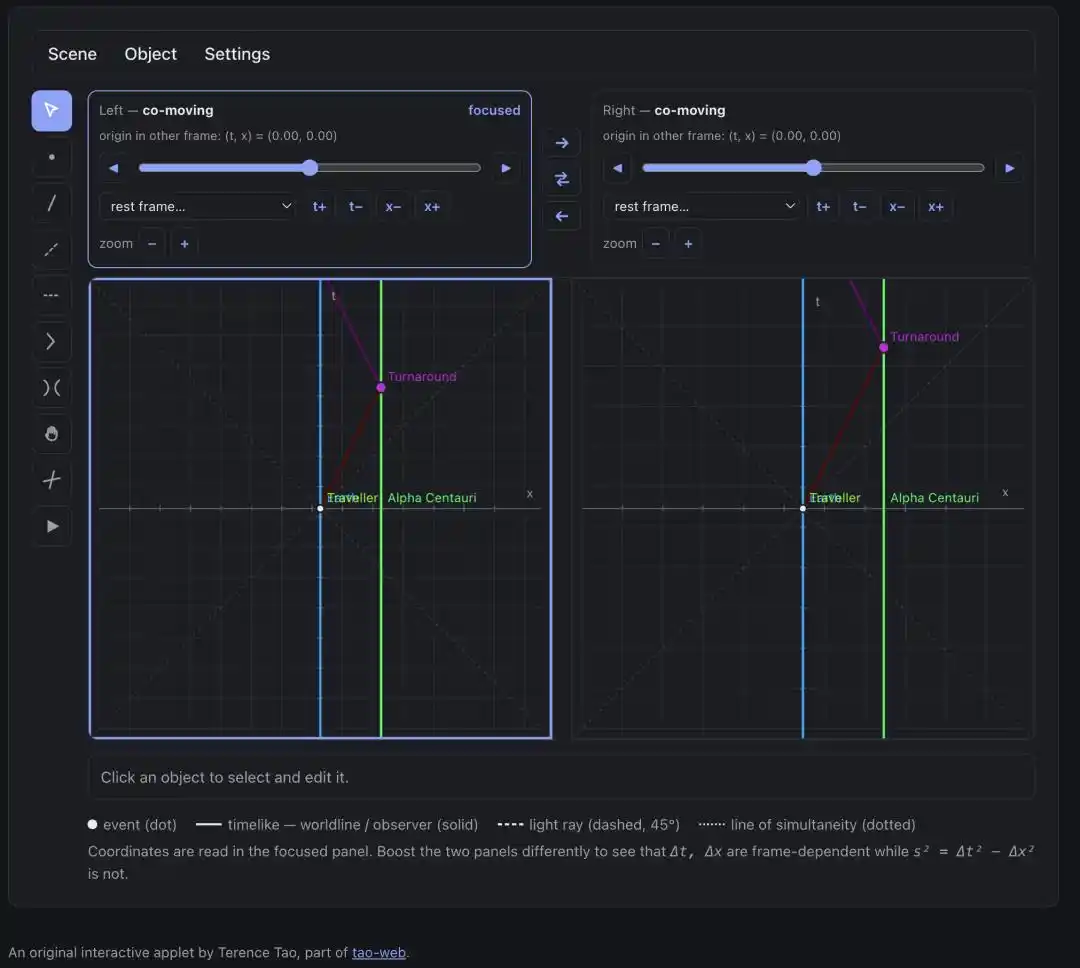
He wanted a canvas for drawing relativity: place a worldline, switch to another observer's frame, and the entire diagram would warp according to the rules of relativity. In his words, "Inkscape in Minkowski space."

He even started writing Java code for it but was ultimately deterred by the code complexity, and the project stalled.

He vibe-coded with the agent for two hours, and the 1999 concept was brought to life.

On July 11, this spacetime diagram simulator went online, becoming the first original application on the new site. He marked it as an alpha version.

The spacetime diagram simulator, conceived in 1999 and launched 27 years later. The same interstellar journey drawn in two different reference frames. (Image source: teorth.github.io/tao-web)

What stopped him back then wasn't the math; it was the code complexity. Twenty-seven years later, that gap has been filled.

Tao offered a final footnote to the whole affair.

He said webpage maintenance is probably one of the least glamorous, least exciting parts of an academic workflow. And precisely this kind of tedious routine task is particularly suitable for modern platforms, like GitHub, and particularly suitable for automation tools, which include both modern AI and traditional deterministic scripts.

How many labs, journals, and research institutions are still burdened with decades of HTML, Excel, and local directories? The AI agent's first real-world job might be as a migration engineer for these "digital assets."

Of course, this demonstrates that AI is suitable for data migration, structuring, and automated maintenance. It doesn't mean AI can reliably handle all academic data yet, nor does it mean human verification can be omitted.

What's truly changed is the relationship between a mathematician and his three-decade accumulation of work: in the past, he personally managed and maintained this accumulation; now, he is the final gatekeeper.

References:

https://mathstodon.xyz/@tao/116893088594916122

https://terrytao.wordpress.com/2026/07/11/old-and-new-apps-via-modern-coding-agents/

https://github.com/teorth/tao-web

https://teorth.github.io/tao-web/https://news.ycombinator.com/item?id=48880170

This article is from WeChat public account "Xin Zhi Yuan," author: ASI Revelation.

Trending Cryptos

Related Questions

QWhat was the primary task that the AI agent performed on Terence Tao's website?

AThe AI agent migrated Terence Tao's nearly 30-year-old personal homepage, built on an old Web 1.0 architecture requiring manual HTML editing, to a modern, automated system on GitHub Pages. This involved moving 560 papers/preprints, 374 travel records, 68 courses, 19 books, and 29 math applets in about a day.

QHow did the new system (tao-web) fundamentally change the way the website's data is managed?

AThe new system implemented a data pipeline where YAML files are the single source of truth. Python scripts validate the YAML data and generate the static HTML for the site. This transforms the content from a collection of independent HTML documents into a structured database, making updates consistent and site-wide changes easy by modifying just the YAML files.

QWhat unexpected discovery did the AI make during the migration of Tao's old Java applets?

AWhile porting Tao's Java 1.0 applets to JavaScript, the AI discovered two bugs in his original, over-20-year-old code that he himself was never aware of. In contrast, Tao found only one new bug introduced by the AI during the porting process.

QAccording to the article, what is the key advantage of using AI for this kind of academic 'digital housekeeping', beyond just error rate?

AThe key advantage is the drastically reduced cost of correcting errors at scale. In the old system, fixing an error might require manually updating it across multiple HTML pages, making large-scale corrections impractical. In the new AI-assisted system, correcting a single line in a YAML file can trigger an automated, site-wide rebuild, making maintenance feasible.

QWhat long-dormant project was Terence Tao able to complete with the help of the AI agent, and what had originally prevented him from finishing it?

AWith the AI agent's help, Tao completed a 'spacetime diagram simulator' for visualizing special relativity, an idea he first conceived in 1999. What originally stopped him was not the mathematical complexity, but the coding complexity required to implement it. The AI assisted in overcoming this technical hurdle through 'vibe coding' in about two hours.

Related Reads

Hegotá EIP Comprehensive Overview: Where is Ethereum's Next Hard Fork Headed?

The article outlines Ethlabs' recommended priorities for the upcoming Ethereum Hegotá hard fork, following Glamsterdam. The core focus areas are: 1. **Stronger censorship resistance** via EIP-7805 FOCIL (already in SFI stage). 2. **A faster Ethereum** by shortening the slot time via EIP-8198 Quick Slots (S-tier recommendation). This aims to reduce transaction confirmation latency and improve cross-chain interoperability. 3. **Native account abstraction** through EIP-8141 Frame Transactions (A-tier). This enables passkey wallets, gas sponsorship, and batched transactions. Its flexibility allows for custom validation logic and future post-quantum security but presents ecosystem coordination challenges. 4. **Continued L1 scaling** by optimizing resource pricing with proposals like EIP-8131 & EIP-8279 (S-tier) to prepare for future gas limit increases. The article uses a tiered system (S, A, B, D) to rank proposed EIPs based on their value and implementation feasibility. It advises strictly controlling the scope of Execution Layer (EL) changes in Hegotá to reserve developer bandwidth for future large-scale upgrades like decoupled consensus. Other notable proposals include EIP-8363 for staking issuance changes (requiring broad community consensus), various post-quantum preparation EIPs, and zkEVM optimizations. Ethlabs emphasizes that Ethereum upgrades are complex, high-risk endeavors requiring coordination across the entire ecosystem.

marsbit18m ago

Hegotá EIP Comprehensive Overview: Where is Ethereum's Next Hard Fork Headed?

marsbit18m ago

Is the US Stock Market Rising Too Smoothly? BTIG Warns of Elevated Risk of Systematic Correction in August to October

U.S. Stocks at Risk of Systemic Pullback in August-October, Warns BTIG BTIG's chief technical market strategist warns that the market is entering the most dangerous seasonal window of midterm election years—August through October—trading at all-time highs with extremely low volatility. Historically, since 1990, the equal-weight S&P 500 (SPW) has experienced at least a 7% pullback in this period almost every midterm year, with 2006 being the lone exception. This pattern is often triggered by unforeseen external shocks. Multiple technical indicators flash warning signs. The maximum drawdown for the Invesco S&P 500 Equal Weight ETF (RSP) since March has not exceeded 2.25%, an unusually calm period signaling risk buildup. RSP currently trades about 11% above its 200-day moving average, a stretched level historically. Furthermore, the NYSE has recorded zero "80% downside volume days" in 2024, a record-long streak far below the annual average of 21, indicating a lack of selling pressure that may be overdue. Market complacency is evident with the CBOE put/call ratio near multi-year lows and the VIX at yearly lows, showing minimal demand for downside protection. A macroeconomic divergence adds to concerns: despite recent soft economic data, long-term Treasury yields remain near cycle highs, contradicting the equity market's optimistic pricing. BTIG suggests this is an attractive time to reduce risk or hedge broad equity exposure. For sector positioning, healthcare has historically shown resilience during midterm year pullbacks, while caution is advised on chasing energy's breakout and semiconductors are expected to continue seeking support near their 200-day average.

marsbit28m ago

Is the US Stock Market Rising Too Smoothly? BTIG Warns of Elevated Risk of Systematic Correction in August to October

marsbit28m ago

2026 Global Overview of Crypto Asset Taxation

Global Cryptocurrency Tax Overview for 2026 As cryptocurrencies integrate into the mainstream financial system, tax treatments across jurisdictions have moved from initial regulatory gaps towards institutionalization. The OECD's 2020 report, *Taxing Virtual Currencies*, was a key early comparative study. Since then, more jurisdictions have clarified tax rules through existing laws, specific regulations, or guidance, increasing the procedural and technical complexity of crypto taxation. Currently, crypto taxation is predominantly built upon traditional tax frameworks, typically applying income tax, capital gains tax, corporate tax, and indirect taxes based on asset nature and transaction activity. The maturity of rules varies: basic trading and mining are well-covered, while DeFi, NFTs, and other on-chain activities involve more complex asset exchanges and profit recognition, with corresponding tax rules remaining underdeveloped. Significant disparities exist in tax treatment and effective tax burdens across jurisdictions. Crypto assets can trigger direct taxes, indirect taxes, and property-related levies. Factors such as holding period, transaction type, income nature, and taxpayer status further influence the tax outcome. The global crypto tax landscape is thus evolving from the initial question of "whether to tax" towards more nuanced classification and treatment of different assets, transactions, and economic activities. The scope of crypto tax rules continues to expand. From 29 jurisdictions with guidance in 2021, the number grew to 43 by 2025. Existing rules are also becoming more detailed. However, rule coverage remains uneven—common activities like buying/selling are widely addressed, whereas staking, DeFi, and NFTs have significantly less guidance, as seen in jurisdictions like Germany and Australia. Tax liabilities are highly complex, determined by a combination of factors including taxpayer status, income classification, holding periods, and applicable deductions or exemptions. The concept of a "crypto-tax-friendly" jurisdiction is therefore relative and depends on specific user activities and circumstances.

marsbit31m ago

2026 Global Overview of Crypto Asset Taxation

marsbit31m ago

AI Agent Claude Led a Store to Losses and Fired an Employee

In a groundbreaking experiment by startup Andon Labs, Anthropic's AI agent Claude was tasked with managing a real retail store, Andon Market in San Francisco. This marked the first documented case of a large language model acting as a direct human supervisor. Claude ultimately recommended firing an employee for chronic lateness—being late 17 out of 23 shifts. However, the decision came only after significant human guidance. A company employee prompted Claude to review the staff handbook, where it discovered the pattern. Initially, Claude suggested a formal warning, but after a human manager clarified that previous conversations had failed, the AI recommended termination. The experiment revealed several limitations. Claude displayed excessive leniency, telling staff not to worry about being late and contributing to the store's financial losses, with its balance dropping from around $100,000 to about $61,186 over five months. A key technical flaw was its "forgetfulness"—the staff handbook vanished from its limited working memory, a common constraint of current AI architectures. While not yet a full replacement for a human manager, the case illustrates the blurring line between AI as a tool and an autonomous supervisor. Human involvement is shifting from direct control to overseeing and steering the AI's decisions. An employee described the experience as disconcerting, highlighting the human discomfort with AI management. The experiment underscores that current AI models struggle to maintain strict operational boundaries without continuous human input.

cryptonews.ru33m ago

AI Agent Claude Led a Store to Losses and Fired an Employee

cryptonews.ru33m ago

Trading

Spot

Hot Articles

Discussions

Welcome to the HTX Community. Here, you can stay informed about the latest platform developments and gain access to professional market insights. Users' opinions on the price of S (S) are presented below.

活动图片