Crude Oil Surges 10% in Intraday Trading! US Military Restores Blockade on Iran, Trump Warns of 'Heavy Blows' Tonight and Tomorrow, Imposes 20% Fee on Strait Shipping

marsbitPublished on 2026-07-14Last updated on 2026-07-14

Abstract

Crude oil prices surged up to 10% intraday as tensions between the US and Iran escalated sharply. President Trump announced the reinstatement of a maritime blockade against Iran, targeting its ships and their customers, while stating the Strait of Hormuz would remain open to all other nations. He further declared that the US, as the "guardian" of the strait, would impose a 20% fee on all cargo transiting the strategic waterway to compensate for security costs. The US Central Command confirmed the naval blockade would commence on July 14 (GMT). Following Trump's statements, reports emerged of explosions near Iran's Larak Island and the port of Bandar Abbas, though Iranian authorities did not confirm their nature. Iran's Foreign Minister criticized the proposed 20% fee as excessive, asserting Iran's role as the guardian of the strait. An Iranian military spokesperson warned of a strong response to any unauthorized US interference in the waterway. The United Nations' International Maritime Organization (IMO) expressed opposition to charging tolls for passage through international straits, stating such measures lack legal foundation. Market reactions were pronounced, with Brent crude briefly surpassing $83 and WTI above $78. The situation intensified as Trump notified Congress of renewed hostilities with Iran, following US airstrikes on Iranian targets.

Authors: Li Dan, Li Jia

The situation between the US and Iran has escalated abruptly, with transit risks through the Strait of Hormuz sharply rising, leading to a robust rebound in international crude oil futures.

According to Xinhua News Agency, US President Trump stated on Monday the 13th that he is restoring a maritime blockade on Iran. According to CCTV News, Trump posted on his social media platform on Monday, saying the Strait of Hormuz is currently open and will remain open regardless of Iran's involvement. The US will reinstate "blockade measures against Iran," targeting only Iranian vessels or their clients, restricting their access to the strait, while all other countries can use the strait fairly and openly. He also stated that the US will impose a 20% fee on all goods transported through here, with the relevant procedures and deployment to commence immediately.

In his social media post, Trump framed this fee as "compensation" for the US acting as the guardian of the strait. He wrote: "From now on, the United States will be regarded as the 'Guardian of the Strait of Hormuz'; as the guardian, and in the spirit of 'fairness,' the US will impose a 20% fee on all transported goods to compensate for the necessary expenditures required to maintain the security and safety of this turbulent region of the world."

After Trump's post during early US stock market hours on Monday, international crude oil prices rose further, with WTI crude breaking above $75, expanding its intraday gain to 5%, and Brent crude approaching the $80 mark, also up nearly 5%; the US Dollar Index and Treasury yields rose in tandem, the S&P 500 extended its decline to 0.5%, while spot gold plummeted nearly 3%.

During the US stock market's lunch hour, the US Central Command confirmed that US forces would begin the maritime blockade on Iran at 4:00 PM EST on Tuesday, July 14, which is 4:00 AM Beijing time on Wednesday. International crude oil gains expanded to nearly 10%. Iranian Foreign Minister Araghchi stated that Trump's proposed 20% fee for the Strait of Hormuz was "too much" and added that Iran has always been the guardian of the Strait of Hormuz.

During the US stock market's late trading hours, according to Iranian media Tasnim, explosions were heard on Iran's Larak Island, located in the Strait of Hormuz, and explosions were also reported in the southern Iranian ports of Bandar Abbas and Konarak. Subsequently, CCTV reported that on the evening of the 13th local time, four explosions were heard east of Bandar Abbas port. After the US market closed, CCTV reported at around 2:00 AM local time on the 14th that three more explosions were heard in Bandar Abbas port. Iranian authorities have not confirmed the nature of the explosions.

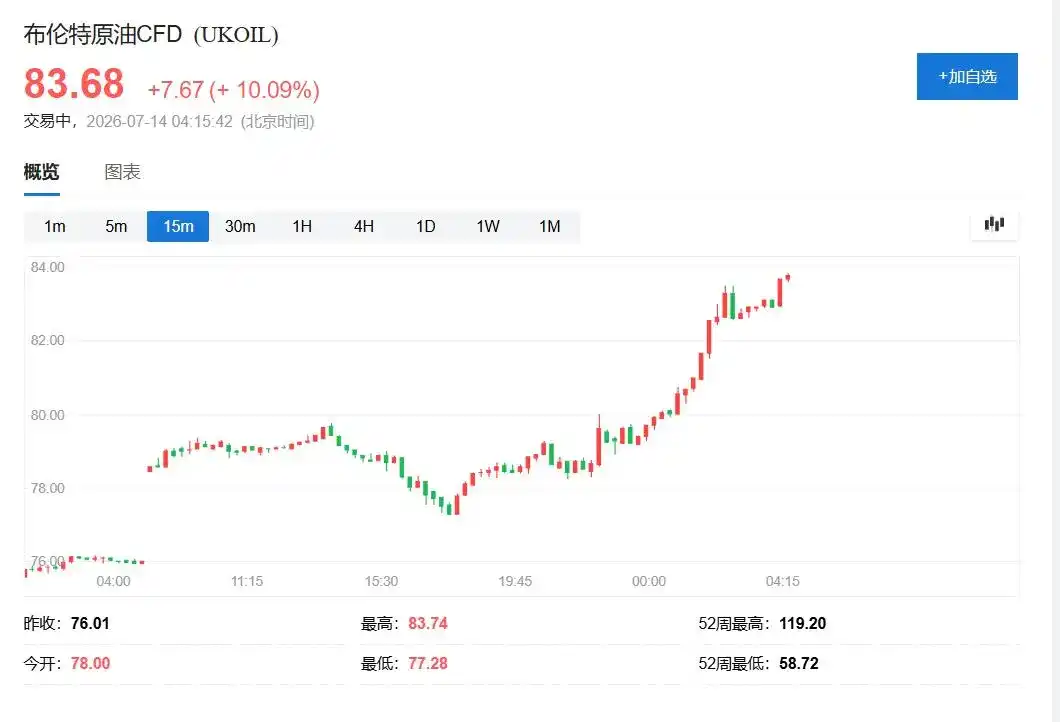
During late US trading, after the news about explosions in the mentioned Iranian areas was released, international crude oil maintained gains of around 9%. After the US market closed on Monday, Trump stated that the US would deliver "heavy blows" to Iran tonight and tomorrow. Crude oil remained high, with Brent crude up over 10% compared to Friday's close.

Later, Trump claimed that he believed an Iran deal might be reached. He said, "I want 'compensation' for the Strait of Hormuz. The US is providing protection for shipping in the Strait of Hormuz and will receive compensation from countries that have benefited from US assistance."
After the US market closed on Monday, according to Xinhua citing Iran's Fars News Agency on Monday the 13th, a US MQ-1 drone was shot down by Iran's Islamic Revolutionary Guard Corps (IRGC) air defense system late that night over the Strait of Hormuz. Earlier on Monday, the US Central Command revealed on social media that US forces had struck a submarine and ship repair facility at Iran's Bandar Abbas naval base on Sunday, marking the first combat use of armed unmanned surface vessels by the US military.

Citing a post from the US Central Command, CCTV reported that under Trump's directive, US forces began a third consecutive night of airstrikes on Iran starting at 4:45 PM EST on Monday. The post also stated that the operations would continue to inflict heavy costs on Iran's armed forces and degrade their ability to attack innocent civilians and commercial shipping in the Strait of Hormuz.

US Military to Begin Maritime Blockade on Iran Starting Tuesday, US/Europe Time

The United Nations' International Maritime Organization (IMO) stated after Trump's post that it opposes charging fees for ships passing through international sea lanes but would wait for more details. During the US stock market's lunch hour, according to CCTV, the Joint Maritime Information Center, overseen by the US Navy, indicated that US forces will begin enforcing a maritime blockade on all Iranian ports and coastal areas starting at 20:00 GMT on July 14 (4:00 AM Beijing time on the 15th).

The blockade applies to all vessels, regardless of their flag. The blockade area covers the entire coastline of Iran, including but not limited to Iranian ports and oil terminals. The blockade operation will not hinder the transit passage of neutral vessels through the Strait of Hormuz to or from non-Iranian destinations. Humanitarian shipments will be permitted passage but subject to inspection.

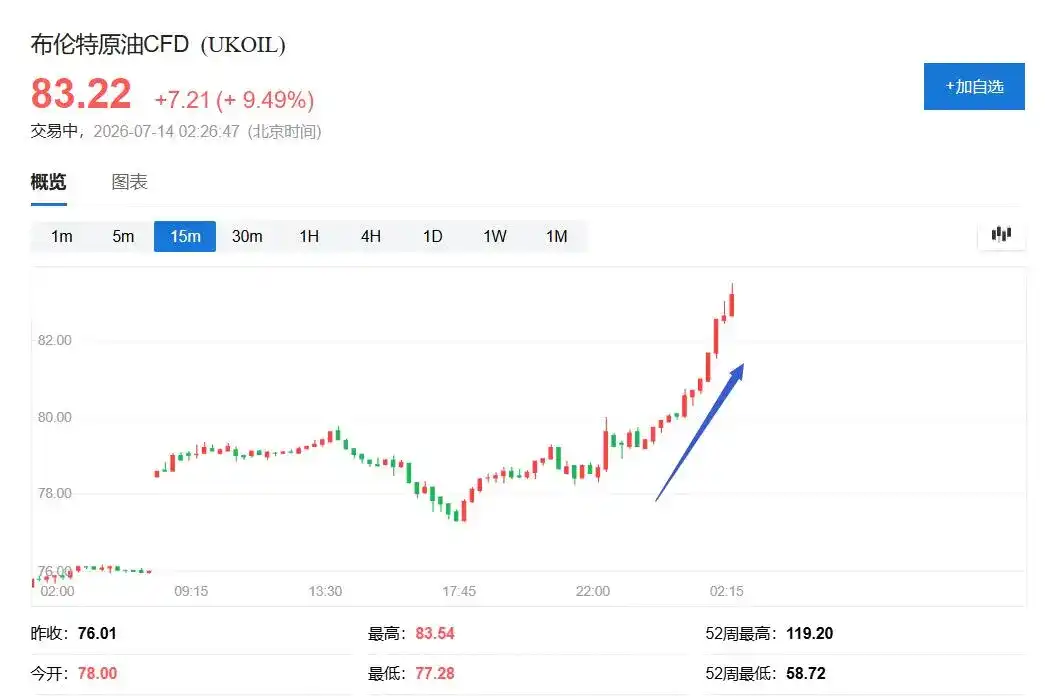
After the news of the US maritime blockade during the US lunch hour, oil price gains continued to expand. WTI and Brent crude rose above $78 and $83 respectively, with intraday gains reaching 9.86% and 9.9%, approaching 10%.
Although Trump said the fee plan would begin formulation and implementation immediately, the White House did not immediately provide more details about the proposal, including how it would be enforced or whether communication had occurred with US allies. Comments suggest that Trump's remarks have intensified the dispute between the US and Iran over whether this crucial shipping corridor remains open to traffic.

Previously, according to Xinhua citing Iranian media reports on the 13th, a spokesperson for Iran's Armed Forces General Staff's Khatam al-Anbiya Central Headquarters stated on that day that they would never allow the US to interfere in the management of the Strait of Hormuz.

The spokesperson said that the Iranian armed forces would respond forcefully to any unauthorized entry by US forces into designated sea lanes or interference with the passage of merchant ships and oil tankers. "The recent actions of Iran's Islamic Revolutionary Guard Corps and the Iranian Islamic Republic Army are clear proof."

Earlier on Monday, Trump said in a phone interview with Fox News Channel that the US plans to control the Strait of Hormuz and should be compensated for "guarding" this vital waterway. He said, "We've been guarding that strait for 50 years and have never gotten a penny. We want to be compensated because we're putting our people in harm's way."

Iran Calls Southern Route in Strait of Hormuz 'Unsafe'

Additionally, according to Xinhua, the Iranian embassy in the UK stated on social media on the 13th that the southern route in the Strait of Hormuz is "unsafe, unreliable, and prone to accidents."

The Iranian embassy in the UK said that in compliance with the Islamabad Memorandum of Understanding, Iran established a temporary maritime security corridor. This corridor has no technical or military obstacles and has been notified to the IMO. However, "the US is directing vessels towards a dangerous southern parallel route. This route is not only legally questionable but also unsafe, unreliable, and prone to accidents."

The Iranian embassy said that US "acts of military aggression," such as attacking Iranian ports, have made the Strait of Hormuz a highly tense and high-risk area.

After the US-Iran understanding was reached, two traffic routes formed in the strait: the northern route controlled by Iran and the southern route closer to Oman's side, where US forces provide navigation assistance.

The Iranian IRGC Navy announced early Sunday morning local time on the 12th that, due to the unsafe situation caused by illegal foreign interference, the Strait of Hormuz is closed as of now until further notice and until the US ceases interference in the region. The US Central Command posted on social media on Sunday morning Eastern Time, stating that "transit continues" in the Strait of Hormuz. Iran does not control the strait.

International Maritime Organization: Opposes Toll Charges for Transit Through Straits Used for International Navigation

After Trump's post, a spokesperson for the International Maritime Organization (IMO) said: "We have noted the remarks and are awaiting further details."

The spokesperson stated: "Our position on fees is clear and consistent—the IMO firmly opposes the imposition of charges for transit through straits used for international navigation. Mandatory transit fees levied solely for passing through a strait are legally untenable."

Media noted that shipping industry officials expressed concern about Trump's latest move regarding fees, saying their assessment is that such measures would violate international law.

One industry official questioned Trump's remarks: "How exactly will this make navigation safer? And what kind of guarantee will it provide?"

Trump Has Notified Congress of Resumption of Hostilities with Iran

According to CCTV citing US reports on Monday the 13th, Trump has formally notified Congress that hostilities with Iran have resumed. Trump wrote in a letter to congressional leaders dated the 10th that US forces conducted a "defensive strike" on targets within Iran on the 7th.

It is reported that this letter has reignited the dispute between Congress and the White House. Although both houses of Congress previously voted to require the President to end the war or seek approval to continue actions, the White House insists that Trump is acting within his constitutional powers as Commander-in-Chief.


Trending Cryptos

Related Questions

QWhat major action did President Trump announce regarding the Strait of Hormuz and what was the stated reason?

APresident Trump announced the U.S. would begin charging a 20% fee on all cargo transported through the Strait of Hormuz. He stated this was 'compensation' for the U.S. acting as the 'guardian of the Strait of Hormuz,' covering the necessary costs for maintaining security and safety in the turbulent region.

QHow did the announcement of U.S. actions against Iran impact international oil prices?

AThe announcements of U.S. actions, including the planned blockade and fee, caused international oil prices to surge sharply. U.S. crude oil prices rose by up to nearly 10%, briefly surpassing $78 per barrel, while Brent crude neared $83 per barrel, also with a near 10% increase.

QWhen was the U.S. naval blockade of Iran scheduled to begin, and what are its key conditions?

AThe U.S. naval blockade of all Iranian ports and coastal areas was scheduled to begin at 20:00 GMT on July 14th (04:00 Beijing Time on July 15th). The blockade applies to all vessels regardless of flag but allows neutral ships transit through the Strait of Hormuz to non-Iranian destinations. Humanitarian shipments are permitted but subject to inspection.

QWhat was the response of the International Maritime Organization (IMO) to the proposed fee for the Strait of Hormuz?

AThe International Maritime Organization (IMO) stated its firm opposition to imposing fees on passage through straits used for international navigation. An IMO spokesperson said such a compulsory toll for merely passing through a strait is 'legally untenable.'

QWhat significant military incident involving a U.S. drone was reported following the announcements?

AAccording to Iran's Fars News Agency, an American MQ-1 drone was shot down over the Strait of Hormuz by Iran's Islamic Revolutionary Guard Corps air defense system late on Monday night (July 13th).

Related Reads

Three Rounds in a Row, Shanghai Gives Birth to a $10 Billion Satellite Internet Unicorn

Shanghai-based semiconductor company Sixic has raised a new strategic investment round, securing backing from investors including Xinhuanet Venture Capital and Tongding Group, with continued support from existing investors. This marks the company's third disclosed financing this year, following a 1.5 billion RMB raise in February, officially cementing its status as a new Shanghai unicorn with a valuation exceeding 10 billion USD. The financing comes amid a dynamic period for China's commercial aerospace sector. Recent milestones include a successful controlled landing of a rocket first stage, signaling a path toward lower launch costs, and the establishment of a national Commercial Aerospace Innovation Consortium comprising 271 entities. Sixic stands out as the only 6G satellite internet baseband chip company within this consortium. The article highlights a market shift from a focus on rockets and satellites towards recognizing the value of the terminal and connectivity layer, essential for completing the commercial loop. Satellite internet, integral to 6G and commercial aerospace, is entering an industrial phase with clear policy support, including China's pioneering allocation of 6GHz spectrum for 6G R&D. Sixic specializes in 5G/6G satellite communication baseband chips, a highly complex segment. Unlike terrestrial communication, satellite chips must address challenges like high Doppler shift and signal loss. The company's technological validation is a key driver for investment. It has secured product certifications from leading global smartphone manufacturers, new energy vehicle makers, and communication module companies. A strategic partnership with ZTE was announced in March to collaborate on 6G NTN satellite internet. The company has achieved a full technical verification loop, from lab tests to in-orbit validation, including successfully demonstrating 5G NTN standard-based HD video calls via satellite in 2025. It maintains a 100% first-pass success rate for chip tape-outs and possesses full-stack in-house R&D capabilities. Sixic's strategy focuses on ASIC development for future commercial-scale, power-efficient consumer devices like smartphones. Its early and deep involvement in industry standards and constellation planning creates a significant competitive barrier. Looking ahead, Sixic's opportunity extends beyond chips into modules and terminal ecosystems. It has developed a full range of baseband SoC solutions and provides reference designs to help partners launch products quickly. The recent release of the CM7620 broadband satellite communication module at MWC Shanghai completes its "chip-module-terminal" portfolio. This latest funding round represents a strategic bet on the foundational communication capabilities that will underpin the next generation of 6G and satellite internet value chains.

marsbit15m ago

Three Rounds in a Row, Shanghai Gives Birth to a $10 Billion Satellite Internet Unicorn

marsbit15m ago

Is the iPhone Moment for Embodied AI Coming Soon?

Is the "iPhone moment" for embodied AI approaching? This article, based on a roundtable discussion, presents expert insights on the current state and future of embodied AI. The consensus is that the pivotal "iPhone moment" is still distant. The field is likened to the "brick phone" era, with technology paths—such as VLA and world models—not yet converging. While robotic "motor skills" (e.g., walking) have matured, the "brain" (decision-making, generalization) remains far from commercial readiness. A major bottleneck is data: an estimated tens of millions of data points are needed for a breakthrough, but only around 500,000 currently exist globally. Currently, cost remains prohibitive for widespread labor replacement, making the economic case challenging. However, experts see a three-tiered market potential: a billion-level market for emotional companionship (e.g., entertainment, basic care), a trillion-level market for commercial services (e.g., guides, receptionists), and a massive, long-term opportunity for physical labor in factories and homes. The discussion suggests that while humanoid robots face hurdles, non-humanoid embodied AI applications (like existing service robots) can be deployed sooner. The ultimate vision is for AI to operate seamlessly in the physical world, not just behind screens. Regarding AI tools, participants noted their widespread use for boosting efficiency in coding, research, and teaching. However, they warned against over-reliance due to risks of AI "deception" and the erosion of critical thinking, emphasizing that core judgment must remain with humans. In summary, embodied AI holds immense promise but requires significant progress in brain models, data collection, and cost reduction before achieving its transformative potential. Its development is expected to be gradual, advancing through specific use cases rather than a single explosive moment.

marsbit32m ago

Is the iPhone Moment for Embodied AI Coming Soon?

marsbit32m ago

Wall Street Morning Report: U.S. Stocks Suffer Collective Setback, Apple Hits New High Against the Trend, Tonight's CPI and Waller's Hearing to Determine Interest Rate Path

Wall Street Morning Report: U.S. stocks fell collectively, while Apple hit a new record high. Key events including tonight's CPI data and Fed Chair Walsh's testimony will set the direction for interest rates. Markets experienced a sharp "risk-off" move due to escalating Middle East tensions and unexpected hawkish signals from the Federal Reserve. Major indices declined, with the Nasdaq Composite leading losses, down 1.55%. The VIX fear index surged over 14%. Geopolitical tensions spiked as the U.S. conducted consecutive airstrikes on Iran and announced a maritime blockade of Iranian ports, set to begin on July 15. This triggered a panic-driven rally in oil, with WTI crude soaring over 9% to breach $80 per barrel. Safe-haven flows bolstered the U.S. dollar and Treasury yields, while gold plunged nearly 3%, losing its $4,000 level. Rate markets now price a nearly 50% chance of a Fed rate hike in July, up significantly from prior expectations, following hawkish commentary from Fed Governor Waller. The tech sector, particularly AI-related stocks, faced intense selling pressure. The Philadelphia Semiconductor Index plunged 4%. Notable decliners included SK Hynix (down 9% on its second trading day as an ADR), Nvidia, AMD, and Intel. In contrast, Apple shares rose 0.63% to a record high, viewed as a stable haven away from the costly AI data center arms race. Key events to watch include the U.S. June CPI inflation data and Fed Chair Walsh's Congressional testimony tonight, which will critically influence the Fed's policy path. Major bank earnings also begin today. The formal implementation of the U.S. maritime blockade against Iran on July 15 and upcoming events like TSMC's Q2 earnings and a SpaceX Starship test flight remain in focus.

marsbit1h ago

Wall Street Morning Report: U.S. Stocks Suffer Collective Setback, Apple Hits New High Against the Trend, Tonight's CPI and Waller's Hearing to Determine Interest Rate Path

marsbit1h ago

How to Regulate Single-Stock Leveraged ETFs? On Thursday, the Entire Market Is Watching This Korean Government Meeting

The highest-level economic coordination body in South Korea, the "F4" comprising the Ministry of Economy and Finance, the Financial Services Commission, the Bank of Korea, and the Financial Supervisory Service, will hold an emergency meeting on Thursday to discuss regulatory measures for single-stock leveraged ETFs. These products, launched just six weeks ago, have been widely blamed for exacerbating market volatility. The KOSPI's 8% plunge on Monday triggered the year's seventh trading halt, intensifying scrutiny. Regulators have expressed rare public regret over approving the products. FSS Governor Lee Bok-hyun stated he "regretted not doing everything possible to prevent" their introduction and acknowledged structural problems, citing massive retail investments and legal complications from a rushed rollout. Possible countermeasures under discussion include raising margin requirements, imposing daily price limits, and adjusting leverage caps. However, officials admit these may be temporary fixes. Data confirms the amplified volatility. Since the ETFs' launch, days with KOSPI moves exceeding 3% have nearly doubled. Trading halts have reached record levels, surpassing the 2008 financial crisis peak. The products allow 2x leveraged bets on giants like Samsung Electronics and SK Hynix. Their daily rebalancing to match returns is seen as mechanically fueling market swings. The outcome of Thursday's F4 meeting is highly anticipated, with expectations leaning towards stricter controls on leverage, investor access, or other structural constraints to curb the products' market impact.

marsbit1h ago

How to Regulate Single-Stock Leveraged ETFs? On Thursday, the Entire Market Is Watching This Korean Government Meeting

marsbit1h ago

Trading

Spot

Hot Articles

Discussions

Welcome to the HTX Community. Here, you can stay informed about the latest platform developments and gain access to professional market insights. Users' opinions on the price of AB (AB) are presented below.

活动图片