Título original: Wall Street Pulls Back From Bitcoin』s Money-Spinning Basis Trade
Autor original: Sidhartha Shukla,Bloomberg
Compilación: Peggy,BlockBeats
Nota del editor: El arbitraje de base de Bitcoin, que alguna vez fue considerado "infalible", está perdiendo silenciosamente su atractivo: los contratos abiertos de CME y Binance están cambiando, y el diferencial de precios se ha reducido hasta el punto de que apenas cubre los costes de financiación y ejecución.
Superficialmente, se trata de un espacio de arbitraje que se está comprimiendo; en un nivel más profundo, el mercado de derivados de criptoactivos está madurando. Las instituciones ya no necesitan obtener ganancias "transfiriendo" activos, y los operadores están pasando del apalancamiento a las opciones y las coberturas. La era simple de los altos rendimientos se está desvaneciendo, y la nueva competencia se dará en estrategias más complejas y refinadas.
A continuación, el texto original:
El mercado de derivados de criptoactivos está experimentando un cambio silencioso pero significativo: una de las estrategias de trading más estables y rentables está mostrando signos de fallo.
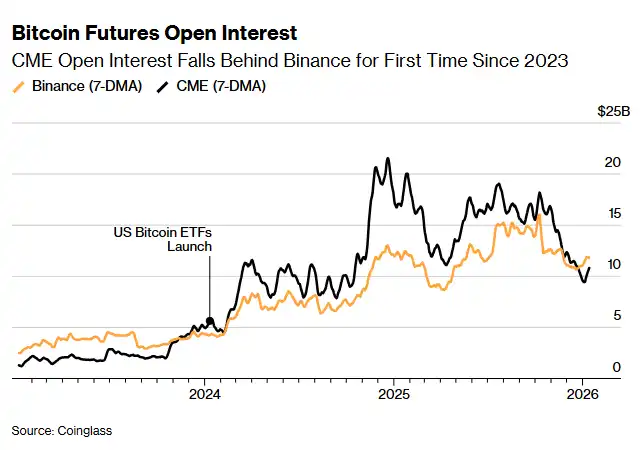
La operativa de "carry trade" (compra de spot y venta de futuros) utilizada comúnmente por las instituciones para obtener beneficios de la diferencia de precios se está desmoronando. Esto no solo presagia una rápida compresión del espacio de arbitraje, sino que también envía una señal más profunda: la estructura del mercado de criptoactivos está cambiando. Los contratos abiertos de futuros de Bitcoin del Chicago Mercantile Exchange (CME) han caído por debajo de los de Binance por primera vez desde 2023, lo que demuestra aún más que las oportunidades de arbitraje, antes muy rentables, se están erosionando rápidamente a medida que los diferenciales se estrechan y el acceso al mercado se vuelve más eficiente.
Tras el lanzamiento de los ETF de Bitcoin spot a principios de 2024, el CME se convirtió en el lugar preferido de los escritorios de negociación de Wall Street para ejecutar este tipo de estrategias. Esta lógica operativa es muy similar al "comercio de base" (basis trade) de los mercados tradicionales: comprar Bitcoin spot a través de ETF y vender simultáneamente contratos de futuros, obteniendo ganancias de la diferencia de precio entre ambos.
Y en los meses posteriores a la aprobación de los ETF, esta llamada "estrategia delta neutral" a menudo ofrecía rendimientos anualizados de dos dígitos, atrayendo miles de millones de dólares; dinero al que no le importaba la dirección del precio de Bitcoin, solo obtener el rendimiento. Pero fueron precisamente los ETF, que impulsaron la rápida expansión de esta operativa, los que sembraron las semillas de su fin: a medida que más y más escritorios de negociación se apresuraban a entrar, el diferencial de arbitraje se fue cerrando rápidamente. Hoy, los rendimientos de esta operativa apenas cubren los costes de financiación.
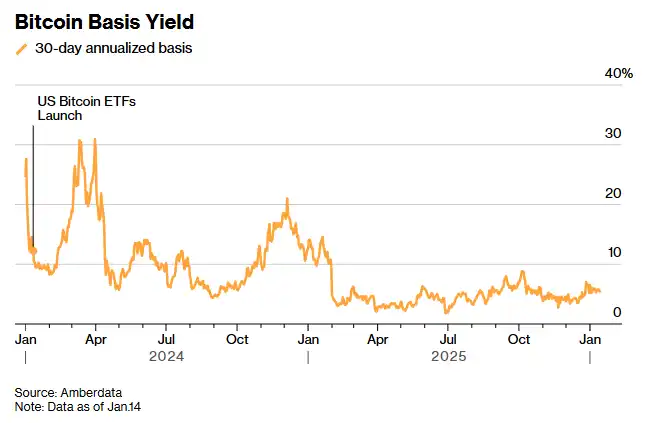
Según datos compilados por Amberdata, el rendimiento anualizado actual a un mes ronda el 5%, cerca de sus mínimos recientes. Greg Magadini, director de derivados de Amberdata, señaló que hace un año, la base estaba cerca del 17%, mientras que ahora ha caído a alrededor del 4,7%, apenas suficiente para cubrir el umbral de los costes de financiación y ejecución. Mientras tanto, el rendimiento de los bonos del Tesoro estadounidense a un año es de aproximadamente el 3,5%, lo que hace que el atractivo de esta operativa se desvanezca rápidamente.
En el contexto de la continua contracción de la base, según datos compilados por Coinglass, el volumen de contratos abiertos de futuros de Bitcoin del CME ha caído desde un pico de más de 21.000 millones de dólares a menos de 10.000 millones; mientras que los contratos abiertos de Binance se han mantenido relativamente estables, en torno a los 11.000 millones de dólares. James Harris, director ejecutivo de la gestora de activos digitales Tesseract, afirmó que este cambio refleja más una retirada de los fondos de cobertura y las grandes cuentas estadounidenses, y no una retirada generalizada de los activos cripto tras el pico de precios de Bitcoin en octubre.
Exchanges de criptoactivos como Binance son los principales lugares de negociación de contratos perpetuos. Estos contratos se liquidan, valoran y calculan sus márgenes de forma continua, a menudo varias veces al día. Los contratos perpetuos, comúnmente abreviados como "perps", representan la mayor parte del volumen de operaciones del mercado de criptoactivos. El año pasado, el CME también lanzó contratos de futuros de menor valor nominal y mayor plazo, cubriendo activos cripto y mercados de índices bursátiles, ofreciendo posiciones de futuros de una manera cercana al mercado spot, permitiendo a los inversores mantener contratos hasta por cinco años sin tener que renovarlos frecuentemente.
Harris de Tesseract señaló que históricamente, el CME ha sido el lugar preferido para el capital institucional y las operaciones de "carry trade". Añadió que que el volumen de contratos abiertos del CME sea superado por el de Binance "es una señal importante de que la estructura de participación del mercado se está trasladando". Calificó la situación actual como un "reinicio táctico", impulsado por la caída de los rendimientos y el adelgazamiento de la liquidez, más que por una pérdida de confianza en el mercado.
Según una nota de CME Group, 2025 es un punto de inflexión clave para el mercado: a medida que el marco regulatorio se aclara gradualmente y mejoran las expectativas de los inversores hacia este sector, el capital institucional también comenzó a expandirse desde las apuestas simples en Bitcoin a tokens como Ethereum, XRP de Ripple y Solana.
CME Group declaró: "Nuestro volumen medio diario de contratos abiertos nominales de futuros de Ethereum en 2024 fue de aproximadamente 1.000 millones de dólares, y para 2025, esta cifra ha crecido hasta acercarse a los 5.000 millones de dólares".
Aunque los recortes de tipos de la Fed han reducido el coste de financiación, esto no ha logrado impulsar una recuperación sostenida en el mercado de criptoactivos desde la caída generalizada de los precios de varios tokens el 10 de octubre. La demanda de préstamos se ha debilitado, los rendimientos de las finanzas descentralizadas (DeFi) están en niveles bajos, y los operadores prefieren utilizar opciones y herramientas de cobertura en lugar de apalancarse directamente para apostar por una dirección.
Le Shi, director gerente en Hong Kong del creador de mercado Auros, afirmó que a medida que el mercado madura, los participantes tradicionales ahora tienen más canales para expresar puntos de vista direccionales, desde ETF hasta acceso directo a los exchanges. Este aumento de opciones reduce la diferencia de precios entre los distintos lugares de negociación, lo que naturalmente comprime el espacio de arbitraje que antes impulsaba el volumen de contratos abiertos del CME.
Le dijo: "Aquí hay un efecto de autocorrección". Considera que cuando los participantes del mercado se agrupan continuamente en los lugares de negociación con menores costes, la base se estrecha y el impulso para realizar operaciones de carry trade también se debilita.
El miércoles, Bitcoin cayó hasta un 2,4%, a 87.188 dólares, antes de recortar pérdidas. Esta caída llegó a borrar todas las ganancias del año.
Bohumil Vosalik, director de inversiones de 319 Capital, afirmó que la era de obtener altos rendimientos casi sin riesgo probablemente haya terminado, lo que obligará a los operadores a recurrir a estrategias más complejas en mercados descentralizados. Para las instituciones de alta frecuencia y de tipo arbitraje, esto significa que tendrán que buscar oportunidades en otros lugares.
[Enlace original]



















