The 3 Bitcoin Rules That Tell When The Bear Market Is Fully Over

bitcoinistPublished on 2026-05-13Last updated on 2026-05-13

Abstract

Crypto analyst Bee outlines three Bitcoin rules to identify the end of the bear market: it lasts at least 350 days, the bottom never forms without touching the 350-day moving average (MA 350), and the price always drops more than expected. Based on these, he argues the current bear market is not over, projecting a potential drop to around $46,000 to tag the MA 350 at $47,000 before a true bottom forms. Despite a recent rally above $82,000, Bitcoin struggles to hold $80,000 amid hot CPI data and stalled U.S.-Iran talks, with Bee expecting another downtrend. Another analyst, Colin, is more open to the cycle bottom being in than a month ago but still anticipates a retest of the $60,000-$70,000 range lows later this year. Alternatively, he notes that if the bottom isn't in, prolonged sideways trading reduces the odds of a significantly lower floor. Bitcoin is currently trading around $81,200.

Crypto analyst Bee has outlined three Bitcoin rules that provide insights into when the bear market is likely to end. This comes as BTC struggles again to hold above the psychological $80,000, with experts predicting another imminent decline.

Bitcoin Bear Market Rules As To When The Bear Market May End

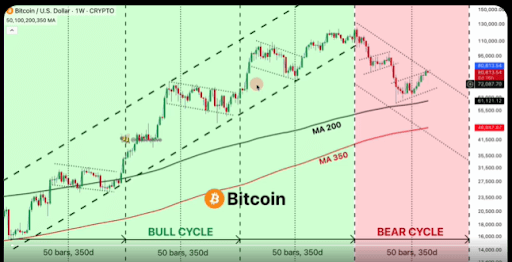
In an X post, Bee stated that Bitcoin has three rules in a bear market. First, he noted that the bear market lasts at least 350 days. The analyst also mentioned that the bottom never forms without touching the MA 350, and lastly, the price always drops further than anyone expects. Based on this, he suggested that the bear market is yet to end despite BTC’s recent relief rally.

His accompanying chart showed that BTC could still drop to around $46,000 before a bottom forms for Bitcoin in this bear market. The analyst also noted that the 350-day moving average is at $47,000, and that level remains untouched. However, Bee remarked that the good news is that the leading crypto is already 65% of the way through the bear cycle.

Source: Chart from Bee on X

For now, the analyst expects another downtrend, with Bitcoin potentially reaching new lows. Bee noted that there are too many things working against this bullish momentum at the moment, which is why he is confident that the leading crypto will still drop further. He declared that the flush is coming and that when the MA 350 gets tagged, he will flip bullish.

His analysis comes amid Bitcoin’s recent rally above $80,000, with BTC reaching $82,000 over the weekend. However, the leading crypto is now struggling to stay above this level, falling below $80,000 yesterday on the back of the hot CPI inflation data. U.S.-Iran peace talks have also stalled, which puts BTC at risk of another decline.

Analyst Open To The Bottom Being In

Crypto pundit Colin, who had previously predicted another downtrend for Bitcoin, said he is more open to the idea that the bottom is in than he was a month ago. However, if that is the case, the analyst opined that BTC is still likely to retest the range lows between $60,000 and $70,000 later this year.

On the other hand, Colin also said he is open to the idea that the cycle bottom isn’t in yet and that BTC could see lower prices toward the end of the year. He noted that the logic is that the longer BTC trades sideways or higher, the less the odds are of a lower bear market floor.

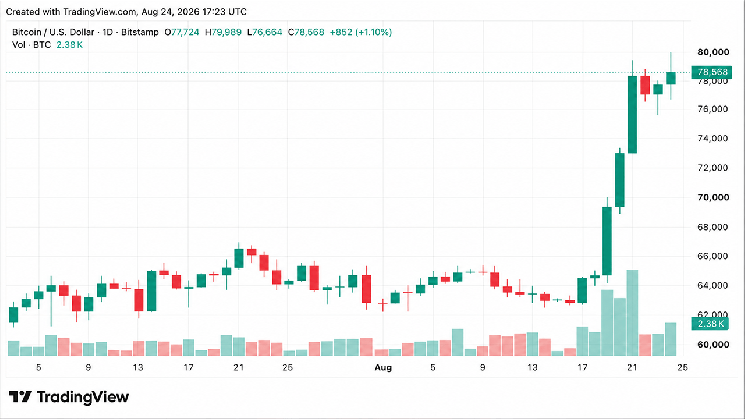
At the time of writing, the Bitcoin price is trading at around $81,200, down in the last 24 hours, according to data from CoinMarketCap.

BTC trading at $80,961 on the 1D chart | Source: BTCUSDT on Tradingview.com

Related Questions

QAccording to analyst Bee, what are the three rules that define when the Bitcoin bear market is fully over?

AThe three rules are: 1) The bear market lasts at least 350 days. 2) The bottom never forms without the price touching the 350-day moving average (MA 350). 3) The price always drops further than anyone expects.

QWhat price level does analyst Bee suggest Bitcoin might need to drop to before a bottom forms in the current bear market?

AAnalyst Bee suggests, based on his chart, that Bitcoin could still drop to around $46,000 before a bottom forms, noting that the 350-day moving average is at $47,000 and remains untouched.

QWhat event does Bee state will cause him to 'flip bullish' on Bitcoin?

ABee states that he will flip bullish when the price of Bitcoin tags (touches) the 350-day moving average (MA 350).

QWhat is analyst Colin's updated view on whether the Bitcoin cycle bottom is in?

AAnalyst Colin says he is more open to the idea that the bottom is in than he was a month ago, though he still believes a retest of the range lows between $60,000 and $70,000 is likely later this year.

QWhat two recent events are mentioned as putting Bitcoin at risk of another decline?

AThe two events mentioned are the hot CPI inflation data and the stalled U.S.-Iran peace talks.

Related Reads

Winter for Crypto IPOs: Consensys and Ledger Withdraw Applications

The crypto IPO window is tightening significantly in 2026, marked by prominent companies delaying or pausing their public listing plans. Following a successful 2025 "harvest year" that saw Circle, Bullish, and Gemini go public amidst a bull market, the tide has turned. Consensys, developer of MetaMask, recently postponed its IPO until at least fall 2026. Hardware wallet leader Ledger also suspended its planned US listing due to unfavorable market conditions, with Kraken having previously delayed its own plans. This shift is driven by a cooling market in 2026, characterized by a significant Bitcoin price correction, declining trading volumes, and reduced investor risk appetite for crypto stocks. The poor post-IPO performance of 2025 listings like Circle and Bullish, which saw major share price declines, has heightened investor caution. This contrasts sharply with the current AI sector, where companies like SpaceX, OpenAI, and Anthropic are commanding massive valuations and investor enthusiasm based on narratives of stable, exponential growth. Crypto companies now face pressure to transition from hype-driven models to demonstrating reliable cash flows and robust compliance. While the paused IPO plans may lead to valuation resets and affect ecosystem liquidity, they also accelerate industry consolidation toward stronger, more compliant infrastructure players. A potential recovery in Bitcoin's price and clearer regulations could reopen the IPO window in the latter half of 2026.

marsbit1h ago

Winter for Crypto IPOs: Consensys and Ledger Withdraw Applications

marsbit1h ago

ChatGPT Can Manage Your Money for You. Would You Trust It with Your Bank Account?

OpenAI has launched a personal finance tool for ChatGPT, currently in preview for US-based ChatGPT Pro users. This feature allows users to connect their bank and investment accounts (via Plaid, supporting over 12,000 institutions) directly to ChatGPT. It analyzes transactions, generates visual dashboards, and offers conversational financial advice—such as budgeting or planning for major purchases—based on the user's actual data. This move follows OpenAI's acquisitions of fintech startups Roi and Hiro Finance, signaling a strategic push into vertical "super assistant" applications, similar to its earlier health-focused feature. However, the launch has sparked significant privacy concerns. Critics question the safety of granting such sensitive financial access to an AI, especially amid ongoing lawsuits alleging OpenAI shared user chat data with third parties like Meta and Google. OpenAI emphasizes that ChatGPT only reads data (no transaction capabilities), deletes it within 30 days if disconnected, and offers opt-out options for model training. Yet, trust remains a major hurdle. The trend reflects a broader industry shift: AI companies like Anthropic and Perplexity are also targeting high-value, data-rich domains like finance and health. While technically promising, the tool operates in a regulatory gray area—it provides personalized guidance but disclaims formal financial advice or liability. Ultimately, OpenAI's challenge is convincing users to trust an AI with their most private financial information.

marsbit1h ago

ChatGPT Can Manage Your Money for You. Would You Trust It with Your Bank Account?

marsbit1h ago

Trading

Spot
Futures

Hot Articles

What is $BITCOIN

DIGITAL GOLD ($BITCOIN): A Comprehensive Analysis Introduction to DIGITAL GOLD ($BITCOIN) DIGITAL GOLD ($BITCOIN) is a blockchain-based project operating on the Solana network, which aims to combine the characteristics of traditional precious metals with the innovation of decentralized technologies. While it shares a name with Bitcoin, often referred to as “digital gold” due to its perception as a store of value, DIGITAL GOLD is a separate token designed to create a unique ecosystem within the Web3 landscape. Its goal is to position itself as a viable alternative digital asset, although specifics regarding its applications and functionalities are still developing. What is DIGITAL GOLD ($BITCOIN)? DIGITAL GOLD ($BITCOIN) is a cryptocurrency token explicitly designed for use on the Solana blockchain. In contrast to Bitcoin, which provides a widely recognized value storage role, this token appears to focus on broader applications and characteristics. Notable aspects include: Blockchain Infrastructure: The token is built on the Solana blockchain, known for its capacity to handle high-speed and low-cost transactions. Supply Dynamics: DIGITAL GOLD has a maximum supply capped at 100 quadrillion tokens (100P $BITCOIN), although details regarding its circulating supply are currently undisclosed. Utility: While precise functionalities are not explicitly outlined, there are indications that the token could be utilized for various applications, potentially involving decentralized applications (dApps) or asset tokenization strategies. Who is the Creator of DIGITAL GOLD ($BITCOIN)? At present, the identity of the creators and development team behind DIGITAL GOLD ($BITCOIN) remains unknown. This situation is typical among many innovative projects within the blockchain space, particularly those aligning with decentralized finance and meme coin phenomena. While such anonymity may foster a community-driven culture, it intensifies concerns about governance and accountability. Who are the Investors of DIGITAL GOLD ($BITCOIN)? The available information indicates that DIGITAL GOLD ($BITCOIN) does not have any known institutional backers or prominent venture capital investments. The project seems to operate on a peer-to-peer model focused on community support and adoption rather than traditional funding routes. Its activity and liquidity are primarily situated on decentralized exchanges (DEXs), such as PumpSwap, rather than established centralized trading platforms, further highlighting its grassroots approach. How DIGITAL GOLD ($BITCOIN) Works The operational mechanics of DIGITAL GOLD ($BITCOIN) can be elaborated on based on its blockchain design and network attributes: Consensus Mechanism: By leveraging Solana’s unique proof-of-history (PoH) combined with a proof-of-stake (PoS) model, the project ensures efficient transaction validation contributing to the network's high performance. Tokenomics: While specific deflationary mechanisms have not been extensively detailed, the vast maximum token supply implies that it may cater to microtransactions or niche use cases that are still to be defined. Interoperability: There exists the potential for integration with Solana’s broader ecosystem, including various decentralized finance (DeFi) platforms. However, the details regarding specific integrations remain unspecified. Timeline of Key Events Here is a timeline that highlights significant milestones concerning DIGITAL GOLD ($BITCOIN): 2023: The initial deployment of the token occurs on the Solana blockchain, marked by its contract address. 2024: DIGITAL GOLD gains visibility as it becomes available for trading on decentralized exchanges like PumpSwap, allowing users to trade it against SOL. 2025: The project witnesses sporadic trading activity and potential interest in community-led engagements, although no noteworthy partnerships or technical advancements have been documented as of yet. Critical Analysis Strengths Scalability: The underlying Solana infrastructure supports high transaction volumes, which could enhance the utility of $BITCOIN in various transaction scenarios. Accessibility: The potential low trading price per token could attract retail investors, facilitating wider participation due to fractional ownership opportunities. Risks Lack of Transparency: The absence of publicly known backers, developers, or an audit process may yield skepticism regarding the project's sustainability and trustworthiness. Market Volatility: The trading activity is heavily reliant on speculative behavior, which can result in significant price volatility and uncertainty for investors. Conclusion DIGITAL GOLD ($BITCOIN) emerges as an intriguing yet ambiguous project within the rapidly evolving Solana ecosystem. While it attempts to leverage the “digital gold” narrative, its departure from Bitcoin's established role as a store of value underscores the need for a clearer differentiation of its intended utility and governance structure. Future acceptance and adoption will likely depend on addressing the current opacity and defining its operational and economic strategies more explicitly. Note: This report encompasses synthesised information available as of October 2023, and developments may have transpired beyond the research period.

363 Total ViewsPublished 2025.05.13Updated 2025.05.13

What is $BITCOIN

Discussions

Welcome to the HTX Community. Here, you can stay informed about the latest platform developments and gain access to professional market insights. Users' opinions on the price of BTC (BTC) are presented below.

活动图片