EIP-8363 Explained: Burning Staking Rewards to Save Ethereum? Independent Node Operators Might Be the First to Leave

marsbitPublished on 2026-08-12Last updated on 2026-08-12

Abstract

Analysis of EIP-8363: A Proposal to Burn Staking Rewards and its Potential Impacts on Ethereum A new Ethereum Improvement Proposal, EIP-8363, has sparked significant debate. Its core mechanism is to progressively burn validator consensus rewards, aiming to reduce the issuance rate to 0% once 50% of the total ETH supply is staked. Proponents argue this would cap the staked ETH ratio, enhancing credible neutrality and censorship resistance by discouraging excessive centralization among large staking operators and liquid staking token (LST) providers. However, a critical analysis suggests the proposal may create more problems than it solves. While it compresses the ETH staking range where profitability turns negative (from 70-100 million ETH down to 50-60 million ETH), it does not fundamentally alter the competitive disadvantage of independent stakers. Due to economies of scale, large operators would still retain advantages in costs and MEV opportunities. Independent stakers are predicted to be the first to face negative real returns under the new curve. The economic repercussions could be severe. A sharp decline in base staking yield would disrupt DeFi ecosystems built around this yield, potentially reversing incentives for borrowing ETH and triggering large-scale unwinding of leveraged staking strategies. This could lead to significant selling pressure on ETH as professional staking operations become unprofitable and exit. The proposal is criticized for being based on unce...

Author: ETH Daily News

Compiled by: TechFlow Deep Tide

Deep Tide TechFlow Introduction: EIP-8363 proposes burning validator rewards, reducing the staking yield to zero to compress the scale of staking. However, this analysis suggests that the new proposal not only fails to solve oligopoly but will also cause independent stakers to fall into losses first and may trigger a chain reaction of DeFi lending and deleveraging. For ETH holders or DeFi users, this is a risk in the economic model change that must be taken seriously.

Understanding the Issuance Burn Proposal

Gradual issuance burn compresses the unprofitable range for staking, but independent stakers may still be the first to experience negative returns.

Happy Monday, August 10, 2026.

The issuance burn proposal (EIP-8363) has dominated timelines over the past week. Proposed on August 4, 2026, it aims to burn validator consensus layer rewards along a new issuance curve, reducing issuance to 0% once 50% of all ETH is staked. This is an economic change, not a technical one. Related discussions have been confusing.

Important note: This is not a technical explanation, only my (incomplete) understanding.

Current situation: With a minimum issuance floor of 1.5% annualized yield, the supply of staked ETH is growing and will continue to grow.

EIP-8363: Under this proposal, the supply of staked ETH will not exceed 50%, as issuance will be 0% at that point (no incentive to stake).

Difference: The new proposal compresses the unprofitable ETH staking range from 70 million-100 million ETH to 50 million-60 million ETH (<50%).

My judgment: EIP-8363 attempts to address real issues, but the cost outweighs the benefits.

What It Does

Gradual issuance burn reduces issuance by burning a portion of validator rewards. It will burn the base reward along a gradual curve, reaching a 100% burn ratio (0% issuance) when the staked supply hits 50%. This change will be implemented gradually over an 18-month transition period. The proposal aims to suppress the staked ETH supply from exceeding 50%, helping to maintain a balanced staking ratio.

Why It Was Proposed

The publicly stated goals of EIP-8363 are to enhance credible neutrality and capture resistance. The current issuance curve has a floor of 1.5% annualized yield, even if 100% of ETH is staked. Since everyone has an incentive to keep staking ETH, more staking share tends to concentrate with large operators, custodians, and liquid staking providers. The proposal (paraphrased) argues:

Too big to fail: If a major operator gets slashed or exploits the system, it could become too big to fail, and the network would have a moral obligation to compensate its users via a hard fork.

Weakened social slashing: Large operators could collude to circumvent social slashing events. The social layer would find it harder to coordinate a fork.

Dilution: As more ETH is issued, the total ETH supply increases, diluting everyone's real yield. The proposal argues independent stakers are hit especially hard and suggests ETH holders are overpaying for security through dilution.

Forced staking: The increasing ETH supply forces non-staking holders to either stake or face dilution risk. This reduces available ETH in the market.

LST replaces ETH: As more ETH gets staked, LSTs become the default asset in DeFi. This introduces systemic risk due to increased smart contract risk, governance risk, and issuer risk.

Dependency: Apps and protocols issuing derivatives gain outsized political and economic leverage over the network.

The Same Endgame

Both the current situation and issuance burn lead to unfavorable final states. Issuance burn is framed as slightly better than the status quo because it compresses the ETH staking range where independent stakers, institutions, and LSTs become unprofitable. But both lead to the same place, with large staking entities retaining advantages.

The capture resistance issue persists. In both scenarios, independent stakers would be the first to hit negative real returns. Professional staking operators always have economies of scale: lower fixed costs, more MEV opportunities, better uptime, bulk discounts. In fact, MaxEB (EIP-7251) has further reduced operational overhead for large stakers.

This is the crux of the debate: What's the difference between ETH staking becoming unprofitable at 70 million-100 million ETH (current) vs. around 50 million-60 million ETH (issuance burn)?

Issuance-driven base staking yield drives demand for ETH, incentivizing entities from digital asset finance firms, institutions, ETFs, liquid staking protocols, to individual holders to buy and stake ETH. Staked ETH reduces circulating supply, easing sell pressure on the asset. Reducing issuance would have the opposite effect.

With lower yield, currently profitable validators would fall into losses sooner and need to exit. As noted, independent stakers would be the first among all stakers to reach negative real returns. I disagree with the claim that this proposal specifically protects independent stakers. When other opportunities offer better returns, stakers will be incentivized to unstake and take their gains to seek profits elsewhere.

Businesses Forced to Close

Some businesses are built on Ethereum's yield. They buy ETH, participate in network validation, and provide real services. They are using the network as designed. Declining yield squeezes their profit margins, and we will see businesses shut down and unstake ETH. This would also create significant selling pressure on ETH.
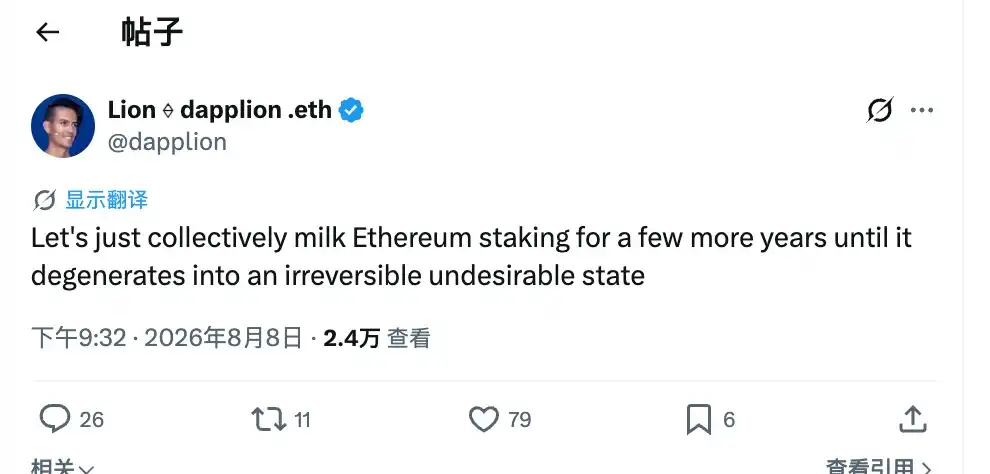
Some supporters of this EIP describe businesses built on Ethereum's yield as "extracting" from the network or receiving a "systemic subsidy." This rhetoric dismisses the real work being done: teams like Obol building DVT infrastructure, or public goods funding mechanisms like Octant—they are solving hard problems, not extracting rents.

Impact on DeFi

The entire Ethereum DeFi ecosystem utilizes the base staking yield. A sudden drop in ETH staking yield would directly reduce the lending rate for ETH across all of DeFi. Currently, market participants borrow ETH to stake, lend ETH to capture yield, and use ETH as collateral to borrow stablecoins and buy more ETH.

Reducing staking yield reverses these incentives. Market participants would borrow ETH to sell. They would stop lending ETH due to low yield and switch to stablecoins as collateral instead of ETH. This would trigger a massive unwind of staking yield strategies: DeFi vaults would see outflows, DeFi Total Value Locked would drop, and demand for ETH would decline.

Not all DeFi users are yield farmers. DeFi provides financial services access to users worldwide. Many rely on it for savings, investment, and hedging against local currency inflation. They too would be hit by falling yield. A sudden change of this magnitude has far-reaching consequences. More concerning is the turmoil it could unleash.

Based on Expectations

One reason this EIP is controversial is that it's based on expectations. How the market reaches equilibrium in two years under either curve remains unknown.

The new curve reaches equilibrium when real yield is greater than 0%, so self-funded stakers can still sustain themselves.
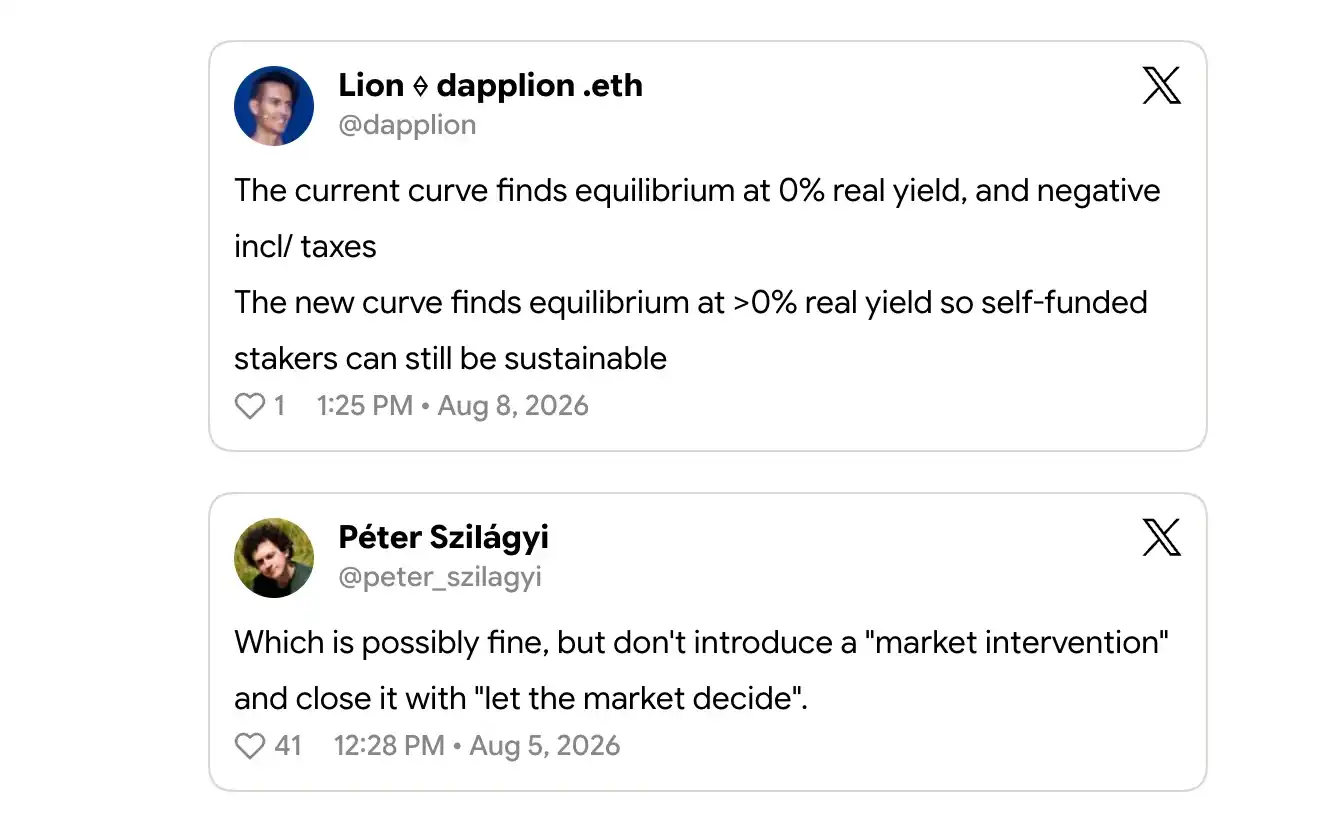
A key argument from supporters is that under the new proposal, the market will find equilibrium above 0%. Analysis by pa7x1 ("Shape of Future Issuance Curves") shows that under the current curve, independent stakers hit negative real returns first when 70 million ETH is staked. This expectation is based on cost estimates. Under the new proposal, independent stakers hit negative real returns when less than 60 million ETH is staked. If actual costs are higher than estimated, this threshold could arrive even sooner.

The Longer-Term Roadmap

I haven't seen discussion about EIP-8363's relation to the target validator set of 128,000. The Ethereum roadmap includes changes to reduce the number of validators. A smaller validator set helps reduce the load of signatures, attestations, and state on the consensus layer. MaxEB (EIP-7251) aims to ease this burden by consolidating validators. This long-term series of improvements helps Ethereum move closer to single-slot finality.

Issuance burn effectively caps the amount of staked ETH, thereby reducing the number of validators. It's unclear if reducing the validator set is an indirect goal of the issuance burn proposal. Clarification from researchers would be helpful.

I think the goal of a balanced staking ratio is good.

I think it alleviates, but does not solve, the problems it claims to address.

I think the cost outweighs the benefits.

Trending Cryptos

Related Questions

QWhat is the main purpose of the EIP-8363 proposal described in the article?

AThe main purpose of EIP-8363 is to gradually burn validator rewards, reducing the issuance rate to 0% once 50% of all ETH is staked. It aims to limit the staked ETH supply from exceeding 50%, thereby enhancing credible neutrality, reducing capture risk, and maintaining a balanced staking ratio.

QAccording to the article, how does the author believe EIP-8363 affects independent stakers compared to large staking entities?

AThe author argues that under EIP-8363, independent stakers will still be the first to reach negative real yields, just at a lower staking threshold (around 50-60 million ETH) compared to the current situation (70-100 million ETH). Large operators retain advantages like economies of scale, lower costs, and better MEV opportunities.

QWhat is one of the potential negative consequences for the DeFi ecosystem mentioned in the article if EIP-8363 is implemented?

AA potential negative consequence is that a sudden drop in ETH staking yield could trigger a large-scale unwinding of staking yield strategies. This could lead to capital outflows from DeFi vaults, a decrease in Total Value Locked (TVL), and reduced demand for ETH as lending rates and incentives shift.

QWhat does the article claim is a significant problem with the current Ethereum issuance curve that EIP-8363 attempts to address?

AThe article states the current issuance curve has a minimum Annual Percentage Yield (APY) floor of 1.5%, which incentivizes staking even at 100% ETH staked. This leads to concentration among large operators and Liquid Staking Token (LST) providers, forces non-stakers into staking to avoid dilution, and increases systemic risks as LSTs become the default DeFi asset.

QWhat long-term Ethereum roadmap goal might EIP-8363 indirectly support, as suggested in the article's conclusion?

AThe article suggests EIP-8363 might indirectly support the long-term goal of reducing the validator set size (e.g., to a target of 128,000 validators). By capping the total staked ETH, it reduces the number of validators, which aligns with improvements like MaxEB (EIP-7251) aimed at reducing consensus layer load and moving towards single-slot finality.

Related Reads

"Ontology Faction" vs. "Supplier Faction": In-depth Observation of Dexterous Hand Track Financing in 2026

The article analyzes the robotics "dexterous hand" sector in 2026, revealing intense investment activity. Key insights include: The sector is divided into two camps: "Body Manufacturers" (15 companies like Zhuji Power, Xingdong Era, Xingchen Intelligence) that integrate self-developed dexterous hands into their humanoid robots, and "Third-Party Suppliers" (32 companies) that independently sell complete dexterous hands or core components like tactile sensors and micro-motors. Body Manufacturers secured significantly larger average funding rounds (over ¥8B vs. under ¥2B for suppliers), reflecting bets on the broader humanoid robot market. While body makers now view in-house hand R&D as essential for differentiation, they still heavily rely on external suppliers for key underlying components like sensors and actuators. The supplier landscape is further segmented. "Complete Hand" suppliers (e.g., Critical Point AGILINK, Lingxin Qiaoshou, Xynova) face fierce consolidation as scale becomes critical. "Tactile Perception" specialists (e.g., Paxini, Daimeng, Qianjue) possess high technical barriers and early-mover advantages. "Core Component" makers (e.g., Wuji Tech, Zhijian Zhiqing, Nuoshi Robotics) are "hidden champions" with deep expertise in motors and drive systems, benefiting from import substitution. The analysis concludes the industry is structurally diverging. A hybrid model of body-maker integration plus specialist outsourcing will likely dominate. Suppliers will undergo significant consolidation, particularly among complete hand makers, while component specialists with deep technical moats are poised for sustained growth.

marsbit12m ago

"Ontology Faction" vs. "Supplier Faction": In-depth Observation of Dexterous Hand Track Financing in 2026

marsbit12m ago

Is 'Light In, Memory Out' Becoming the New Trading Narrative in the U.S. Stock Market?

Is "Light in, Memory out" Becoming the New Narrative in U.S. Stock Trading? Following the growing market consensus that AI chip valuations may have peaked, capital is seeking the next AI-related theme. In this context, the "Light in, Memory out" narrative is emerging – signaling a shift where optical communication stocks are taking the baton from memory. Optical communication, utilizing light signals (primarily via fiber optics) for data transmission, is critical for AI. AI model training and inference rely on massive GPU clusters that require frequent exchange of vast data, generating immense east-west traffic. Traditional copper interconnects face physical limits at high speeds (short distances, high power, interference). Optical interconnects solve this with higher bandwidth density, longer reach, and better energy efficiency, becoming crucial for scaling AI clusters. The narrative is validated by diverging stock performance. While memory stocks (like Micron, SK Hynix) have corrected amid crowded positioning and growth concerns, optical communication stocks (AAOI, COHR, LITE) have surged roughly 40-50% since August, driven by strong earnings and accelerating demand from AI cluster expansion and the transition to 800G/1.6T technology. LITE’s recent earnings solidified the story, beating estimates with impressive margins (gross margin above 50%, operating margin 36.4%). Its guidance projected an operating margin near 40% next quarter, faster than expected. Management noted laser capacity remains insufficient to meet strong demand and confirmed its key CPO (Co-Packaged Optics) client is accelerating plans. COHR's upcoming earnings are highly anticipated for further confirmation. However, risks are evident after the sector's sharp rally. The current dilemma is believing the narrative while avoiding buying at a peak. In a thematic rotation market, survival is key – prepare your tools before deciding how to position. Disclaimer: This summary is for informational purposes only and does not constitute investment advice.

marsbit12m ago

Is 'Light In, Memory Out' Becoming the New Trading Narrative in the U.S. Stock Market?

marsbit12m ago

OpenClaw Founder Peter Steinberg's Latest Speech: The Life and Death Revelation of an Open Source Project, How OpenClaw Emerged from the Eye of the Storm

Peter Steinberg, founder of the wildly popular open-source AI agent project OpenClaw, reflects on its turbulent journey from creation to near-collapse and resurgence. It began in late 2024 from his personal frustration with sending prompts from phone to computer. He built a WhatsApp relay that felt "magical," but initial excitement was limited to friends. After adding Discord support and launching a public server, the project exploded virally overnight, attracting massive attention, rebranding requests (from "Claudis" to OpenClaw), and even praise from NVIDIA's CEO. The intense scrutiny and pressure nearly broke Steinberg. The biggest technical crisis came from over-optimizing for a specific AI model provider, which suddenly canceled subscriptions, forcing a rushed shift to open-weight models. OpenClaw's weekly downloads plummeted before surging to a record high after being "declared dead." Steinberg realized he had stopped enjoying the build process and using his own product, making it a duty rather than a passion. His key lesson: "Fun is speed." Recovery came by refocusing on building for himself, forming a non-profit, and receiving crucial support (e.g., from NVIDIA for security). The team is now using OpenClaw to build OpenClaw itself, emphasizing its core value: a private, open alternative where "your agent, your machine, your life." He shares insights: the first user should be yourself; balance bug fixes with new features to maintain interest; the current bottleneck is reliable toolchains, especially for Mac testing. His story underscores that creation thrives on personal need, endures through storms when the joy of building returns, and persists by "living in the future and building what's missing."

marsbit51m ago

OpenClaw Founder Peter Steinberg's Latest Speech: The Life and Death Revelation of an Open Source Project, How OpenClaw Emerged from the Eye of the Storm

marsbit51m ago

Trading

Spot

Hot Articles

Discussions

Welcome to the HTX Community. Here, you can stay informed about the latest platform developments and gain access to professional market insights. Users' opinions on the price of ETH (ETH) are presented below.

活动图片