# Trust Related Articles

HTX News Center provides the latest articles and in-depth analysis on "Trust", covering market trends, project updates, tech developments, and regulatory policies in the crypto industry.

IOSG|Decentralized AI: Ethereum's Next Decade Bet

A Glimpse into Decentralized AI: Ethereum's Next Decade Bet In a future scenario, AI assistants could autonomously handle complex tasks like booking flights by coordinating with specialized AI agents. However, a critical challenge emerges: how can AI determine which other agents to trust? Current AI agents operate in isolated ecosystems (e.g., OpenAI, Google), unable to communicate or verify each other’s reliability—a "trust crisis" akin to early fragmented email systems. While protocols like Google’s A2A (Agent-to-Agent) and Anthropic’s MCP (Model Context Protocol) enable AI-to-AI communication, they lack a trust mechanism. ERC-8004 proposes a solution by leveraging Ethereum to provide AI agents with: 1. **Identity**: A unique, verifiable on-chain ID (as an NFT) to prevent forgery. 2. **Reputation**: A transparent, immutable rating system (like Uber or Taobao reviews) recorded on-chain. 3. **Validation**: For high-risk tasks, third-party verification via cryptographic proofs or trusted execution environments. Ethereum’s neutrality is key: it offers a decentralized, tamper-proof foundation for AI identity and reputation, avoiding reliance on any single corporation. The Ethereum Foundation’s dedicated dAI (Decentralized AI) team aims to position Ethereum as the settlement and coordination layer for the AI economy, marking a strategic shift from DeFi/NFTs to "on-chain intelligence." The ecosystem is already advancing, with 1,100+ developers, 70+ demos, and integrations like Taiko L2 and x402 (a payment protocol by Coinbase/Cloudflare). Combined, ERC-8004 and x402 could enable a closed-loop economy where AI agents autonomously complete tasks and receive payments. In the long term, this could allow users to hire AI agents effortlessly, monetize their own agents, and enjoy interoperable AI assistants beyond walled gardens. While success isn’t guaranteed, ERC-8004 represents a pivotal narrative shift for Ethereum—potentially becoming the "TCP/IP" for decentralized AI.

marsbit01/19 13:59

IOSG|Decentralized AI: Ethereum's Next Decade Bet

marsbit01/19 13:59

Making Encryption Warm: Reflecting on CoinEx's Brand Value Built on Education, Philanthropy, and Long-Termism at Its Eighth Anniversary

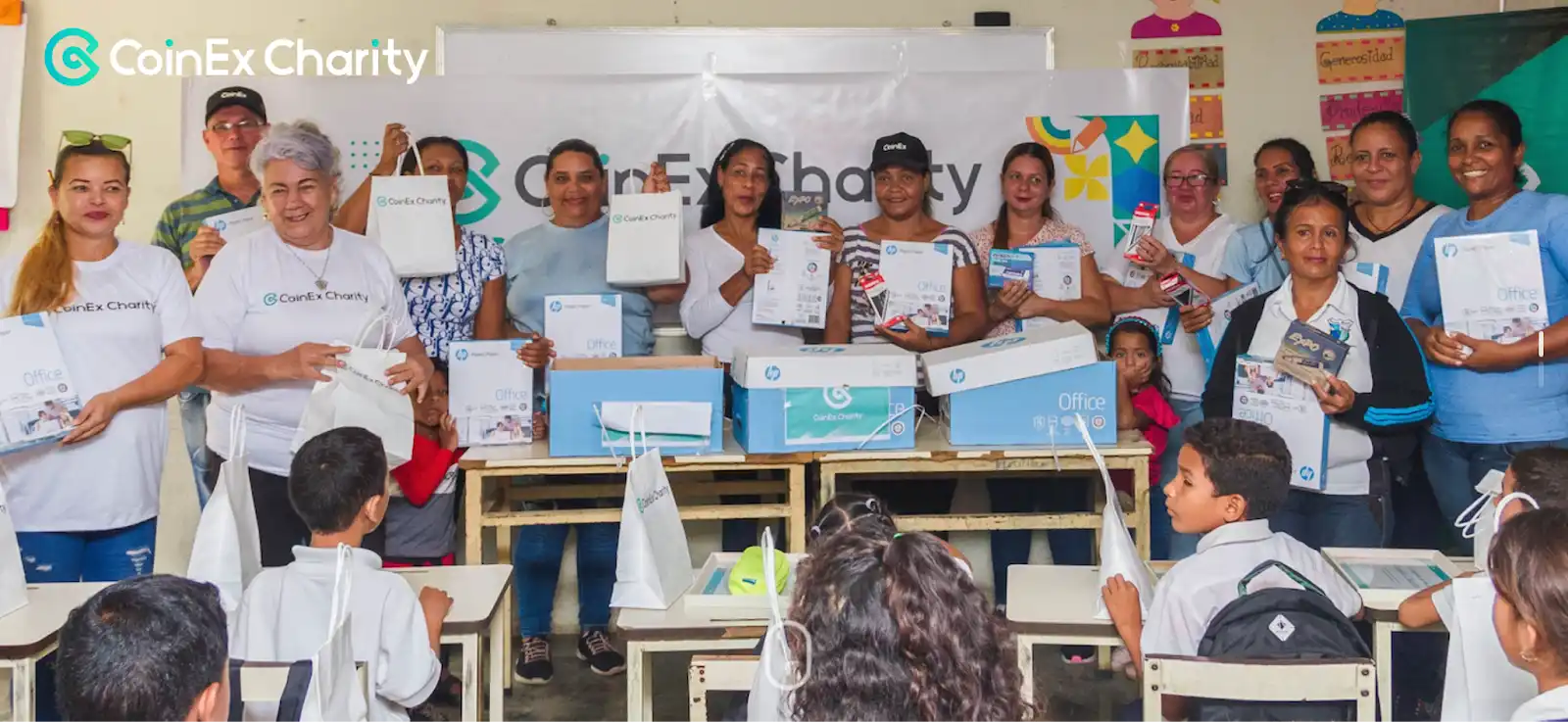
CoinEx Celebrates 8th Anniversary with Focus on Education, Charity, and Long-Term Value As CoinEx marks its eighth anniversary, the platform has garnered multiple industry accolades in 2025, including "Cryptocurrency Exchange of the Year" from U.Today and "Best Centralized Exchange (CEX)" from BeInCrypto. These awards reflect CoinEx’s commitment to security, user experience, and sustainable operations amid a volatile crypto market. Beyond technical excellence, CoinEx has prioritized social responsibility through its CoinEx Charity initiative. Under the "Bridging Hope" project, the organization has supported communities across Asia, Africa, and the Middle East by deploying Starlink internet infrastructure, providing Web3 and digital literacy education, and contributing to environmental and disaster recovery efforts. These actions address critical gaps in digital access and education, ensuring broader participation in the Web3 ecosystem. CoinEx’s long-term investment in non-transactional areas—such as education, transparency, and public welfare—has built a foundation of trust and expanded the platform’s global influence. By combining technological innovation with social impact, CoinEx demonstrates that crypto platforms can foster both growth and meaningful change, making the industry more accessible and equitable for all.

marsbit01/12 11:29

Making Encryption Warm: Reflecting on CoinEx's Brand Value Built on Education, Philanthropy, and Long-Termism at Its Eighth Anniversary

marsbit01/12 11:29

Ethereum's Year of Interoperability: A Deep Dive into EIL, a Grand Experiment in Entrusting 'Trust' to Game Theory?

Ethereum is entering a major phase of mass adoption in 2026, driven by the development of the Ethereum Interoperability Layer (EIL). EIL is not a new blockchain but a set of standards and protocols designed to connect Ethereum’s Layer 2 (L2) networks seamlessly. It aims to standardize state proofs and message passing between L2s, enabling native interoperability without altering their core security models. Currently, L2s operate as isolated environments with separate signatures, assets, and user experiences. EIL, combined with Account Abstraction (ERC-4337) and a trust-minimized messaging layer (XLP), allows users to perform cross-chain transactions with a single signature, abstracting away complexities like gas fees and repeated authorizations. Unlike traditional bridges or intent-based solutions, EIL avoids introducing new trust assumptions like solvers. Instead, it relies on XLP providers to facilitate instant transactions, with Ethereum L1 serving as a fallback enforcement layer via slashing mechanisms in case of malfeasance. However, EIL faces challenges in balancing efficiency and security. Its model shifts trust from technical verification to economic incentives and penalties, raising questions about sustainability under market volatility, scalability in multi-chain environments, and the economic feasibility of liquidity provision. Despite these open questions, EIL represents a significant experiment in expanding Ethereum’s interoperability while preserving its core values of decentralization and self-custody.

marsbit01/12 09:59

Ethereum's Year of Interoperability: A Deep Dive into EIL, a Grand Experiment in Entrusting 'Trust' to Game Theory?

marsbit01/12 09:59

6th Man Ventures Founder: Forget the 'Token vs. Equity' Debate, What Really Needs to Be Trusted?

Mike Dudas, founder of The Block and 6th Man Ventures, argues that the debate between tokens and equity misses the point: the real question is what deserves trust. He suggests there is no one-size-fits-all answer to whether a "dual token + equity" structure works. Instead, the core principle is trusting a team that is not only exceptional but also long-term oriented, committed to building a founder-led, enduring business like Binance. Dudas notes that for application-layer projects requiring sustained leadership, tokens often underperform compared to equity. Many DeFi 1.0 founders have left their projects, which are now maintained by DAOs in "maintenance mode," struggling with slow and ineffective decision-making. Pure equity isn’t always superior either—tokens enable functions like fee discounts, staking for airdrops, and access rights, which equity can’t easily replicate. He proposes a hybrid model: an equity entity operates on a "cost-plus" basis to serve a token-driven protocol, aiming not to maximize its own profits but to maximize the token’s and ecosystem’s value. This requires high trust in the team, as token holders lack strong legal rights. Ultimately, success depends on the team’s capability, credibility, execution, vision, and action. The best tokens will thrive by 2026 if teams communicate well, conduct buybacks, enable substantive governance, and direct value to the token through utility.

marsbit01/12 08:09

6th Man Ventures Founder: Forget the 'Token vs. Equity' Debate, What Really Needs to Be Trusted?

marsbit01/12 08:09

a16z: 3 Ways Crypto Will Outgrow Cryptocurrency by 2026

a16z: 3 Ways Crypto Will Move Beyond Crypto by 2026 The article outlines three key trends for 2026, as predicted by a16z crypto experts: 1. **Smarter, Broader Prediction Markets:** Prediction markets will become more sophisticated by integrating with AI and crypto. They will offer a wider range of contracts for detailed events, moving beyond major elections. This growth presents challenges, such as resolving disputed outcomes, which new decentralized governance and LLM oracles can address. AI agents trading on these platforms could uncover new predictive strategies. Prediction markets won't replace polls but will complement them, with crypto providing tools to verify respondents are human. 2. **Crypto Tech as a Foundational Tool Beyond Blockchains:** The cryptographic tool SNARKs (succinct proofs for verifying computations) will see drastically reduced overhead costs, dropping to around 10,000x the cost of the original computation. This efficiency, achievable on a single GPU, will make "verifiable cloud computing" practical. Users running CPU workloads in the cloud will be able to obtain cryptographic proofs of correctness at a reasonable cost, enabling trust in off-chain computations. 3. **The Rise of "Staked Media":** The traditional media model is being supplemented by a new paradigm where commentators use crypto tools to make verifiable commitments and back their opinions with action. This involves using tokenized assets, programmable locks, and prediction markets to prove they are not engaging in hype or "pump and dump" schemes. Trust is built not on claims of neutrality but on transparent, auditable proof—staking assets to show they have "skin in the game."

marsbit01/11 01:43

a16z: 3 Ways Crypto Will Outgrow Cryptocurrency by 2026

marsbit01/11 01:43

Visa Crypto Head: Eight Major Evolution Directions for Crypto and AI by 2026

Cuy Sheffield, Head of Crypto at Visa, outlines eight key themes for the evolution of cryptocurrency and AI by 2026, emphasizing a shift from theoretical potential to practical, reliable implementation. Cryptocurrency is transitioning from a speculative asset class into a high-quality technology. Its underlying infrastructure has become faster, cheaper, and more reliable, shifting its primary value from speculation to utility, particularly for payments and settlement. Stable币 are the clearest example of this, succeeding on objective merits like cost, speed, and global reach, and enabling adoption without ideological buy-in. As crypto becomes infrastructure, distribution capabilities and existing customer relationships—often held by large, regulated institutions—will matter more than pure technical novelty. For AI, the focus is shifting from raw intelligence to trust and reliability. AI agents are proving most valuable not as autonomous entities but as tools that reduce coordination costs in knowledge work—spanning research, analysis, and operations, not just coding. Their current limitation isn't capability but trust, requiring systems that are verifiable, consistent, and transparent. Successful AI integration is now a systems engineering challenge, relying on architecture, state management, and monitoring, not just model prompts. This development is creating a tension between the capital-intensive, centralized development of frontier models and the rapid iteration of open-source alternatives, leading to unresolved governance questions. Finally, the convergence of these fields is enabling new economic interactions. Programmable money, like stablecoins, is emerging as the native currency for AI agents, allowing for automated, fine-grained, and continuous payment flows between machines, opening the door to novel economic behaviors. The overarching trend is a move from flashy technological novelty to a focus on reliability, governance, and distribution, as both technologies become deeply embedded into real-world systems and workflows.

marsbit01/07 12:10
Visa Crypto Head: Eight Major Evolution Directions for Crypto and AI by 2026

marsbit01/07 12:10

The 7 Golden Rules of Crypto Marketing

The 7 Golden Rules of Crypto Marketing outlines a strategic shift towards conversion efficiency in 2026. The core principle is building a system that consistently transforms user trust, built through content and creators, into tangible on-chain actions like user growth, liquidity, and trading volume. The seven key rules are: 1. **Content as Infrastructure:** Prioritize deep, educational content (analyses, market commentary) that builds lasting familiarity and trust over multiple market cycles, as seen with Moonpay and Phantom. 2. **Personal Trust over Brand Accounts:** Leverage credible individuals (founders, analysts) as the primary trust vehicles, with official accounts playing a supporting role, exemplified by Kalshi and Polymarket. 3. **Targeting via On-Chain Behavior:** Use observable on-chain data to segment audiences and tailor messaging for higher conversion, a strategy effectively used by Jupiter. 4. **High-Engagement Narrative:** Focus on a single, product-aligned core narrative (e.g., Polymarket's "real-world markets") to solidify market positioning. 5. **Output-Oriented Communities:** Build communities where value is measured by members' tangible contributions (content, governance, events), enabling scalable growth as in the Solana ecosystem. 6. **Aligned Creator Incentives:** Partner with creators using performance-based models (revenue/share) to ensure quality content and long-term advocacy, even in bear markets. 7. **Financialized Marketing:** Measure all marketing efforts (content, channels) by their quantifiable on-chain outcomes, integrating marketing data with product and growth dashboards for accountability, as demonstrated by Polymarket and Kalshi. Ultimately, successful crypto marketing treats trust as a scalable system where content is the foundation, individuals are the conduit, and data bridges trust to action.

marsbit01/07 09:13

The 7 Golden Rules of Crypto Marketing

marsbit01/07 09:13

With Compliance and Security as the Foundation, AI Empowers Users: KuCoin is Redefining the Crypto Partner

In 2025, the cryptocurrency industry is shifting from rapid growth to a new phase focused on compliance depth and technological innovation. KuCoin, a leading global crypto exchange, is at the forefront of this transition. The platform recently secured regulatory approvals, including registration with Australia’s AUSTRAC and the stringent MiCA license in the EU, enabling compliant operations across 29 European countries. These achievements reflect KuCoin’s commitment to meeting high standards in capital adequacy, user asset protection, and transparency. Beyond compliance, KuCoin has introduced Kia, an AI-powered investment assistant designed to help users navigate complex market data and make informed decisions. Kia processes real-time news, on-chain metrics, and social sentiment, offering clear, actionable insights in natural language—effectively democratizing access to institutional-grade analysis. Underpinning these efforts is KuCoin’s $2 billion Trust Building Initiative, emphasizing "Trust First. Trade Next." The initiative includes investments in security certifications like SOC 2 Type II and ISO 27001, as well as social responsibility projects worldwide. By combining robust compliance and security with AI-driven tools, KuCoin is evolving from a trading platform into a trusted crypto partner, positioning itself for sustainable growth in an increasingly regulated and competitive market.

marsbit01/05 09:43

With Compliance and Security as the Foundation, AI Empowers Users: KuCoin is Redefining the Crypto Partner

marsbit01/05 09:43

活动图片