# Trust Related Articles

HTX News Center provides the latest articles and in-depth analysis on "Trust", covering market trends, project updates, tech developments, and regulatory policies in the crypto industry.

Binance CEO Year-End Letter: Crossing the Mountains, Hand in Hand with the Sea of People

Binance Co-CEOs Yi He and Richard Teng reflect on 2025 as a pivotal year, marked by reaching 300 million users—meaning one in every 27 people globally now uses Binance. Despite challenges like AI market volatility, trade wars, and regulatory uncertainty, the industry demonstrated strong resilience. Key regulatory milestones, such as the GENIUS Act, provided clarity and protection, ending the "wild west" era of crypto. The year saw a fusion of centralized and decentralized finance, with retail trading surging 125% and institutional adoption growing—30% of large investors already hold digital assets. Nearly half of all BTC and ETH trades occurred on Binance, with over 60% of on-chain transactions via Binance Wallet. The Alpha 2.0 platform facilitated $1 trillion in volume, $780M in airdrops, and attracted 17M users. Traditional finance embraced crypto, with significant ETF inflows and major institutions tokenizing bonds. Trust remains paramount: Binance safeguards $162.8B in user assets, proven via PoR. The platform enhanced security, reducing major illegal risks by 96%, blocking $6.69B in fraudulent transactions, and recovering $11.7M for users. Compliance efforts expanded with 29 certifications and a 1,280-person team. Looking to 2026, Binance anticipates growth driven by global economic stability, tech advances, and clearer regulations like the RFIA/CLARITY Act. The focus remains on "Freedom of Money," through security, compliance, and education initiatives like Binance Junior and Binance Charity ($43.55M donated to date). The co-CEOs thank the community and invite others to join in building an open financial future.

marsbit12/31 15:43

Binance CEO Year-End Letter: Crossing the Mountains, Hand in Hand with the Sea of People

marsbit12/31 15:43

Hacker Attack Halves Flow, Rollback Plan Sparks Civil War in Ecosystem

Flow, a Layer 1 blockchain built by Dapper Labs, suffered a major security breach last Saturday when a hacker exploited an execution layer vulnerability, transferring approximately $3.9 million in assets off-chain. The attack caused the price of FLOW to plummet by over 50%, dropping from $0.173 to $0.079, though it later partially recovered to around $0.107. Initially, the Flow Foundation proposed rolling back the network to a checkpoint before the attack occurred, which would have erased all transactions within a six-hour window. This decision was met with strong opposition from ecosystem partners, especially cross-chain bridges like deBridge and LayerZero, who warned that a rollback could cause asset duplication, inconsistencies, and significant losses for legitimate users. Facing community backlash and partner concerns, the foundation abandoned the rollback plan. Instead, it adopted an "Isolation Recovery Plan" developed in coordination with key partners. The new strategy involves no chain reorganization, preserves all legitimate user transactions, and temporarily restricts accounts that received illicitly minted tokens. The network will be restored in multiple stages, with full functionality expected within 24 to 48 hours. The incident has raised questions about network reliability and governance, shifting the crisis from a technical issue to a broader challenge of trust in Flow's decentralized integrity.

marsbit12/29 05:18

Hacker Attack Halves Flow, Rollback Plan Sparks Civil War in Ecosystem

marsbit12/29 05:18

Hacker Attack Cuts Flow in Half, Rollback Plan Sparks Civil War Within Ecosystem

A severe hack targeting the Flow blockchain, developed by Dapper Labs, led to the theft of approximately $3.9 million due to an execution layer vulnerability. The incident caused the token FLOW to plummet by over 50%, dropping from $0.173 to $0.079, though it later partially recovered to around $0.107. Initially, the Flow Foundation proposed rolling back the network to a checkpoint before the attack to remove all transactions within a six-hour window, aiming to eliminate fraudulent activity. However, this plan faced strong opposition from cross-chain bridge partners and community members. Key partners, including deBridge and LayerZero, warned that a rollback could cause severe issues like double-spending and inconsistent asset states across chains, potentially harming legitimate users and bridge operators. Under significant criticism, Flow abandoned the rollback plan and instead adopted an "Isolation and Recovery" strategy. This new approach involves no chain reorganization, preserves all legitimate user transactions, and temporarily restricts accounts that received illicitly minted assets. The recovery is being executed in phases, with Cadence environment repairs prioritized first, followed by gradual reactivation of EVM functionality and cross-chain services. The incident sparked a broader debate about decentralization and chain integrity, with critics arguing that the initial rollback proposal revealed excessive centralization. The revised recovery plan has eased some tensions, but the event remains a significant test for Flow's ecosystem stability and trustworthiness.

Odaily星球日报12/29 05:09

Hacker Attack Cuts Flow in Half, Rollback Plan Sparks Civil War Within Ecosystem

Odaily星球日报12/29 05:09

Avon Co-founder's Viral Article: Why Has DeFi Lost Its Charm?

The article "Why DeFi Has Lost Its Charm" by Avon co-founder Prince argues that DeFi is no longer perceived as innovative or exciting, despite continued development and maturation. The core issue is a shift in user psychology from curiosity to caution, and a convergence of user behavior around incentives rather than genuine utility. DeFi Summer represented a period of rapid innovation and market structure formation, but today's DeFi often feels like a repetition of established patterns with better execution. User behavior has become highly speculative and optimized around trading, leverage, and easy exits. This has shaped the ecosystem's expectations: participation is now something that requires monetary compensation, rather than being driven by a product's inherent usefulness. Lending in DeFi, for example, has evolved into short-term financing for positions like leverage and arbitrage, rather than functioning as a true credit market. Yield has become a baseline expectation for participation, justified by the numerous risks (smart contract, governance, oracle, bridge risks). This leads to a "rented" adoption—activity spikes during incentive programs but vanishes afterward, making it difficult to build sustainable, long-term projects. Trust has also been eroded by years of exploits, scams, and governance failures, making users more cautious and less willing to explore new projects. This risk aversion, combined with the high compensation demanded for risk, has compressed the space for experimentation. The author concludes that DeFi hasn't failed; it has successfully optimized for a specific set of behaviors (liquidity, speed, exit ease) but in doing so, has made it harder to expand into new use cases. For DeFi to regain its charm, it must create structures that make different user behaviors rational—where capital stays for reasons beyond incentives, and yield represents a responsible decision rather than a headline number. This would lead to quieter, slower, but more sustainable growth driven by genuine need.

Odaily星球日报12/24 09:51

Avon Co-founder's Viral Article: Why Has DeFi Lost Its Charm?

Odaily星球日报12/24 09:51

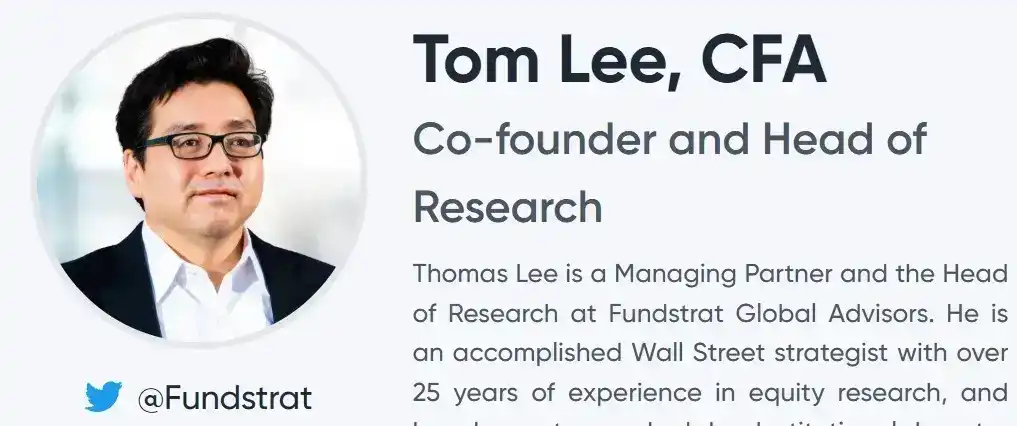
Publicly Pumping Ethereum, Internally Bearish in Reports: Is Tom Lee's Team Still Trustworthy?

Tom Lee, co-founder of Fundstrat and a prominent public Ethereum bull, faces credibility questions after an internal Fundstrat report presented a bearish short-term outlook, contrasting his highly optimistic public statements. Publicly, Lee repeatedly called Ethereum to reach $12,000-$15,000 by end-2025 and declared it "severely undervalued" at $3,000. He has been a vocal "perma-bull" in media appearances. However, Fundstrat's internal 2026 Crypto Outlook report, led by Digital Asset Strategist Sean Farrell, advised paying subscribers to expect a significant market correction in early 2026. Its base case predicted ETH could fall to $1,800-$2,000 and BTC to $60,000-$65,000, citing macroeconomic risks like a potential U.S. government shutdown and Federal Reserve leadership change. The report recommended clients increase cash/stablecoin holdings and wait for better entry points, while maintaining a long-term bullish year-end 2026 target of $4,500 for ETH. Fundstrat responded that the discrepancy stems from different analysts serving different client types: Lee's long-term, structural views are for traditional investors with low (1%-5%) crypto allocations, while Farrell's tactical, short-term risk management is for crypto-heavy portfolios. Critics argue this distinction was never clearly disclosed in Lee's public media appearances, which serve as marketing for Fundstrat's subscription service. Further complicating matters, Lee is also Chairman of BitMine, a company adopting an Ethereum treasury strategy, raising potential conflict of interest concerns about his public endorsements. The incident highlights the blurred lines between personal commentary, institutional research, and marketing in the crypto research space.

marsbit12/23 03:08

Publicly Pumping Ethereum, Internally Bearish in Reports: Is Tom Lee's Team Still Trustworthy?

marsbit12/23 03:08

活动图片