Avalanche Quietly Becomes an RWA Public Chain

Foresight NewsPublished on 2026-07-16Last updated on 2026-07-16

Abstract

Avalanche has strategically shifted its focus towards becoming a leading blockchain for Real-World Asset (RWA) tokenization and payments, moving beyond its initial gaming-centric reputation. Data from RWA.xyz shows Avalanche ranks third among blockchains when considering networks used for settlement, thanks to its unique subnet architecture (now independent Avalanche L1s following the Avalanche9000 and Granite upgrades). These upgrades drastically reduced operational costs and increased autonomy for validators, making it an attractive, cost-effective EVM-compatible Layer 1 for institutional partners. Major institutions like Securitize (which hosts tokenized versions of funds like BlackRock's BUIDL), Galaxy (issuing a $75M CLO), and FinChain have launched significant RWA projects on Avalanche. Its combination of low transaction costs, fast finality, and high customizability through its L1 stack appeals to traditional finance. This is further evidenced by partnerships with entities like NHN KCP, NEC, Progmat, and the formation of the Avalanche Payments Collective with members including Franklin Templeton and VanEck. Recent proofs-of-concept, such as a cross-border settlement for Hyundai, demonstrate practical utility. While Avalanche's ecosystem and institutional adoption are rapidly expanding, its native token (AVAX) price has not reflected this growth, as the protocol prioritizes network flexibility and adoption over immediate tokenomics adjustments like buybacks.


Written by: Eric, Foresight News


Perhaps in many people's impressions, Avalanche is still a public chain focused on gaming. While it can't be said to have completely abandoned gaming now, it's evident that the currently hot topics of RWA tokenization and payments have become Avalanche's signature strengths.


According to data from RWA.xyz, the total value of tokenized RWA assets on the Avalanche network has reached $2.1 billion, ranking second only to Ethereum, BNB Chain, Solana, and Stellar.
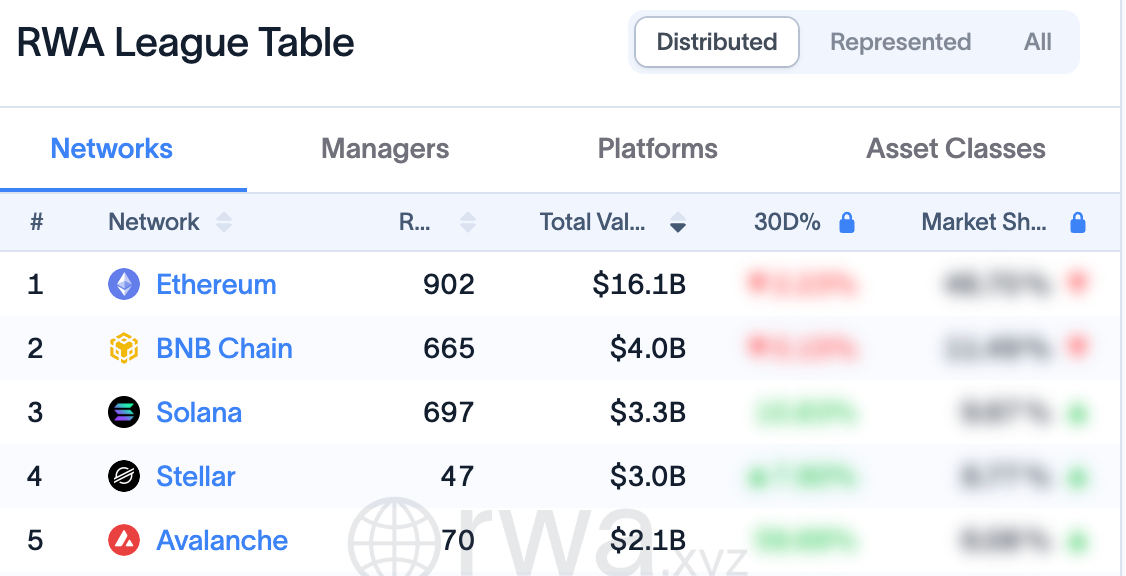


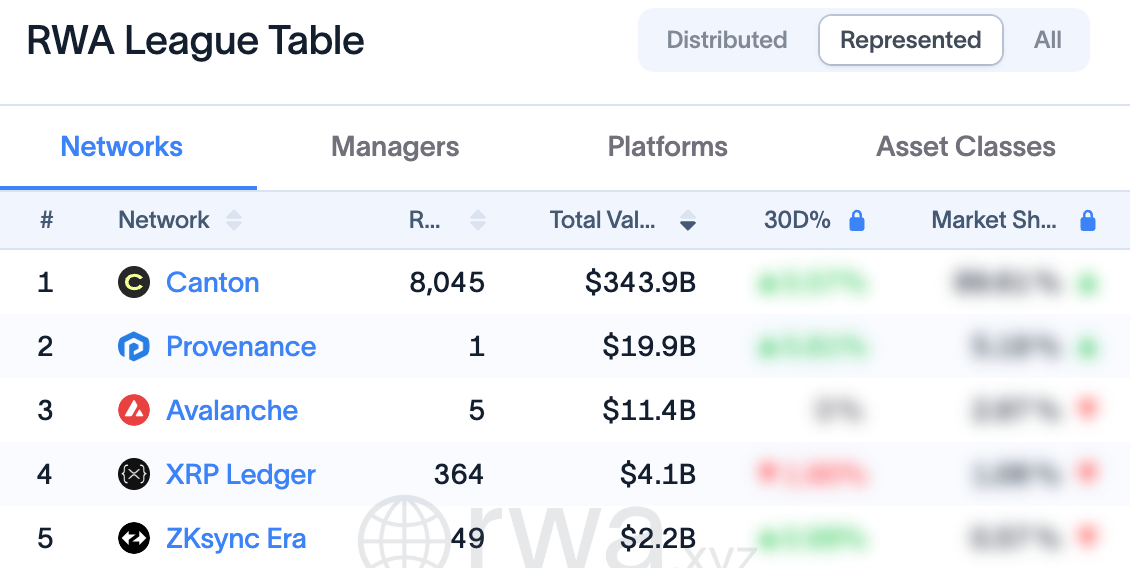
However, this ranking only accounts for these chains acting as 'distribution networks,' meaning the scenario where tokenized RWA assets are directly issued on the mainnet of these chains. If we calculate the situation where the chain is used solely as a 'settlement network,' Avalanche's rank rises to third place.


Thanks to its unique subnet mechanism, Avalanche has become the preferred choice for many traditional financial institutions. And all of this began with an upgrade at the end of 2024.


In December 2024, the Avalanche9000 upgrade was officially activated on the Avalanche mainnet. The core changes of this upgrade primarily included:


Restructuring Subnets into independent Avalanche L1s;

Removing the 2000 AVAX staking requirement for L1 validators, replacing it with a subscription fee of approximately 1.33 AVAX per month;

Reducing the minimum base Gas fee on the C-Chain from 25 nAVAX to 1 nAVAX (a decrease of about 96%).


Previously, to establish an Avalanche subnet, each validator needed to stake 2000 AVAX. A subnet with 20 validators would require staking 40,000 AVAX. After switching to the monthly subscription model of 1.33 AVAX, the same 20 validators only need fees of 26.6 AVAX per month. It would take over 125 years of continuous payments to reach the 40,000 AVAX level.


This greatly increased the cost-effectiveness and autonomy of building a dedicated chain based on the Avalanche stack. Before this change, besides staking 2000 AVAX, subnet validators also needed to participate in the consensus of the mainnet's X-Chain, P-Chain, and C-Chain, forcing synchronization between the mainnet and subnet states. After the update, L1 validators only need to sync the latest P-Chain state, with the purpose of tracking their validator weight (for consensus) and validating ICM (Interchain Messaging) messages.


Of course, the downside of this approach is evident: Avalanche L1s are responsible for their own security. The mainnet becomes a coordination layer and does not provide security support, similar to the relationship between Ethereum and sidechains. However, this trade-off facilitated the explosion of RWA tokenization and payments.


One year after the completion of the Avalanche9000 upgrade, Avalanche underwent the Granite upgrade, introducing dynamic block times, biometric login, cheaper cross-chain message passing, and achieving sub-second finality.


With the infrastructure upgrades complete, Avalanche began its rapid sprint on the path of integration with traditional finance.


In November 2025, Securitize received authorization under the EU's DLT Pilot Regime, enabling it to issue, trade, and settle tokenized securities at the market infrastructure level, and linking this with its U.S. operations as a broker-dealer, digital transfer agent, and alternative trading system. For the deployment of this system, Securitize chose Avalanche.
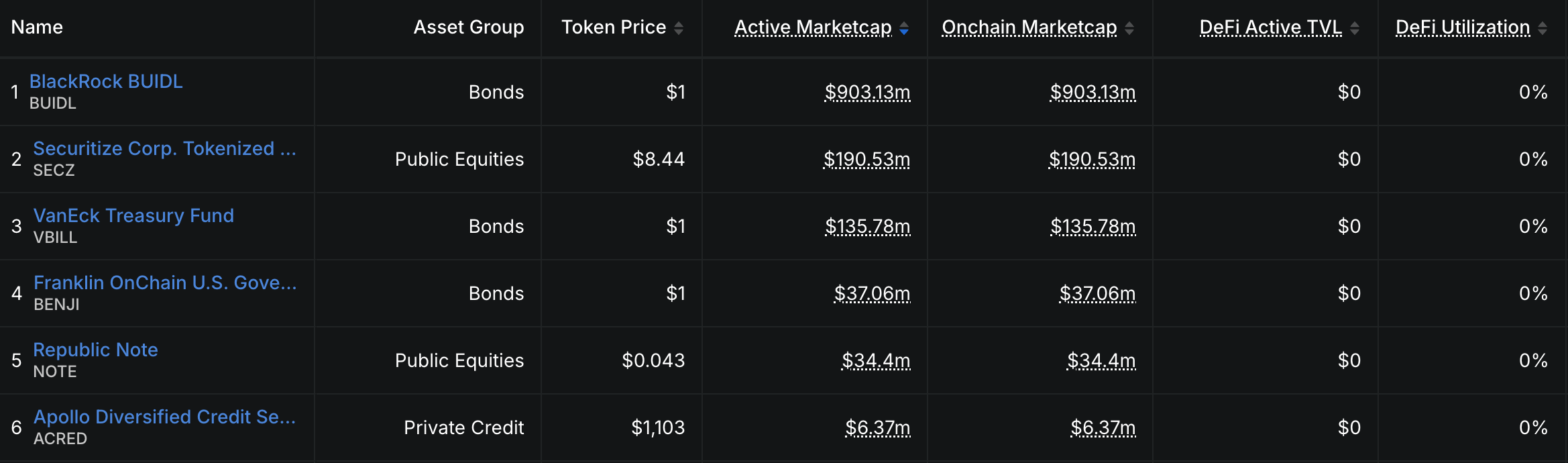


Securitize, which listed on the NYSE earlier this month, had actually chosen Avalanche as early as 2020. On the very day of its listing, Securitize launched tokenized versions of its own stock on both Avalanche and Solana. Beyond that, tokenized assets issued on or custodized by Securitize, such as the BlackRock BUIDL fund, ParaFi's tokenized venture fund, and the Apollo ACRED fund, form the main source of the $2.1 billion in tokenized RWA assets on the Avalanche mainnet.


In addition to Securitize, Galaxy also issued a total of $75 million in tokenized Collateralized Loan Obligation (CLO) notes, 'Galaxy CLO 2025-1,' on Avalanche in early 2026. FinChain, the Web3 brand under Fosun Wealth, also launched the yield-bearing RWA stablecoin FUSD on Avalanche at the beginning of the year.
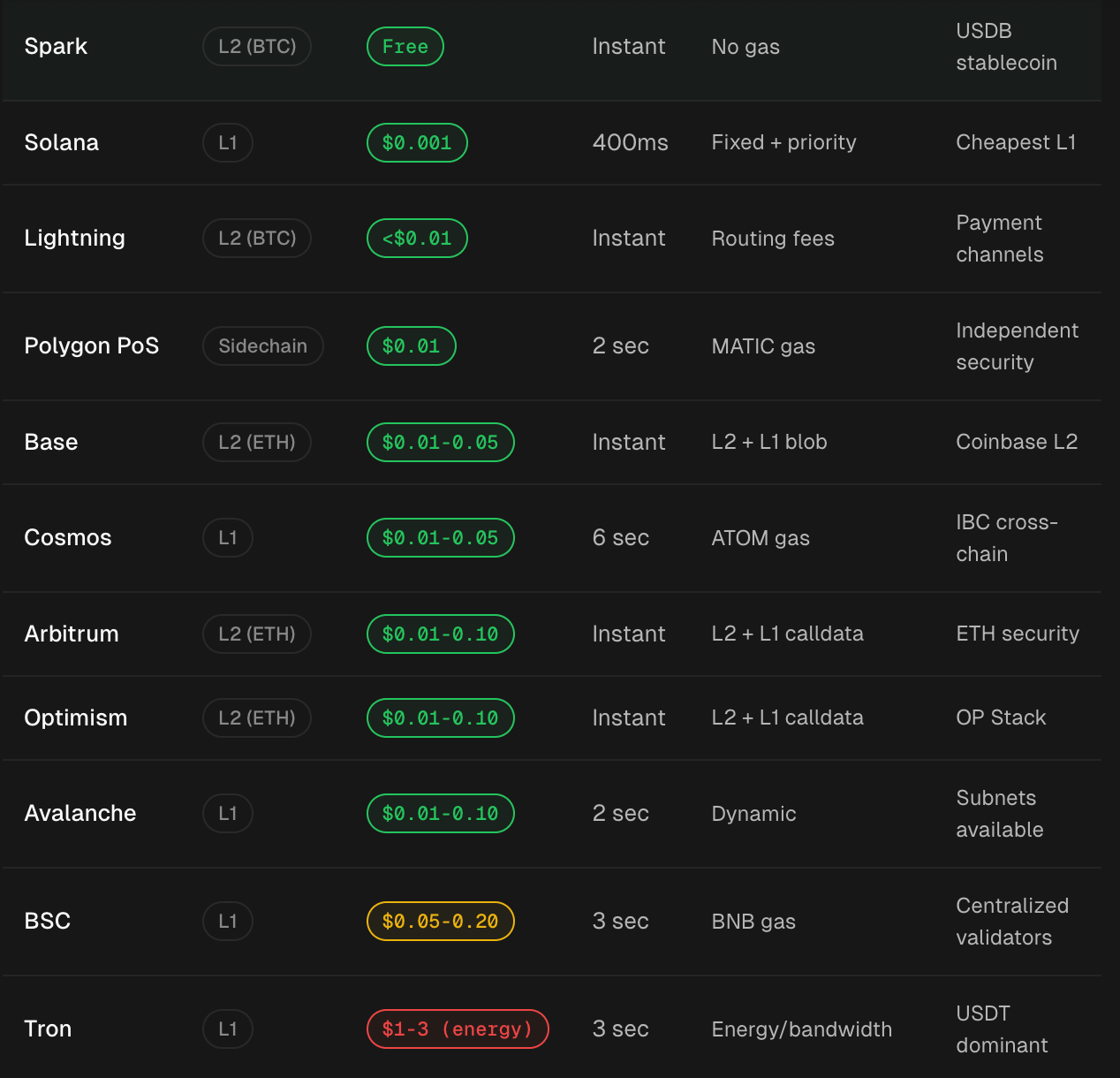


From a Gas fee perspective, Solana is almost peerless. However, many institutions choose Avalanche because it can be considered the most cost-effective choice in the realm of EVM-compatible chains.


How to understand 'cost-effectiveness'? Base, Arbitrum, and OP Mainnet also offer native EVM environments with costs comparable to Avalanche, or even slightly advantageous. However, the final confirmation of transactions on these L2s requires waiting for L1 block production, giving Avalanche, as an L1, a clear advantage in transaction 'finality.' Compared to Ethereum and BNB Chain, Avalanche again holds a cost advantage.
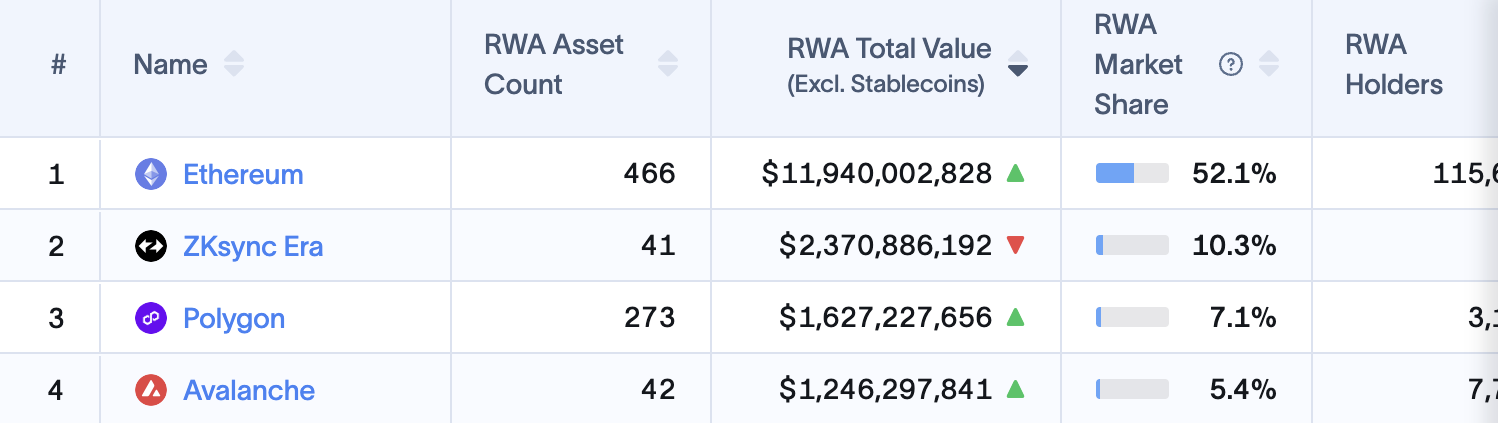


This advantage in settlement speed and 'finality' also once gave Polygon and ZKsync a head start. Polygon, as a sidechain, is inherently more independent, while ZKsync's ZKPs can almost guarantee 'finality' even before L1 confirmation. By the end of 2025, ZKsync and Polygon ranked just behind Ethereum in terms of total tokenized RWA asset value and were ahead of Avalanche.


After discussing the advantages of the mainnet, let's move on to Avalanche subnets, now known as the updated Avalanche L1s.


Avalanche L1s provide partners with a comprehensive development stack and a high degree of freedom, allowing participants to build personalized L1s at a very low cost to meet various needs. In April of this year, South Korean payment service provider NHN KCP signed a memorandum of understanding with Ava Labs, planning to jointly build an L1 network for payment scenarios based on Ava Cloud.


Then, in July, NEC Corporation and Japan's largest security token platform, Progmat, also turned to Avalanche. NEC aims to explore on-chain services combining its biometric digital identity technology with Avalanche's multi-chain architecture, with the core feature being that biometric data is not stored on-chain, only the proof of successful verification is submitted. This primarily serves in-store stablecoin payments for foreign tourists in Japan. Progmat is transitioning from a Corda 5-based consortium chain to a dedicated Avalanche L1, involving active tokenized assets exceeding 452 billion yen (approximately $27 billion).


On June 18th, the Avalanche Payments Collective was formally launched, with 28 institutions including Franklin Templeton, VanEck, WisdomTree, Paxos, and Kraken joining. It aims to establish an ecosystem covering settlement, stablecoins, fund infrastructure, foreign exchange, asset management, compliance, and global payments.


Less than a month after the organization's establishment, Hyundai Motor America (HMA) and Hyundai Motor Mexico (HMM) completed their first Proof-of-Concept (POC) for enterprise-level cross-border settlement via the Axiym platform on the Avalanche network. In this test, HMA converted $20,000 into USDT and transferred it to HMM, which then converted it back to USD. The complete cross-border transfer and verification process took an average of 7 minutes, compared to the 3 to 4+ hours typically required for traditional interbank transfers.


Looking back now, Avalanche has built a 'Mainnet + Avalanche L1' system that can cover nearly all aspects from tokenized RWAs to the payment field. Correspondingly, Aave has also chosen Avalanche as the first station for its multi-chain deployment of Aave V4, pointing to the potential of combining traditional finance with DeFi.


In this wave of enthusiasm, Avalanche has transformed and adapted incredibly fast, carving out its own path without the hype of Solana or the resources of BNB Chain. However, somewhat mismatched with the actual progress, the price of AVAX has returned to levels seen in late 2020 and early 2021.
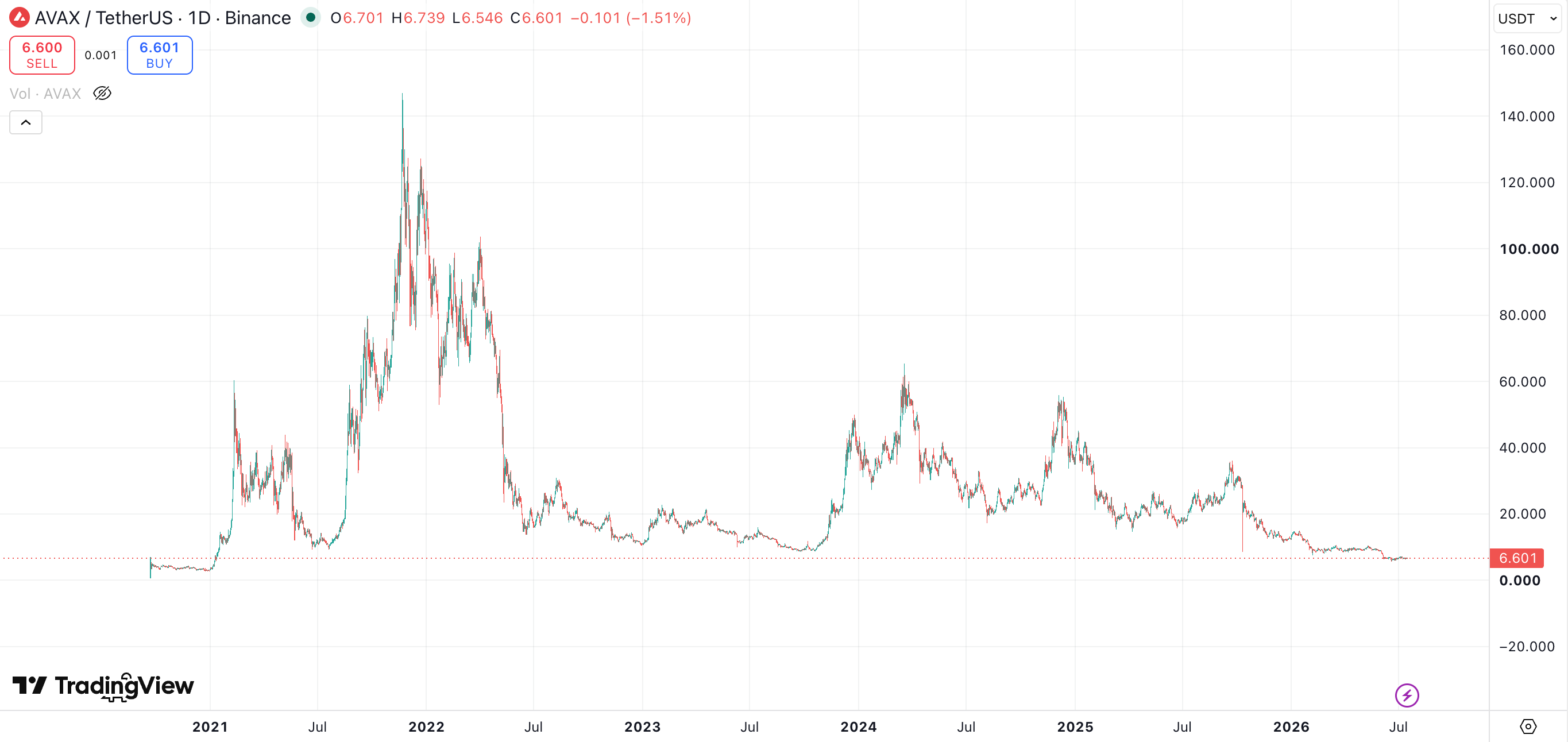


Avalanche's token economic model has not seen major recent adjustments, nor has it introduced buyback and burn mechanisms to stimulate token price. Avalanche L1s are relatively independent chains and do not require AVAX for Gas fees; the activity on the Avalanche C-Chain has not fundamentally changed either. To date, the fee burn based on EIP-1559 has only reduced approximately 5.1 million AVAX, less than 1% of the total supply of 720 million.


But as mentioned earlier, for a team with such strong execution capability, this might just be a temporary trade-off. Reducing the economic burden on partners and granting more autonomy to increase Avalanche's activity levels is the more important direction for now. Hastily introducing buyback and burn mechanisms could reduce the funding flexibility for protocol teams, potentially forcing the Foundation or Ava Labs to sell large amounts of tokens to maintain operations, which would ultimately be detrimental to the protocol's long-term development.

Trending Cryptos

Related Questions

QAccording to the article, what is Avalanche's primary focus area now, and how does this differ from its previous perception?

AAccording to the article, Avalanche's primary focus area now is Real World Asset (RWA) tokenization and payments, which has become its 'golden hallmark.' This differs from its previous perception, where many people saw it as a blockchain primarily focused on gaming.

QWhat were the key changes introduced by the Avalanche9000 upgrade in December 2024, and how did they benefit RWA development on the network?

AThe key changes of the Avalanche9000 upgrade included: restructuring Subnets into independent Avalanche L1s, replacing the 2000 AVAX staking requirement for L1 validators with a monthly subscription fee of about 1.33 AVAX, and reducing the minimum base Gas fee on the C-Chain by 96%. These changes drastically lowered the cost and increased the autonomy for building dedicated chains, which provided significant convenience for the explosion of RWA tokenization and payments on Avalanche.

QWhat major traditional financial institution used Avalanche for its DLT pilot mechanism authorization, and what significant tokenized assets are linked to this institution on Avalanche?

ASecuritize, which has now listed on the NYSE, obtained EU DLT pilot mechanism authorization and deployed its system on Avalanche. Major tokenized assets linked to Securitize on Avalanche include BlackRock's BUIDL fund, ParaFi's tokenized venture fund, and Apollo's ACRED fund, which form the main source of the $2.1 billion in tokenized RWA assets on Avalanche's mainnet.

QHow does the article explain Avalanche's 'cost-effectiveness' advantage for institutions compared to other EVM-compatible chains and Layer 2 solutions?

AThe article explains that Avalanche is considered highly cost-effective in the EVM-compatible space. Compared to other L1s like Ethereum and BNB Chain, it has a cost advantage. Compared to Layer 2s like Base, Arbitrum, and OP Mainnet, which have comparable costs, Avalanche as an L1 has a clear advantage in transaction 'finality' speed, as L2 transactions need to wait for L1 block confirmations for final settlement.

QWhat recent development involves Avalanche in the payments sector, and which notable collective was formed to advance this ecosystem?

AA recent development in the payments sector involved Hyundai Motor America (HMA) and Hyundai Motor Mexico (HMM) conducting a Proof-of-Concept for cross-border corporate settlement on Avalanche via the Axiym platform. Furthermore, the Avalanche Payments Collective was launched, with 28 institutions including Franklin Templeton, VanEck, and Paxos, aiming to build an ecosystem covering settlement, stablecoins, capital infrastructure, and global payments.

Related Reads

Upbit is Anxious: A Hasty Counterattack Aimed at Regaining Stablecoin Market Share

Title: Upbit's Rushed Counterattack to Reclaim Stablecoin Market Share Facing a dramatic shift in South Korea's stablecoin market, leading exchange Upbit launched a promotional campaign from July 26 to August 9, waiving the 0.05% trading fee for stablecoins paired with the Korean Won (KRW) and rapidly listing new stablecoins like RLUSD and USDG. This move is a direct response to its plummeting market share in this sector. Historically a duopoly with Bithumb, the market has been reshaped since October 2025 when Coinone permanently removed fees for USDC trading. By June 2026, Coinone led with 34.8% of stablecoin volume, followed by Bithumb (31.1%) and Upbit (30.1%). This contrasts sharply with the overall crypto market, where Upbit commands 60%. The data shows stablecoin demand is highly sensitive to fees, as users primarily buy them to transfer capital overseas for derivatives trading or forex arbitrage. South Korean exchanges have seen a net outflow of stablecoins for 18 consecutive months, totaling approximately 14.9 trillion KRW, underscoring their role as a cross-border capital conduit. Upbit's limited-time promotion initially boosted its daily stablecoin volume by 162%, but the surge was almost entirely in USDT (98.1% of volume). The newly listed stablecoins saw negligible, fleeting interest. Furthermore, the promotional effect quickly waned in the second week, with volume dropping 33% on weekdays. A concurrent weakening of the KRW also contributed to the trading spike, independent of the fee waiver. The analysis suggests that once the promotion ends, Upbit is unlikely to retain its temporary gains unless it matches Coinone's permanent zero-fee policy, forcing a choice between market share and fee revenue. Upbit's strategic push may be less about immediate profit and more about preparing for future regulatory shifts. With South Korea's *Digital Asset Basic Act* on the horizon, which will regulate KRW-backed stablecoins, and following Dunamu's (Upbit's parent) integration into Naver Financial to build a payment ecosystem, securing a dominant position in the dollar stablecoin distribution channel holds long-term strategic value. However, potential regulatory conflicts could prevent Upbit from listing a future Naver-issued KRW stablecoin, making the current fight for dollar stablecoin flow even more critical.

marsbit2h ago

Upbit is Anxious: A Hasty Counterattack Aimed at Regaining Stablecoin Market Share

marsbit2h ago

Michael Saylor Compares Bitcoin and Gold!

Michael Saylor, founder of MicroStrategy, argues that Bitcoin fundamentally changes how wealth is stored and transferred by transforming digital scarcity into economic value. He describes Bitcoin as the first digital monetary network, combining computers, digital networks, and cryptography. It digitizes monetary assets, allowing their supply to be controlled by public protocols rather than institutions, thus converting economic value into information transmissible over global networks. Comparing Bitcoin to gold, Saylor states that while increasing Bitcoin's supply is harder, its integration with software and transfer is easier. He highlights Bitcoin's proof-of-work mechanism, which ties it to the physical world by consuming real energy to secure the ledger, making past transactions immutable. This creates a shared security system involving miners, energy companies, and investors. Saylor suggests "digital monetary energy" is a more accurate term than "digital gold." He emphasizes that the Bitcoin network is an adaptive ecosystem of miners, nodes, developers, and users. Its core design is intentionally simple, focused on maintaining a secure ledger for scarce digital assets, with complex functionalities built in higher-layer applications. This architecture allows Bitcoin to serve as a foundation for transmitting value and fostering innovation in payments and financial services. Saylor notes Bitcoin's deeper impact lies in creating digital sovereignty, where private keys give individuals permissionless control over their economic power, with ownership verified mathematically, not by institutions. He concludes that while gold's physical scarcity makes it money, Bitcoin's digital scarcity does the same, characterizing Bitcoin as the monetary energy of the digital age.

cryptonews.ru3h ago

Michael Saylor Compares Bitcoin and Gold!

cryptonews.ru3h ago

Trading

Spot

Hot Articles

How to Buy PEOPLE

Welcome to HTX.com! We've made purchasing ConstitutionDAO (PEOPLE) simple and convenient. Follow our step-by-step guide to embark on your crypto journey.Step 1: Create Your HTX AccountUse your email or phone number to sign up for a free account on HTX. Experience a hassle-free registration journey and unlock all features.Get My AccountStep 2: Go to Buy Crypto and Choose Your Payment MethodCredit/Debit Card: Use your Visa or Mastercard to buy ConstitutionDAO (PEOPLE) instantly.Balance: Use funds from your HTX account balance to trade seamlessly.Third Parties: We've added popular payment methods such as Google Pay and Apple Pay to enhance convenience.P2P: Trade directly with other users on HTX.Over-the-Counter (OTC): We offer tailor-made services and competitive exchange rates for traders.Step 3: Store Your ConstitutionDAO (PEOPLE)After purchasing your ConstitutionDAO (PEOPLE), store it in your HTX account. Alternatively, you can send it elsewhere via blockchain transfer or use it to trade other cryptocurrencies.Step 4: Trade ConstitutionDAO (PEOPLE)Easily trade ConstitutionDAO (PEOPLE) on HTX's spot market. Simply access your account, select your trading pair, execute your trades, and monitor in real-time. We offer a user-friendly experience for both beginners and seasoned traders.

8.1k Total ViewsPublished 2024.03.29Updated 2026.06.02

How to Buy PEOPLE

Discussions

Welcome to the HTX Community. Here, you can stay informed about the latest platform developments and gain access to professional market insights. Users' opinions on the price of PEOPLE (PEOPLE) are presented below.

活动图片