After Two Years of Waiting, Apple's AI for China Finally Passes Regulatory Filing, Integrates with Qwen

marsbitPublished on 2026-07-15Last updated on 2026-07-15

Abstract

China's cyberspace authority has approved seven mobile on-device generative AI services for public offering, including Apple Intelligence, Huawei Celia AI, OPPO AndesGPT, vivo BlueOS AI, Xiaomi Hyper AI, Samsung Galaxy AI, and Nubia's Doubao model. This marks the largest single batch of such approvals in China. Apple's AI service, arriving two years after its global announcement at WWDC 2024, will integrate Alibaba's Qwen model for Chinese users on iOS, iPadOS, macOS, and visionOS, offering text/image understanding and content generation without switching apps. An accidental early release of Apple Intelligence in China in March revealed its strengths in on-device speed and privacy, but also limitations in handling complex tasks compared to cloud-based models. The official approval resolves the compliance hurdle. Apple's delay in launching AI features in China has been cited as a factor affecting its recent competitive pressure in the market, where local rivals have already integrated advanced AI. While the global version of Apple's new Siri AI uses Google's Gemini, the China version will be powered by Alibaba Qwen. The final step for users is awaiting the actual integration of these features in future iOS updates.

Just now, the Cyberspace Administration of China announced: Apple Intelligence, Huawei Celia AI Model, OPPO AndesGPT Model, vivo BlueVivo On-Device Model, Xiaomi HyperMind AI, Samsung Galaxy AI, and Nubia Doubao Mobile Model — 7 on-device generative AI services for mobile phones have passed the regulatory filing.
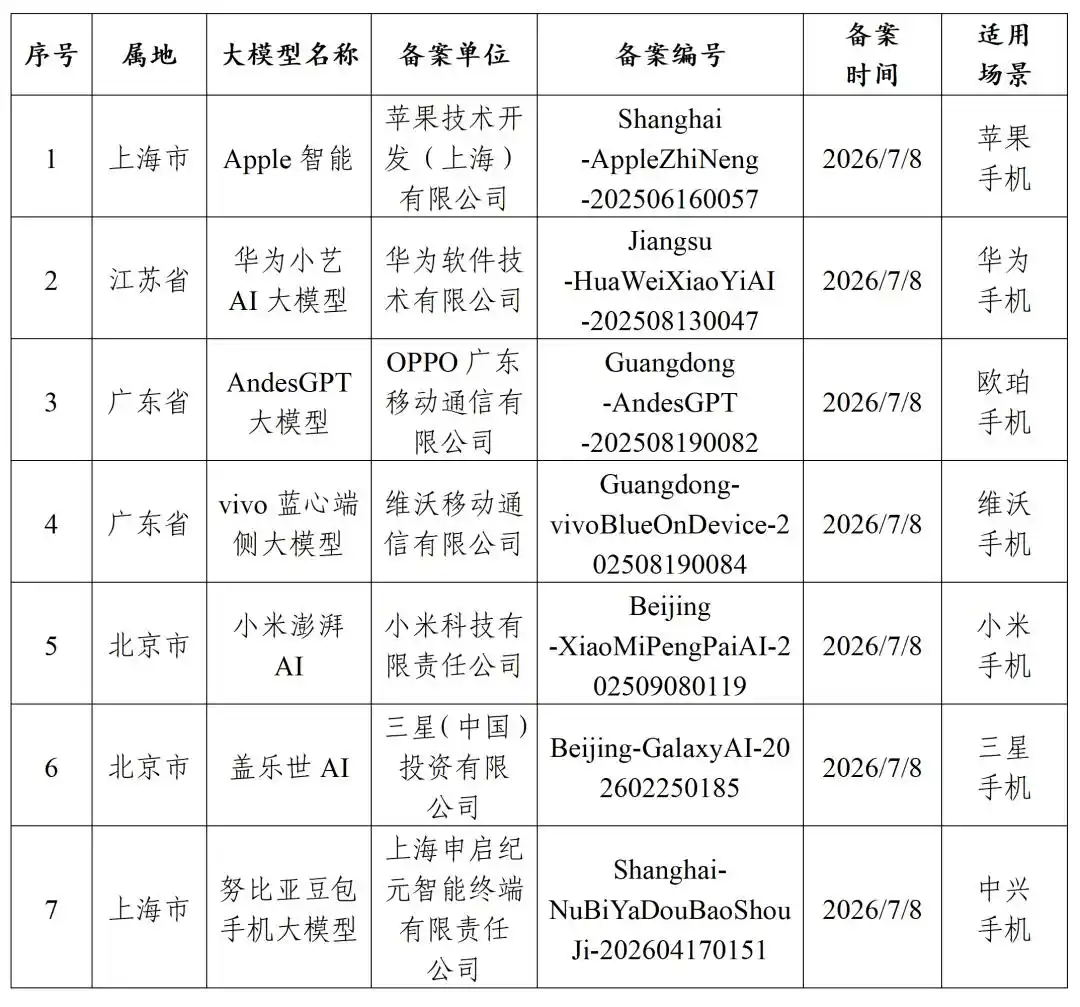
Announcement on Releasing Filing Information for 7 On-Device Generative AI Services for Mobile Phones

This is the largest collective approval in the domestic on-device mobile AI field to date.

Counting from its debut at WWDC in June 2024, Chinese users have waited two years for Apple AI.

Alibaba's Qwen will be integrated as the AI capability into Apple Intelligence, providing Chinese users of iOS, iPadOS, macOS, and visionOS with abilities like text and image understanding, content generation, and more.

In response to this news, Alibaba stated:

Alibaba's Qwen will be integrated as the AI capability into Apple Intelligence, delivering intelligent experiences to Chinese users of iOS, iPadOS, macOS, and visionOS.

Users can directly experience Qwen's text and image understanding, content generation, and other capabilities on Apple devices without needing to switch between apps.

The filing is the compliance admission ticket, but even before Apple obtained this ticket, Chinese users had experienced a brief, preliminary version.

The Previously Leaked Test Version of Apple AI Left Much to Be Desired

On March 31 this year, the day before Apple's 50th anniversary, an "Apple Intelligence and Siri" entry appeared in the Settings page of iPhones in China.

There was no launch event, no press release. The feature went live and was quickly taken down.

Bloomberg journalist Mark Gurman judged it to be an accidental push: Apple wouldn't launch its AI for China without any promotional activity, wouldn't choose the early hours of the morning in China to go live, and the visual recognition was calling on a Google engine rather than a domestic one, which is also unreasonable for China. Regulatory approval had not yet been granted at that time.
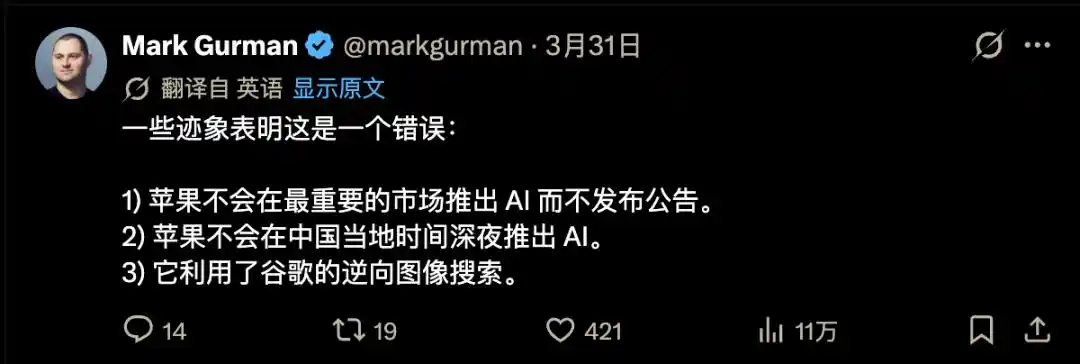
https://x.com/markgurman/status/2038701276699967554

The hands-on results from that brief appearance can be summarized in two words: fast, but rough.
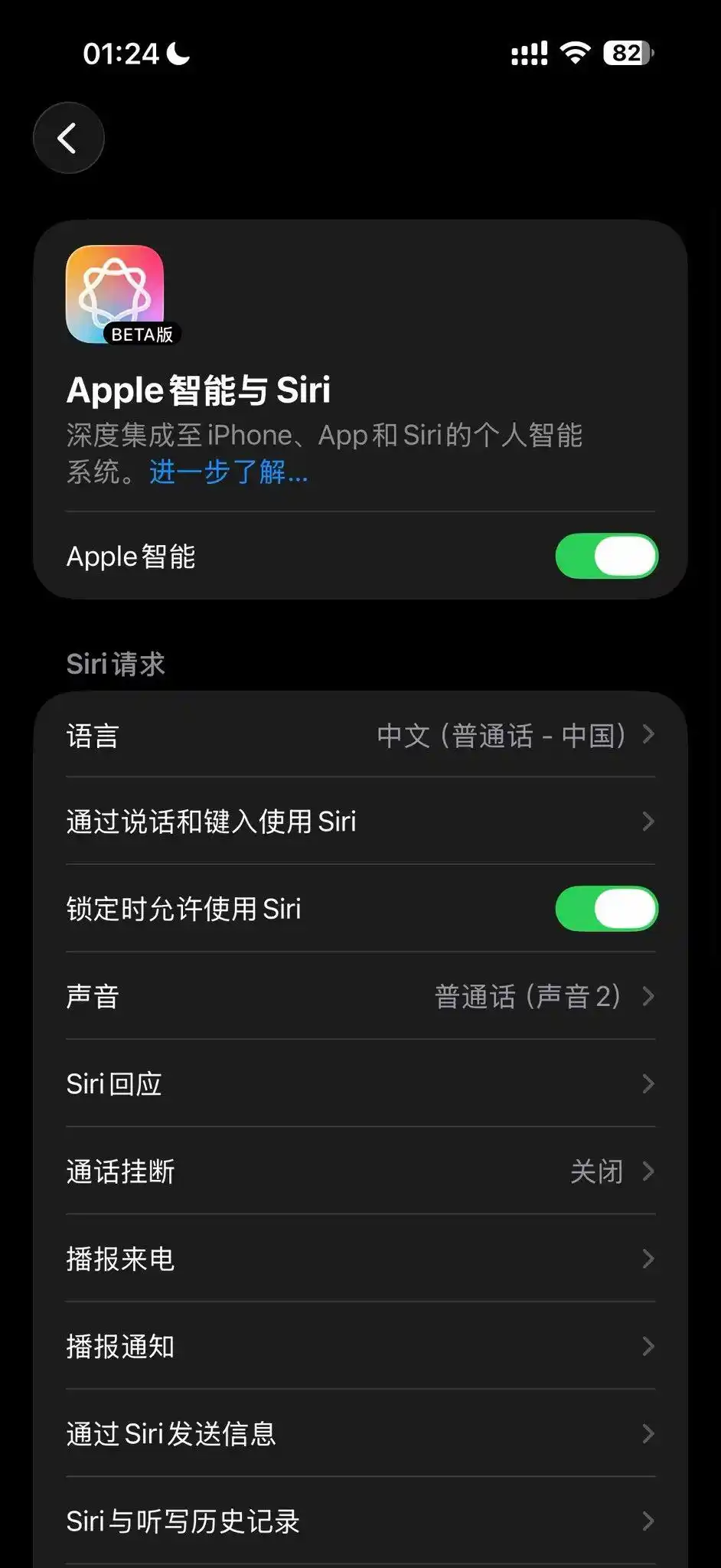
The speed of the on-device model was the most immediate perception.

Text polishing, information summarization, AI erasure — responses were almost instantaneous.

A 200-word draft clicked to "Change to Professional Tone" produced results in less than two seconds.

The Image Playground supported generating images from text descriptions, producing images in three to five seconds, but the phone noticeably heated up.

All processing was done locally, with no data uploaded to the cloud, ensuring privacy — at the cost of accuracy.

Summarizing complex long texts would miss key information; tone rewriting occasionally produced unnatural expressions.

AI erasure worked okay on simple backgrounds, but with complex scenes, it showed issues like residual shadows, blurred edges, and broken textures.

Writing tools, translation, visual recognition — each was usable, each had a noticeable gap compared to competitors using cloud-based large models.

Apple made a trade-off between privacy and performance, choosing the former.

Although the leaked version in March was taken down at lightning speed in less than a day, it prematurely revealed the capability boundaries of Apple Intelligence for China: on-device models are fast, protect privacy, but depth and accuracy require supplementation by cloud models.

Previously, there was no clear, reliable information confirming which model was actually integrated.

Seven Approved, Apple Late by Two Years

Apple wasn't alone in passing the filing.

Also receiving admission tickets on the same day were Huawei, OPPO, vivo, Xiaomi, Samsung, and Nubia — the on-device AI of 7 phone manufacturers collectively approved.

Nubia's Doubao Mobile Model is expected to debut during WAIC.

For Apple, the cost of being late is already written in its financial reports.

iPhone sales in the Chinese market have been under continuous pressure. Cook previously admitted in an earnings call that the absence of Apple Intelligence was a reason for the decline in competitiveness.

Huawei, Xiaomi, and OPPO have long made AI features standard on flagships. Some brands have even integrated models like DeepSeek , widening the experience gap.

Previously, at WWDC 26, Apple showcased the new-generation Siri AI developed in collaboration with Google and based on Gemini, supporting cross-app contextual awareness and natural conversation, even capable of pulling up email and calendar information in real-time during calls.

However, at that time, Apple also made it clear: the new Siri AI would not immediately land in the Chinese market.
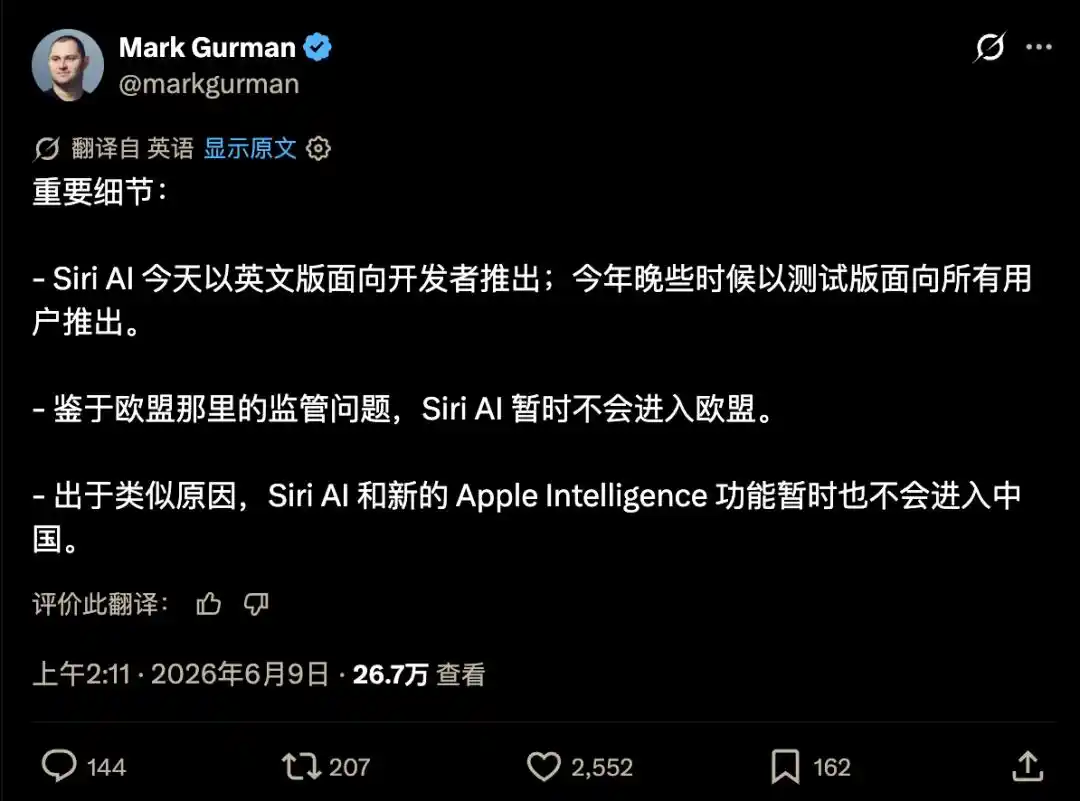
https://x.com/markgurman/status/2064047700488655019

The foundational AI capability for the Chinese version is Alibaba's Qwen , which is different from the technology stack used in the overseas version.

Apple has not given any promises regarding the official launch timeline or the completeness of features.

The filing resolves the compliance issue, but between filing and product launch, there are still engineering steps like version adaptation, feature tailoring, and model optimization to complete.

For users of iPhones in China, judging the true value of this AI admission ticket simply requires attention to: whether Apple Intelligence appears in the next iOS update log and how many features are retained.

Until then, the two-year wait is just one step away from being over.

This article is from the WeChat public account "New Zhiyuan", author: ASI Apocalypse

Trending Cryptos

Related Questions

QWhat is the main news regarding Apple's AI services in China as reported in the article?

AThe main news is that Apple's 'Apple Intelligence' AI service for the Chinese market, along with AI services from six other smartphone manufacturers, has officially passed regulatory filing in China. Its capabilities will be integrated with Alibaba's Tongyi Qianwen model.

QWhich Chinese company's AI model will power Apple Intelligence for users in China?

AAlibaba's Tongyi Qianwen (Qianwen) AI model will provide the AI capabilities for Apple Intelligence on iOS, iPadOS, macOS, and visionOS devices for users in China.

QWhat was the issue with the Apple AI test version that briefly appeared on iPhones in China in March?

AThe test version, which was likely an accidental release, was characterized as fast but rough. It performed operations on-device for privacy, but this resulted in lower accuracy and depth compared to cloud-based models, with issues like missing key information in summaries and imperfect AI object removal.

QWhy did Apple's AI delay pose a problem for the company in China according to the article?

AAccording to the article, the delay in launching Apple Intelligence in China negatively impacted iPhone sales. Apple CEO Tim Cook acknowledged that the absence of competitive AI features was a reason for the declining competitiveness of iPhones in the Chinese market, where rivals like Huawei and Xiaomi had already integrated advanced AI into their flagships.

QHow is the Apple Intelligence service for China different from the version announced for other markets?

AThe Chinese version of Apple Intelligence uses Alibaba's Tongyi Qianwen as its AI foundation, whereas the version showcased for other markets at WWDC 26 is based on a partnership with Google and its Gemini model. The technical stacks and capabilities are therefore different.

Related Reads

Token Buyback Volumes Continue to Rise, But Price Lows Keep Falling

The volume of token buybacks continues to grow, but the minimum price level is constantly declining, according to an internal memo by Bitwise CIO Matt Hogan. He argues that most crypto tokens, except Bitcoin, are undervalued as investors are unaware of the revenue now being returned to holders. He highlights the example of Hyperliquid, which has bought back and burned $1.3 billion worth of its $HYPE token. Hogan posits that tokens are beginning to trade based on revenue, similar to stocks and bonds, marking the end of an era where scaling networks provided little token utility. He links token valuation to strengthening protocol revenue, noting that Hyperliquid has earned over $800 million in the past year and spends nearly all fees on $HYPE buybacks. Following this model, protocols like Uniswap and Aave have implemented fee mechanisms to buy back and burn their own tokens. The trend has also affected base chains like Solana and Aptos, which have proposed or enacted higher fee burns. However, the memo acknowledges that reducing token supply has not reliably boosted prices. A Cryptopolitan report found many tokens with regular buybacks still underperformed the market. Even Hyperliquid's upward trend broke, and Pump.fun conducted significant buybacks near token lows. Hogan cautions that token buybacks differ from stock buybacks due to the lack of contractual claims on profits or assets, as governance rules can always be rewritten.

cryptonews.ru13m ago

Token Buyback Volumes Continue to Rise, But Price Lows Keep Falling

cryptonews.ru13m ago

NullReceiver abandons the recording address that made EtherHiding easy to detect

**Sonatype Research Labs has uncovered six malicious npm packages that retrieve command-and-control server addresses from an attacker's Ethereum wallet.** Three of the packages are legitimate, popular libraries that were compromised: `@kolbo/mcp`, `agentgui`, and `godot-kit`. The other three are purely malicious packages: `envpack-conf`, `postcss-initial-provider`, and `tailwindcss-motion-advanced`. All six deploy the same payload. The malware loader queries the Ethereum blockchain for the latest outgoing transaction from a specific wallet. It extracts bytes from the recipient field of that transaction, converts them into two IPv4 addresses, and uses these as primary and backup command-and-control servers. After connecting, it fetches, decodes, and executes a second-stage payload using `eval()` or by spawning a child process. This method, dubbed **"NullReceiver,"** is an evolution of the earlier "EtherHiding" technique. While EtherHiding hid data in transaction fields and sent funds to a fixed "burner" address (creating a monitoring point), NullReceiver sends no funds and generates unique, dynamic receiver addresses, making detection harder. OpenSourceMalware has linked this activity to the North Korean Lazarus group's "Contagious Interview" campaign. Sonatype advises developers to remove the affected package versions immediately and check their systems for signs of secondary payload execution.

cryptonews.ru15m ago

NullReceiver abandons the recording address that made EtherHiding easy to detect

cryptonews.ru15m ago

Cryptomarket Loses $14 Billion Due to Hacks. What Was Special About 2026?

The cryptocurrency market lost over $14 billion due to hacks and code exploits from 2016 to 2026, according to a CoinGecko report. The year 2026 has seen a significant spike, with 164 separate incidents recorded as of August—a 70% increase from all of 2025. Although the total financial loss for 2026 currently stands at about $1.2 billion, still below the peak of $2.77 billion in 2022, the number of attacks is unprecedented. Analysts attribute this rise to improved tracking methods and increased malicious activity, possibly fueled by advancements in artificial intelligence. Notable 2026 breaches include the April hacks of Drift and Kelp protocols, resulting in losses of $295 million and $293 million, respectively. The Kelp exploit, linked to North Korean hackers, involved minting unbacked tokens via a LayerZero bridge vulnerability, which were then used as collateral on Aave. This triggered a massive withdrawal of liquidity from Aave and the broader DeFi sector, leading to over $20 billion in sector-wide outflows by August, despite the eventual recovery of the stolen Kelp funds. The report also highlights that market reactions to hacks often inflict greater financial damage than the exploits themselves. For instance, following the BonkDAO hack, the token's market cap fell by nearly $140 million, far exceeding the $21 million direct loss. Other examples include the DRIFT token dropping 80% and Step Finance's token losing over 99% of its value, leading to the protocol's bankruptcy. The analysis notes that the real total damage is likely higher, as it excludes individual wallet breaches and broader ecosystem losses.

cryptonews.ru17m ago

Cryptomarket Loses $14 Billion Due to Hacks. What Was Special About 2026?

cryptonews.ru17m ago

Trading

Spot

Hot Articles

Discussions

Welcome to the HTX Community. Here, you can stay informed about the latest platform developments and gain access to professional market insights. Users' opinions on the price of S (S) are presented below.

活动图片