# Trading Related Articles

HTX News Center provides the latest articles and in-depth analysis on "Trading", covering market trends, project updates, tech developments, and regulatory policies in the crypto industry.

Tokenization Scale Soars to $4.3 Billion, But Why Did Securitize Incur a $5.5 Million Loss?

Securitize's first quarterly report post-IPO reveals a paradox: while its tokenized assets under management hit a record $4.3 billion (up 16% YoY) and platform trading volume surged 147% to $5.3 billion, total revenue fell 5% to $14.4 million. Tokenization revenue specifically dropped ~12% to $7.8 million, leading to an adjusted EBITDA loss of $5.5 million. CFO Francisco Flores explained that most trading volume is not yet monetized, with the majority of tokenization revenue still coming from one-time projects like new protocol integrations. In contrast, asset servicing revenue, a more recurring stream, grew slightly to $6.6 million. The company has lowered its full-year revenue guidance to $70-$80 million from an initial projection of $110 million. Industry experts note this highlights a structural challenge for the tokenization sector. Scaling assets on-chain doesn't automatically scale a profitable business model. Current implementations often rely on costly, customized projects for each new asset or jurisdiction. The future, they argue, lies in building standardized infrastructure that generates recurring "infrastructure revenue" from post-issuance activities like compliance, distributions, and secondary trading—similar to enterprise software. Analysts caution against misinterpreting high trading volumes as indicative of a mature fee-based model, as Securitize's broad volume metric includes many non-monetized actions. The key test for the industry is whether adding billions in new assets can generate sustainable revenue without constant new custom projects.

marsbit08/20 10:06

Tokenization Scale Soars to $4.3 Billion, But Why Did Securitize Incur a $5.5 Million Loss?

marsbit08/20 10:06

Bitcoin 'Whale Investors' Increase Their Holdings by 43,000 BTC, Ending a Months-Long Selling Wave

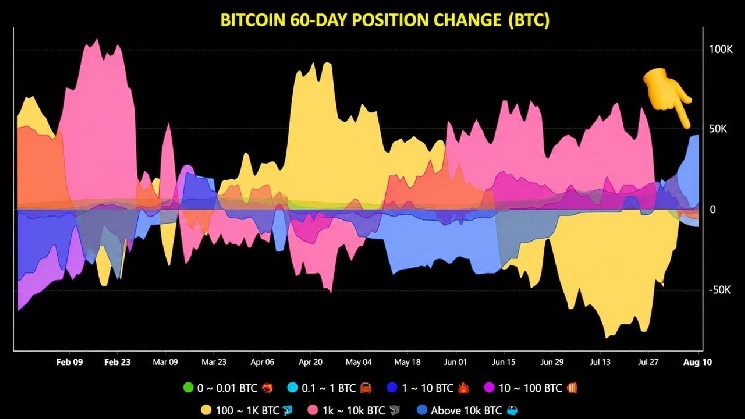
Large Bitcoin holders, defined as non-exchange and non-mining pool wallets, have accumulated approximately 43,000 BTC (worth around $2.9 billion) over the past 60 days. This marks a significant reversal from a several-month period where this same group were net sellers, contributing to downward pressure on Bitcoin's price following its October 2025 all-time high. The accumulation began when Bitcoin fell to around $60,000, a level that seemingly attracted large holders who had stayed on the sidelines during the sharper phase of the decline. Bitcoin has since recovered to trade in a narrower range between $62,000 and $65,000. This renewed demand is not limited to the largest "whale" wallets. Balances of so-called "dolphin" holders also increased in the same period, indicating a broader accumulation trend beyond just a handful of mega-wallets. This activity occurs against a backdrop of declining overall market activity, with August spot trading volumes hitting their lowest monthly level since August 2021, meaning the whale purchases represent a disproportionately large share of total market activity. This buying shift contrasts with the dominant selling trend seen for much of 2026 from other major entities. Looking ahead, a key factor to watch is whether this large-investor activity persists as Bitcoin approaches the upper bound of its recent $62k-$65k trading range.

cryptonews.ru08/19 13:36

Bitcoin 'Whale Investors' Increase Their Holdings by 43,000 BTC, Ending a Months-Long Selling Wave

cryptonews.ru08/19 13:36

Frenzy Surrounding Unitree's Humanoid Robots Exceeds Hyperliquid Traders' Expectations

The Chinese robotics company Unitree Robotics made a highly anticipated debut on the Shanghai Stock Exchange on August 19, 2026. Its shares soared 629% above their IPO price, valuing the company at approximately $66 billion at the start of trading. This represents one of the most significant investor frenzies around physical AI—systems combining AI with robots. Prior to the listing, crypto traders on the Hyperliquid platform had already been speculating on the company's value through a perpetual futures contract, pegging its valuation at around $38 billion. The actual debut massively exceeded these crypto market predictions by about 75%. The contract's trading volume reached $64 million. Unitree, specializing in humanoid and quadruped robots, is now mainland China's first publicly listed humanoid robot company. It shipped over 5,500 humanoid units in 2025, leading global sales. The company's 2025 revenue surged to 1.7 billion yuan from 393 million yuan a year earlier, with a net profit of 278 million yuan and gross margins exceeding 60%. The IPO, which raised about 6.1 billion yuan ($905 million), reflects intense investor interest in the physical AI sector. JPMorgan estimates the humanoid robot market could grow from $2 billion in 2025 to $300 billion by 2035, with China holding about 75% of the global market share due to lower production costs. However, analysts warn of potential overvaluation, noting the stock's price far exceeds traditional financial metrics and is driven by retail speculation. The company faces the challenge of translating pilot projects and demonstrations into widespread commercial adoption. Strategic investors in the IPO included AI firm DeepSeek, Tencent, and units of major state-owned companies.

cryptonews.ru08/19 11:31

Frenzy Surrounding Unitree's Humanoid Robots Exceeds Hyperliquid Traders' Expectations

cryptonews.ru08/19 11:31

BIT Trading Moment: BTC Buying Pressure Rises but Bearish Sentiment Remains Strong, 50-Month EMA Difficult to Break, SK Hynix Attempts to Stabilize Memory

BIT Trading Hours: BTC Buying Rebounds but Bearish Sentiment Persists; 50-Month EMA Presents Resistance; SK Hynix Attempts to Stabilize the Memory Sector. Bitcoin briefly reclaimed $65,000, its first time since August 10th, showing a temporary decoupling from traditional risk assets pressured by soaring long-term U.S. Treasury yields. Key support is seen at $62k-$63k, with resistance near the 50-month Exponential Moving Average around $65.4k. While on-chain data indicates recovering spot demand, potentially signaling a local bottom, the options market remains skewed bearish. BIT analysis notes significant downside risk remains if historical bear market patterns repeat, with a potential drop to ~$45.5k. Global equity markets faced intense selling pressure, driven by a bond market storm. The U.S. 30-year yield hit a multi-year high above 5.33%, raising global funding costs. The AI sector was at the epicenter of the sell-off, with the Philadelphia Semiconductor Index plunging ~5% as investors questioned the sustainability of massive AI capital expenditures amid high debt costs. Storage stocks like Micron led declines. SK Hynix's announcement of a major share buyback provided some stability to the memory sector during after-hours trading. However, most tech stocks remained under pressure. In Asia, South Korean and Japanese indices fell sharply, heavily impacted by chip stock declines. Chinese robotics company Unitree Tech had a volatile market debut on Shanghai's STAR Market, soaring over 600% at one point before paring gains, making its founder a billionaire. Despite this individual success, the broader robotics sector in A-shares sold off heavily. Key upcoming events include the U.S. 20-year Treasury auction and the release of the Federal Reserve's July meeting minutes, which will be crucial tests for bond market stability and monetary policy expectations.

marsbit08/19 09:29

BIT Trading Moment: BTC Buying Pressure Rises but Bearish Sentiment Remains Strong, 50-Month EMA Difficult to Break, SK Hynix Attempts to Stabilize Memory

marsbit08/19 09:29

Bitwise CIO: Three Major Cognitive Errors Common Among Crypto Investors Today

Bitwise CIO Matt Hougan highlights three key misconceptions he believes many crypto investors currently hold, presenting them as opportunities for those who see beyond them. First, investors significantly underestimate the total addressable market for crypto applications. While many view platforms like Uniswap only as tools for trading crypto assets (a ~$2 trillion market), their true potential lies in tokenizing and trading *all* asset classes—such as stocks and bonds—which represent markets hundreds of trillions of dollars in size. Second, there's a persistent overestimation of traditional financial institutions' ability to dominate crypto-native sectors. Examples like PayPal's stable币 (with ~1% market share vs. Tether/Circle's 88%) and Fidelity's custody business (trailing Coinbase) show that crypto-native firms often win due to faster iteration, focused expertise, and established user trust within the crypto ecosystem. Third, investors linearly extrapolate future on-chain transaction volumes from today's data, severely underestimating potential growth. The shift to 24/7 trading for tokenized assets could multiply trading hours by 5x. When combined with AI agents that may execute trades far more frequently than humans, transaction volumes could grow by 10x to 100x, massively boosting revenue for underlying blockchains and applications. Hougan concludes that the gap between the rapid pace of industry change and slower mainstream perception updates creates significant investment opportunities.

marsbit08/19 08:07

Bitwise CIO: Three Major Cognitive Errors Common Among Crypto Investors Today

marsbit08/19 08:07

活动图片