Tokenization Scale Soars to $4.3 Billion, But Why Did Securitize Incur a $5.5 Million Loss?

marsbitPublished on 2026-08-20Last updated on 2026-08-20

Abstract

Securitize's first quarterly report post-IPO reveals a paradox: while its tokenized assets under management hit a record $4.3 billion (up 16% YoY) and platform trading volume surged 147% to $5.3 billion, total revenue fell 5% to $14.4 million. Tokenization revenue specifically dropped ~12% to $7.8 million, leading to an adjusted EBITDA loss of $5.5 million. CFO Francisco Flores explained that most trading volume is not yet monetized, with the majority of tokenization revenue still coming from one-time projects like new protocol integrations. In contrast, asset servicing revenue, a more recurring stream, grew slightly to $6.6 million. The company has lowered its full-year revenue guidance to $70-$80 million from an initial projection of $110 million. Industry experts note this highlights a structural challenge for the tokenization sector. Scaling assets on-chain doesn't automatically scale a profitable business model. Current implementations often rely on costly, customized projects for each new asset or jurisdiction. The future, they argue, lies in building standardized infrastructure that generates recurring "infrastructure revenue" from post-issuance activities like compliance, distributions, and secondary trading—similar to enterprise software. Analysts caution against misinterpreting high trading volumes as indicative of a mature fee-based model, as Securitize's broad volume metric includes many non-monetized actions. The key test for the industry is whether adding bil...

Written by: Gino Mato

Compiled by: Saoirse, Foresight News

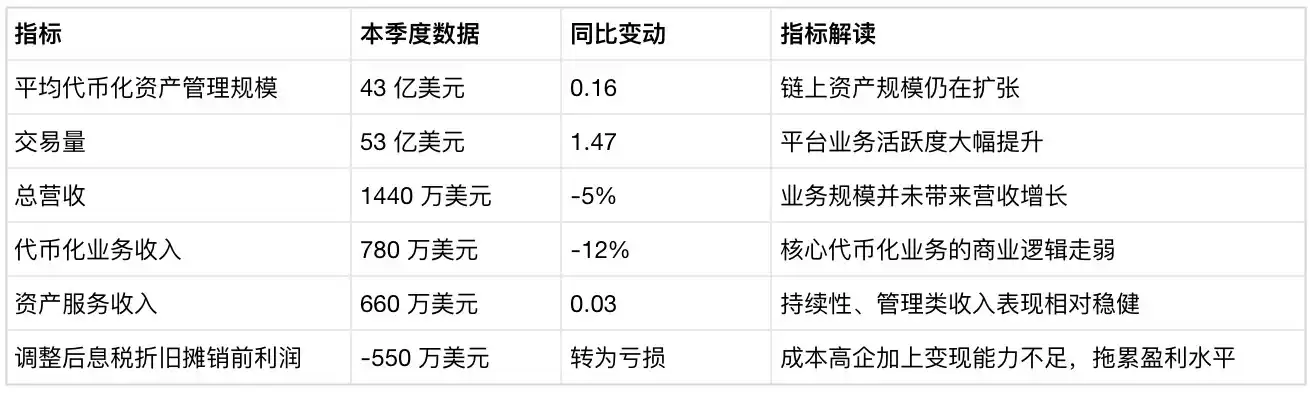
Securitize's first quarterly earnings report since going public: the average assets under management on its tokenization platform reached a historic high of $4.3 billion, a 16% year-over-year increase; platform trading volume surged 147% to $5.3 billion.

However, the company's total revenue decreased by 5% year-over-year to just $14.4 million; tokenization business revenue dropped approximately 12% to $7.8 million; adjusted EBITDA turned into a loss of $5.5 million.

Compared to the same period last year, the company has tokenized more assets and handled a significantly larger business volume, yet its earnings have decreased.
CFO Explains the Discrepancy Between Scale and Revenue

Securitize CFO Francisco Flores stated in the earnings call that, at this stage, revenue from assets under management (AUM) is minimal, and the vast majority of platform trading volume has not yet been commercialized.

He added that most of the tokenization business revenue still comes from projects such as integrating new protocols and expanding business networks.

Meanwhile, asset servicing revenue—fees charged for managing the platform's existing assets—performed much better, rising slightly by 3% to $6.6 million. Flores noted that monetizing transactions is a medium-to-long-term opportunity, and the current business model cannot yet tap into this part of the revenue.

Pre-IPO materials from Securitize had projected the company's 2026 total revenue to reach $110 million, with EBITDA of $32 million. Management claimed that $85 million of this revenue was contractually guaranteed, recurring, or based on existing assets and partnerships, making the initial forecast highly achievable.

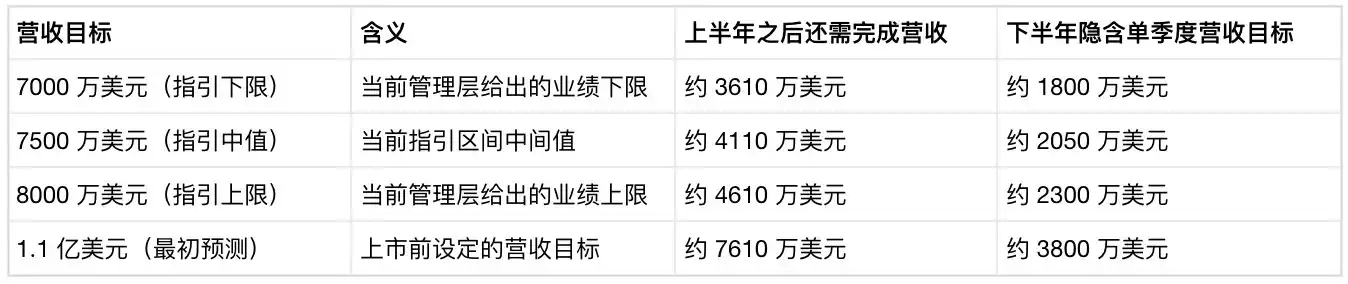
Now, management has lowered the full-year revenue guidance to $70–80 million. The company's total revenue for the first half of the year was $33.9 million. To meet the lower end of the guidance, quarterly revenue in the second half needs to reach about $18 million; to reach the upper end, quarterly revenue needs to approach $23 million.

To achieve the original $110 million target, quarterly revenue would need to be $38 million, more than 2.6 times the revenue level of this quarter.
Why Is There Such a Huge Gap Between Tokenized Asset Scale and Revenue?

Edwin Mata, CEO of tokenization platform Brickken, stated that the contradiction revealed in Securitize's financial report is a structural challenge faced by the entire industry.

He noted that tokenized assets under management can continue to rise, but the underlying commercial monetization model struggles to scale at the same pace; merely tokenizing more assets does not automatically create a business model that grows accordingly.

Mata explained that current tokenization implementations largely rely on large-scale custom projects, dedicated system integrations, adaptations for different jurisdictions, and extensive professional services for each new asset issuance.

Adding a new asset class, entering a new jurisdiction, or launching a new product often equates to starting a new implementation project. When revenue depends on custom implementations project by project, the growth rate of tokenized assets will far outpace the recurring revenue it can generate.

Mata believes the truly significant business opportunity lies after assets are tokenized, not during the issuance phase. Companies need infrastructure capable of managing financial products long-term, covering access control, compliance, reporting, distribution, corporate actions, and secondary market transfers.

This is the difference between implementation revenue and infrastructure revenue: implementation revenue is a one-time fee for deploying assets onto the blockchain; infrastructure revenue is the recurring fee for maintaining the ongoing operation of assets on-chain.

In his view, to capture infrastructure revenue, the tokenization industry needs to look to enterprise software: building standardized infrastructure, creating reusable workflows, and supporting multiple financial products and jurisdictions within a single system.

Complex business structures will still require consulting and professional services, but the core profit logic must be embedded within the infrastructure itself.

Why Simply Calculating Platform Fees Leads to Misjudgment

Utkarsh Ahuja, Founder and Managing Partner of Moon Pursuit Capital, believes Securitize's earnings report serves as a realistic warning: the speed of industry adoption and commercialization are not in sync at all.

He poses questions to investors: When assets under management and trading volume continue to expand, what happens commercially? How much of this growth translates into recurring revenue? Do profit margins improve? Do operational efficiencies increase as the business scales?

Ahuja stated that the tokenization industry is entering a rational development phase. The market has validated over recent years that institutions are indeed willing to tokenize real-world assets; now it's time for the underlying infrastructure business models supporting this sector to be tested.

As more institutional capital flows into tokenized assets, investors will increasingly focus on revenue quality, customer retention, profit margins, and the long-term commercial returns of maintaining assets. This is also key to distinguishing whether a platform is a genuinely sustainable business or merely a growth story.

Simply dividing Securitize's $14.4 million revenue by $5.3 billion in trading volume might seem to yield a decent platform fee rate, but this calculation does not reflect the company's actual profitability at all.

Securitize's trading volume statistics are broad, encompassing investments, redemptions, dividends, and cross-chain asset transfers; as CFO Flores admitted, only a tiny fraction of this volume currently generates revenue.

A more realistic conclusion is this: The fact that Securitize has not yet established a mature 'platform activity-revenue sharing' model is far more significant than any single fee rate figure.

How Will the Tokenized Asset Scale-Revenue Contradiction Evolve?

Bullish Scenario: Securitize focuses on tokenized public stock business, leveraging issuers tokenizing shares, broker capabilities, and atomic settlement to drive high-frequency trading, thereby earning transaction fees. Management believes tokenized stocks have stronger trading attributes compared to tokenized treasuries or credit products. However, this is a medium-to-long-term strategic move and will not impact the current fiscal year's performance.

To achieve full-year revenue close to or reaching $80 million, quarterly revenue in the second half needs to be about $23 million, a significant acceleration compared to the current quarter.

Bearish Scenario: Assets under management and trading volume continue to hit new highs, but the underlying business model remains reliant on custom projects one by one. Tokenization business revenue fluctuates sharply, and asset servicing revenue growth is too slow to offset these issues.
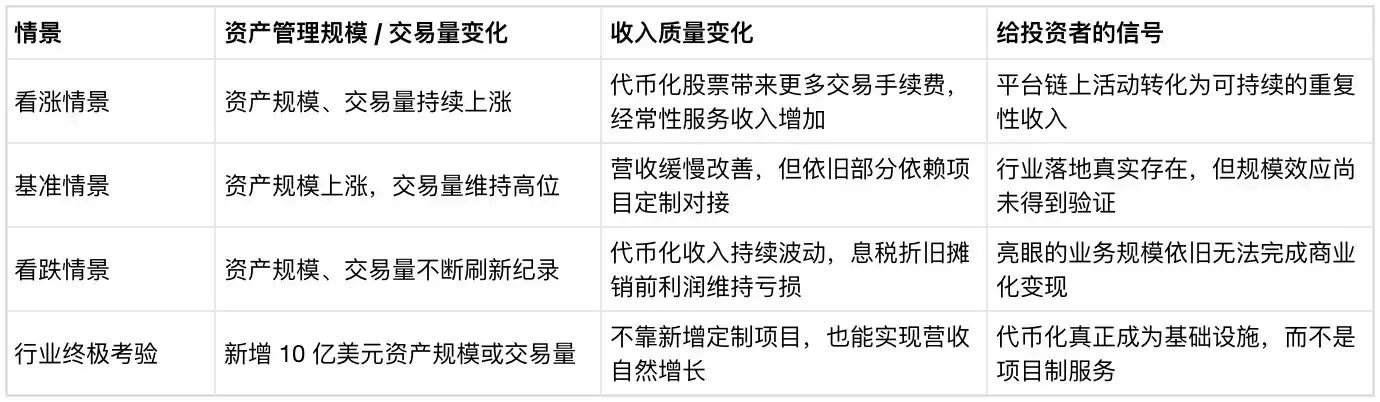
If full-year revenue only meets the lower guidance of $70 million, quarterly revenue would need to be only about $18 million, slightly higher than this quarter. Even as announced business scale continues to reach new highs, adjusted EBITDA could remain in the red.

The core challenge the tokenization industry must face next: when a platform adds billions more in assets or trading volume, can it autonomously generate recurring revenue without relying on new projects?


Trending Cryptos

Related Questions

QWhat are the key financial results of Securitize as revealed in its first earnings report after going public?

ASecuritize's first quarterly earnings report after its public listing showed its tokenized assets under management reached a record high of $4.3 billion, a 16% year-on-year increase, and its trading volume soared 147% to $5.3 billion. However, total revenue fell 5% year-on-year to $14.4 million, tokenization revenue dropped about 12% to $7.8 million, and adjusted EBITDA turned to a loss of $5.5 million.

QWhy did Securitize's revenue decline despite a significant increase in platform transaction volume, according to the CFO?

AAccording to CFO Francisco Flores, the vast majority of the platform's transaction volume has not yet been commercially monetized. Tokenization revenue is still largely derived from projects involving new protocol integrations and network expansion. The revenue from transaction volume represents a long-term opportunity that the current business model cannot yet capture.

QWhat fundamental industry challenge does the Securitize earnings report highlight, according to Brickken's CEO?

ABrickken's CEO Edwin Mata states that the contradiction revealed in Securitize's earnings is a structural problem for the entire tokenization industry. While tokenized assets under management can grow rapidly, the underlying commercial profit models do not scale automatically. Tokenization often relies on large, customized, one-off projects for each new asset, jurisdiction, or product launch, leading to a significant gap between the speed of asset expansion and the generation of recurring revenue.

QWhat is the difference between 'implementation revenue' and 'infrastructure revenue' in the context of tokenization?

AIn the context of tokenization, 'implementation revenue' refers to one-time fees for deploying assets onto the blockchain. 'Infrastructure revenue' refers to ongoing, recurring fees generated from maintaining the continuous operation of assets on the blockchain, covering services like access control, compliance, data reporting, dividend distribution, and secondary market transfers.

QWhat are the potential bullish and bearish scenarios for Securitize's future development outlined in the article?

AThe bullish scenario involves Securitize focusing on tokenized public equities, which have stronger trading attributes than bonds or credit products. This could generate transaction fees from high-frequency trading, but this is a long-term play unlikely to impact this year's results. The bearish scenario envisions continued growth in assets under management and trading volume, but the business model remains reliant on one-off custom projects, leading to volatile tokenization revenue and insufficient growth in asset servicing revenue to offset this, potentially keeping the company in an adjusted EBITDA loss position.

Related Reads

Terence Tao's Remote Dialogue with Wang Hong: Mathematics Must Learn to 'Digest' AI

Two Fields Medalists, Terence Tao and Maryna Viazovska, share a common view on the flood of AI-generated proofs in mathematics: the community must learn to "digest" them. While AI can rapidly produce and even formally verify proofs, Tao argues that a correct proof is only the first step. For a result to become usable knowledge, it must be understood, absorbed, and integrated into the existing mathematical framework by human mathematicians. He illustrates this by spending several days "digesting" an AI-assisted proof of the long-standing Sendov conjecture. His process involved tracing sources, identifying key ideas, simplifying the argument, and rewriting it into a human-readable narrative. This digestion not only verified the proof but also revealed it could solve a stronger conjecture and be presented with more elementary tools. Tao criticizes the current race for priority based solely on who announces a proof first, often skipping verification and explanation. He proposes shifting value to the crucial work of interpreting, reviewing, and consolidating results. In his recent ICM talk, he emphasized that if authors cannot explain their AI-generated proof to peers, it shouldn't be published. To facilitate this new workflow, Tao introduced "Palomar," a registry for Lean-verified results. It serves as a digestion hub, cataloging problems, proof code, and AI involvement, aiming to coordinate efforts and ensure completeness. Under this model, full credit for a result would require multiple milestones: generation, verification, explanation, and final publication. The core message is clear: as AI transforms the front end of mathematical discovery, the irreplaceable role of mathematicians will be to synthesize, contextualize, and communicate these advances, turning raw outputs into enduring knowledge.

marsbit2m ago

Terence Tao's Remote Dialogue with Wang Hong: Mathematics Must Learn to 'Digest' AI

marsbit2m ago

The U.S. Treasury Department Doubles Treasury Repurchases to Stabilize the Market, But U.S. Stocks Only Edge Up Slightly — Is the Real Signal Hidden in Bitcoin?

The US Treasury significantly boosted its long-term bond repurchase program to curb surging yields, sparking a notable rally in Bitcoin while leaving the stock market with only modest gains. Facing high long-term bond yields that pressured equities, especially tech stocks, the Treasury announced it would double the maximum size of its repurchases for 10- to 30-year bonds. This move, seen as the government stepping in to provide liquidity and stabilize confidence, initially pushed bond yields lower. However, the market reaction was unusual. While liquidity-sensitive Bitcoin surged from around $64,000 toward $70,000, major US stock indices posted only minor gains. Previously high-flying AI-related sectors like semiconductors continued to weaken, largely ignoring the news. The article interprets Bitcoin's sharp rise as the key signal, reflecting its role as a gauge for dollar liquidity. The Treasury's action is seen as injecting fresh money into the system. While stocks remain preoccupied with sector-specific concerns, Bitcoin immediately priced in this loosening of financial conditions. This shift suggests the market's underlying dynamic may be transitioning from a fight for existing capital to an expectation of new inflows, potentially broadening the rally beyond the concentrated AI trade that dominated recent months.

marsbit7m ago

The U.S. Treasury Department Doubles Treasury Repurchases to Stabilize the Market, But U.S. Stocks Only Edge Up Slightly — Is the Real Signal Hidden in Bitcoin?

marsbit7m ago

Trading

Spot

Hot Articles

Discussions

Welcome to the HTX Community. Here, you can stay informed about the latest platform developments and gain access to professional market insights. Users' opinions on the price of S (S) are presented below.

活动图片