Trade.xyz Captures Over Half of Hyperliquid's Trading Volume with AI Chip Stocks and Crude Oil Perpetual Contracts

marsbitPublished on 2026-08-19Last updated on 2026-08-19

Abstract

**Title:** Trade.xyz Captures Over Half of Hyperliquid's Trading Volume with AI Chip Stocks and Oil Perpetuals **Summary:** Driven by the launch of AI chip stock and oil perpetual contracts, Trade.xyz has become the dominant builder on Hyperliquid following its HIP-3 upgrade, now accounting for over 55% of the platform's trading volume. The HIP-3 proposal shifted market creation from validator votes to a staking and auction model, allowing builders like Trade.xyz to deploy their own perpetual futures markets. Trade.xyz's focus on traditional assets like AI/Compute equities, crude oil, and major indices has attracted significant on-chain trading activity. In the past month alone, it generated approximately $5 million in fees, which are split 50/50 with Hyperliquid. A significant portion of this revenue is used for open-market buybacks of the HYPE token, reducing its circulating supply and creating a direct link between platform activity and token value capture. This growth highlights both the potential for ecosystem concentration around a single major builder and the evolving mechanisms for HYPE's value accrual.

Author:Coin Metrics State of the Network

Compiled by: Deep Tide TechFlow

Deep Tide Introduction: Hyperliquid's HIP-3 transformed the listing of perpetual contracts from validator voting to staking plus auction. Trade.xyz became the major player, capturing over half of Hyperliquid's trading volume in August. It attracted on-chain traders with perpetual contracts for traditional assets like AI chip stocks, crude oil, and the S&P. Its fee sharing continues to drive HYPE buybacks. Understanding this mechanism is crucial for assessing Hyperliquid's ecosystem concentration and HYPE's value capture.

Key Takeaways

In August, Trade.xyz's perpetual markets accounted for 55% of Hyperliquid's total market trading volume.

In July, trading volume for AI & compute stocks and indices on Trade.xyz constituted approximately 53% of its total volume.

Volume changes drove Trade.xyz to generate $5 million in fees over the past month. After a 50/50 split with Hyperliquid, most of its revenue is used to repurchase HYPE from the open market, reducing circulating supply.

Introduction

Hyperliquid's average daily futures trading volume over the past 30 days was about $8.5 billion, accounting for roughly 4.6% of global futures volume. Perpetual futures contracts have no expiration date and don't require managing the underlying asset, making it simpler to gain futures exposure. Compared to trading options with expirations, perpetuals only require paying a small funding rate to maintain positions and keep the futures price pegged to the spot price. Hyperliquid brings traditional financial operations like matching order books and low-latency trading on-chain, combining them with perpetual futures.

The Hyperliquid Improvement Proposal HIP-3, launched in October 2025, made the creation of perpetual futures markets permissionless. Now, builders can deploy their own futures markets to generate revenue, expand the ecosystem, and reduce reliance on Hyperliquid validators.

In this issue of State of the Network, we explore Hyperliquid's HIP-3 upgrade, Trade.xyz's market share, and how fee sharing from popular non-crypto markets creates value for the HYPE token.

How HIP-3 Improved Hyperliquid

HIP-3 unlocked the ability for independent builders to create perpetual markets. Previously, validators would vote to approve the creation of new perpetual markets. This caused delays and concentrated dependency on Hyperliquid validators.

With HIP-3, builders who stake 500,000 HYPE (approximately $27 million) earn the right to directly deploy three perpetual markets. After deployment, they can bid to create more. HIP-3 uses a 31-hour Dutch auction with a floor price of 500 HYPE (~$27,000), where builders bid to deploy the next market. After a builder wins an auction, the starting price for the next auction doubles from the winning price, then linearly decreases to 500 HYPE until another builder wins. Auction proceeds are used to repurchase HYPE tokens and reduce circulating supply.

Beyond the slashable 500,000 HYPE staking requirement, the auction costs have raised concerns about market centralization among HIP-3 builders—only a few can be profitable. Trade.xyz has become the largest HIP-3 perpetual exchange. Its open interest exceeds $4 billion, and it contributes an increasingly high share of trading volume and fees to the Hyperliquid ecosystem.

Trade.xyz's Rise as the Dominant Builder

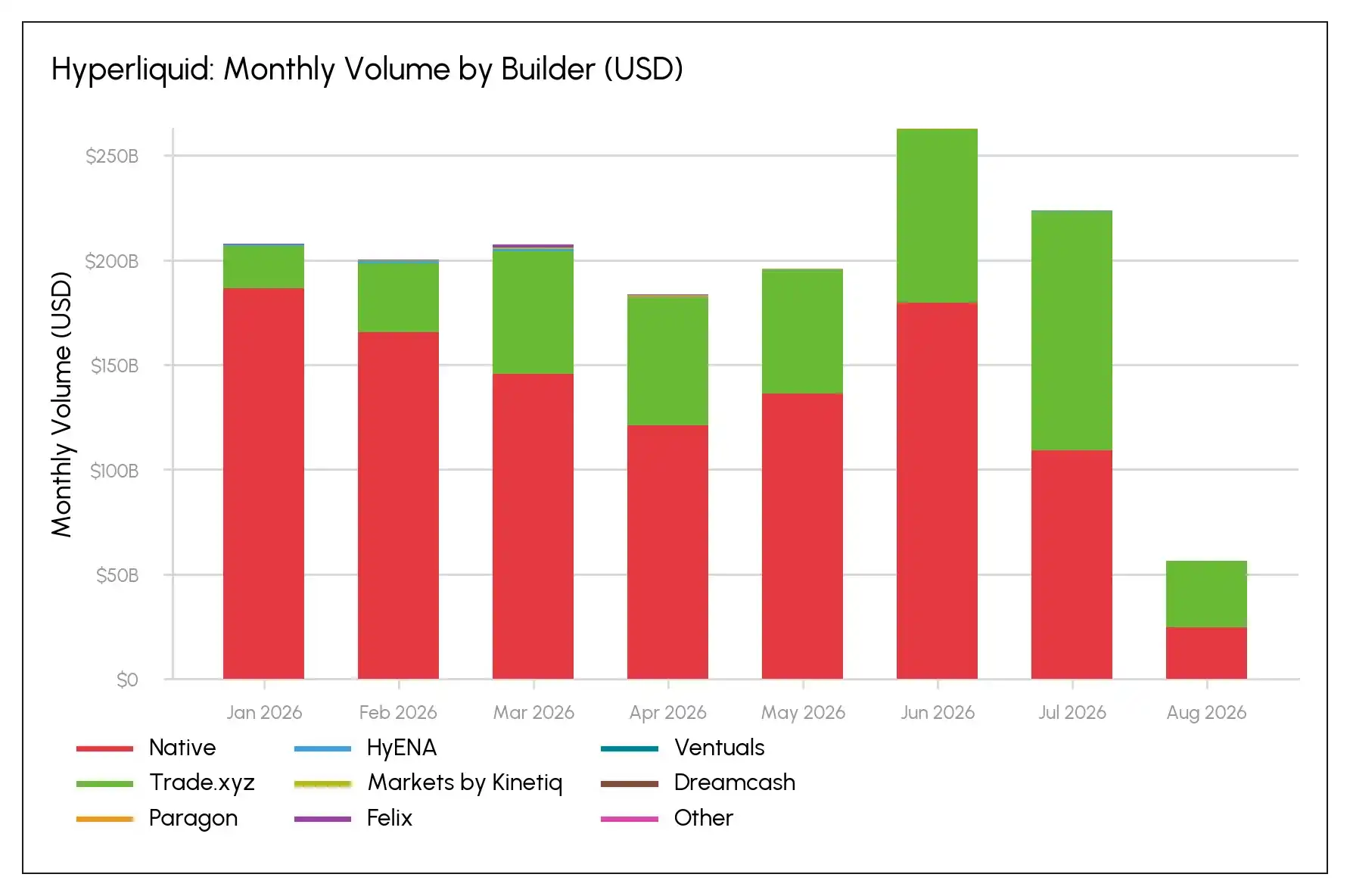
Trade.xyz has captured a significant share of Hyperliquid's perpetual trading volume. Since January 2026, Trade.xyz has completed over $460 billion in trading volume, accounting for about 30% of Hyperliquid's total volume.
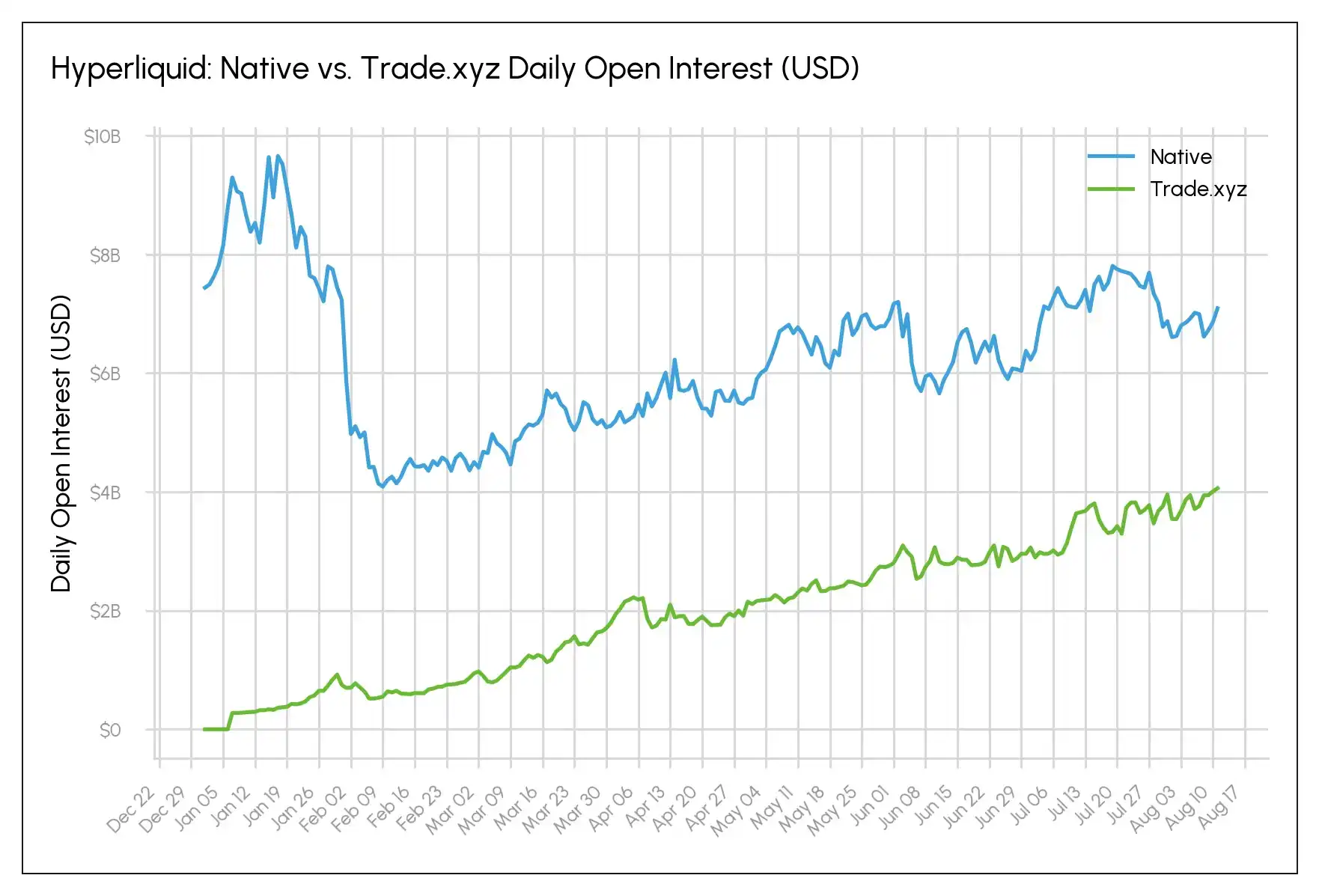
Hyperliquid currently has 484 markets: 232 natively issued by Hyperliquid, 108 deployed by Trade.xyz, and 144 deployed by other HIP-3 builders. Over the past month, Trade.xyz won 23 auctions and added 8 stock perpetual markets. Trade.xyz also added stocks of chipmakers like GIGADEV and CXMT, and compute ETFs like LYTE and NCLD. In August, Trade.xyz's monthly trading volume surpassed that of Hyperliquid's native markets, contributing about 55% of Hyperliquid's total volume.
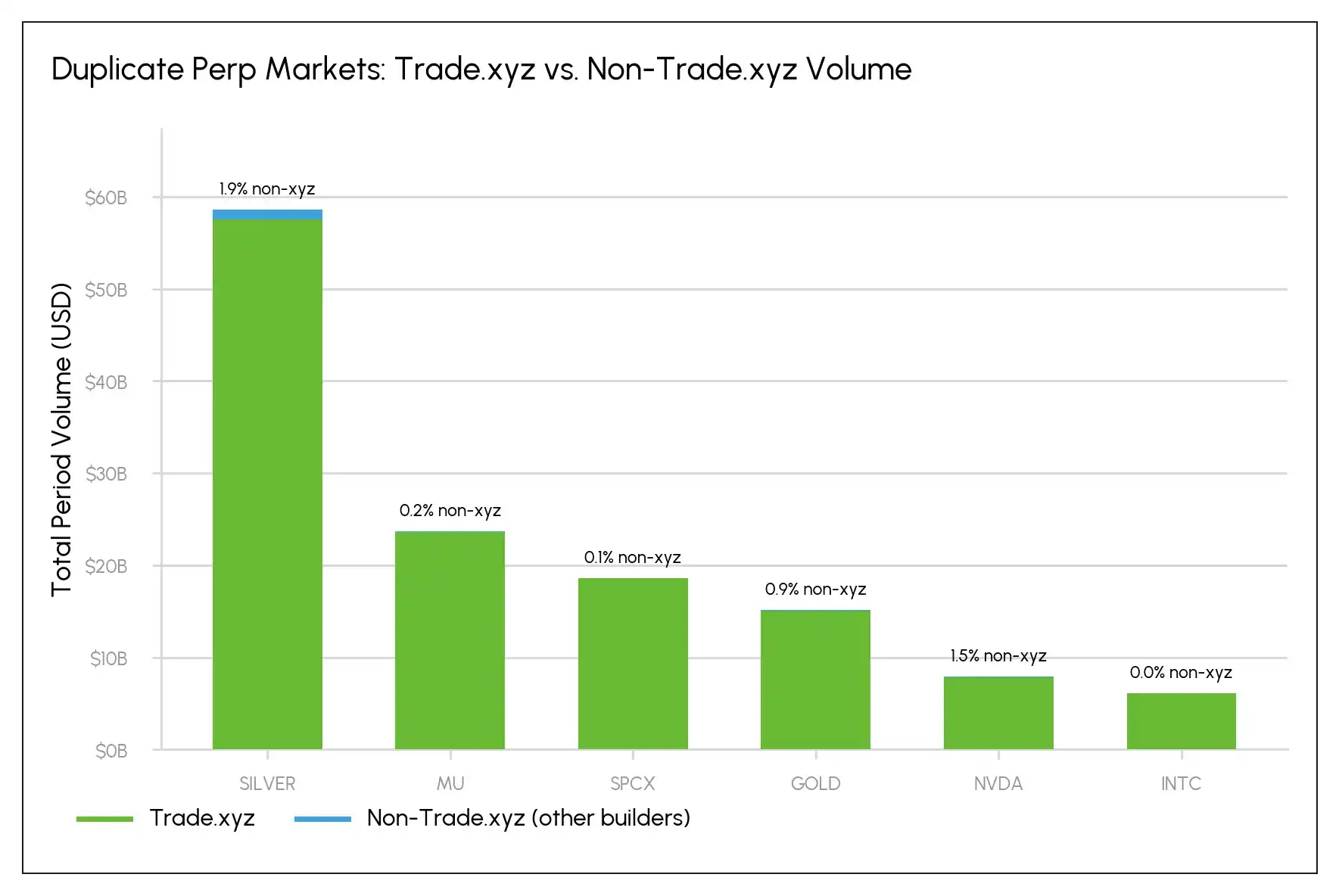
Builders can create duplicate markets, customizing leverage caps and oracles to offer traders alternative markets. However, in existing duplicate markets, Trade.xyz captures almost 100% of the volume. This forces smaller builders to differentiate through niche perpetual markets not yet listed by Trade.xyz.

A Deeper Look at Individual Markets

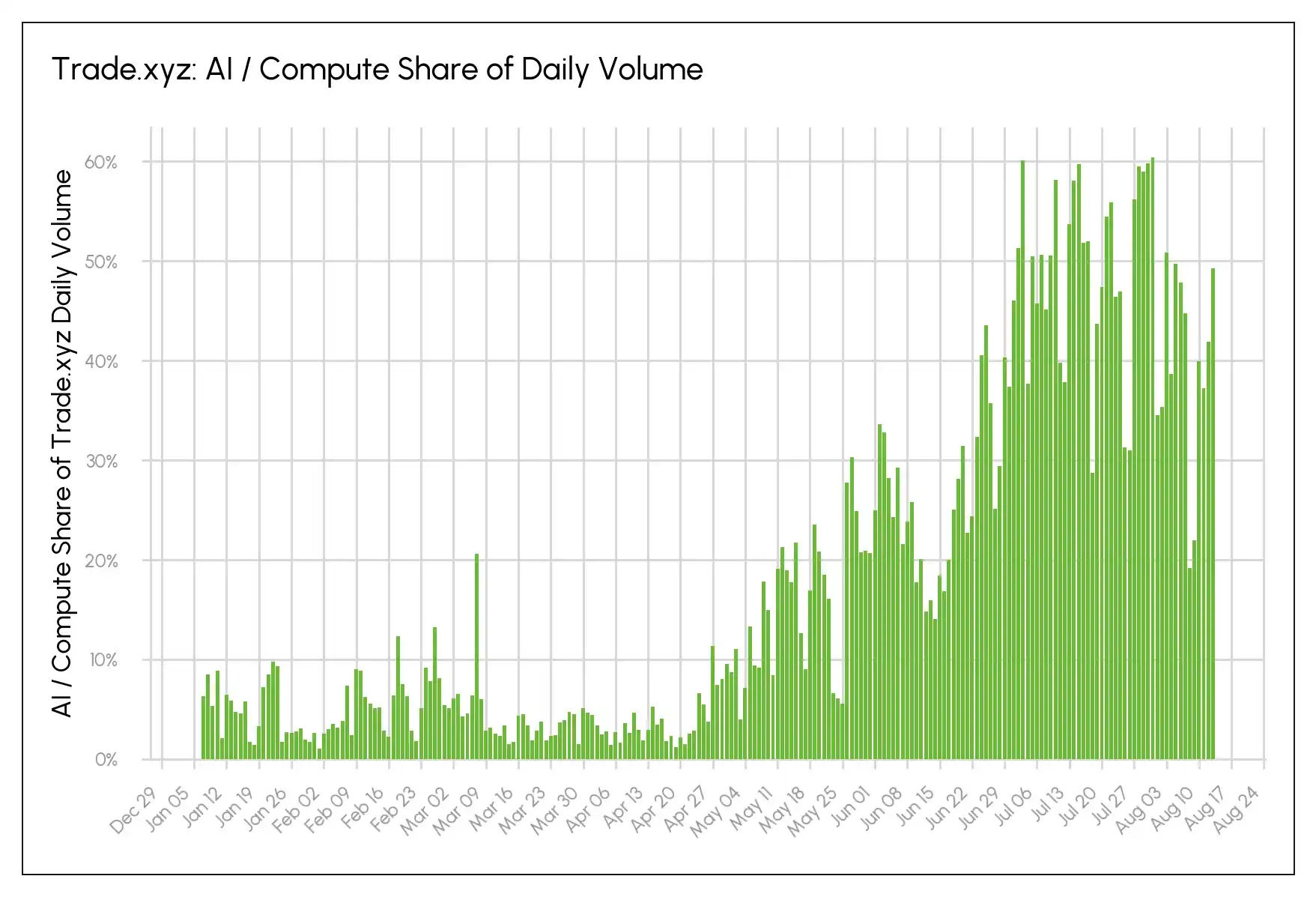
Trade.xyz focuses on adding stock and commodity perpetual markets. Both Hyperliquid and Trade.xyz have captured one of the hottest narratives currently—AI/compute trading. As traders explore the commoditization of compute costs and build yield curves, Trade.xyz supports various perpetual contracts related to AI companies and industry benchmarks.
A basket of perpetual contracts for AI hyperscalers and chipmakers has taken off on Trade.xyz, contributing over 53% of its daily volume in July. SK Hynix and Micron markets each contributed over 20% of this basket's volume. SanDisk, the DRAM Index, and NVDA were the next most traded markets within the AI/compute narrative.

Although AI/compute trading has garnered recent attention, examining Trade.xyz's daily top markets helps illustrate the popularity of perpetual contracts, especially for traditional finance investments.
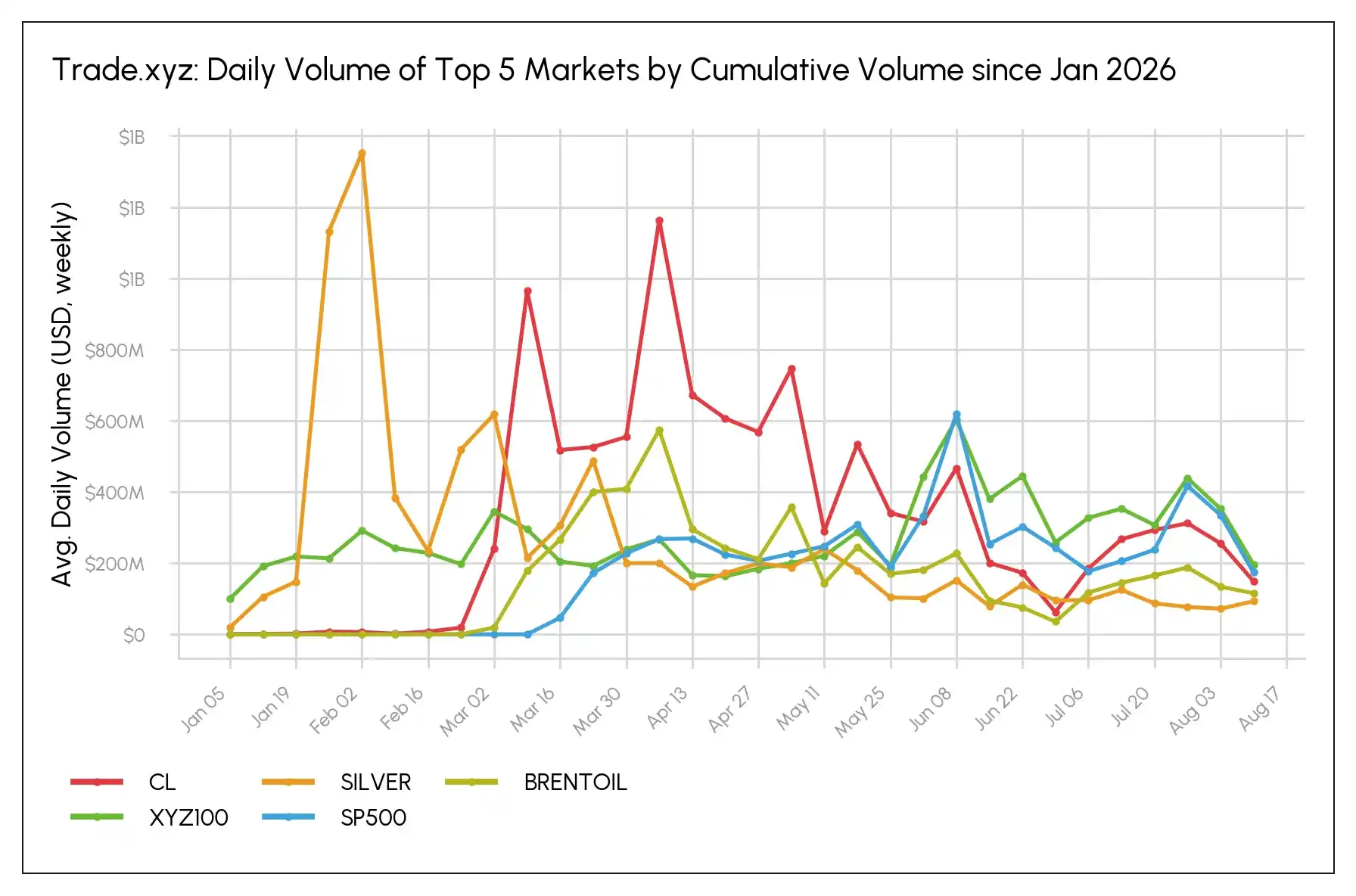
Since January, Crude Oil, Silver, Brent Crude, the Nasdaq 100 alternative, and the S&P 500 contract have been the top five perpetual contracts on Trade.xyz by cumulative volume. Despite previous high concentration, traders can react to events via 24/7 markets. After-hours and weekend volume spikes can occur in markets like Crude Oil due to geopolitical tensions. In August, these markets accounted for about 30% of Trade.xyz's total volume, down from a peak of 88%, indicating traders are diversifying their attention to newly listed markets on Trade.xyz.
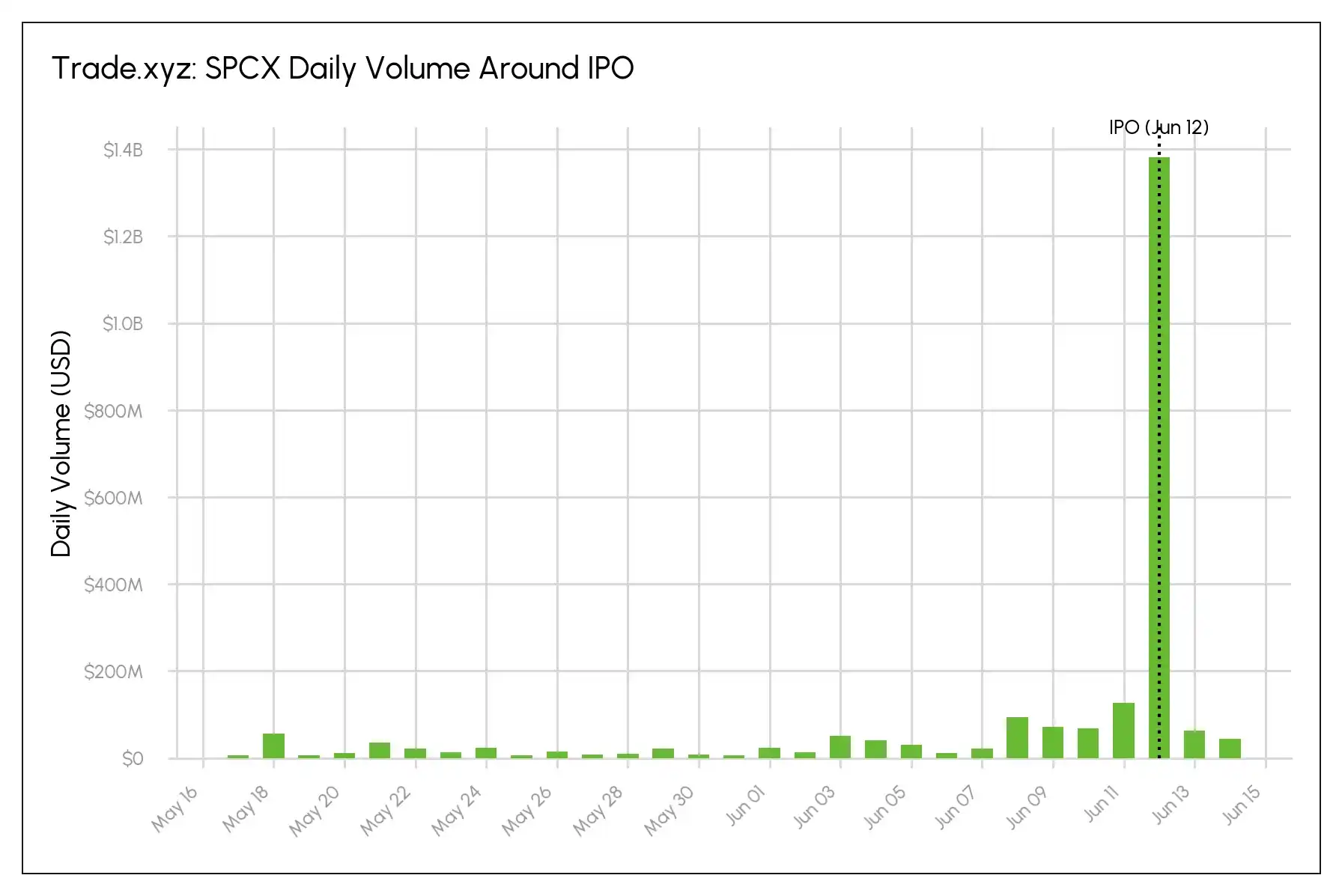
The development of pre-IPO stock perpetuals also offers significant upside. The SPCX IPO generated over $1.3 billion in volume on Trade.xyz as traders speculated on the company's valuation. Trade.xyz's ability to quickly list markets allows it to capture short-term opportunities and generate substantial fees for itself and Hyperliquid.

How Fees Are Generated and How They Affect HYPE

Hyperliquid charges double the standard maker and taker fees for perpetual markets not operated by validators. Currently, Trade.xyz is in a growth mode, encouraging platform adoption by reducing fees by over 90%.

Trade.xyz generated $5 million in fees over the past month. These fees are split 50/50 with Hyperliquid, which primarily uses the funds to repurchase and burn HYPE tokens.
Since January 2026, we've observed a weak positive correlation between the HYPE token price and Hyperliquid's total trading volume. HYPE's value capture is becoming increasingly diversified. The growth of prediction markets, pre-IPO perpetuals, and revenue from USDC reserves all contribute to the valuation of HYPE and the Hyperliquid ecosystem.

Hyperliquid's Aligned Quote Asset (AQAv2) provides additional revenue. For all outstanding USDC on Hyperliquid, Circle shares 90% of the income generated from underlying investments with Hyperliquid. As more perpetual markets are deployed with USDC as the quote asset, Hyperliquid will earn more revenue for HYPE buybacks.

Trade.xyz is the leading HIP-3 builder in terms of open interest and trading volume. Over the past month, most perpetual trading volume has shifted from Hyperliquid's native markets to those listed by Trade.xyz. This is attributed to the markets available on Trade.xyz and hot trends—the AI/compute narrative, geopolitical tensions, and pre-IPO valuation exposure.

If Trade.xyz exits its growth mode, higher realized fee rates could increase fee revenue and potential HYPE buybacks. A resurgence in crypto perpetual activity could provide an additional source of volume. Hyperliquid and Trade.xyz continuing to offer services and integrations beneficial to the ecosystem can bring more value to the HYPE token. Trade.xyz is attracting an increasing number of users to participate in traditional finance investments through 24/7 markets.


Trending Cryptos

Related Questions

QAccording to the article, how has the HIP-3 upgrade changed the process for launching perpetual futures markets on Hyperliquid?

AThe HIP-3 upgrade has changed the process from one requiring approval by Hyperliquid validators to a permissionless system. Builders can now deploy perpetual markets by staking 500,000 HYPE and participating in Dutch auctions to win the right to deploy additional markets.

QWhat percentage of Hyperliquid's total market trading volume did Trade.xyz capture in August?

AIn August, Trade.xyz captured approximately 55% of Hyperliquid's total perpetual market trading volume.

QWhat was a major thematic focus of Trade.xyz's trading volume in July, and what percentage did it constitute?

AIn July, trading related to AI and computing power stocks and indices was a major focus on Trade.xyz, constituting approximately 53% of its total trading volume.

QHow are the fees generated by Trade.xyz's markets distributed, and what is the primary use of Hyperliquid's share?

AThe fees generated by Trade.xyz's markets are split 50/50 with Hyperliquid. Hyperliquid primarily uses its share of the revenue to repurchase and burn HYPE tokens from the open market.

QBesides trading fees, what is another revenue source mentioned for Hyperliquid related to its stablecoin usage?

AAnother revenue source is the Aligned Quote Asset (AQAv2) program. Circle shares 90% of the revenue earned from the underlying investments of all outstanding USDC on Hyperliquid with the protocol.

Related Reads

Why Didn't Oil Prices Stabilize Above $100 as Traffic Through the Strait of Hormuz Plunged Again?

Despite a significant drop in daily oil tanker traffic through the critical Strait of Hormuz in August, Brent crude oil prices have failed to stabilize above $100 per barrel, instead hovering around $90. This contrasts with traditional market logic, where a threat to a chokepoint handling roughly 20 million barrels per day (27% of global seaborne oil) should trigger a sustained supply risk premium. The article explains that the market is pricing in increased transit costs rather than an imminent, complete supply cutoff. Investors currently believe multiple buffers can absorb the shock: strategic and commercial inventories, the potential for coordinated stock releases, available OPEC+ spare capacity, and alternative export routes from the Gulf. Furthermore, workarounds like ship-to-ship transfers outside the Strait and route adjustments by buyers and shippers add resilience, though at a higher cost for insurance, financing, and longer voyages. The underlying U.S.-Iran tensions frame this reassessment as a problem of cost allocation across the supply chain. The price action suggests traders are awaiting clearer signals—such as a military escalation, sustained Iranian attacks, or stricter enforcement of secondary sanctions on buyers—before pricing in a worst-case, long-term disruption scenario. In the longer term, the episode is accelerating investments to reduce dependency on the Strait, such as expanded storage and pipeline infrastructure, which will embed higher costs into the energy system. While Brent may remain range-bound for now, the real-time impact of the Hormuz risk is likely appearing first in freight rates, insurance premiums, and regional product spreads like diesel crack margins. The stability of current prices depends on how much longer these existing buffers can effectively absorb the mounting transit costs and logistical friction.

marsbit14m ago

Why Didn't Oil Prices Stabilize Above $100 as Traffic Through the Strait of Hormuz Plunged Again?

marsbit14m ago

BONK Crypto Treasury Company Has Only $2.14 Million Cash Left, 70% of Revenue Comes from Founder's Own Platform

BONK Inc. (BNKK), the NASDAQ-listed company associated with the Solana meme coin BONK, reported stark financials for the first half of the year. While revenue skyrocketed 6,218% year-over-year to $5.5 million, the company posted a net loss of $7.88 million and its cash reserves plummeted to just $214,000. Its auditors issued a "going concern" warning, citing cumulative losses of $191.4 million, negative operating cash flow, and critically low liquidity. A critical detail is that $3.92 million, or 71%, of its revenue came from an "affiliate revenue share" with LetsBonk.fun, a meme coin launchpad. This platform is linked to founder Mitchell Rudy, whose entity, Lucky Dog Holdings, beneficially owns approximately 40.2% of common stock and all C Series preferred shares. These preferred shares grant the holder the right to elect half of the company's board. The company's financial structure is further intertwined with Rudy; it sold $50 million worth of stock to his entities, accepting payment in BONK tokens. Fluctuations in the value of these and other held digital assets led to an $8.17 million unrealized loss, the primary driver of the net loss. With operating cash outflows of $4.17 million for the half-year, the remaining cash covers roughly nine days of operations at the current burn rate, highlighting severe financial strain despite top-line growth.

marsbit46m ago

BONK Crypto Treasury Company Has Only $2.14 Million Cash Left, 70% of Revenue Comes from Founder's Own Platform

marsbit46m ago

CryptoQuant Noted a Signal of a Bitcoin Reversal

CryptoQuant has highlighted a potential reversal signal for Bitcoin, suggesting the bearish phase might be nearing its end as on-chain metrics show initial signs of spot demand recovery. Their analysis indicates that the 30-day spot demand metric has recovered from -206,000 BTC in late July to approximately -5,000, close to turning positive for the first time since February 2026. Historically, such a reversal has been followed by a median 60-day price gain of 18.1%, with a win rate of 78% (increasing to 87% when valuations are depressed). However, they caution that this is a favorable sign, not a guarantee. Analysts from Bitfinex Alpha note that two of three conditions for a sustainable Bitcoin recovery are already met: improved Federal Reserve rate expectations and relatively accommodative financial conditions, thanks to easing inflation and reduced odds of a near-term rate hike. The missing third catalyst is a capital rotation from traditional markets (like stocks and AI infrastructure) into cryptocurrencies. If this occurs, Bitcoin could reclaim $70,000. Conversely, continued negative flows might see support tested around $57,000. Current headwinds include significant weekly outflows from US spot Bitcoin ETFs (roughly $385 million) and reduced stablecoin supply. Wintermute offers a more cautious outlook, pointing to the same large ETF outflows and ongoing miner selling pressure. They note that Bitcoin has failed to rally despite the improved Fed outlook, which is typically bullish for risk assets. As an example, they cite miner Riot Platforms, which sold a substantial portion of its Bitcoin reserves in Q2 as its mining cost (~$91,000 per BTC) remains far above the current market price, forcing sales for liquidity. This combination of ETF outflows and miner selling is suppressing new demand.

cryptonews.ru47m ago

CryptoQuant Noted a Signal of a Bitcoin Reversal

cryptonews.ru47m ago

Is a Strong Ruble Good? Not for the Budget: Treasury Already Short 1.5 Trillion

The Russian budget has lost about 1.5 trillion rubles in revenue since the start of 2026 due to the ruble being stronger than the government's planned exchange rate. The budget was based on an average annual rate of 92.2 rubles per US dollar, but the actual average for the first seven and a half months was just 76.9 rubles. This discrepancy creates a significant shortfall, as every ruble of appreciation against the dollar reduces annual budget revenues by 140–160 billion rubles. When accounting for oil and gas revenues, the sensitivity is even higher, with potential annual losses reaching up to 2.5 trillion rubles. So far this year, the budget has already missed out on roughly 1.7 trillion rubles. The ruble's exchange rate has shown considerable volatility in 2026, ranging from a low near 71 rubles per dollar in May to over 85 rubles by mid-August. Despite this recent weakening, the year's average remains well below the budget target, creating a structural deficit in oil and gas revenues. Forecasts suggest the final average rate for 2026 will be around 80–82 rubles, which would result in a budget shortfall of about 1.6 trillion rubles. A strong ruble reduces import costs and inflation but also cuts the ruble earnings of exporters and threatens the funding of social obligations. The gap between the planned and actual rate is attributed not only to oil price dynamics but also to the fiscal rule mechanism, which can influence the currency's direction. The Ministry of Finance recently halted foreign currency sales under this rule, removing dollar supply from the market and contributing to pressure on the exchange rate. The budget policy is now forced to adapt to a stronger ruble than originally planned.

cryptonews.ru48m ago

Is a Strong Ruble Good? Not for the Budget: Treasury Already Short 1.5 Trillion

cryptonews.ru48m ago

Trading

Spot

Hot Articles

How to Buy CHIP

Welcome to HTX.com! We've made purchasing USD.AI (CHIP) simple and convenient. Follow our step-by-step guide to embark on your crypto journey.Step 1: Create Your HTX AccountUse your email or phone number to sign up for a free account on HTX. Experience a hassle-free registration journey and unlock all features.Get My AccountStep 2: Go to Buy Crypto and Choose Your Payment MethodCredit/Debit Card: Use your Visa or Mastercard to buy USD.AI (CHIP) instantly.Balance: Use funds from your HTX account balance to trade seamlessly.Third Parties: We've added popular payment methods such as Google Pay and Apple Pay to enhance convenience.P2P: Trade directly with other users on HTX.Over-the-Counter (OTC): We offer tailor-made services and competitive exchange rates for traders.Step 3: Store Your USD.AI (CHIP)After purchasing your USD.AI (CHIP), store it in your HTX account. Alternatively, you can send it elsewhere via blockchain transfer or use it to trade other cryptocurrencies.Step 4: Trade USD.AI (CHIP)Easily trade USD.AI (CHIP) on HTX's spot market. Simply access your account, select your trading pair, execute your trades, and monitor in real-time. We offer a user-friendly experience for both beginners and seasoned traders.

4.4k Total ViewsPublished 2026.04.21Updated 2026.06.02

How to Buy CHIP

Discussions

Welcome to the HTX Community. Here, you can stay informed about the latest platform developments and gain access to professional market insights. Users' opinions on the price of CHIP (CHIP) are presented below.

活动图片