# Strategy Related Articles

HTX News Center provides the latest articles and in-depth analysis on "Strategy", covering market trends, project updates, tech developments, and regulatory policies in the crypto industry.

Bitcoin Short-Term Bullish Structure Validated, HYPE Accumulation Window Opens | Guest Analysis

**Bitcoin and HYPE Market Analysis: Short-Term Outlook and Trading Strategies** This market analysis examines Bitcoin (BTC) and HYPE amid volatile conditions, providing short-term outlooks and specific trading strategies. **Key Outlooks:** * **Bitcoin (BTC):** Focus is on whether BTC's recent move above $65,000 holds. A successful breakout could lead to a test of the $69,500-$70,500 resistance zone, where medium-term short positions are considered. A failure, breaking below $65,000, may trigger a decline towards the $59,000-$60,000 support area. * **HYPE:** The token completed a four-wave correction and is now rebounding. The key resistance zone is $62.5-$64.57. The trading strategy is "buy on dips," looking for entry opportunities near the $52-$54.5 or deeper $47-$49 support zones, pending confirmation from proprietary models. **BTC Trading Strategy:** * **Medium-term:** Primarily looking to establish short positions (up to 60% allocated capital) if price rallies to the $69,500-$70,500 resistance area and shows signs of reversal. Alternative plans involve initiating shorts on a breakdown below $65,000. * **Short-term:** Allocate up to 30% capital for intraday "spread" trades based on support/resistance levels on 30/60-minute charts. **HYPE Trading Strategy:** * **Short-term:** Adopt a dip-buying approach. Consider light long positions (under 30% capital) when price tests key support levels ($52-$54.5 or $47-$49) and shows stabilization, confirmed by proprietary "Price Spread" and "Momentum Quant" models. **Trade Recap:** The analysis reviews a successful HYPE long trade from the previous week, executed at ~$54.39 and closed at ~$60.85 for an ~11.88% gain, based on signals from the aforementioned models. **Risk Management Emphasis:** The article stresses strict capital allocation (under 30-60%), immediate initial stop-loss placement, and a trailing stop-loss protocol to lock in profits as trades move favorably. ***Disclaimer:** All analysis, models, and strategies are for educational purposes based on technical analysis, not investment advice. Markets are volatile; trade with caution.*

marsbit06/15 06:24

Bitcoin Short-Term Bullish Structure Validated, HYPE Accumulation Window Opens | Guest Analysis

marsbit06/15 06:24

Alibaba's Yet Another New Business Division: What Signal Does It Send?

Alibaba has established a new "Token Foundry" business unit, merging its Tongyi large model division and Future Life Lab. Led directly by Group CEO Wu Yongming, this marks the company's third significant AI organizational reshuffle in 2026, following the creation of the Alibaba Token Hub (ATH) and a Group Technology Committee. The move signals a strategic shift from consolidating AI resources to accelerating productization and commercialization. The "Token Foundry" name reflects Alibaba's ambition to become a foundational supplier in the AI era, focusing on model development and commercial application. Key teams, including those behind the high-performing HappyHorse video generation model, have been integrated into the new unit. Concurrently, Zhou Jingren, architect of the Qwen model series, has been appointed Group Chief Scientist to lead a new AI Future Research Institute, focusing on long-term technological breakthroughs like Agent capabilities. This restructuring creates a clear four-layer AI architecture within Alibaba: the research institute for frontier exploration, Token Foundry for core models and commercialization, MaaS for platform services, and business units like Qianwen (C端) and Wukong (B端) for end-user applications. The adjustments align with a global trend among tech giants like Google and Microsoft to centralize AI leadership under the CEO and deeply integrate research with business units. The urgency is driven by a narrowing competitive window. Alibaba has announced its AI business is now entering a commercialization phase, with AI-related revenue seeing triple-digit growth for eleven consecutive quarters. The company faces intense competition in the MaaS (Model-as-a-Service) sector from rivals like ByteDance and Tencent. The Token Foundry initiative represents Alibaba's effort to streamline execution and enhance competitiveness in this critical, fast-evolving landscape.

marsbit06/11 10:36

Alibaba's Yet Another New Business Division: What Signal Does It Send?

marsbit06/11 10:36

From Return to Resignation: Chen Hang's 437 Days at DingTalk

The 437-Day Return and Departure of Chen Hang at DingTalk This article chronicles the 437-day period from March 31, 2025, to June 11, 2026, when Chen Hang (also known as "No Move") returned as CEO of DingTalk, the enterprise communication platform he originally founded, only to later step down. Chen Hang, the creator of DingTalk in 2015, was brought back by Alibaba in 2025 after the company acquired his subsequent startup, HHO. His return was driven by Alibaba's renewed focus on AI and DingTalk's strategic role as its key to-B AI application. However, his aggressive management style, marked by strict work policies like mandatory clock-ins and extended hours, quickly caused internal friction and was criticized as being at odds with Alibaba's culture. Despite the internal turmoil, Chen Hang drove significant product launches. In August 2025, he unveiled "AI DingTalk 1.0," featuring new products like the AI-native entry point "DingTalk ONE." By March 2026, he announced "Wukong," touted as the world's first enterprise-grade AI-native work platform, representing a fundamental rebuild of DingTalk's architecture. The turning point came in early June 2026. A detailed internal post criticizing DingTalk's work culture went viral, followed by a public critique from a former executive. This prompted an unprecedented public rebuke from the Alibaba Partners Committee, which stated such management was not aligned with company values. One day later, on June 11, Alibaba announced Chen Hang's departure. He was succeeded by Chen Yusen, a 32-year-old technical expert known for founding cybersecurity firm Changting Technology. While Chen Hang's tenure laid the technical foundation for DingTalk's AI transformation with "Wukong," his leadership style ultimately led to his replacement as the company seeks a new direction under younger leadership.

marsbit06/11 10:23

From Return to Resignation: Chen Hang's 437 Days at DingTalk

marsbit06/11 10:23

Doubao Charges More than GPT, While DeepSeek Slashes Prices Dramatically: Who Will Win?

The article discusses the divergent pricing strategies of two major Chinese AI companies. In May, Doubao (by ByteDance) began testing fees, with its professional tier priced higher than ChatGPT Plus. Meanwhile, DeepSeek permanently cut prices for its V4-Pro API to a quarter of the original, setting new global lows. Doubao, with high user traffic from ByteDance apps like TikTok, leads in monthly active users but faces massive compute costs from its free model. Its move to a freemium model targets heavy users, aiming to balance scale and monetization amid substantial investments. DeepSeek's price cut is attributed to architectural innovations that slash inference costs, adaptation to domestic hardware reducing dependency, and engineering optimizations. It focuses on the enterprise (B2B) market, aiming to become a leading model base. Both companies are currently unprofitable. The article contrasts their approaches with Anthropic, which is profitable by primarily serving enterprises with high-value use cases like coding and agents. It argues that sustainable AI business models require integrating AI into real workflows to deliver tangible ROI, rather than just offering chat services. DeepSeek's recent $7 billion funding round, including investments from Tencent, is noted to bolster its B2B position. The ultimate winner will be the player that successfully transforms AI into measurable returns, whether through consumer productivity ecosystems or enterprise platforms.

marsbit06/11 06:23

Doubao Charges More than GPT, While DeepSeek Slashes Prices Dramatically: Who Will Win?

marsbit06/11 06:23

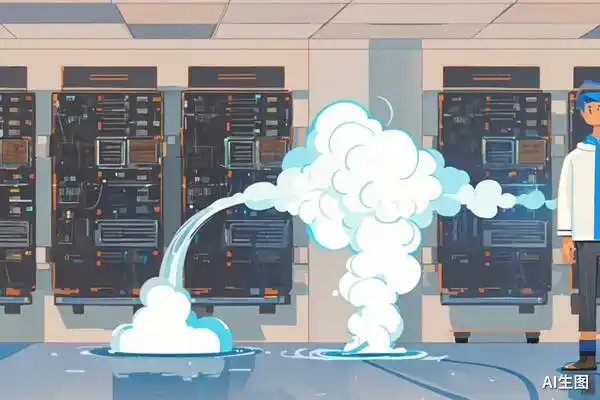
Behind Musk and Huang Jen-hsun's 'AI Factories', an Unseen Battle for Freshwater Has Begun

Behind the "AI factories" of Elon Musk and Jensen Huang lies a hidden battle for a critical resource: fresh water. As AI models like ChatGPT and Claude process billions of prompts daily, they consume vast amounts of water for cooling. By 2030, global AI infrastructure is projected to use 9.3 trillion liters annually—enough to meet the basic needs of 1.3 billion people. This "water grab" stems from the massive heat generated by high-powered GPUs. Over 70% of data centers use evaporative cooling systems, where water absorbs heat and evaporates into the atmosphere, depleting local groundwater. Training models like GPT-4 can consume over 600 million liters of water. Tech giants like Google and Microsoft report skyrocketing water usage, sparking conflicts with local communities over resources. A flashpoint occurred in Memphis, Tennessee, where Musk's xAI built the Colossus supercomputer. It draws nearly 3.8 million liters of drinking water daily from local aquifers, leading to public outrage and legal action. In response, xAI is building an $80 million water recycling plant to use treated wastewater instead. Facing pressure, companies like Microsoft promote "waterless" closed-loop cooling systems. However, these systems increase electricity consumption by 20-30%, shifting the water burden to power plants, which require immense cooling water themselves—a case of indirect water footprint transfer. For China's AI industry, this crisis offers a strategic warning and opportunity. Instead of replicating the West's resource-intensive model, China can leverage its "East Data, West Computing" policy to locate data centers in cooler, water-rich regions like Guizhou. Furthermore, developing lightweight edge computing for smart homes and embodied AI robots can drastically reduce the need for constant cloud queries, cutting both water and energy consumption at the source. The freshwater war underscores a fundamental question: Will AI be a tool for human advancement or a silicon-based monster competing for our planet's last drops of clean water? The answer is becoming clearer as the water vapor rises.

marsbit06/11 05:23

Behind Musk and Huang Jen-hsun's 'AI Factories', an Unseen Battle for Freshwater Has Begun

marsbit06/11 05:23

BIT Weekly Market Outlook: Highs Halved, Panic Doubled. The $60,000 Line is the Sole Lifeline

BIT Market Weekly: Halving from the Peak, Doubling Panic. $60K is the Sole Lifeline. The crypto market faces intense pressure from multiple fronts. MicroStrategy's symbolic sale of 32 BTC, its first since December 2022, shattered its "only accumulate" mantra, triggering panic and significant whale selling (~25,000 BTC). This pushed Bitcoin below MicroStrategy's average cost basis, causing unrealized losses. Bearish momentum intensified as spot Bitcoin ETFs saw a record 13-day net outflow streak, with $4.4 billion exiting, led by BlackRock's IBIT. Concurrently, macro risks mounted: sticky inflation dampened rate cut hopes, Mt.Gox wallet movements stoked sell-off fears, and renewed Middle East tensions added uncertainty. Derivatives data reveals a market at a critical juncture. Short-term options show extreme panic (negative Skew), but forward-term Skew has turned positive, signaling institutional expectations for a recovery in 3-6 months. Most notably, institutional activity shifted from defensive hedging to opportunistic bottom-fishing. They are selling puts and buying calls around the $60,000 level, effectively using options to establish controlled long positions. The $60,000 level is now the core battleground, hosting the largest concentration of put options open interest. It represents a binary outcome for the market. Holding above it could provide a base for stabilization, while a break below risks a swift decline toward the next major support at $55,000. Given the high uncertainty ahead of key CPI data and the FOMC meeting, the primary recommendation is risk management via Collar strategies to cap downside. For accumulation, structured products like DCPs or Bullish Seagulls can be deployed in batches near $60,000, mimicking institutional "selling puts to accumulate" logic. While volatility selling appears attractive as Implied Volatility shows topping signals, it's advised only with defined-risk spreads until $60,000 support is confirmed. Current levels are unsuitable for large-scale profit-taking; holding core positions with hedges is preferred.

marsbit06/10 07:26
BIT Weekly Market Outlook: Highs Halved, Panic Doubled. The $60,000 Line is the Sole Lifeline

marsbit06/10 07:26

活动图片