# Revenue Related Articles

HTX News Center provides the latest articles and in-depth analysis on "Revenue", covering market trends, project updates, tech developments, and regulatory policies in the crypto industry.

Building USDC by Its Own Hands, Why Does Coinbase Turn to Support Competitor OUSD?

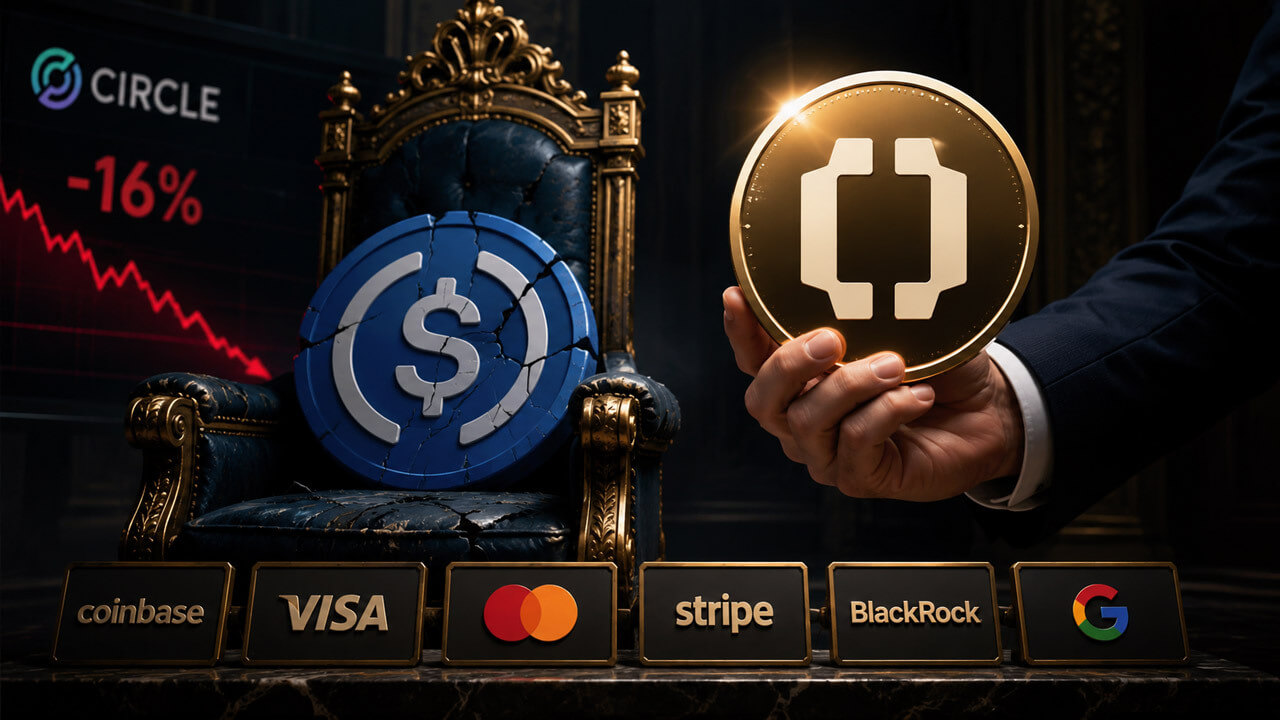
Coinbase, a key distributor of the dominant stablecoin USDC, has joined over 140 major companies—including Visa, Mastercard, and BlackRock—as a founding member of the Open USD (OUSD) alliance, a move that directly challenges the current stablecoin economic model. The new project aims to upend the established profit structure by offering zero minting and redemption fees and allocating the majority of reserve interest earnings to distribution partners, rather than the issuer. This shift highlights a growing power struggle in the $320+ billion stablecoin market, where platforms with massive user bases are demanding a larger share of the revenue generated from the underlying reserves. Circle, the issuer of USDC, saw its stock plummet 16% on the day of the OUSD announcement, reflecting investor concern over the potential strain on its crucial partnership with Coinbase. While Coinbase earned over $900 million from its USDC partnership in 2024, its support for a competing model gives it significant leverage as its revenue-sharing agreement with Circle nears expiration in August 2026. Circle CEO Jeremy Allaire defended the USDC model, emphasizing its decade-long development, deep liquidity, and extensive ecosystem integration, which he argues cannot be easily replicated by a large, potentially slow-moving consortium. He also questioned the sustainability of a zero-fee model and warned that diverting all reserve interest would leave issuers without funds for critical compliance and operational infrastructure. Analysts remain skeptical of OUSD's prospects, citing the "cold start" problem of building liquidity, potential governance challenges within a large alliance, and heightened regulatory scrutiny. The emergence of OUSD signals a broader industry bifurcation, where stablecoins are increasingly viewed as backend settlement tools. The core competition is shifting from technology to a direct negotiation over how profits from the network are distributed between issuers and the powerful distribution channels.

Foresight News07/03 03:58

Building USDC by Its Own Hands, Why Does Coinbase Turn to Support Competitor OUSD?

Foresight News07/03 03:58

From Pump.fun to Collector Crypt: Has Solana's Revenue Throne Changed Hands?

From Pump.fun to Collector Crypt: Is Solana’s Revenue Throne Changing Hands? Solana’s on-chain narrative is expanding from meme coins to tokenized trading cards. Previously, Pump.fun dominated consumer revenue on Solana. However, starting in Q2 2026, Pump.fun's quarterly revenue growth slowed, while Collector Crypt shows a stronger recent growth trajectory. Data indicates Pump.fun's Q1 revenue was $108.3M, dropping 36.1% to $69.2M in Q2 so far. Conversely, Collector Crypt's revenue grew 108.8%, from $12.3M in Q1 to $25.8M in Q2 to date, with recent weekly revenue hitting $5.1M. While Pump.fun remains larger in scale, Collector Crypt demonstrates stronger short-term momentum. Collector Crypt's model involves custodying graded physical trading cards, minting corresponding NFTs on Solana, and selling randomized packs. Revenue comes from pack sales, secondary market fees, and royalties. Its profitability, estimated around 4-5%, stems from bulk card purchases at a discount and a buyback system for users. However, a full-scale reversal in rankings hasn't occurred. Year-to-date, Pump.fun's revenue is ~$177.5M (with its ecosystem at ~$466.5M), vastly exceeding Collector Crypt's ~$38.1M. The shift is more about narrative and recent growth dynamics than total historical volume. Pump.fun relies on speculative token launches, while Collector Crypt focuses on collectibility, scarcity, and real-world asset backing. This highlights a broadening of Solana's consumer revenue sources beyond meme coins. The sustainability of Collector Crypt's growth depends on maintaining demand for randomized packs, expanding beyond Pokémon cards (currently dominant) into sports cards, and navigating potential regulatory scrutiny on "loot box" mechanics. In conclusion, Pump.fun remains the larger revenue engine, but Collector Crypt's rise signifies a diversification of Solana's consumer application revenue into tangible, collection-based scenarios alongside speculative meme coin activity.

链捕手07/02 09:15
From Pump.fun to Collector Crypt: Has Solana's Revenue Throne Changed Hands?

链捕手07/02 09:15

Grayscale: These 15 Profitable Crypto Protocols Are Severely Undervalued

Grayscale Research identifies 15 top-revenue crypto protocols trading at significant valuation discounts, with many at single-digit or even 1x revenue multiples. Protocols like Pump.fun, PancakeSwap, and Meteora have market capitalizations roughly equal to their annual revenue. The report argues these financially-focused protocols (DEXs, lending, staking) are fundamentally undervalued and could benefit from the potential passage of the CLARITY Act, expected as soon as next month. This legislation aims to clarify digital asset regulation, potentially reducing institutional barriers and driving on-chain activity. The analysis breaks down the protocols into three groups: the "1x Club" (market cap ≈ revenue), mid-tier protocols with 3-9x multiples (e.g., Aave, Lido, Jupiter), and high-multiple protocols like Hyperliquid (15x) and Uniswap (37x), where valuation reflects future potential rather than current cash flows. Grayscale applies a traditional DCF model to Aave, suggesting a one-year price target of ~$175, representing ~130% upside from current levels. The report notes a risk-off macro environment since the Iran conflict has further compressed valuations, creating a potential entry window. The conclusion highlights that while the valuation data presents an intriguing opportunity, the investment thesis is contingent on the CLARITY Act's passage and subsequent institutional capital flows. Investors are cautioned to consider Grayscale's inherent conflict of interest as a crypto asset manager with products tied to these assets.

marsbit06/25 10:01

Grayscale: These 15 Profitable Crypto Protocols Are Severely Undervalued

marsbit06/25 10:01

活动图片