In the past two years, LLMs have made rapid progress in "natural language to mathematical models" and "natural language to solver code." Models can understand problem statements, write MIP formulations, call Gurobi or other solvers, and appear to possess basic optimization modeling capabilities. However, this is far from sufficient for real-world, industrial-scale problems.
The true challenge is not simply translating constraints one by one into mathematical expressions, but designing algorithms that can run, run accurately, and run fast on large-scale instances. Even if an MIP model is perfectly correct, handing it to a general-purpose solver might fail to produce a high-quality solution with provable bounds within an hour. This is why real-world OR engineers still need to write decomposition algorithms, column generation, Benders, local search, meta-heuristics, and math-heuristic hybrid algorithms.
Recently, researchers from MIT and other institutions have proposed FrontierOR: an LLM evaluation benchmark focused on the capability to design large-scale optimization algorithms.
Unlike traditional benchmarks that only test "whether modeling is possible" or "whether a solver can be called," FrontierOR focuses on whether LLMs can, like real OR researchers and engineers, design scalable, high-quality, and efficient algorithms based on complex problem structures.

Paper link: arxiv.org/abs/2605.25246
Project homepage: frontieror.vercel.app
Code link: github.com/Minw913/FrontierOR
Dataset link: SmartOR/FrontierOR
The core question of FrontierOR is precisely: Can today's most powerful large models, starting from real-world problems, autonomously design efficient and competitive algorithms? Can they move beyond merely "calling solvers" and instead, like OR experts, choose decomposition, heuristic, search, and hybrid strategies based on problem structure?
The significance of this work lies in shifting the evaluation focus for LLM-for-OR from "can they write models" to "can they design algorithms." This is also a crucial threshold that large models must cross to be deployed in real industrial decision systems.
Research Background
Several benchmarks already focus on the modeling capabilities of LLMs for optimization problems, such as generating mathematical programs based on natural language problems, calling solvers, or verifying answers on small-scale instances. These tasks are very important, but they often fail to answer a question closer to industrial deployment: Can the model proactively create more effective algorithmic pathways on large-scale instances where solver performance has plateaued?
In operations research and optimization practice, general-purpose solvers are the starting point, not the endpoint. Real problems often have special structures: network flow structures, time decomposition structures, vehicle routing structures, inventory and routing coupling, machine and job coupling in scheduling, capacity and coverage coupling in location problems, and so on. Skilled algorithm engineers leverage these structures to decompose, approximate, relax, and recombine the original problem, then solve it using heuristic or exact hybrid methods.
Therefore, a truly OR-oriented large model benchmark must satisfy three conditions simultaneously: problems are realistic enough, instances are large enough, and evaluation is rigorous enough. FrontierOR is proposed in this context: it is not a set of "optimization exercises" for large models, but rather transforms complex, peer-reviewed problems from the OR literature of the past three decades into automatically evaluatable algorithm design tasks.
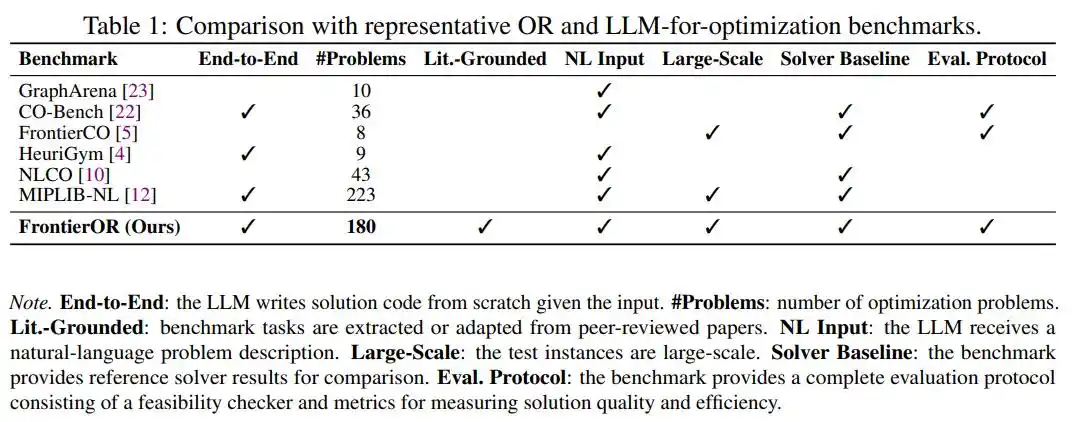
Table 1 Multidimensional comparison of FrontierOR with representative OR/LLM-for-optimization benchmarks
Research Method
The construction process of FrontierOR can be summarized in four steps: selecting problems from literature, transforming paper problems into standardized task components, undergoing both automatic and expert quality checks, and then screening for a more challenging Hard subset.
- Step 1: Selecting Real Problems from Literature. The data source covers 180 papers from over 20 OR journals spanning 1992–2025. Selected tasks require clear problem definitions, and the original papers must demonstrate the engineering value of specialized algorithms over general-purpose solvers.
- Step 2: Standardized Task Components. Each paper is transformed into a natural language problem description, mathematical model, Gurobi reference implementation, reference solutions, and an independent feasibility checker.
- Step 3: Two-Layer Quality Verification. First, automatic cross-validation checks consistency between Gurobi reference solutions and the feasibility checker. Subsequently, 15 OR experts conduct multiple rounds of review, verifying consistency among models, descriptions, code, and checkers.
- Step 4: Hard Subset Screening. From the 180 tasks, select the 50 most difficult ones, focusing on scenarios with combinatorial explosion, larger scale, tighter constraint coupling, and where Gurobi cannot prove optimality within a 1-hour budget.
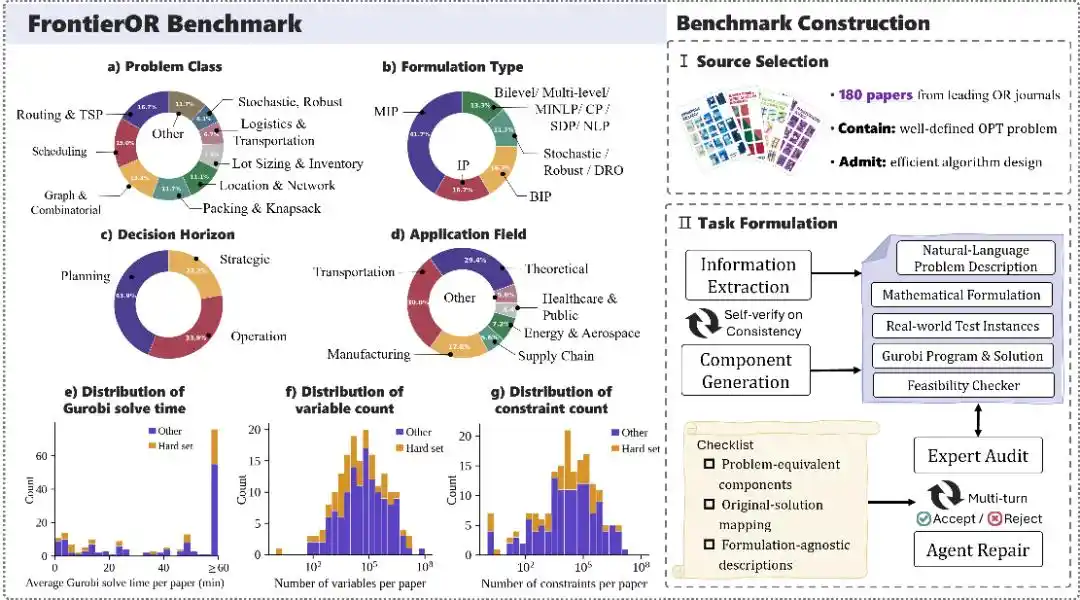
Figure 1 Overview of the FrontierOR benchmark: problem categories, application domains, instance sizes, and construction process
Evaluation Protocol
The evaluation process also emphasizes end-to-end capability. The model first generates a complete algorithm program based on the natural language task. The program undergoes a pre-screening on small instances for executability, feasibility, and quality: if it times out, is infeasible, or has a gap greater than 10% compared to Gurobi on small instances, it does not proceed to large-instance evaluation.
After passing pre-screening, the program runs on multiple large-scale instances per task and is compared against the expert-reviewed Gurobi reference solution. FrontierOR uses four metrics: Execution rate, Feasibility, Solution quality, and Quality-Time Efficiency (QTE). Among these, QTE is the strictest: only solutions with an objective value relative gap ≤1% to the Gurobi reference solution, or better than Gurobi's solution, are considered successful.
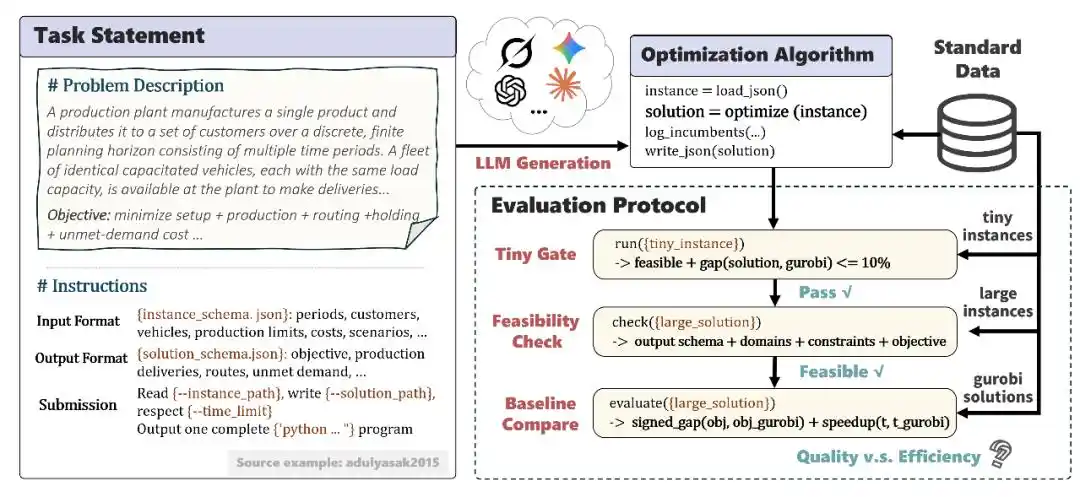
Figure 2 FrontierOR's two-stage evaluation process: small-instance pre-screening, large-instance assessment of quality and speed
Experimental Results
One-shot: Executability Approaches Upper Limit
In the one-shot setting, the model needs to generate a complete algorithm program from scratch. It can perform limited self-debugging based on execution errors but cannot iteratively rewrite the algorithm based on evaluation feedback. This setting tests the model's comprehensive ability to read, model, design algorithms, and code in a single attempt.
The results show that the strongest models already have very high executability. For example, GPT-5.3-Codex achieves an Execution rate of 0.98 on the Full set, while Gemini 3.1 Pro and Claude Opus 4.6 both reach 0.93. This indicates that for cutting-edge models, "whether the code can run" is no longer the main bottleneck.
But executability does not equal effective solving. Feasibility, Solution quality, and QTE remain significantly lower than Execution rate. In other words, large models can already generate formally complete optimization programs, but ensuring these programs remain feasible, near-optimal, and faster than Gurobi on industrial-scale problems remains difficult.
From an overall tiered perspective, frontier models significantly outperform other mainstream models on both the Full set and the Hard subset. On the full FrontierOR set, frontier models' Feasibility is concentrated around 0.60–0.62, while other mainstream models range from about 0.18 to 0.42. The gap persists on the Hard subset: frontier models score 0.49–0.64, while other mainstream models drop to 0.13–0.37.
The Hard subset further widens the algorithmic capability gap among frontier models. On the Full set, the QTE of the three frontier models falls within a narrow range of 0.25–0.31, seemingly close. But on the Hard subset, Claude Opus 4.6's QTE remains at 0.32, while GPT-5.3-Codex drops to 0.18—a difference of nearly 2x. Thus, the Hard subset becomes the true "watershed for algorithm engineering capability."
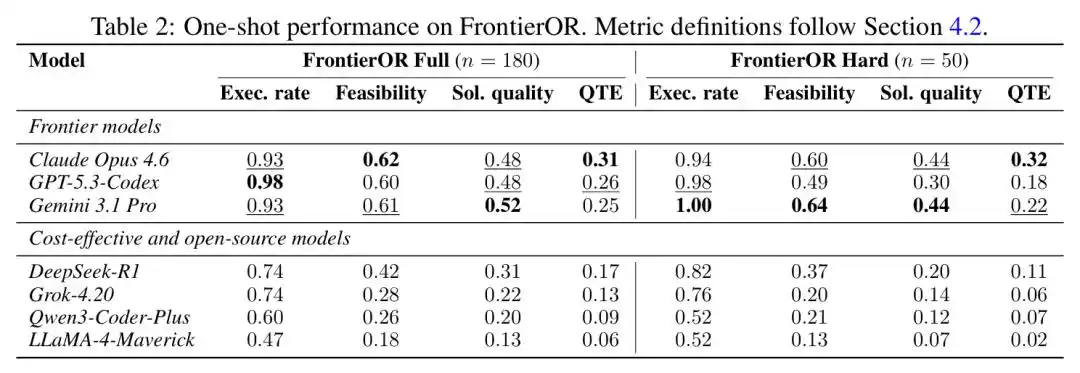
Table 2 FrontierOR one-shot evaluation results: Execution rate, Feasibility, Solution quality, and QTE on the Full set and Hard subset
Algorithm Selection Diverges
The research team further analyzed the solving methods employed by the model-generated programs, categorizing them into five types: pure solver calls, decomposition, constructive heuristics, local search/meta-heuristics, and math-heuristic hybrid methods. This analysis is crucial as it directly reveals whether the model truly possesses algorithm design awareness.
The results show that weaker models heavily rely on pure solver calls. For example, about 99% of LLaMA-4-Maverick's programs are monolithic solver calls, essentially throwing the problem at a general-purpose solver. In contrast, Claude Opus 4.6's method distribution is the most balanced: approximately 37% pure solver, 27% local search/meta-heuristics, and 27% math-heuristic hybrid.
More importantly, non-pure-solver methods generally have an advantage in the QTE metric. This means "method diversity" itself is a competitive edge: the more a model can choose decomposition, heuristic, and hybrid algorithms based on problem structure, the more likely it is to achieve both quality and speed on large instances.
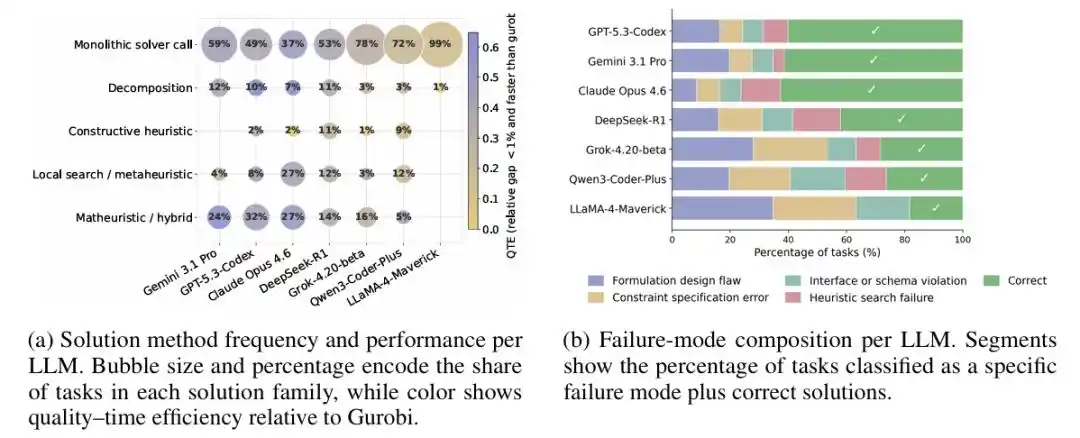
Figure 3 Distribution of solving methods and failure mode analysis for programs generated by different models
Failure Mode Shift: From "Cannot Model" to "Insufficient Search Depth"
Failure mode analysis shows that as model capability improves, the location of errors is systematically shifting later in the process. Weaker models mainly make errors in early-stage aspects like mathematical model design, constraint specification, and I/O schema. Stronger models show significantly fewer errors in these foundational areas, with new bottlenecks shifting to the depth and quality of heuristic search.
This is very similar to the learning path of a human algorithm engineer. Beginners first make modeling errors: unclear variable definitions, missing constraints, input/output mismatches. More experienced engineers are less prone to these basic errors but face harder problems: whether the search strategy is strong enough, whether neighborhood design is effective, whether relaxation and repair can balance speed and quality.
Therefore, FrontierOR not only tells us "who scores higher," but also "where the capability bottlenecks are." This is especially important for designing next-generation LLM-for-OR systems: future breakthroughs may not come from models better at writing formulas, but from systems better at search, better at combining algorithmic skills, and better at using feedback for self-improvement.
Self-Evolution
A single generation is only the first step. In reality, algorithm design is never a one-shot, final-draft process, but an iterative cycle of running, analyzing failure, modifying strategies, and running again. FrontierOR therefore further evaluates three test-time self-evolution frameworks: OpenEvolve, EoH, and CORAL.
The experiment selected the hardest 40% of tasks from the Hard subset as the self-evolve test set, using GPT-5.3-Codex's one-shot generated program as the initial seed. Each framework was uniformly limited to 30 candidate programs, with the final best result taken as the terminal state. This ensures differences stem primarily from the search mechanism, not from different initial programs.
The results are impressive: under all three self-evolution frameworks, the optimal candidate program significantly outperforms the one-shot generation across all metrics. QTE increased from the one-shot score of 0.15 to a maximum of 0.50. This means that on the most difficult tasks, about half of the large instances can now be solved by LLM-generated algorithms that simultaneously satisfy the conditions of "quality close to Gurobi" and "speed not slower than Gurobi."
Among them, CORAL, leveraging a multi-agent shared memory mechanism, achieved the most stable improvement with a QTE of 0.50; OpenEvolve followed closely with a QTE of 0.49; EoH also brought significant improvement, albeit with more performance fluctuation and a QTE of 0.33.
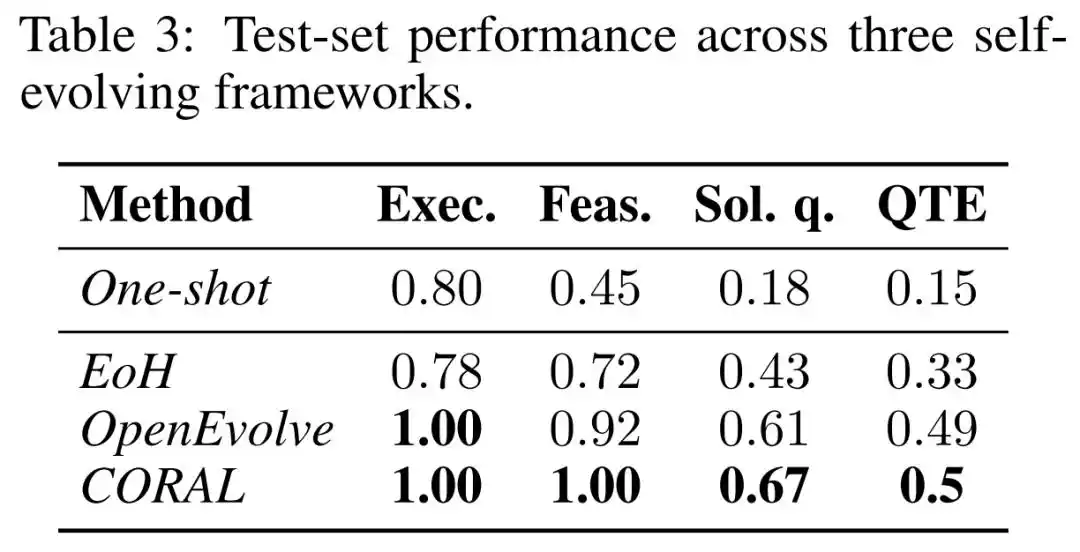
Table 3 Performance of three test-time self-evolution frameworks on the hardest tasks: QTE increased from 0.15 to a maximum of 0.50
Observing the evolution trajectories reveals an insightful phenomenon: the speed dimension often breaks through the Gurobi baseline within the first 5 attempts, while the solution quality dimension is much more difficult. The reason is understandable: making an algorithm faster can be achieved by adopting lightweight constructive heuristics; but achieving near-global optimality *while* being faster requires more refined neighborhoods, repair strategies, relaxation strategies, and search control.
This indicates that LLM self-evolution is not simply "trying the code a few more times." Truly effective self-evolution needs to remember historical failures, identify performance bottlenecks, dynamically adjust search directions, and make structured trade-offs between speed and quality.
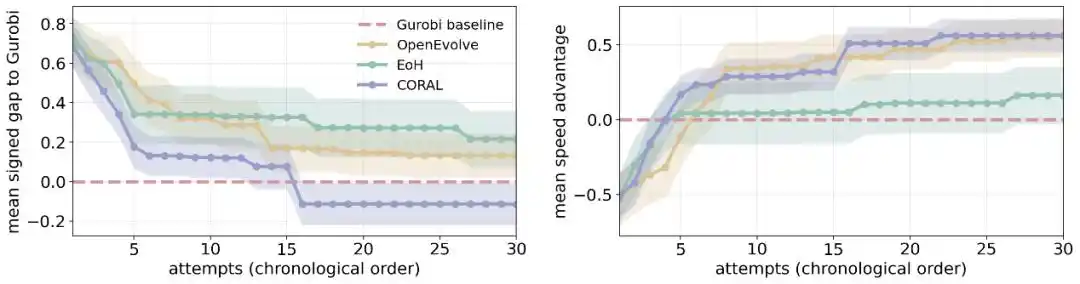
Figure 4 Quality-Speed two-dimensional evolution trajectories of the three self-evolution frameworks: speed is easier to break through first, quality improvement is harder
Future Applications
The value of FrontierOR extends beyond ranking models; it provides clear R&D directions for next-generation intelligent optimization systems. If large models can stably comprehend real business needs, identify optimization structures, invoke or combine appropriate algorithmic skills, and self-improve through execution feedback, they have the potential to become the "AI Algorithm Engineer" within industrial decision systems.
In supply chain scenarios, such a system could automatically generate scheduling and routing algorithms tailored to specific scales based on orders, warehouses, inventory, transportation networks, and time requirements. In energy systems, it could design fast approximate solving strategies for grid dispatch, energy storage management, and load balancing. In transportation and urban systems, it could generate optimization algorithms for real-time deployment considering dynamic demand, congestion propagation, and resource constraints.
Furthermore, FrontierOR hints at the future form of agentic optimization: the LLM is no longer just a code generator, but an algorithm design agent that can use a skill library, call verifiers, run experiments, perform error attribution, and actively explore within a limited budget.
Outlook
- Build an OR Algorithm Design Skill Library. Precipitate common strategies like decomposition, relaxation, column generation, local search, repair, restart, and hybrid solving into retrievable, composable, executable skill modules, enabling agents to automatically select algorithm templates based on problem structure.
- Develop More Reliable Verifiers/Evaluators. Evaluators should not only check feasibility but also identify which type of constraints cause failure or which local search stagnates, thereby transforming execution feedback into directions for the next design round.
- Enhance Budget Scheduling Capability for Self-Evolution. On large-scale instances, each evaluation is expensive. Future systems need to learn when to explore new structures, when to fine-tune parameters, and when to terminate ineffective directions.
- Promote Deep Integration of LLMs and Traditional Optimizers. The most promising direction may not be "LLMs replacing solvers," but rather LLMs responsible for discovering structures and designing algorithms, while traditional solvers handle local exact optimization and trustworthy verification.
In summary, FrontierOR has drawn the first systematic map of large models' OR algorithm engineering capability: large models can already write some competitive optimization algorithms, but what truly determines the upper limit is no longer code syntax or formula translation, but rather structure discovery, search design, and self-evolution capabilities.
If the previous phase of LLM-for-OR research answered "Can large models model?," then FrontierOR begins to ask a harder and more realistic question: Can large models become true algorithm designers?
Reference materials: arxiv.org/abs/2605.25246
This article is from the WeChat public account "新智元", author: 新智元; editor: LRST