# Blockchain Related Articles

HTX News Center provides the latest articles and in-depth analysis on "Blockchain", covering market trends, project updates, tech developments, and regulatory policies in the crypto industry.

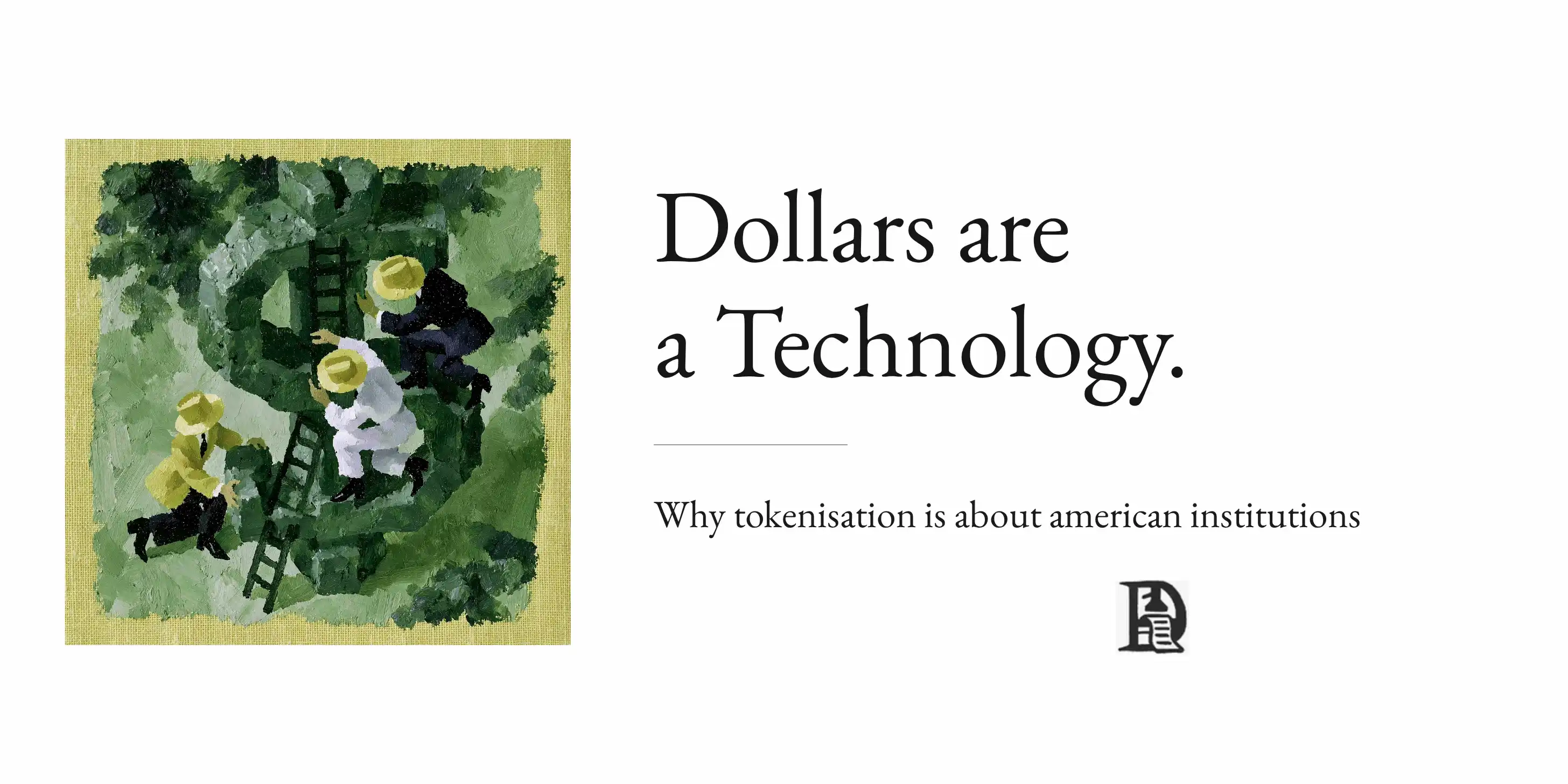
The Dollar is a Technology: Stablecoins Are Exporting U.S. Institutions to the World

This article argues that stablecoins and blockchain infrastructure are becoming a vehicle for exporting American financial systems globally. The core thesis is that the U.S. dollar, as a "technology," is increasingly embedded in blockchain rails, moving beyond a reserve currency to represent the institutional stability of the United States itself. The piece highlights three key areas where this is happening: 1. **Cross-border payments and trade finance:** Companies like Keyrails use stablecoins and blockchain to streamline and secure trade finance for emerging markets (e.g., Nigeria-China trade), offering faster, often cheaper dollar liquidity than traditional systems. 2. **Programmable collateral and credit:** Platforms like SemiLiquid allow institutions to use tokenized assets (e.g., treasuries, stocks) as "programmable collateral" for loans without moving them from custody, unlocking capital efficiency and improving transparency in institutional lending. 3. **Financing real-world assets:** Protocols like USD.AI create lending markets for productive, hard-to-finance assets like AI GPUs, connecting global stablecoin liquidity to physical capital. The author concludes that the true value of these new blockchain-based financial platforms lies not just in transaction volume, but in the deep, hard-to-replicate "context" (data, trust, operational knowledge) they build around specific economic activities like trade and asset finance. This represents crypto's evolution into an operating system for real-world capital formation, moving beyond speculation.

marsbitYesterday 08:12

The Dollar is a Technology: Stablecoins Are Exporting U.S. Institutions to the World

marsbitYesterday 08:12

To Counter Quantum Threat, Ethereum Abandons Poseidon and Switches to Traditional Hashes

On August 13th, Ethereum researcher Justin Drake announced a strategic pivot in the face of the quantum computing threat: the Ethereum Foundation will abandon the SNARK-friendly hash function Poseidon at the L1 level in favor of traditional hash functions like SHA2 or BLAKE2. This decision, informed by eight years of research, represents a major shift in Ethereum's post-quantum cryptography roadmap. Poseidon, introduced in 2019, has been favored for zkRollups and zkVMs due to its efficiency within SNARK circuits. However, its shorter cryptographic history and analysis timeline became liabilities when post-quantum security became a critical requirement. The change is enabled by breakthroughs in SNARK design, particularly the adoption of "binary field" arithmetic. This allows traditional hash functions (which rely heavily on bitwise operations) to be verified efficiently in SNARKs, with recent benchmarks achieving millions of hashes per second on a laptop. Another key driver is the accelerating timeline of the quantum threat. Reports warn that "Cryptographically Relevant Quantum Computers" (CRQCs) could break current public-key cryptography (like ECDSA) as early as the 2030s, risking trillions in on-chain assets. The enhanced cryptanalysis capabilities of AI have also weakened some post-quantum candidates, pushing Ethereum towards hash-based schemes, deemed more quantum-resistant. Ethereum's post-quantum deployment plan aims for a production-ready leanVM by 2027, followed by full deployment across the consensus, execution, and data availability layers by 2028. This leanVM will aggregate numerous large post-quantum signatures into a single compact proof per block. Other major blockchains are also preparing. Solana's core developers have independently chosen the NIST-standardized Falcon signature scheme for their post-quantum roadmap. Starknet has outlined a multi-phase plan, starting with replacing its Pedersen hash with BLAKE2. By moving from the specialized Poseidon to the battle-tested SHA2/BLAKE2, Ethereum is opting for mature, widely analyzed cryptographic primitives, prioritizing long-term security assurance in the quantum era.

marsbitYesterday 06:38

To Counter Quantum Threat, Ethereum Abandons Poseidon and Switches to Traditional Hashes

marsbitYesterday 06:38

Selling Block Space Is No Longer Profitable, Arbitrum and MegaETH Venture into Applications

Selling block space is no longer a sustainable core business for blockchains, as it is easily commoditized and generates insufficient revenue to support their valuations, especially when compared to the high fees generated by applications built on them. This report, following up on the "Verticalization" thesis, examines how chains like Arbitrum, Polygon, MegaETH, and Sophon are adapting. It categorizes their strategies into two main paths: **Ecosystem Expansion** and **Product Expansion**. **Ecosystem Expansion** involves chains extending their reach by offering their technology stack to others. Examples include Arbitrum, which earns revenue from chains like Robinhood's L2 built on Arbitrum Stack, and Polygon, which is positioning itself as a payment chain for fintech. However, this model faces challenges, as seen with Optimism's revenue drop after Base left its Superchain, and often fails to translate chain success into sustained token value due to ongoing emissions. **Product Expansion** sees chains vertically integrating by building their own applications to capture more value internally. MegaETH shifted focus to developing first-party consumer apps and launched a native stablecoin, USDm, to capture yield. Similarly, Sophon pivoted from being an independent chain to becoming an application builder on Base. The goal is to directly own the lucrative application fee streams that typically don't flow back to the underlying chain. The conclusion is that with hundreds of chains offering similar block space, differentiation through liquidity alone is not enough. To justify high valuations and ensure sustainability, chains are moving beyond their foundational role. They are evolving into broader ecosystems or application builders themselves, actively working to internalize the value generated within their networks. This represents a pragmatic shift towards utility, where chains are becoming more than just infrastructure providers in a highly competitive landscape.

marsbitYesterday 05:02

Selling Block Space Is No Longer Profitable, Arbitrum and MegaETH Venture into Applications

marsbitYesterday 05:02

On-Chain Finance Finally Posts a Profitable Ledger: Figure's Quarterly Revenue Doubles, Net Profit Hits $87 Million

Blockchain finance firm Figure Technology Solutions reported a strong second-quarter earnings report, potentially serving as the first major proof of profitability for the sector. The company’s GAAP net revenue reached $226 million, up 113% year-over-year, while net profit surged 192% to $87.4 million, yielding a net profit margin of 38.8%. Its quarterly consumer loan origination volume hit $4.3 billion, marking 132% growth. Figure's business focuses on streamlining the U.S. Home Equity Line of Credit (HELOC) market by shifting the entire loan lifecycle—from origination to securitization—onto its proprietary Provenance blockchain. This backend infrastructure significantly reduces processing time and costs while remaining invisible to end borrowers, who simply benefit from faster, cheaper loans. A key growth driver is the Figure Connect platform, a blockchain-based marketplace connecting loan originators and institutional investors. It accounted for 65% ($2.8 billion) of the quarter's volume, demonstrating strong network effects with 489 partner firms. The company is building an integrated on-chain finance ecosystem that includes its SEC-approved yield-generating stablecoin, YLDS. Notably, Figure has achieved this scale and profitability without relying on token sales or speculative crypto economics, instead choosing a traditional IPO path. Its success suggests blockchain's most practical application in finance may be as an efficient, invisible infrastructure layer that solves specific real-world inefficiencies rather than attempting to overhaul the entire system.

marsbitYesterday 04:55

On-Chain Finance Finally Posts a Profitable Ledger: Figure's Quarterly Revenue Doubles, Net Profit Hits $87 Million

marsbitYesterday 04:55

After Tokenized U.S. Treasury Bonds, Tokenized Stocks Are Becoming the New Battleground for RWA

**Tokenized Stocks Emerge as the New RWA Battleground** Following the initial surge of tokenized U.S. Treasuries, the tokenized stock market is rapidly expanding in both scale and quality. Unlike the currently stagnating treasury tokenization market, tokenized stock offerings are seeing significant growth and attracting major players from traditional finance, fintech, crypto exchanges, and native Web3 platforms. The U.S. SEC has outlined a framework for tokenized securities, which applies to stocks: **Issuer-Sponsored Tokenized Securities** (direct tokenization by the issuer, inheriting all shareholder rights but with strict compliance, e.g., Securitize); **Custodial Tokenized Securities** (tokenization of custodied interests, e.g., DTCC, Ondo's recent IVV/MU tokens); **Linked Securities** (tokenized debt notes backed by the stock, offering price exposure and greater on-chain utility, e.g., Ondo, xStocks, Robinhood's new Stock Tokens); and **Security-Based Swaps** (tokenized derivatives contracts, e.g., Robinhood's earlier Classic Stock Tokens). Key platforms are pursuing different strategies: * **Securitize** leads with an issuer-sponsored model, ensuring full rights but limiting on-chain interactions via its compliance-enforcing DS Protocol. * **Ondo** and **xStocks** use the linked security structure for broad accessibility on CEXs and DeFi, though this fragments liquidity and excludes U.S. users. * **Robinhood** recently launched linked security-based Stock Tokens, leveraging its user base and new Robinhood Chain. * Traditional infrastructure giants like **DTCC**, the **NYSE**, and **Nasdaq** are actively developing pilots and platforms for tokenized settlement and trading. * **Coinbase** has announced plans for tokenized stocks, likely using a structure that offers on-chain utility while excluding U.S. customers. Despite different approaches, all players are converging on tokenized stocks as the next major catalyst for the RWA sector. The evolving regulatory landscape and market adoption will shape this competitive new battlefield.

marsbit2 days ago 00:42

After Tokenized U.S. Treasury Bonds, Tokenized Stocks Are Becoming the New Battleground for RWA

marsbit2 days ago 00:42

NullReceiver abandons the recording address that made EtherHiding easy to detect

**Sonatype Research Labs has uncovered six malicious npm packages that retrieve command-and-control server addresses from an attacker's Ethereum wallet.** Three of the packages are legitimate, popular libraries that were compromised: `@kolbo/mcp`, `agentgui`, and `godot-kit`. The other three are purely malicious packages: `envpack-conf`, `postcss-initial-provider`, and `tailwindcss-motion-advanced`. All six deploy the same payload. The malware loader queries the Ethereum blockchain for the latest outgoing transaction from a specific wallet. It extracts bytes from the recipient field of that transaction, converts them into two IPv4 addresses, and uses these as primary and backup command-and-control servers. After connecting, it fetches, decodes, and executes a second-stage payload using `eval()` or by spawning a child process. This method, dubbed **"NullReceiver,"** is an evolution of the earlier "EtherHiding" technique. While EtherHiding hid data in transaction fields and sent funds to a fixed "burner" address (creating a monitoring point), NullReceiver sends no funds and generates unique, dynamic receiver addresses, making detection harder. OpenSourceMalware has linked this activity to the North Korean Lazarus group's "Contagious Interview" campaign. Sonatype advises developers to remove the affected package versions immediately and check their systems for signs of secondary payload execution.

cryptonews.ru2 days ago 20:33

NullReceiver abandons the recording address that made EtherHiding easy to detect

cryptonews.ru2 days ago 20:33

活动图片