# Energy Related Articles

HTX News Center provides the latest articles and in-depth analysis on "Energy", covering market trends, project updates, tech developments, and regulatory policies in the crypto industry.

Abu Dhabi Signs Four Agreements With OpenAI as ADNOC Adopts GPT Technology

Abu Dhabi signed four agreements with OpenAI on November 2 to expand artificial intelligence across government services, energy operations and investment, witnessed by Crown Prince Sheikh Khaled bin Mohamed bin Zayed Al Nahyan alongside OpenAI CEO Sam Altman. The deals support Abu Dhabi's plan to become what officials call the world's first fully AI-native government. One agreement, involving ADNOC, G42 subsidiary Inception42 and OpenAI, makes ADNOC the first energy company to deploy OpenAI's frontier technology. Using GPT models and UAE-based computing infrastructure, the partnership will initially focus on field development planning and linking decisions across production, processing, refining, logistics, sales and trading. ADNOC said the technology will help teams analyse complex operational and commercial information and prepare development plans in hours rather than months, with human experts retaining oversight of important decisions. A second agreement introduces an AI-native Machine-Readable Government initiative, converting selected government policies and regulations into a format AI systems can process to assist officials with routine compliance checks, including permits and certificates. The first pilot, led by the Department of Government Enablement, is already operating with the Abu Dhabi Agriculture and Food Safety Authority and focuses on food imports, with officials retaining final decision responsibility and each AI assessment traceable to the relevant regulation. The third agreement brings together Mubadala, Inception42 and OpenAI to apply AI to investment analysis, identifying opportunities and assessing risks. Under the fourth, Inception42 and OpenAI will work together for five years to support advanced AI adoption across the UAE's government, business and education sectors, including enterprise solutions for large organisations. Altman said the UAE was setting a global standard for AI integration across public and private sectors, with a focus on safety, accessibility and responsible innovation. The Abu Dhabi Media Office did not disclose the financial value of the agreements, which mark a further expansion of OpenAI's work in the UAE as the country continues investing in AI infrastructure and wider adoption.

TheNewsCrypto11/02 19:51
Abu Dhabi Signs Four Agreements With OpenAI as ADNOC Adopts GPT Technology

TheNewsCrypto11/02 19:51

Kevin Muir: As the AI Financing Narrative Retreats Layer by Layer, Why Turn Your Gaze to Canada and Brazil?

Macro analyst Kevin Muir warns that beneath a calm S&P 500 surface, US equities are churning violently: Goldman Sachs' AI Winners vs Losers basket surged 94.2% by June 22 but has since crashed 55%, while the Magnificent 7 keeps climbing and the index barely moves. This extreme negative correlation among individual stocks masks underlying volatility. Muir traces the AI infrastructure funding narrative's retreat: first free cash flow would pay for it, then cheap debt, and now—with borrowing costs up—equity issuance, a classic late-bubble warning sign. He also flags micro-structure distortions from pod shops and tax-sensitive long/short (TALS) strategies, which leave heavily shorted stocks in never-ending slow bleed. Rather than chasing overvalued tech, Muir favors asymmetric opportunities in real assets: Canada, undergoing an economic revival and capex boom under Mark Carney with a more business-friendly environment (Canadian equities have outperformed the S&P 500), and Brazil, where Lula's surprise election win triggered a selloff despite a right-leaning congress and vast strategic commodity reserves. He recommends shorting expensive Canadian banks while going long raw materials, the real economy, and energy, and sees the panic-driven selloff as a buying opportunity—especially oil, as nations boost strategic reserves amid geopolitical uncertainty. Key themes: don't confuse a good company with a good investment; markets are bigger than any president, and no AI bailout should be expected.

marsbit10/28 13:59

Kevin Muir: As the AI Financing Narrative Retreats Layer by Layer, Why Turn Your Gaze to Canada and Brazil?

marsbit10/28 13:59

The 'Great Bitcoin Rejection': The $1.5 Billion Hardware Behind the Pivot to AI

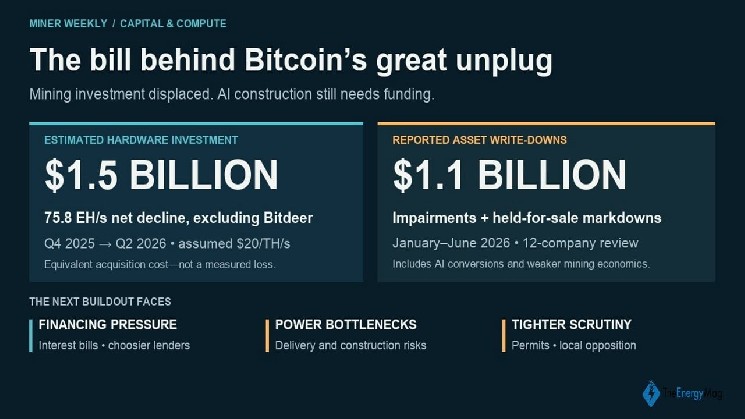
This article examines the significant financial and operational shift of public bitcoin miners towards AI infrastructure, quantifying the costs behind the transition. The analysis highlights that public miners have redirected approximately 75 EH/s of hashrate—worth an estimated $1.5 billion in mining hardware—to support AI and high-performance computing (HPC), leading to a 52% quarterly increase in direct HPC/AI revenue. However, this pivot has triggered substantial asset impairments. In the first half of 2026, 12 tracked companies reported roughly $1.1 billion in asset impairments and write-downs, with IREN and Core Scientific accounting for nearly 89% of that total. Examples illustrate the rapid devaluation. Cipher recorded a $96.1 million write-down on its Black Pearl mining facility—which generated only $57.9 million in revenue in 2025—soon after repurposing it for HPC. The article notes that while not all impairments are directly due to the AI shift, they represent a costly re-evaluation of recent mining investments. The transition creates financial strain. Miners face ongoing cash expenditures for construction and interest payments before new AI revenue streams materialize. For instance, TeraWulf paid $131 million in cash interest while earning about $53 million from HPC leasing in H1 2026. Furthermore, securing new financing is becoming harder as lenders grow more selective. Delays in project completion, such as those faced by Oracle's Project Jupiter due to energy supply issues, prolong the period where mining income has declined but replacement revenue hasn't begun. The shift also occurs amid growing regulatory scrutiny and permitting challenges for data centers regarding energy use and local impact. In summary, the profitability of the pivot to AI will depend not just on future revenue per megawatt, but also on the costs of decommissioning mining gear, site conversion, and servicing debt during the capital-intensive transition period.

cryptonews.ru10/04 20:37

The 'Great Bitcoin Rejection': The $1.5 Billion Hardware Behind the Pivot to AI

cryptonews.ru10/04 20:37

活动图片