Strive CSO Says Saylor ‘Struck Oil’ With STRC As Bitcoin Buys Surge

bitcoinistPublished on 2026-03-24Last updated on 2026-03-24

Abstract

Strive Asset Management's CSO Avik Roy stated that Michael Saylor's MicroStrategy has "struck oil" with its STRC preferred equity offering, calling it a breakthrough in funding Bitcoin acquisitions. Roy explained that STRC offers yield-seeking investors a stable-value product with limited downside volatility, while providing MicroStrategy a scalable capital channel to accumulate more BTC. He described Bitcoin as a "virus" infecting traditional finance, enabling credit creation atop Bitcoin collateral. MicroStrategy raised approximately $1.56 billion through STRC in recent weeks, purchasing over 41,000 BTC. Roy emphasized that continued Bitcoin appreciation is crucial for the model’s long-term success.

Strive Asset Management Chief Strategy Officer Avik Roy said Michael Saylor has effectively “struck oil” with STRC, arguing that Strategy’s latest preferred equity structure has opened a powerful new funding channel for Bitcoin accumulation.

Speaking with The Bitcoin Historian, Roy cast STRC not as just another capital raise, but as a product design breakthrough for Strategy’s treasury model. In his telling, the significance is less about a new ticker and more about what it could unlock: a deeper pool of yield-seeking capital that can be recycled into additional BTC purchases.

Saylor Found A New Funding Engine For Bitcoin

Roy’s argument rested on how Strategy has evolved its financing playbook over time. He said the company first used common equity issuance to buy BTC, then leaned into zero-rate convertible debt during the low-rate era, only to discover that convert buyers often hedged by shorting the stock. That, he argued, created an unhelpful dynamic around MSTR.

The preferred equity route, in his view, was the answer. Roy said the earlier preferred products raised some money, but not at the scale Strategy needed. STRC, by contrast, was designed to stay close to its $100 share price while offering a dividend yield that he said was “somewhere like 12% right now,” making it a more legible product for investors who want yield with limited downside volatility.

“I think of it like striking oil,” Roy said. “You discover oil and the oil just gushes out. And that’s kind of what they’ve identified here is they’ve identified something that really has a lot of financial power to it. And it’s still so early.”

That metaphor sat at the center of the interview. Roy’s point was not that STRC replaces BTC, but that it gives Strategy a more scalable way to bring traditional capital into a Bitcoin treasury strategy. He compared STRC to a stable-value instrument for brokerage accounts, saying investors who do not want direct Bitcoin volatility may still find the structure attractive if it holds near par and keeps paying income.

He went further, arguing that this is how Bitcoin begins to reshape the financial system from the inside. “What Strive and Strategy and these kinds of companies are doing is actually it’s because they understand what Bitcoin’s value is as collateral that they’re building credit on top of that,” Roy said. “They’re using Bitcoin as the virus to infect traditional finance. This is very very good for Bitcoin and very very good for the people who have a stake in the traditional finance sector as well.”

That thesis also helps explain why Roy sees STRC as more than a one-company story. If products like STRC succeed, he suggested, they could become part of a broader “digital credit” market built on BTC-heavy balance sheets. At the same time, he stressed that not every treasury company can follow Strategy’s path. The legal and banking costs involved in issuing preferred securities at scale are high, which means smaller Bitcoin treasury firms may struggle to replicate the model anytime soon.

Roy also tied the STRC story to a larger shift in institutional attitudes. Strategy, he said, is helping banks move toward Bitcoin not by rhetoric but by fee generation. Once banks and brokers can make money from Bitcoin-linked products, the political and regulatory climate around the asset may begin to soften as well.

Even so, he framed the model’s long-term viability around one core assumption: Bitcoin must continue appreciating over time. If that holds, STRC and similar structures could become a major engine for future treasury accumulation. If bond markets eventually begin treating Bitcoin as legitimate collateral rather than assigning it no value, Roy suggested the runway for Strategy and peers could widen considerably.

Strategy’s Bitcoin buying accelerated sharply in early March before cooling in the most recent disclosed week. In the week ended March 8, the company sold roughly $377.1 million of STRC and acquired 17,994 BTC. In the following week, ended March 15, it sold another $1.1804 billion of STRC and purchased 22,337 BTC.

But in the week ended March 22, Strategy reported no STRC issuance and bought a comparatively modest 1,031 BTC, funded by $76.5 million in net proceeds from MSTR stock sales. Across the full three-week stretch, the company accumulated 41,362 BTC, with STRC supplying about $1.56 billion of the capital behind the earlier buying wave.

At press time, BTC traded at $70,655.
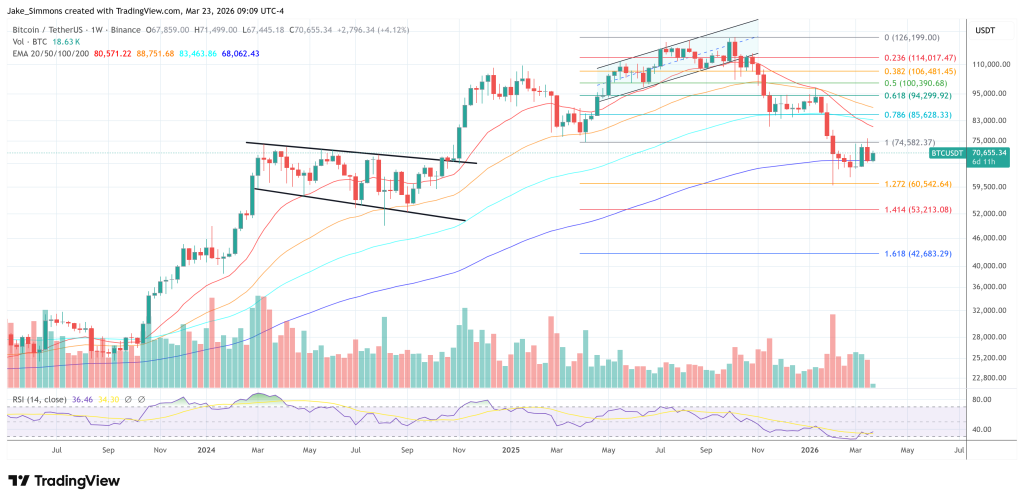
BTC must break above the 1.0 Fib level, 1-week chart | Source: BTCUSDT on TradingView.com

Related Questions

QWhat did Strive Asset Management's Chief Strategy Officer compare Michael Saylor's creation of STRC to?

AHe compared it to 'striking oil', indicating that Saylor discovered a powerful and abundant new financial resource for funding Bitcoin accumulation.

QAccording to Avik Roy, what is the primary advantage of the STRC preferred equity structure over previous financing methods used by MicroStrategy?

AThe STRC structure is designed to stay close to its $100 share price while offering a high dividend yield, making it an attractive product for yield-seeking investors with limited downside volatility, unlike previous methods which created unhelpful dynamics like stock shorting.

QHow does Roy describe the role of Bitcoin in relation to the traditional financial system in this new model?

ARoy describes Bitcoin as a 'virus to infect traditional finance', meaning that companies are using Bitcoin's value as collateral to build credit on top of it, thereby reshaping the financial system from the inside.

QWhat core assumption is the long-term viability of the STRC model dependent on?

AThe model's long-term viability is dependent on the core assumption that Bitcoin must continue appreciating over time.

QHow much capital did STRC supply for MicroStrategy's Bitcoin purchases across the three-week period mentioned in the article?

AAcross the full three-week stretch, STRC supplied approximately $1.56 billion of the capital used for Bitcoin purchases.

Related Reads

Trading

Spot
Futures

Hot Articles

What is $BITCOIN

DIGITAL GOLD ($BITCOIN): A Comprehensive Analysis Introduction to DIGITAL GOLD ($BITCOIN) DIGITAL GOLD ($BITCOIN) is a blockchain-based project operating on the Solana network, which aims to combine the characteristics of traditional precious metals with the innovation of decentralized technologies. While it shares a name with Bitcoin, often referred to as “digital gold” due to its perception as a store of value, DIGITAL GOLD is a separate token designed to create a unique ecosystem within the Web3 landscape. Its goal is to position itself as a viable alternative digital asset, although specifics regarding its applications and functionalities are still developing. What is DIGITAL GOLD ($BITCOIN)? DIGITAL GOLD ($BITCOIN) is a cryptocurrency token explicitly designed for use on the Solana blockchain. In contrast to Bitcoin, which provides a widely recognized value storage role, this token appears to focus on broader applications and characteristics. Notable aspects include: Blockchain Infrastructure: The token is built on the Solana blockchain, known for its capacity to handle high-speed and low-cost transactions. Supply Dynamics: DIGITAL GOLD has a maximum supply capped at 100 quadrillion tokens (100P $BITCOIN), although details regarding its circulating supply are currently undisclosed. Utility: While precise functionalities are not explicitly outlined, there are indications that the token could be utilized for various applications, potentially involving decentralized applications (dApps) or asset tokenization strategies. Who is the Creator of DIGITAL GOLD ($BITCOIN)? At present, the identity of the creators and development team behind DIGITAL GOLD ($BITCOIN) remains unknown. This situation is typical among many innovative projects within the blockchain space, particularly those aligning with decentralized finance and meme coin phenomena. While such anonymity may foster a community-driven culture, it intensifies concerns about governance and accountability. Who are the Investors of DIGITAL GOLD ($BITCOIN)? The available information indicates that DIGITAL GOLD ($BITCOIN) does not have any known institutional backers or prominent venture capital investments. The project seems to operate on a peer-to-peer model focused on community support and adoption rather than traditional funding routes. Its activity and liquidity are primarily situated on decentralized exchanges (DEXs), such as PumpSwap, rather than established centralized trading platforms, further highlighting its grassroots approach. How DIGITAL GOLD ($BITCOIN) Works The operational mechanics of DIGITAL GOLD ($BITCOIN) can be elaborated on based on its blockchain design and network attributes: Consensus Mechanism: By leveraging Solana’s unique proof-of-history (PoH) combined with a proof-of-stake (PoS) model, the project ensures efficient transaction validation contributing to the network's high performance. Tokenomics: While specific deflationary mechanisms have not been extensively detailed, the vast maximum token supply implies that it may cater to microtransactions or niche use cases that are still to be defined. Interoperability: There exists the potential for integration with Solana’s broader ecosystem, including various decentralized finance (DeFi) platforms. However, the details regarding specific integrations remain unspecified. Timeline of Key Events Here is a timeline that highlights significant milestones concerning DIGITAL GOLD ($BITCOIN): 2023: The initial deployment of the token occurs on the Solana blockchain, marked by its contract address. 2024: DIGITAL GOLD gains visibility as it becomes available for trading on decentralized exchanges like PumpSwap, allowing users to trade it against SOL. 2025: The project witnesses sporadic trading activity and potential interest in community-led engagements, although no noteworthy partnerships or technical advancements have been documented as of yet. Critical Analysis Strengths Scalability: The underlying Solana infrastructure supports high transaction volumes, which could enhance the utility of $BITCOIN in various transaction scenarios. Accessibility: The potential low trading price per token could attract retail investors, facilitating wider participation due to fractional ownership opportunities. Risks Lack of Transparency: The absence of publicly known backers, developers, or an audit process may yield skepticism regarding the project's sustainability and trustworthiness. Market Volatility: The trading activity is heavily reliant on speculative behavior, which can result in significant price volatility and uncertainty for investors. Conclusion DIGITAL GOLD ($BITCOIN) emerges as an intriguing yet ambiguous project within the rapidly evolving Solana ecosystem. While it attempts to leverage the “digital gold” narrative, its departure from Bitcoin's established role as a store of value underscores the need for a clearer differentiation of its intended utility and governance structure. Future acceptance and adoption will likely depend on addressing the current opacity and defining its operational and economic strategies more explicitly. Note: This report encompasses synthesised information available as of October 2023, and developments may have transpired beyond the research period.

363 Total ViewsPublished 2025.05.13Updated 2025.05.13

What is $BITCOIN

Discussions

Welcome to the HTX Community. Here, you can stay informed about the latest platform developments and gain access to professional market insights. Users' opinions on the price of BTC (BTC) are presented below.

活动图片