Prediction Markets Hit Record Highs As Bets Explode On Global Conflict

bitcoinistPublished on 2026-03-31Last updated on 2026-03-31

Abstract

Prediction markets are experiencing unprecedented growth, driven by automated AI agents and high-frequency trading bots that extracted approximately $40 million from market inefficiencies in a single month. These markets are increasingly dominated by bets on geopolitical events, such as the US-Israeli conflict with Iran, and major political events like the 2028 US Presidential primary, rather than cryptocurrency prices. TRM Labs reported a 2,800% year-over-year increase, with March 2026 seeing 191 million transactions totaling nearly $24 billion. This surge has attracted regulatory scrutiny over potential insider trading, leading to bipartisan efforts to ban "casino-style" event contracts. Platforms like Kalshi and Polymarket are implementing internal restrictions to preempt stricter regulations, as the industry balances its role as a forecasting tool with concerns over speculation on global conflicts.

Prediction markets are being dominated by automated AI agents and high-frequency trading bots, which extracted around $40 million from market inefficiencies within a single month.

These digital traders look for news of global unrest and respond in milliseconds, often moving the price of a contract before the rest of us can even think about the headline.

This new world of professionalized, machine-based speculation has turned what was once a niche hobby for crypto enthusiasts into a high-stakes financial arena.

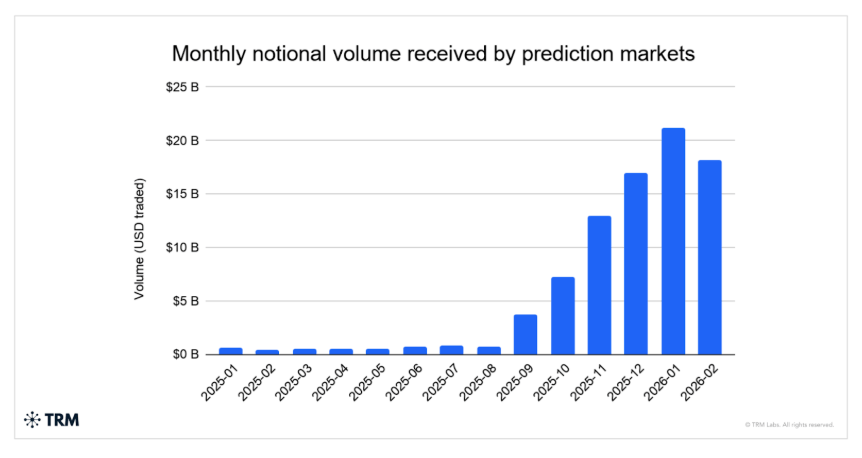
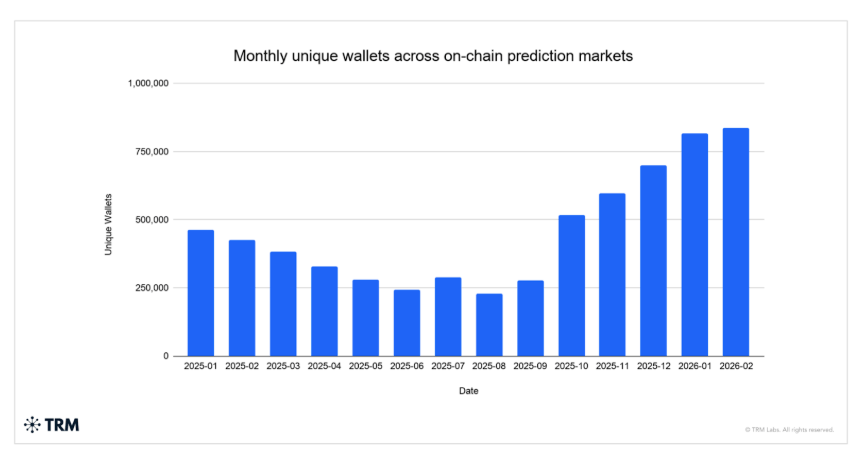
Blockchain analytics company TRM Labs reported that prediction markets have seen substantial growth, fueled by greater accessibility, regulatory progress, and integration with mainstream platforms like Google Finance.

The firm noted that these markets are increasingly serving as real-time indicators for geopolitical and macroeconomic events, gaining attention from major media outlets.

War And Elections Drive Unprecedented Volume

The primary catalyst for this massive activity is no longer the price of digital coins. Instead, traders are putting money on the line over the US-Israeli conflict with Iran and other international flashpoints.

The political implications are also significant, with huge monetary stakes riding on the 2028 US Presidential primary nominations. It has been suggested that such platforms are now being used as a measure of the way in which public opinion is shifting, with their probabilities featured on Google Finance and in the news as a more fluid alternative to traditional political polling.

The extent to which this industry is growing can be quantified by recent figures, which showed an increase of over 2,800% compared to the previous year. Indeed, in March 2026, there were over 191 million transactions in the space.

BTCUSD currently trading at $67,503. Chart: TradingView

To put that in perspective, that figure equates to almost $24 billion in total value for that month alone, representing a staggering increase from the $1.85 billion in March 2025. This indicates that people and investors are viewing these markets as crucial in hedging against any changes in economic policies or shifts in interest rates.

Prediction Markets: Lawmakers Target Event Based Betting

However, the sudden increase in value has caught the attention of regulators in Washington. The regulators have expressed concerns that people may be using inside information to make profits from military actions and other government decisions.

These suspicions of insider trading have led to a bipartisan push for new legislation. US President Donald Trump and members of Congress are looking at a bill that would effectively ban contracts tied to “casino-style” events, potentially stripping the industry of its most popular categories.

Platforms Introduce New Trading Guardrails

In an effort to stave off a total shutdown, major platforms like Kalshi and Polymarket are beginning to implement their own internal restrictions. These measures aim to curb the most controversial types of betting while maintaining the market’s role as a forecasting utility.

Data shows that the outcome of these regulatory battles will determine if the sector stays a permanent fixture of the financial world. For now, the industry remains in a volatile state, balancing between its value as a source of truth and its reputation as a venue for speculating on global tragedy.

Featured image from Unsplash, chart from TradingView

Related Questions

QWhat is the primary catalyst for the massive growth in prediction market activity according to the article?

AThe primary catalyst is no longer the price of digital coins, but traders betting on geopolitical events like the US-Israeli conflict with Iran and other international flashpoints, as well as major political events like the 2028 US Presidential primary nominations.

QHow much value did automated AI agents and trading bots extract from market inefficiencies in a single month?

AAutomated AI agents and high-frequency trading bots extracted around $40 million from market inefficiencies within a single month.

QWhat are US lawmakers concerned about regarding prediction markets, and what action are they considering?

AUS lawmakers are concerned that people may be using inside information to profit from military actions and government decisions. They are considering a bipartisan bill that would ban contracts tied to 'casino-style' events.

QWhat was the reported percentage increase in prediction market transactions in March 2026 compared to the previous year?

AThe reported increase was over 2,800% compared to the previous year, with over 191 million transactions in March 2026.

QHow are major prediction market platforms like Kalshi and Polymarket responding to regulatory pressure?

AThey are implementing their own internal restrictions to curb the most controversial types of betting in an effort to stave off a total shutdown and maintain the market's role as a forecasting utility.

Related Reads

UBS: The Crowdedness of A-Share Tech Stocks Is Far From Reaching Historical Peaks

UBS: A-share tech stocks still far from peak crowding levels A-shares' technology sector has seen a strong rebound, with trading activity hitting record highs, raising concerns about market crowding. However, UBS Securities argues that a key indicator of institutional positioning suggests the current crowding level remains well below historical peaks. While the large-cap tech sector's share of total A-share trading volume and market capitalization have reached historical highs, the overweight ratio of domestic mutual funds in this sector stood at 9.9% in Q1 2026. This is down from 11.6% in Q3 2025 and significantly lower than the historical peak of 14.1% in Q4 2015. It also pales in comparison to the historical peak overweight of 18.7% for the consumer sector. UBS notes that typical cycles from a low to a peak in fund overweighting last about three years, and the current outperformance of the tech/growth style has lasted less than two years since the policy pivot in September 2024. UBS expects A-share earnings recovery to accelerate, providing fundamental support. It forecasts 2026 A-share profit growth to rise to 11% from 3.9% in 2025. Non-financial A-share profits grew 11.8% YoY in Q1 2026, with gross and net profit margins at their highest since 2023. Persistent fund inflows, the expansion of thematic ETFs, and a recovery in private fund issuance are supporting market liquidity. In tactical allocation, UBS favors growth and cyclical styles under its "slow bull" base case, with overweight ratings on six sectors: Electronics (benefiting from semiconductor inventory recovery and AI innovation), Communications (driven by AI computing demand), Machinery (aided by domestic capex recovery), Non-ferrous Metals (due to rising copper/aluminum prices), Chemicals (supported by anti-involution policies), and Electrical Equipment (driven by policy support and AI data center power demand).

marsbit3m ago

UBS: The Crowdedness of A-Share Tech Stocks Is Far From Reaching Historical Peaks

marsbit3m ago

Should You Buy SpaceX Stock at $1.7 Trillion? Here's What the Market Is Worried About

SpaceX is preparing for a massive IPO aiming to raise around $75 billion at a valuation of approximately $1.75 trillion. While its achievements in reusable rockets and the profitable Starlink satellite internet service are clear, the market is concerned about the aggressive valuation. Key issues include: the current $1.75 trillion valuation, which is about 94 times 2025 revenue, seems to price in not just existing businesses but also unproven future ventures like AI infrastructure and orbital data centers. Financially, while Starlink is profitable, the AI division, bolstered by the acquisition of xAI, is incurring massive losses and consuming the majority of capital expenditures. This acquisition also introduced complex related-party financing arrangements and debt onto SpaceX's balance sheet. Furthermore, corporate governance poses a challenge. SpaceX's dual-class share structure ensures founder Elon Musk retains absolute control, limiting ordinary shareholders' influence over high-risk, long-term strategic decisions. The future success of ambitious projects like the Starship rocket—critical for lowering costs and enabling new services—remains a significant variable for the valuation. In summary, the market's apprehension (FUD) centers not on doubting SpaceX's past technological triumphs but on questioning how much premium public investors should pay for a future that combines proven profits with highly speculative and capital-intensive new ventures, all under a governance structure that offers limited shareholder oversight.

marsbit1h ago

Should You Buy SpaceX Stock at $1.7 Trillion? Here's What the Market Is Worried About

marsbit1h ago

Breaking the DeFi Cascading Liquidation Curse: Vitalik Proposes a New Solution

Vitalik Buterin has proposed a new DeFi design to eliminate the automatic liquidation mechanism that causes market instability during sharp downturns. The current system, used by protocols like Aave, triggers forced sales when collateral value falls below a threshold, often exacerbating price drops and creating systemic selling pressure. Buterin's alternative model is based on splitting an asset like ETH into two synthetic option-like tokens, P and N, pegged to a price index. Their combined value always equals one ETH. Instead of sudden liquidation, a position's value gradually drifts from its target peg if the market moves. Users must proactively rebalance their holdings to maintain their desired exposure, transferring the management burden from the protocol to the user or automated tools. A key advantage is the reduced reliance on real-time oracles. Pricing decisions are deferred until contract expiry, allowing for more robust, fault-tolerant oracle designs. This removes a clear liquidation threshold that speculators can target for manipulation or MEV extraction. However, significant challenges remain. Frequent rebalancing could incur high slippage and transaction costs, necessitating new liquidity provider models. The design is better suited for hedging instruments than for stablecoins requiring a rigid 1:1 peg. While not an immediate replacement for existing systems, the proposal challenges the foundational assumption that instantaneous forced liquidation is an unavoidable necessity in DeFi, opening the door for fundamentally different risk management architectures.

marsbit1h ago

Breaking the DeFi Cascading Liquidation Curse: Vitalik Proposes a New Solution

marsbit1h ago

Trading

Spot
Futures

Hot Articles

Discussions

Welcome to the HTX Community. Here, you can stay informed about the latest platform developments and gain access to professional market insights. Users' opinions on the price of AI (AI) are presented below.

活动图片