Prediction markets bet Bitcoin won’t reach $100K before year’s end

cointelegraphPublished on 2025-12-11Last updated on 2025-12-11

Abstract

Prediction markets on Polymarket and Kalshi indicate only a 29-34% probability that Bitcoin will reach $100,000 before the end of 2025. BTC's price faces resistance near $94,000, with analysts suggesting a potential rise to $98,000 if it breaks this level. Key factors suppressing a short-term recovery include macroeconomic uncertainty and a significant slowdown in Bitcoin purchases by corporate treasuries. Despite reduced institutional buying, markets still expect continued accumulation from certain entities. Bitcoin's December high was $94,600, last trading above $100,000 on November 13.

Bitcoin (BTC) could remain pinned below $100,000 for the remainder of 2025 as the market weakened following the US Fed rate cut decision on Wednesday.

Key takeaways:

  • BTC price has only a 30% chance of hitting $100,000 before Jan. 1, according to prediction markets.

  • Bitcoin treasury buying has slowed significantly, hindering short-term recovery attempts.

  • Bitcoin faces resistance at $94,000, with an ascending triangle breakout possible to the $98,000 liquidity zone.

30% chance BTC reclaims $100,000 before New Year

The majority of traders on Polymarket and Kalshi expect Bitcoin to remain below the $100,000 mark for the next 21 days.

As of Dec. 11, Kalshi bettors are pricing in about 34% odds of BTC crossing $100,000 before Dec. 31. Polymarket sets 29% odds of BTC touching $100,000 before the end of 2025.
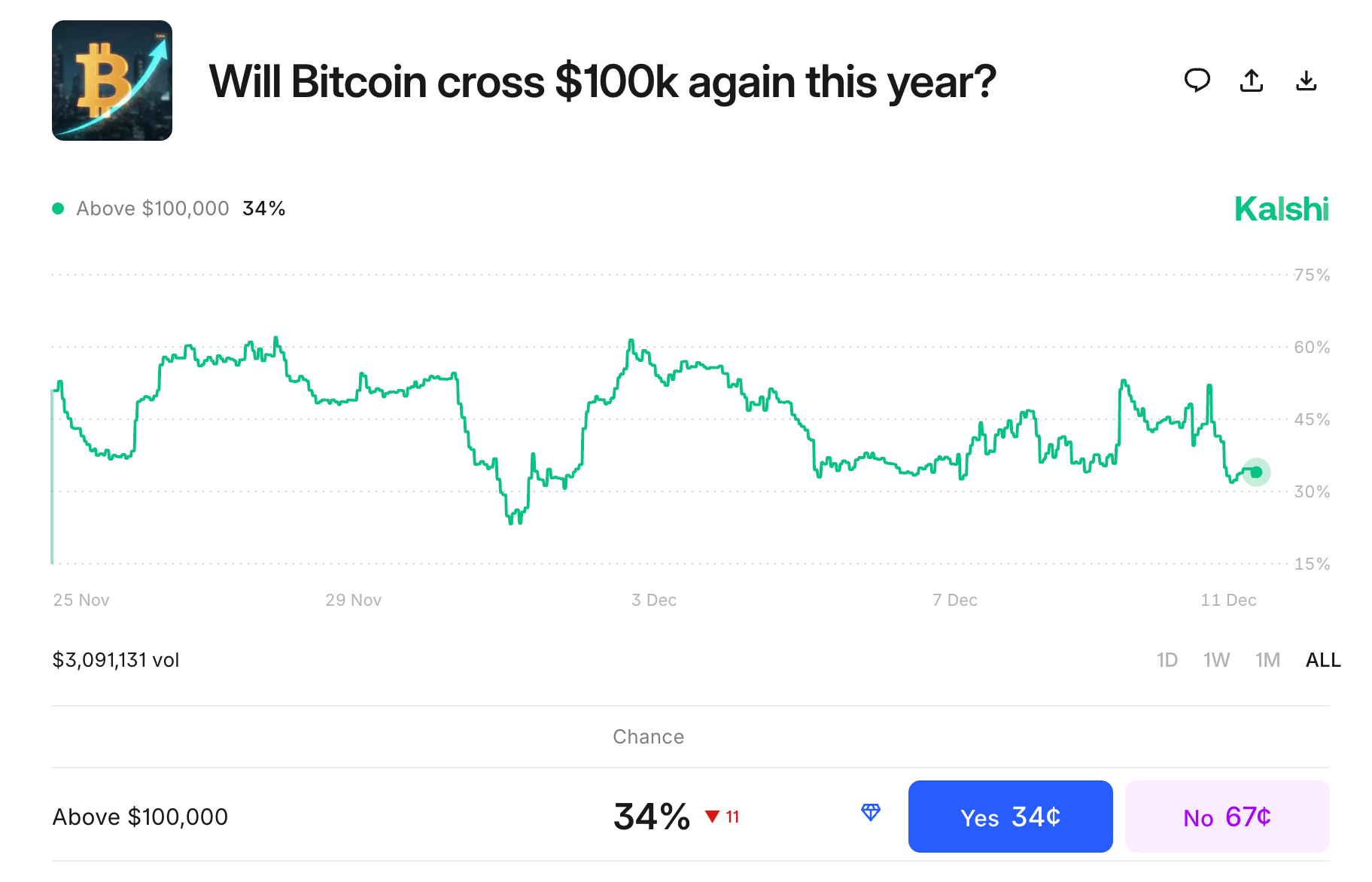
Bitcoin $100K price target before Dec. 31. Source: Kalshi

Bitcoin’s high for December sits at $94,600, reached on Tuesday, and the last time the BTC/USD pair traded above $100,000 was on Nov. 13.

Related: Bitcoin due 2026 bottom as exchange volumes grind lower: Analysis

Several factors have capped Bitcoin’s rebound attempts in the short term, including growing macroeconomic uncertainties and a slowdown in Bitcoin treasury buys.

Data from reveals that the rate of companies purchasing Bitcoin per day continues to fall, a sign that institutions could be exhausted.
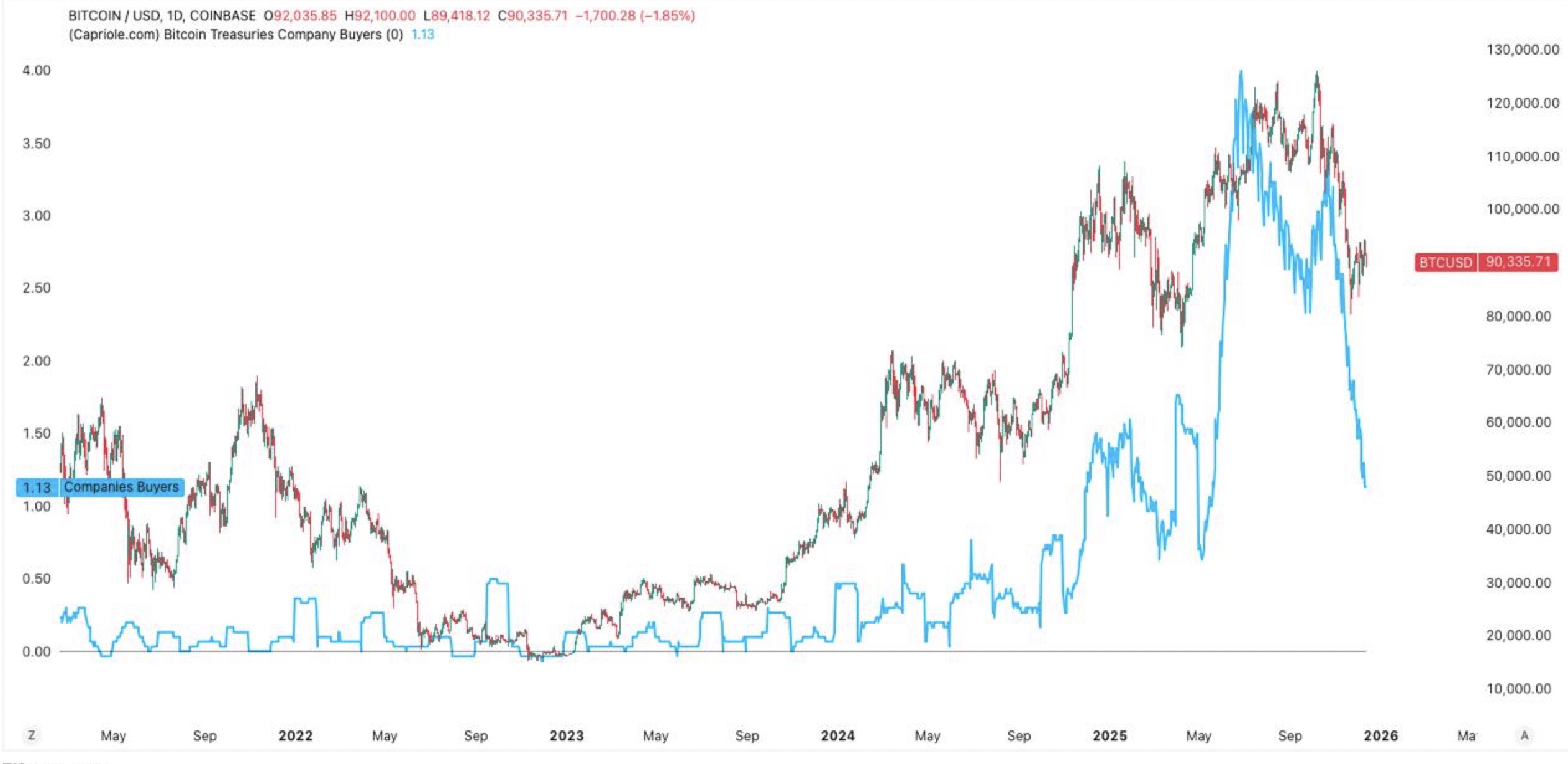
Bitcoin treasury company buyers. Source: Capriole Investments

Despite the reduced Bitcoin treasury demand, Polymarket odds for Strategy selling Bitcoin remain marginal before the end of the year, while expectations for routine small buys stay elevated.

Additionally, Polymarket traders still see routine Strategy purchases this week as a high-probability event, with a 65% chance of buying over 1,000 BTC.

Last week, Strategy expanded its Bitcoin treasury to 660,624 BTC after buying 10,624 coins for roughly $962.7 million, and is on course to match last year’s Bitcoin purchases.

Bitcoin’s upside could be capped at $98,000

Data from Cointelegraph Markets Pro and TradingView shows that the BTC/USD pair has been consolidating within an ascending triangle in lower time frames.

The price is “now pushing against this resistance again,” said analyst Daan Crypto Trades in an X post on Wednesday, referring to the supply zone between the $93,300 yearly open and $94,000.

A break and hold above $94,000 should lead to a move toward the measured target of the triangle around $108,000, but Daan Crypto Trades said it may only go as high as “retesting the previous support area around ~$98K,” adding:

“This is also where a good amount of liquidity is located.”
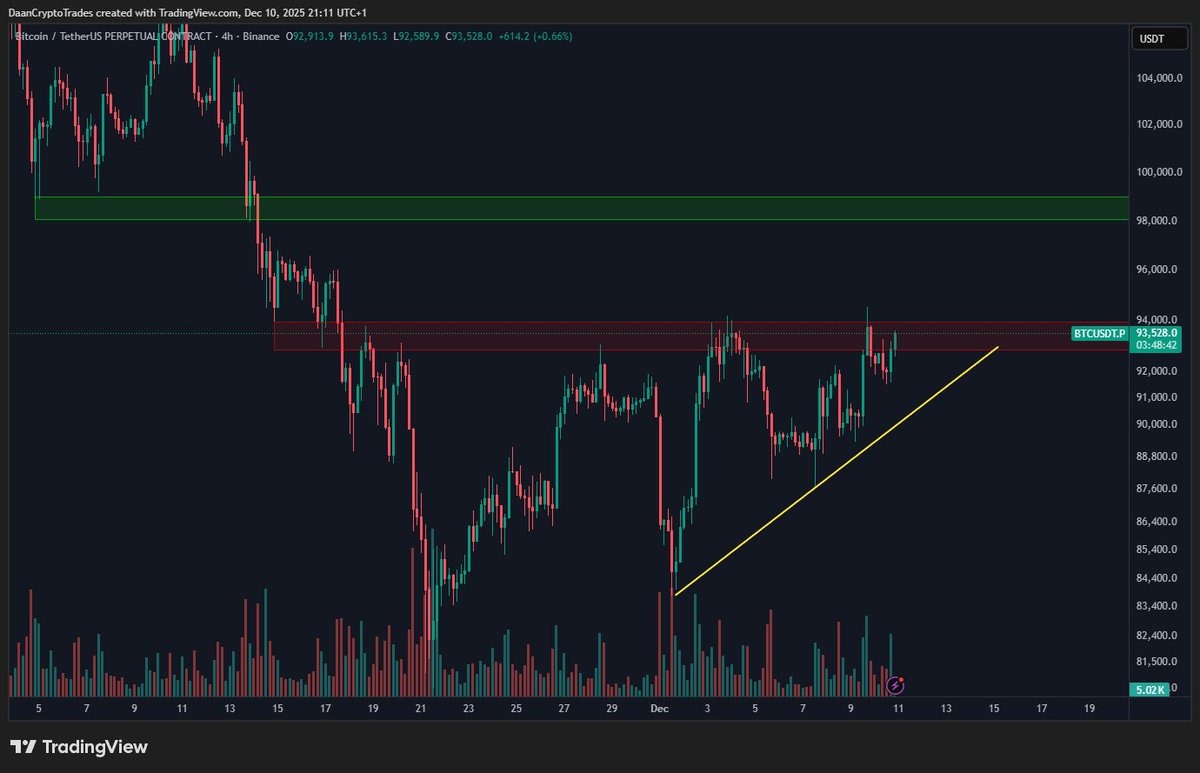
BTC/USD daily four-hour chart. Source: Daan Crypto Trades

As Cointelegraph reported, buyers will have to drive Bitcoin above $94,589 to open the gates for a retest of the $98,000-$100,000 zone.

This article does not contain investment advice or recommendations. Every investment and trading move involves risk, and readers should conduct their own research when making a decision.


Trending Cryptos

Related Reads

Dialogue with Yihui Capital, SoundAI Technology, Ling Universe, and Zhongbo Jili: Opportunities and Challenges in the AI Smart Hardware Track

On June 28, 2026, an event titled "New Opportunities in AI Hardware: The Battle for Interactive Entry Points Begins" was held in Beijing. It featured a report from ITJuzi and discussions with experts from SoundAI, Ling Universe, One Reed Capital, and Zhongbo Juli on the opportunities and challenges in China's AI hardware sector. Key report findings highlight the sector's intense activity: 327 out of 431 startups founded post-2023 have secured funding, with 179 investments in H1 2026 alone. The landscape is dominated by embodied intelligent robots, while wearable tech like smart rings and AI glasses shows rapid growth. Geographically, Shenzhen leads, leveraging its superior hardware supply chain, followed by Beijing and Shanghai. The overarching trend is for companies to focus on micro-innovations within specific scenarios rather than reinventing foundational technology. Industry leaders shared several critical insights: 1. **Balancing Innovation & Market Readiness**: Entrepreneurs face the "hammer looking for a nail" dilemma. Success requires balancing technical capability with user acceptance, cost control, and incremental design improvements rather than chasing disruptive innovation. 2. **Competitive Landscape**: The future interactive entry point may not be a single super-device but a mix of universal terminals and specialized, scenario-specific hardware. While large companies have ecosystem advantages, startups can win by deeply targeting vertical markets and specific user groups. 3. **Core Challenges & Business Models**: Key hurdles include deep understanding of AI models and navigating non-transparent hardware supply chains. Viable business models may involve selling hardware at cost and generating revenue through software subscriptions, but this requires tight control over both hardware BOM and model inference costs. 4. **The Road to Commercialization**: The ultimate test is market validation—achieving sales growth and sustainable cash flow. Companies must find the right application scenario, use edge computing effectively, and close the loop from technology to commercial success. 5. **The Future of Interaction**: Proactive, context-aware interaction is the next frontier, though it's currently limited by issues like model hallucinations and environmental perception. The near-term focus should be on identifying target users and creating a coherent experience in specific domains, such as health wearables. In summary, to succeed in the competitive AI hardware arena, companies must strategically choose their niche, build a team with the right geographical advantages (e.g., leveraging Shenzhen's supply chain), and most importantly, execute a flawless commercialization strategy that translates technology into market-accepted products and sustainable business growth.

marsbit41m ago

Dialogue with Yihui Capital, SoundAI Technology, Ling Universe, and Zhongbo Jili: Opportunities and Challenges in the AI Smart Hardware Track

marsbit41m ago

CryptoQuant Founder: The Cost to Double BTC Has Increased by 20,000 Times, Where Will the $100 Billion Buying Power Come From?

CryptoQuant founder Ki Young Ju analyzes Bitcoin's current capital challenge. He notes that the cryptocurrency market has grown too large for retail-driven momentum alone to generate massive price increases as in past cycles. His calculations show that in 2011, approximately $2.7 million in capital inflow could push BTC's price up by 550x, whereas the current cycle requires an estimated $101 billion in new capital just for a 100% price increase. This shift underscores that sustaining a bull run now depends on attracting large-scale, long-term institutional capital rather than short-term speculative trading. Recent outflows from US spot Bitcoin ETFs, totaling nearly $10 billion since May, highlight the fragility of current demand and challenge the narrative of deep institutional support. While surveys indicate continued institutional interest, these entities prioritize regulated products, risk management, and portfolio integration over speculative gains. For the next significant bull market, Bitcoin must transition to being a core macro asset. The key drivers are no longer just more buyers, but capital allocation from larger, slower-moving entities like wealth advisors, corporate treasuries, banks, and sovereign wealth funds. This new phase pits Bitcoin against other major asset classes like AI for a share of institutional capital, making its growth trajectory dependent on sustained, high-quality inflows from diversified financial balance sheets.

marsbit45m ago

CryptoQuant Founder: The Cost to Double BTC Has Increased by 20,000 Times, Where Will the $100 Billion Buying Power Come From?

marsbit45m ago

Trading

Spot

Hot Articles

Discussions

Welcome to the HTX Community. Here, you can stay informed about the latest platform developments and gain access to professional market insights. Users' opinions on the price of S (S) are presented below.

活动图片