First Day Review of "Musk's WeChat" XChat: Even Worse Than Expected

Odaily星球日报Published on 2026-04-25Last updated on 2026-04-25

Abstract

Elon Musk's much-anticipated "WeChat-like" app, XChat, has officially launched after multiple delays. The initial review reveals a product that falls short of expectations, offering an experience largely similar to X Platform's (formerly Twitter) direct messages, despite being marketed as an encrypted communication tool. Key observations from the first-day test include: 1. The app's promoted "end-to-end encryption" and its claimed relation to Bitcoin's architecture were criticized by experts as a superficial attempt to capitalize on crypto buzz, with no real technical connection. 2. Musk's vision of an ad-free "secure communication system" is technically met, but only because the app is currently extremely basic, featuring only a single chat interface. 3. A promised anti-screenshot feature appears inconsistent; it works in X Platform group chats but fails within the XChat app itself, where screenshots still capture avatars. 4. The app supports 45 languages and has a 16+ age rating, indicating a broader tolerance for content compared to WeChat's 13+ rating. 5. A puzzling login process requires users to verify the email associated with their X account. 6. The touted encryption" feels minimal in practice, with its presence only indicated by a simple "Encrypted - Yes" label on messages. 7. Disappearing message timers for groups can be set from 5 minutes to 4 weeks, with the timer starting upon being read by a user. 8. Group invite links are shared with X Platform groups...

Original|Odaily Planet Daily(@OdailyChina)

Author|Wenser(@wenser 2010 )

After nearly a year of anticipation, and several delays from the original April 17th release date to April 23rd and then 24th, XChat, which promotes the concept of a "Western WeChat," has finally launched. However, contrary to many people's expectations, the newly launched XChat, despite its focus on "encrypted communication," offers a messaging experience not much different from X Platform's (Twitter) direct messages.

Odaily Planet Daily, in a first-look review of this social app that Musk has high hopes for, discovered some "interesting" aspects. Let's all evaluate whether it can become another dark horse in Western social media after Facebook and Instagram (Threads).

Interesting Point No.1: End-to-End Encryption to Casually Reference BTC?

In June last year, when Musk first teased XChat, he stated that the X platform would soon launch a new version of the chat tool XChat, which would support end-to-end encryption, self-destructing messages, sending any file type, and audio/video call functions.
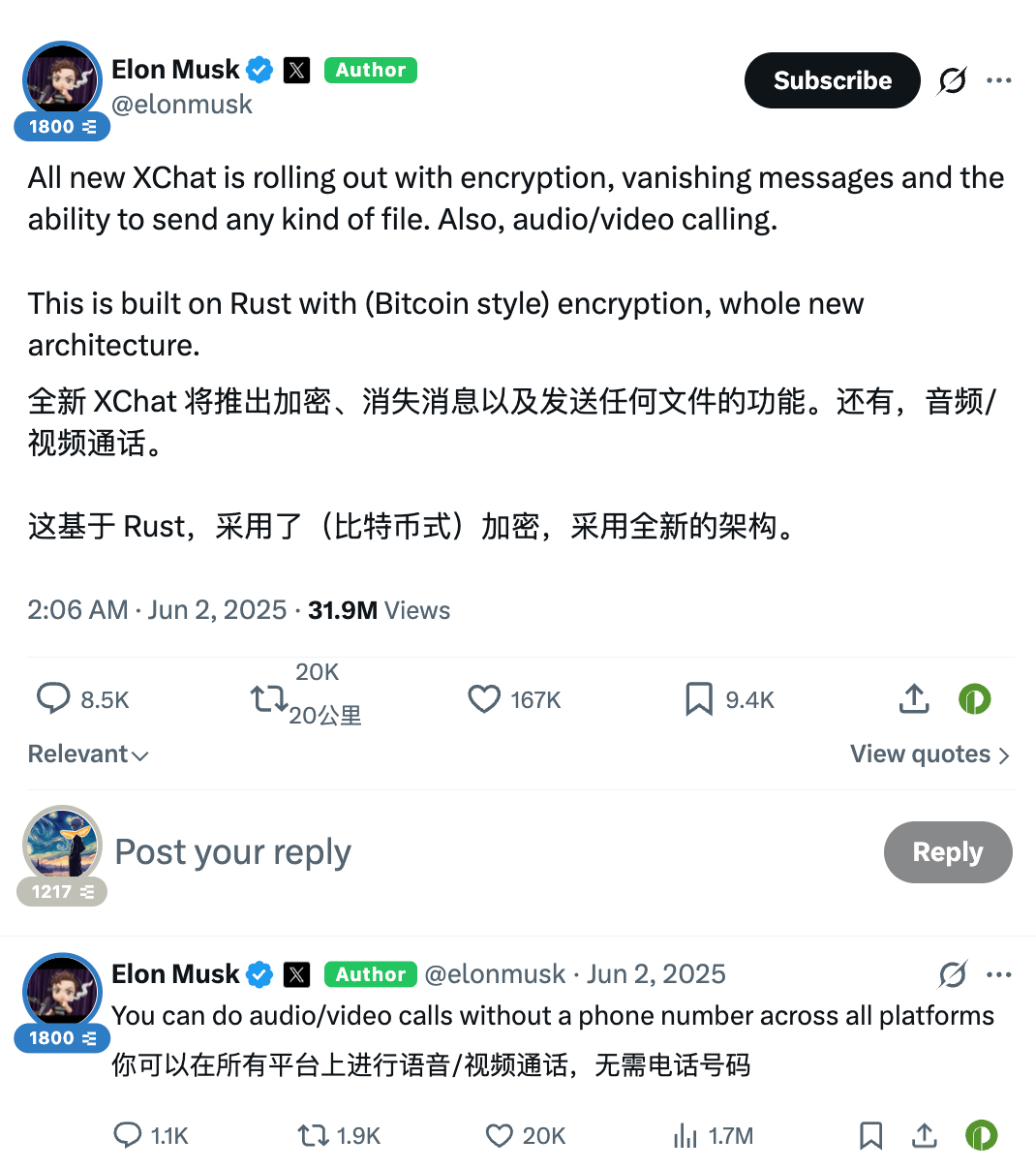
Furthermore, he emphasized that XChat is developed in Rust and incorporates an encryption architecture similar to Bitcoin's, with a completely refactored overall architecture, allowing users to make voice/video calls on all platforms without needing a phone number. (Doesn't that sound like WeChat voice/video calls?)

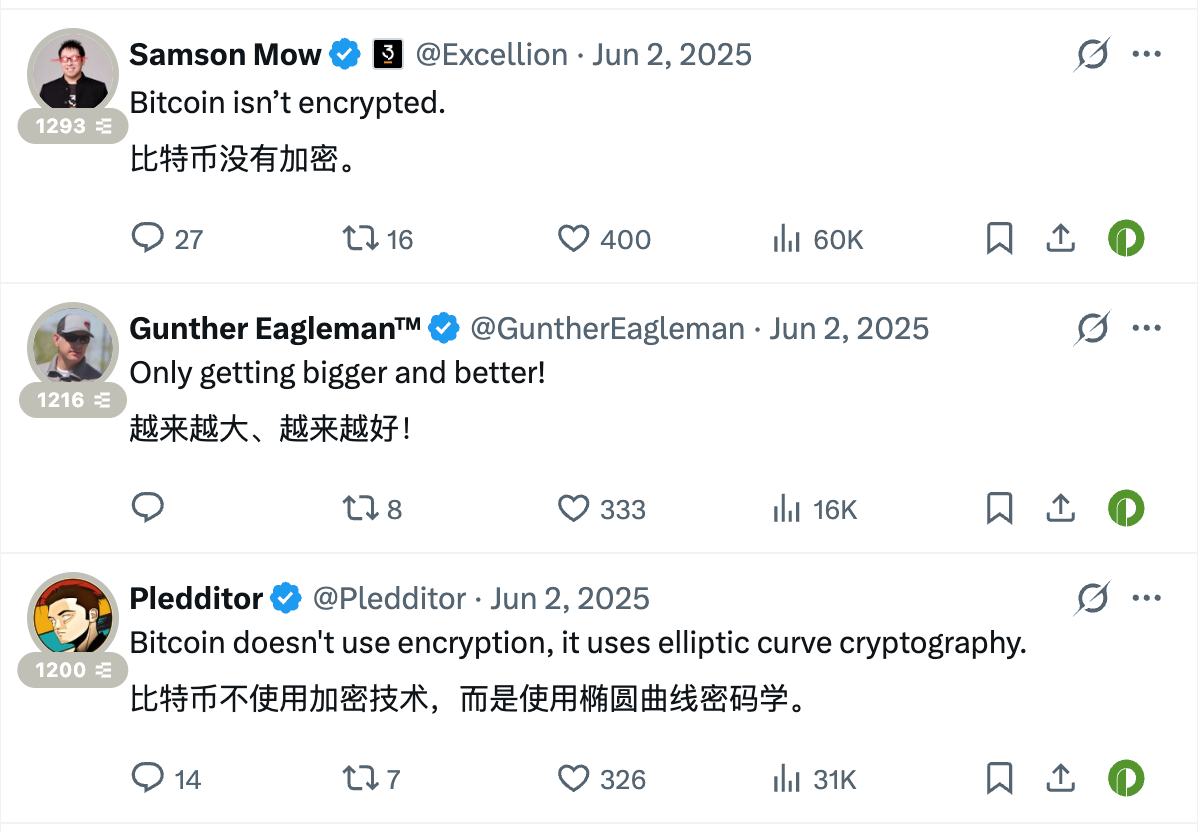
Although subsequently, some cryptocurrency practitioners and cryptographers pointed out that the core functionality of Bitcoin's blockchain is not traditional encryption, and Musk's statement was "purely a hard reach."

In summary, the communication encryption technology of XChat and the cryptographic technology of BTC are not exactly the same; one could say they are completely unrelated.
Interesting Point No.2: No Ads, Aiming to Be "One of the Safest Communication Systems"

On November 2nd last year, Musk was a guest on Joe Rogan's podcast "The Joe Rogan Experience" (Odaily Planet Daily Note: This podcast has an annual revenue of up to $250 million, making it one of the most listened-to radio podcasts in the US) for a deep 3-hour conversation.

During it, Musk stated that he believes the US is a society once eroded by an "ideological virus," which was his original motivation for acquiring Twitter. His goal is to "let the truth be heard" and to build a secure social communication platform (i.e., XChat).

His exact words were: "I don't think any communication system can be called 'perfectly secure,' only 'differently insecure.' XChat uses a 'peer-to-peer encrypted system,' somewhat similar to Bitcoin's technology, with strong resistance to attacks, and we are testing it thoroughly. XChat has no advertising hooks, whereas other communication apps like WhatsApp have ad-related clickbait. They collect your chat information to push targeted ads. This is a huge security vulnerability—if an app can collect enough information to push ads, it means it's collecting a vast amount of private data. They say 'don't worry, it's just for targeted ads,' but others can also use this clickbait to view your information. XChat has no advertising-related functions whatsoever.

I wouldn't say it's absolutely perfect, but our goal is for XChat to replace the old Twitter DMs (Twitter Direct Messages) and become a fully encrypted system. I believe it will be 'one of the safest communication systems.'"

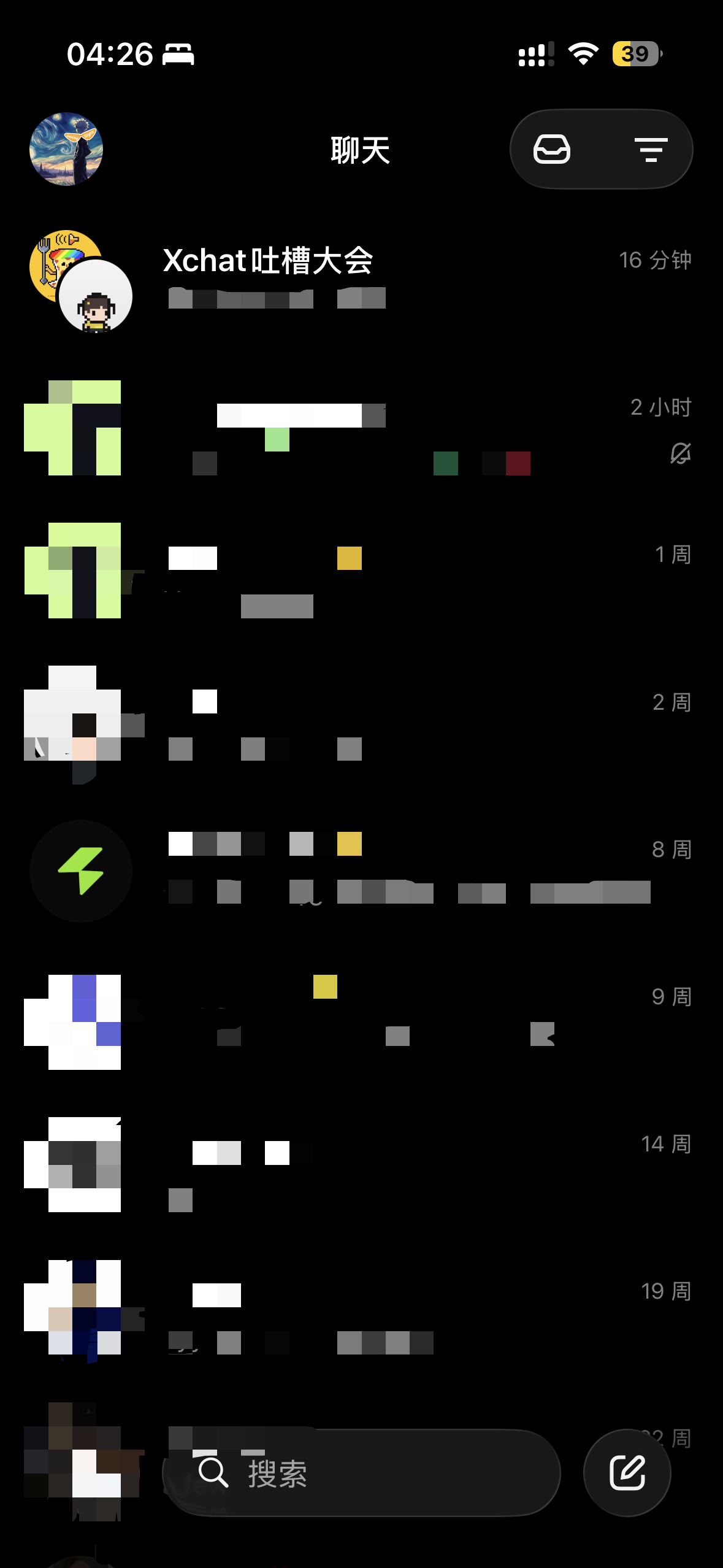
So far, this seems to be achieved, because XChat is currently so simplistic that it has no other pages, only a single [Chats] page.
Interesting Point No.3: Disabled Screenshot Function Malfunctions(?)

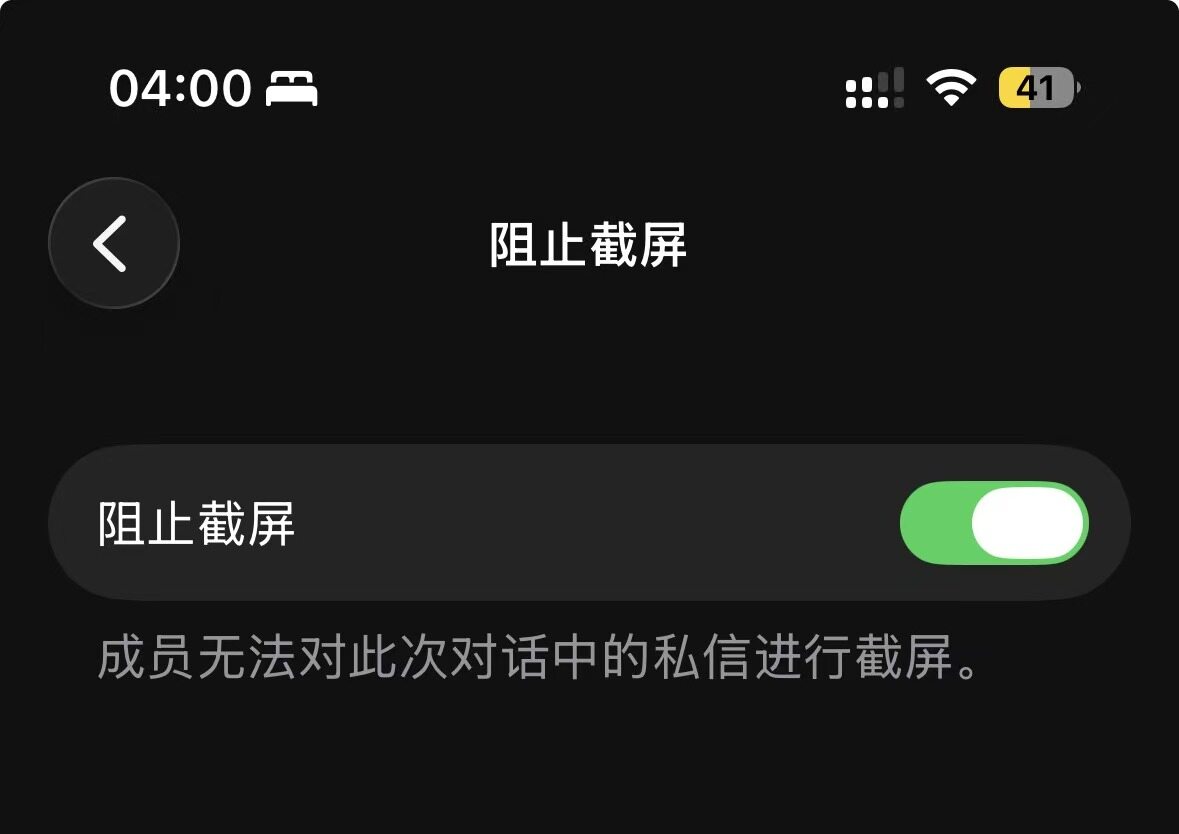
Before XChat's release, many were highly interested in its "disable screenshots" function. According to previous beta versions and the settings of the officially launched app, this function is optional.

However, based on my own attempts, it seems that even when enabled, one can still take screenshots directly in the XChat group chat interface, but the screenshot image only shows the group chat icons without the chat content; whereas taking a screenshot in the X Platform group chat interface displays "This chat is protected, screenshots are not allowed."
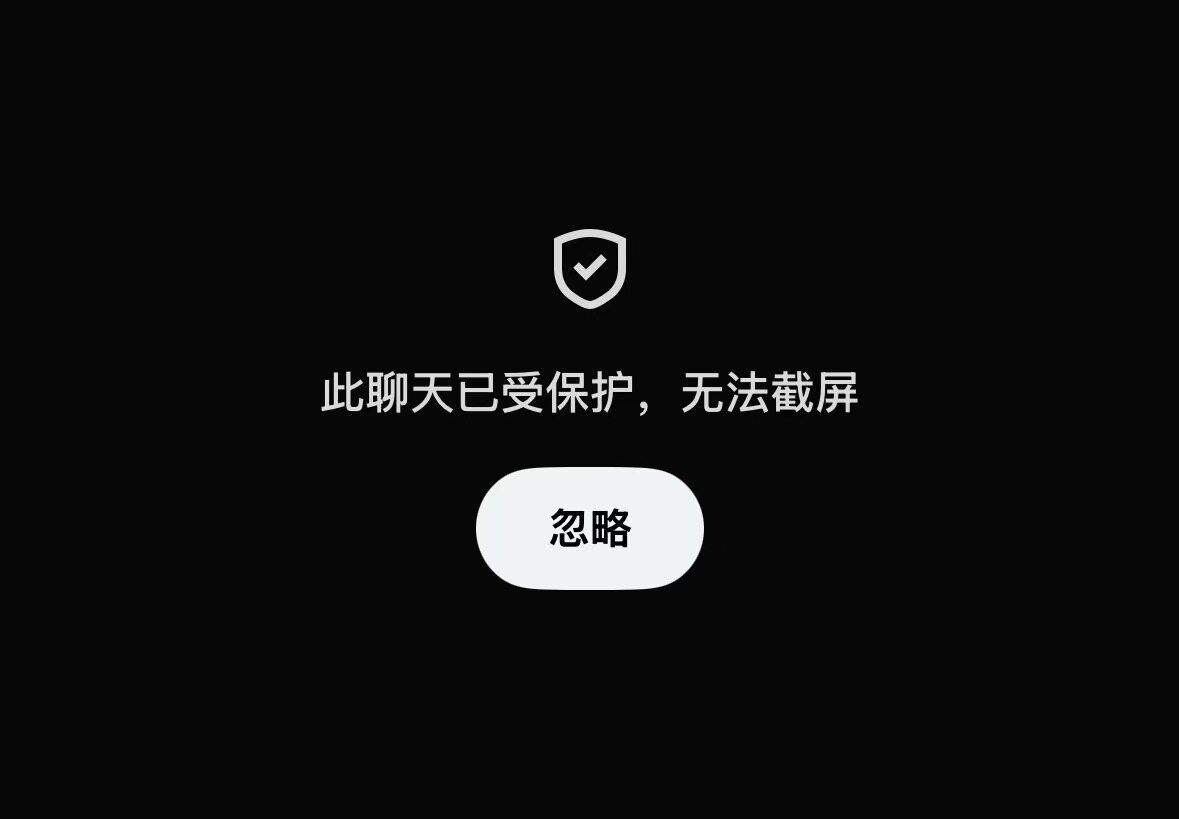
Interface shown after screenshot attempt in X Platform group chat
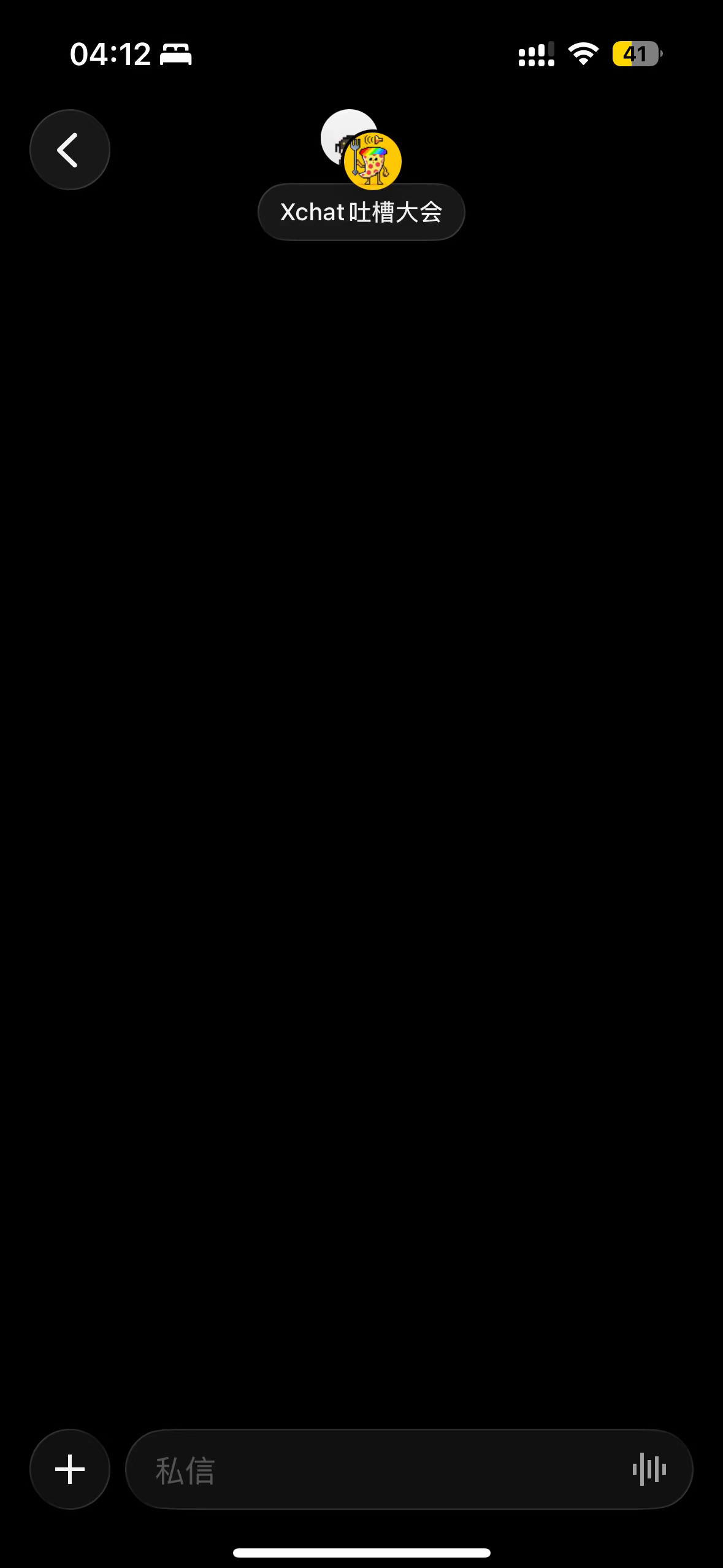
XChat group chat screenshot display

Specific path: [Group] -> [Click group icon] -> [Block Screenshots] -> [Enable/Disable].
Interesting Point No.4: Supports 45 Languages, Age Rating 16+

According to AppStore app information, XChat supports 45 languages including Chinese, German, Japanese, Russian, Korean, etc. Additionally, its user age rating is 16+, meaning it "Includes profanity or crude humor, sexual content or nudity; unrestricted web access, information, and chat". In contrast, WeChat's age rating is 13+. From this perspective, XChat's content尺度 (scale/allowance) is somewhat larger.
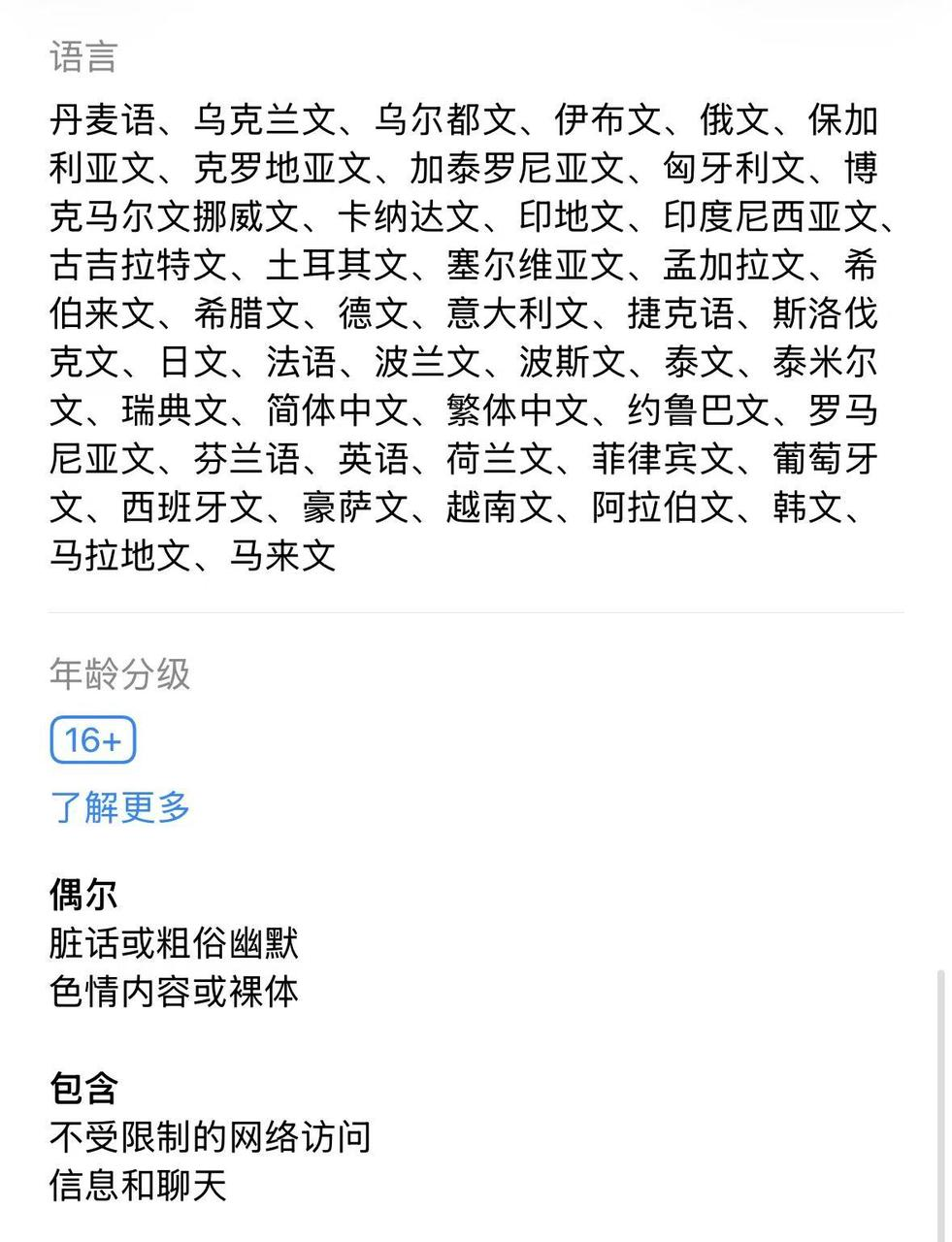
Also attached is the detailed AppStore age rating description:
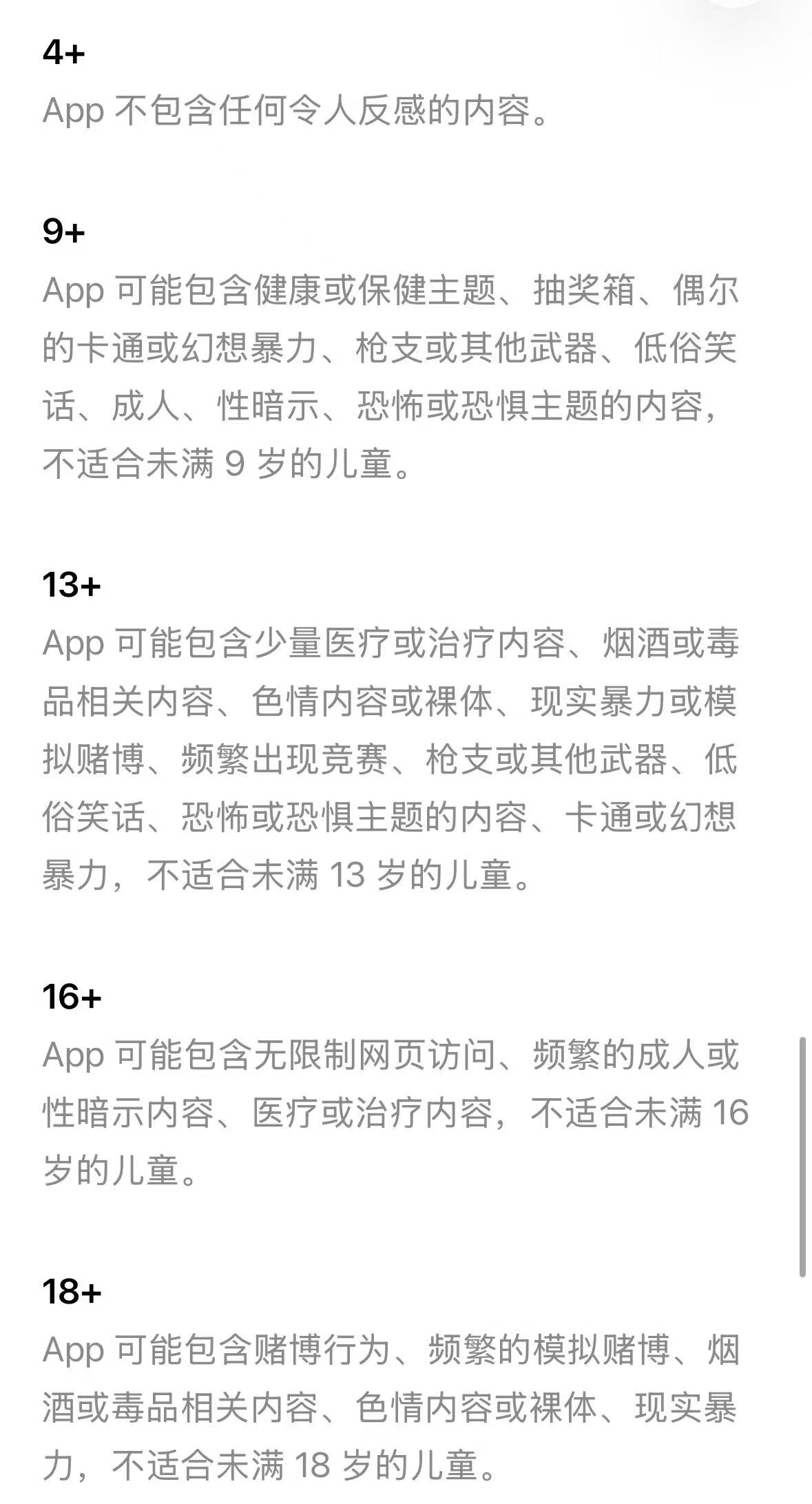
18+ requirements seem slightly broad

Interesting Point No.5: Login Interface Requires Verification of X Account Bound Email

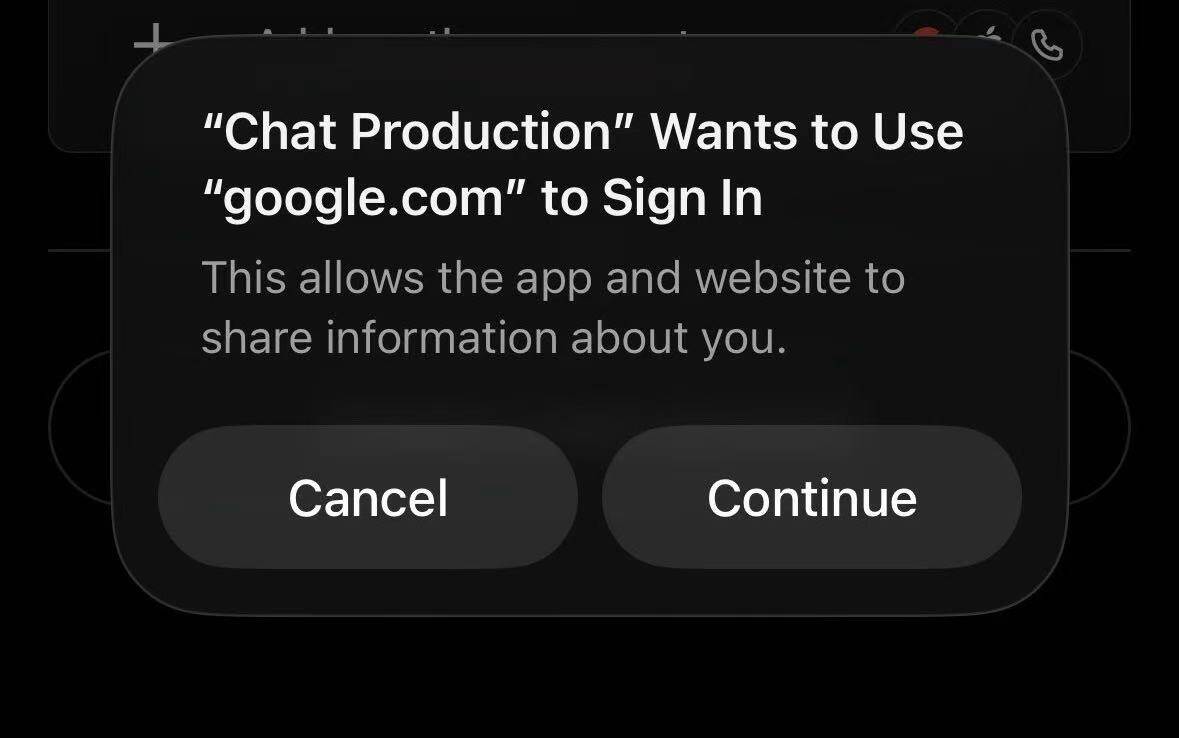
Contrary to pre-launch speculation, the XChat login homepage is an interface to verify the email bound to the user's X platform account. If you don't remember the email associated with your X account, you can check it under [Settings and Privacy] -> [Your Account] -> [Account Information]. If you had 2FA enabled before, you also need to enter the 6-digit verification code.

Although the reason for this operation is not entirely clear: Is it for convenient user email outreach later? Or for KYC policy?暂时不得而知 (Temporarily unknown).
First look upon entering XChat

Interesting Point No.6: Is Encryption Just Superficial?

The previously promoted concept of "encrypted privacy" doesn't feel very obvious currently.

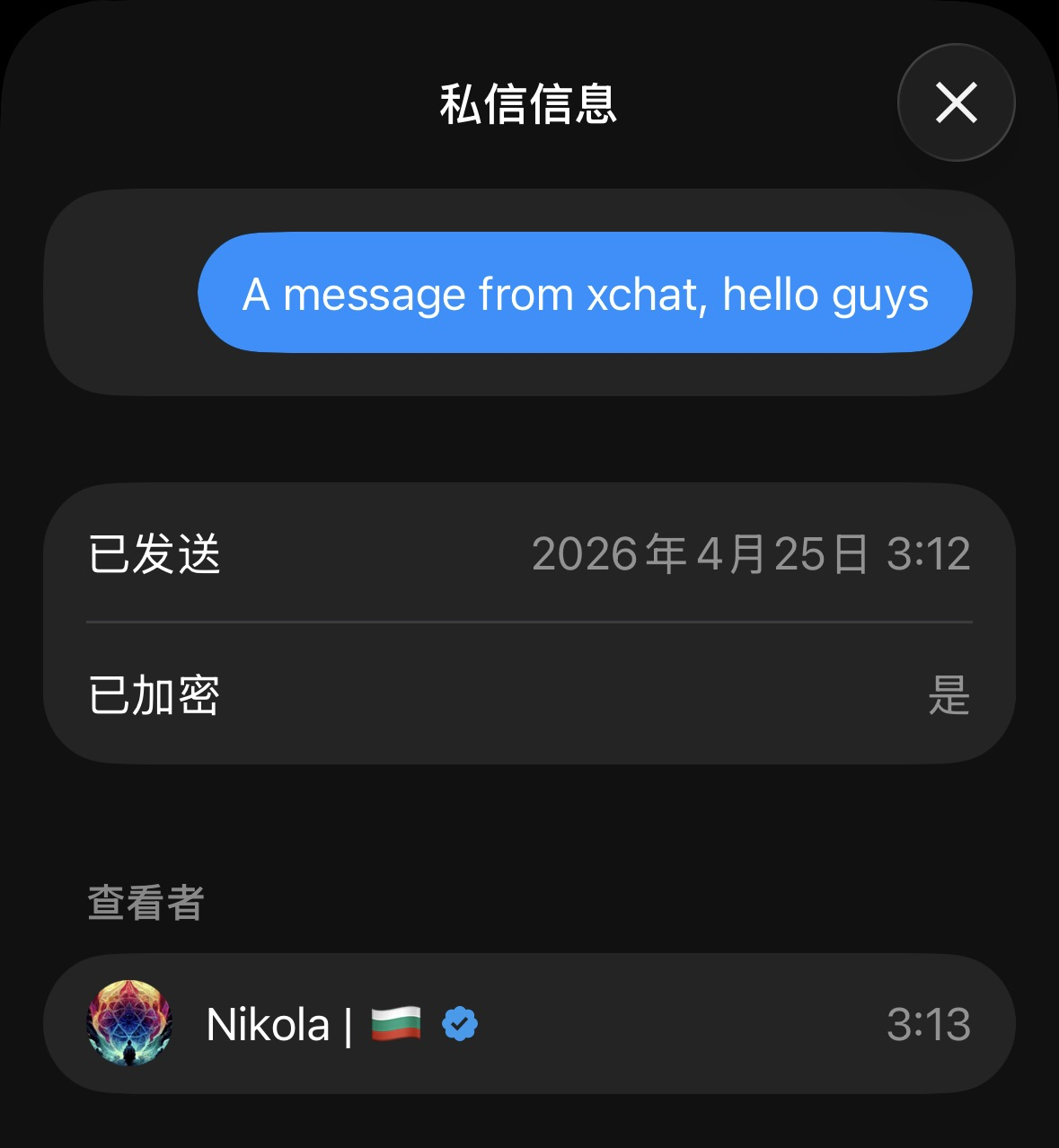
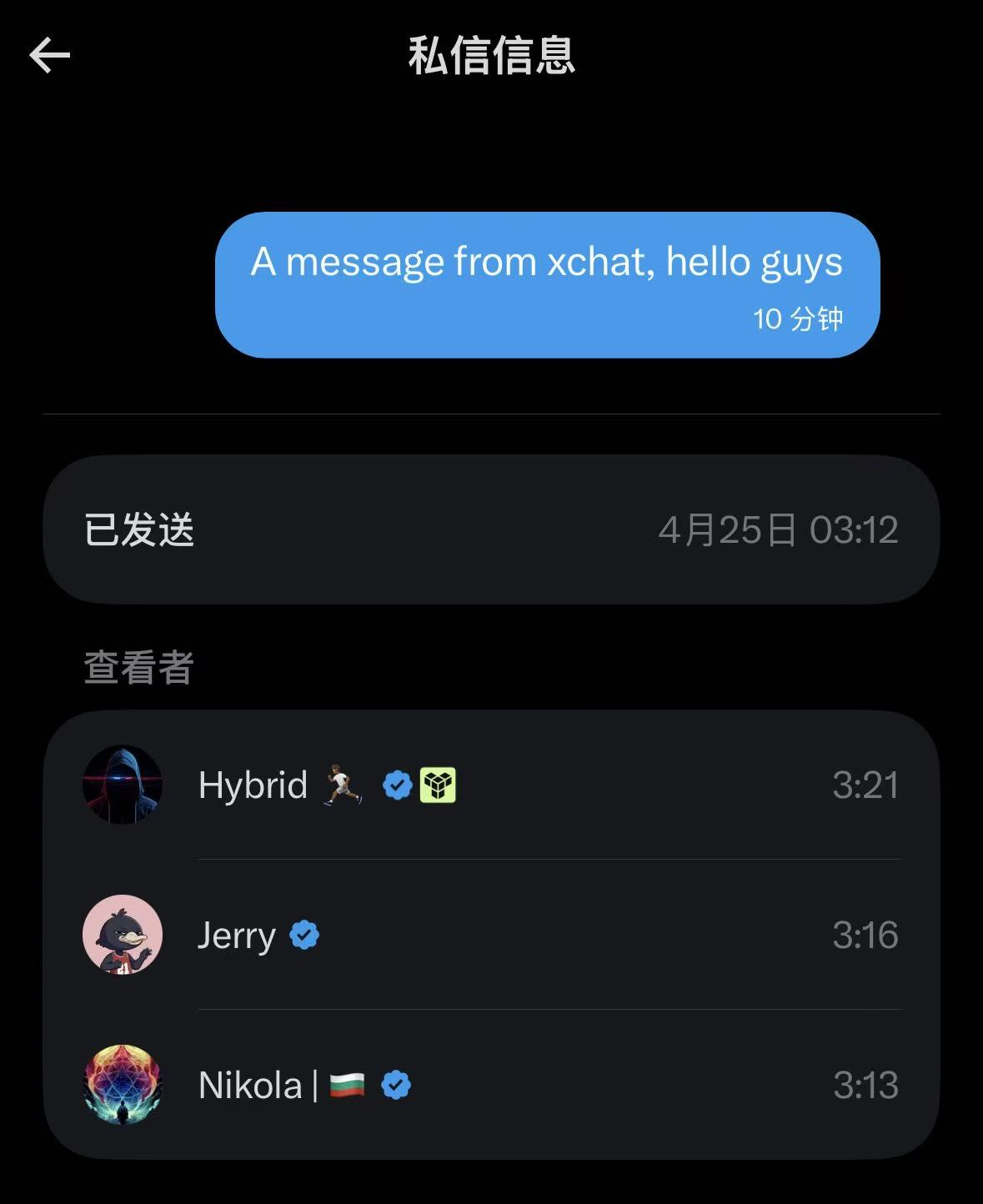
Personal testing shows that messages in the XChat interface are similar to those in the X Platform group interface, just with an additional display of [Encrypted - Yes].

As for the optional setting for [Whether Encrypted], it is not displayed in this version.
"Encrypted" display after long-pressing a message -> clicking "Info" in XChat
Display interface after long-pressing a message -> clicking "Info" in X Platform group chat

Interesting Point No.7: Group Message Self-Destruct Times Range from 5 Minutes to 4 Weeks

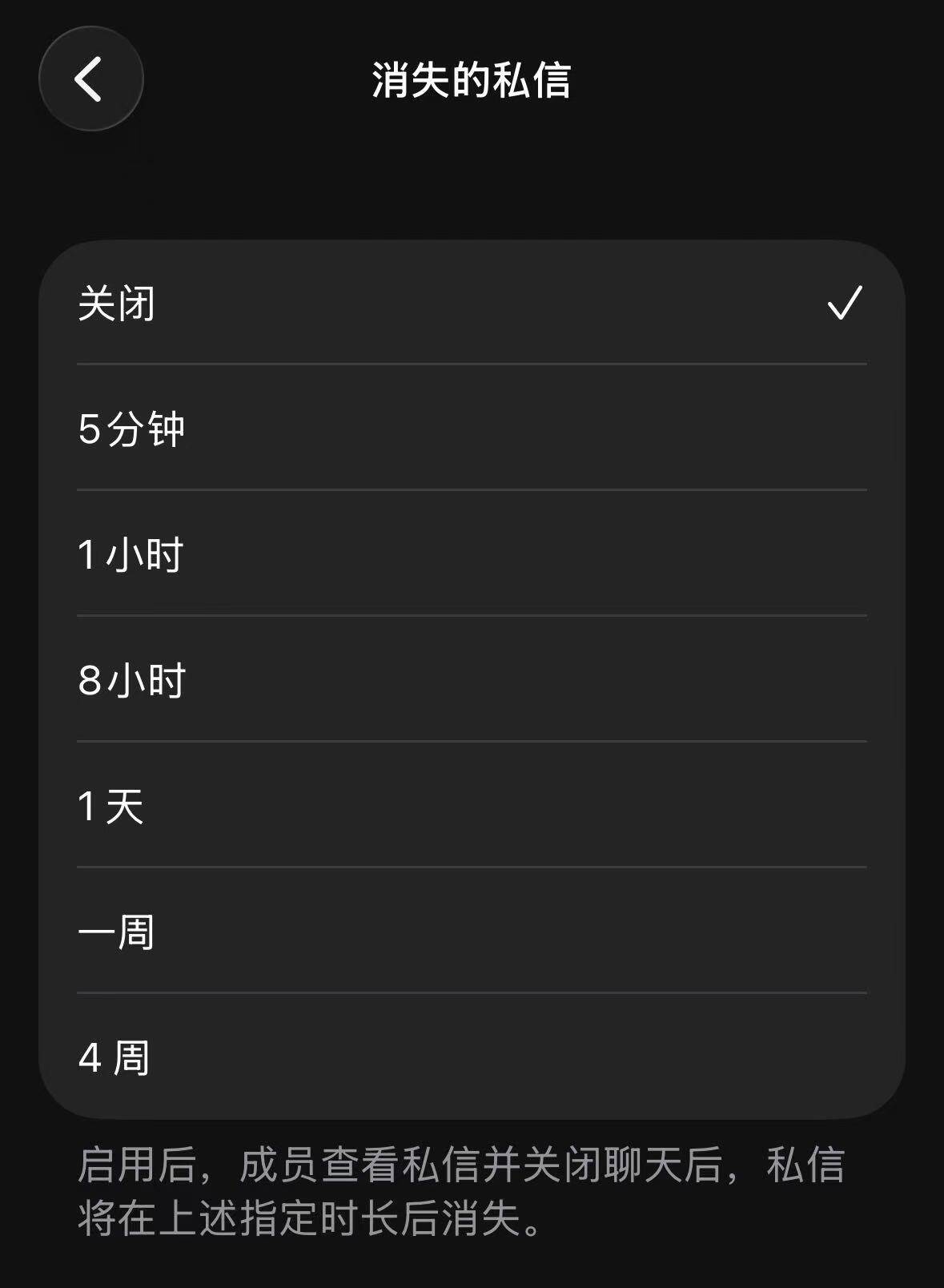
In the XChat group settings, after clicking [Disappearing Messages], you can set the self-destruct duration for group messages. The times are: 5 minutes, 1 hour, 8 hours, 1 day, 1 week, 4 weeks.

According to the note on this function's interface, this duration should be calculated from the time a group member reads the message, not from the time the message was sent.
Specific path: [Group icon] -> [Disappearing Messages]

Interesting Point No.8: XChat Groups Open Invitation Link Function

This function is relatively conventional.

It's worth mentioning that XChat groups share the invitation link function with X Platform groups. If disabled, even if others have the link, they cannot join the group.
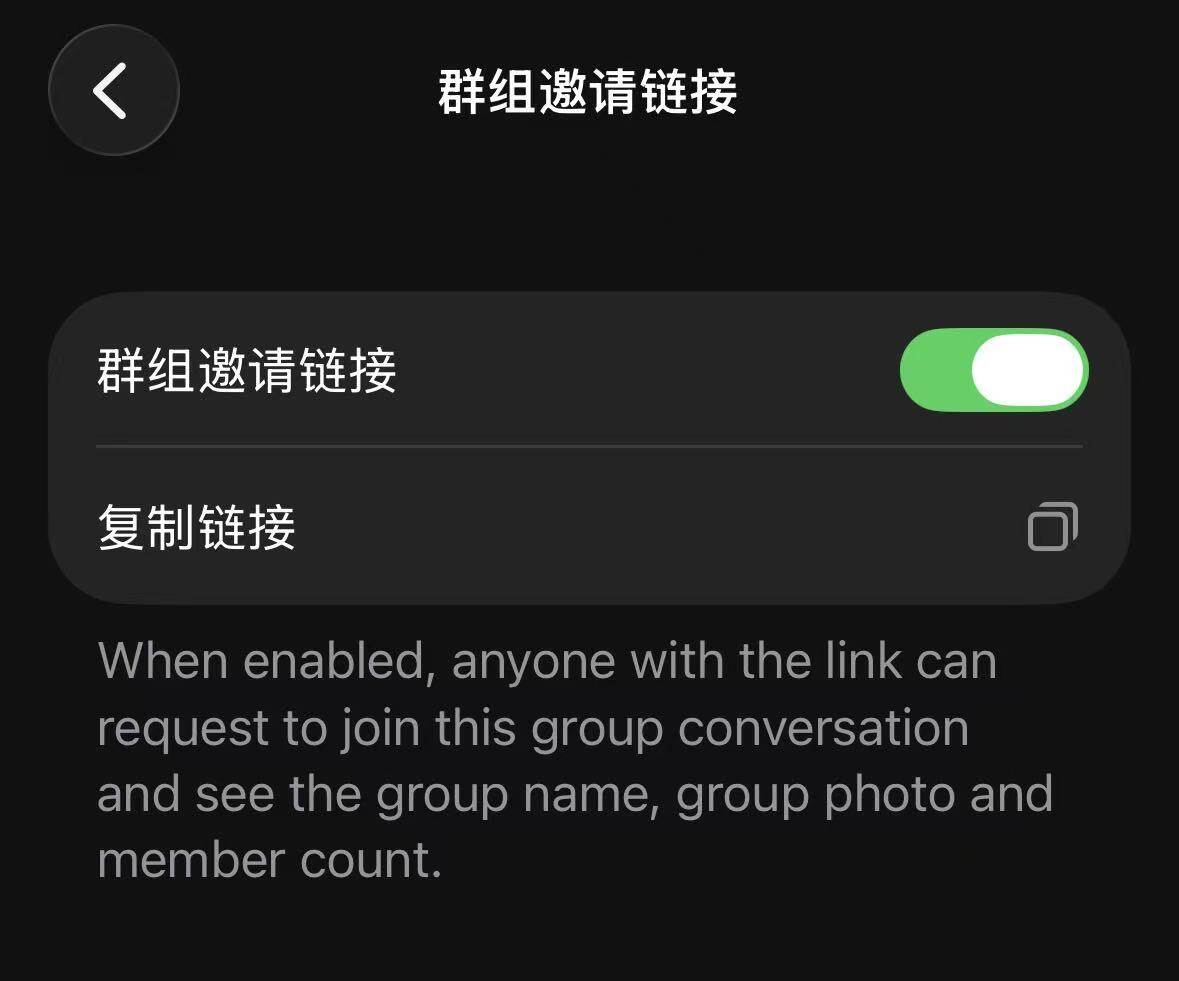
XChat group invitation link settings interface

Interesting Point No.9: XChat Group Member Limit Might Be 1000 People

This point was mentioned in a post by X Platform product lead Nikita Bier previously. The group chat capacity of XChat has not been thoroughly tested yet.

Not long ago, Nikita himself announced the migration of the platform's original Community feature to XChat groups, with a transition deadline of May 30th.

Additionally, he mentioned, "will be increasing the XChat group (member) limit to 500 members, and aiming for 1000 members in the coming weeks. This should cover all communities on X except for a few." Of course, this presumptuous functional setting attracted heavy criticism from X platform users.
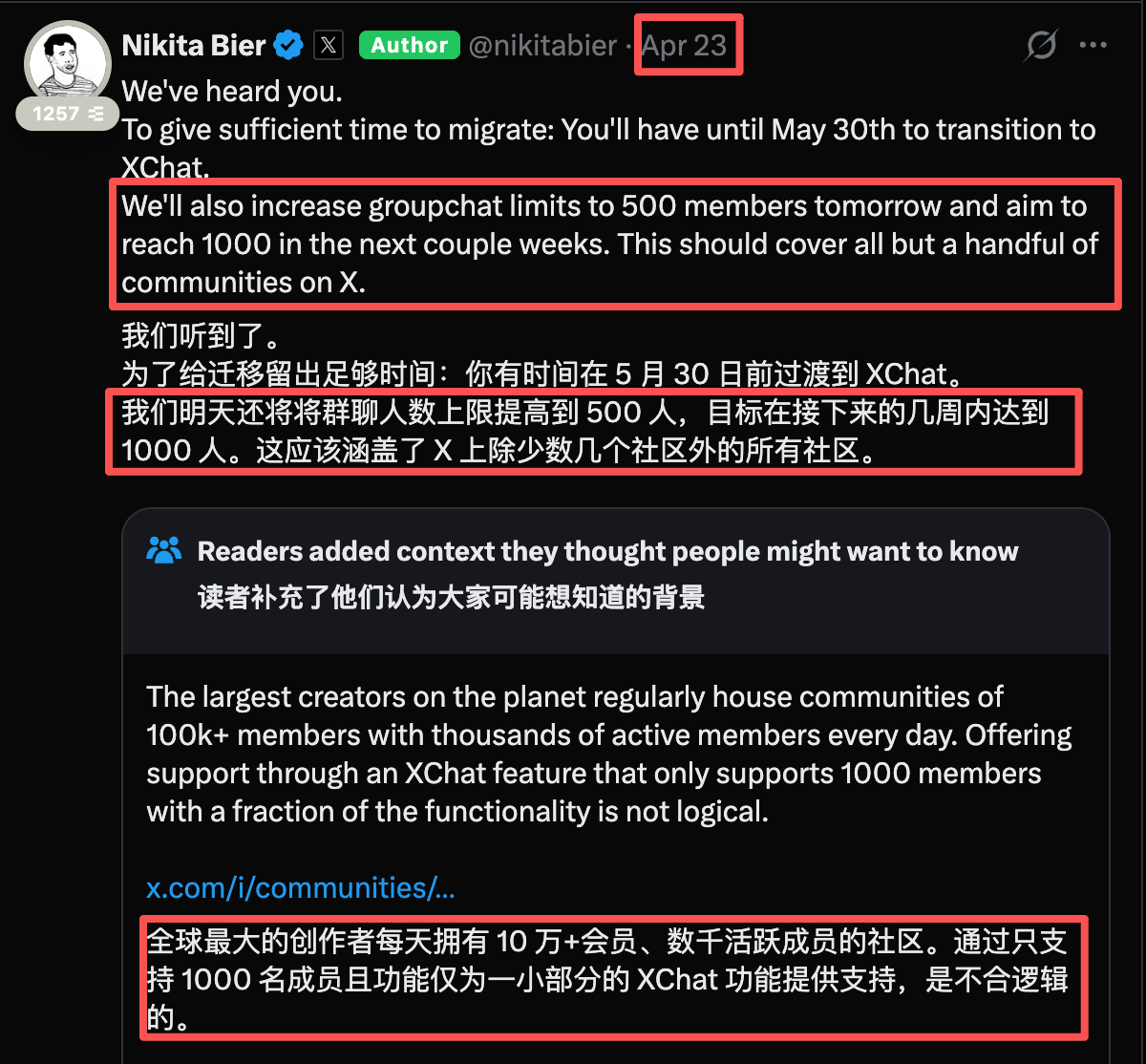
Message posted by Nikita himself on April 23rd, which drew a lot of angry comments

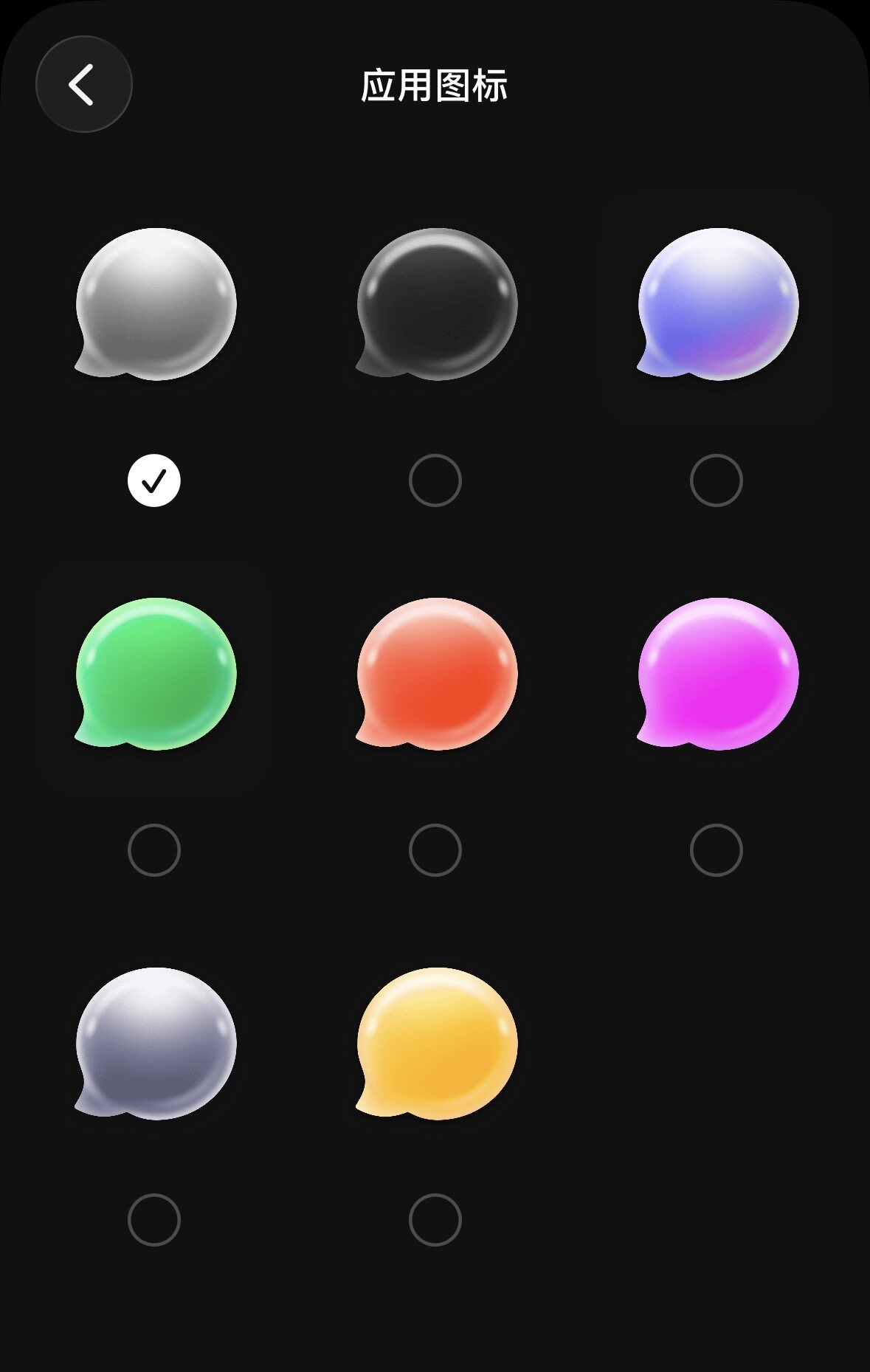
Interesting Point No.10: App Icons Include 8 Varieties, and Bubbles are Extremely Similar to WeChat Bubbles

As shown in previous beta versions, the official version of XChat also prepared white, black, purple, green, orange, pink, gray, and yellow icons—8 colors in total—for users to switch between. Although it's a very small feature, it still adds a touch of much-needed human feel to this chat app focused on encryption and privacy.
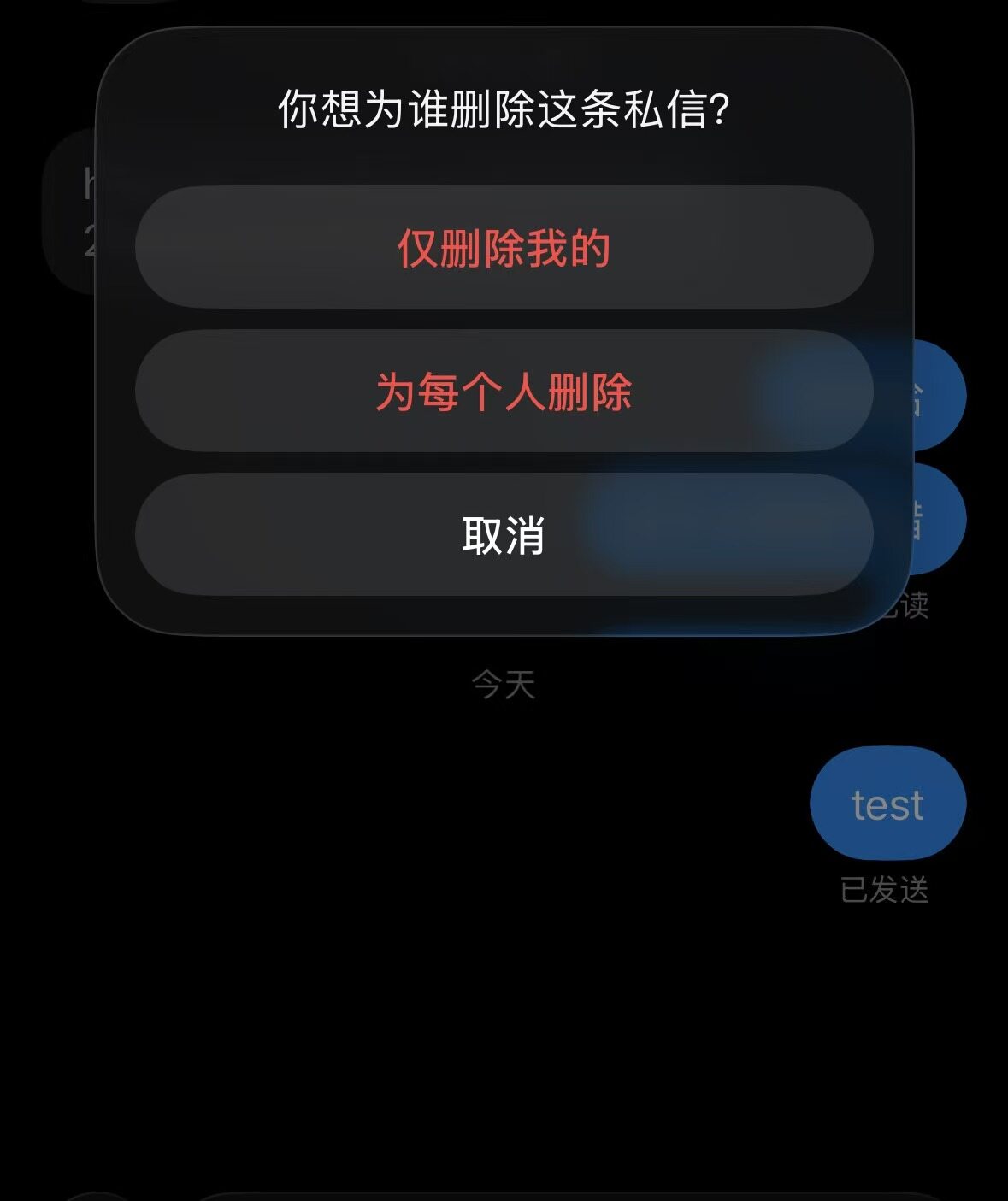
Furthermore, XChat's message deletion function seems borrowed from Telegram, offering "Delete for me" and "Delete for everyone".
Finally, the functions mentioned before XChat's release—one-click import of X contacts and social graph, seamless use of Grok AI, X Money payments, Cashtags—are all temporarily unavailable.

Of course, it's only XChat's first day; there's plenty of time for trial/error and iteration. Let the bullet fly for a while~


Trending Cryptos

Related Questions

QWhat is the main conclusion of the first-day evaluation of XChat, also known as 'Musk's WeChat'?

AThe evaluation concludes that XChat is even worse than expected, with its messaging experience being largely indistinguishable from X Platform's (Twitter) private messages, despite its promotion as an 'encrypted communication' app.

QAccording to the article, how is the encryption technology of XChat related to Bitcoin's technology?

AThe article states that the encryption technology of XChat is completely unrelated to Bitcoin's cryptographic technology. Musk's claim of it using a 'similar encryption architecture to Bitcoin' is criticized as a hard attempt to associate with it, with experts pointing out that Bitcoin's core blockchain functionality is not traditional encryption.

QWhat is one specific feature that did not work as intended during the author's test of XChat?

AThe 'disable screenshots' feature did not work as intended. While it could be enabled in the settings, the author found that screenshots could still be taken in XChat group chats, resulting in an image showing only the group avatars instead of the chat content.

QWhat is the age rating for the XChat application on the AppStore, and how does it compare to WeChat?

AXChat has an age rating of 16+ on the AppStore, which includes content such as profanity, crude humor, sexual content, nudity, and unrestricted web access. In contrast, WeChat has a lower age rating of 13+.

QWhat are some of the promised features that were not available in the initial launch version of XChat?

ASeveral promised features were not available at launch, including one-click import of X contacts and social networks, seamless integration with Grok AI, X Money payments, and Cashtags functionality.

Related Reads

In Conversation with Ray Dalio: We Are Currently in an AI Bubble, with 1% of My Portfolio in Bitcoin

Ray Dalio, founder of Bridgewater Associates, warns in an interview that the current AI boom shows classic bubble characteristics, which could lead to significant economic downturns as seen in past cycles like 1929 or 2000. He explains that speculative enthusiasm, fueled by debt and overvaluation, often precedes a crash when rising rates or taxation force asset sales, causing widespread losses and recession. Dalio also outlines his "Big Cycle" theory, describing an approximate 80-year pattern where widening wealth gaps, massive government deficits, and shifting geopolitical power (like China's rise) create internal conflict and global instability. He emphasizes that we are in a late-cycle, transitional phase where traditional powers like the US and UK face decline. For personal wealth protection, Dalio advises diversification beyond cash into assets like stocks, bonds, real estate, and particularly gold, which he prefers over Bitcoin. While he holds about 1% of his portfolio in Bitcoin as a non-printable hard asset, he views gold as more secure from technological or governmental threats. Regarding AI's impact, Dalio believes it will disproportionately benefit capital owners, worsening inequality by replacing both physical and cognitive labor. He suggests that human intuition and emotional intelligence, combined with AI, will be key for future workers. On taxation, Dalio argues that wealth taxes are impractical and risk triggering asset sell-offs, reducing productive investment. He points to the UK as a cautionary example of debt, low productivity, and political strife. Geopolitically, Dalio foresees a more regionalized world, with the US showing weakness in prolonged conflicts like with Iran, akin to past imperial declines. The ideal outcome, he suggests, is coexisting powerful blocs (e.g., Americas, China-Asia Pacific) without major war.

marsbitJust now

In Conversation with Ray Dalio: We Are Currently in an AI Bubble, with 1% of My Portfolio in Bitcoin

marsbitJust now

Daily 7.2 Trillion KRW: Foreign Capital's Record Net Buying on Friday! Wall Street Says Headwinds for Korean Stock Fund Flows Have Subsided

South Korean stock market sees a dramatic shift in fund flows. On July 31, foreign investors made a record net purchase of approximately KRW 7.2 trillion in KOSPI stocks, marking a fundamental reversal from the persistent large-scale net outflows seen in previous months. This contributed to a significant narrowing of foreign net selling in July to KRW 9.8 trillion, down sharply from KRW 48.4 trillion in June and KRW 44.5 trillion in May. Simultaneously, domestic institutional pressure eased. South Korean pension funds and asset managers turned to a net buying position in July, purchasing KRW 1.0 trillion worth of KOSPI shares, contrasting with net sales in May and June. Market volatility is expected to be dampened by new financial regulations. Effective July 31, the Financial Services Commission tightened access for retail investors to single-stock leveraged ETFs by raising the minimum cash deposit requirement. Trading volumes for these products subsequently dropped to about 50% of their monthly average. Citigroup Research maintains its year-end KOSPI target of 10,000 points. The firm cites several supportive factors: the substantial easing of headwinds from capital outflows, a robust fundamental outlook for the semiconductor sector, historically low market valuations, strong economic fundamentals, and the potential for policy support from financial authorities if needed.

marsbitJust now

Daily 7.2 Trillion KRW: Foreign Capital's Record Net Buying on Friday! Wall Street Says Headwinds for Korean Stock Fund Flows Have Subsided

marsbitJust now

Thanks to Dice Rolls, Bitcoin Keys Are Stored Offline, But Not Everyone Will Do It

The article discusses using dice rolls to generate secure Bitcoin wallet seeds, providing entropy independent of potentially flawed hardware random number generators. It explains that each fair dice roll offers about 2.585 bits of entropy, with around 50 rolls needed for a standard 12-word seed phrase and 99+ recommended for higher security. This method gained attention after a vulnerability was revealed in some Coldcard hardware wallets, where a faulty firmware RNG (dating back to 2021) compromised generated keys. The analysis notes that while a dice-generated main seed was safe from this specific flaw, other Coldcard functions (like creating paper wallets, backup keys, or passwords) could still be vulnerable if they used the defective RNG. The piece argues that while dice-based entropy is technically robust, the manual process is error-prone, tedious, and unrealistic for most new users, who might make mistakes in recording or inputting rolls. It concludes that while manual entropy generation should remain an option for advanced users, the long-term goal is to develop reliable, user-friendly hardware and software that securely generates randomness without requiring specialized knowledge. Coldcard users are advised to check their firmware version and replace any secondary secrets (like paper wallet keys) created with vulnerable devices, while also considering multi-signature setups with devices from different manufacturers for added security.

cryptonews.ru5h ago

Thanks to Dice Rolls, Bitcoin Keys Are Stored Offline, But Not Everyone Will Do It

cryptonews.ru5h ago

Trading

Spot

Hot Articles

Discussions

Welcome to the HTX Community. Here, you can stay informed about the latest platform developments and gain access to professional market insights. Users' opinions on the price of S (S) are presented below.

活动图片














