Polish parliament approves revived crypto bill, heads to Senate

cointelegraphPublished on 2025-12-19Last updated on 2025-12-19

Abstract

Poland's lower house of parliament (Sejm) has again passed a crypto bill, sending it to the Senate for review. The bill, which aligns with the EU's MiCA framework, was previously vetoed by President Karol Nawrocki over concerns it threatened freedoms, property rights, and state stability. Despite no changes, a government spokesperson suggests it is now likely to be signed into law after a classified security briefing provided the president with "full knowledge" of its national security implications. Nawrocki had earlier campaigned against "oppressive" crypto laws, advocating for innovation over regulation.

The Sejm, the lower house of Poland’s legislature, has again passed a bill that could impose restrictions on the cryptocurrency market, following the country’s president’s veto of an earlier attempt.

In a Thursday vote, Polish lawmakers voted 241 for and 183 against the Crypto-Assets Market Act, a bill previously vetoed by President Karol Nawrocki. On Friday, the bill was sent to the Senate for further consideration.
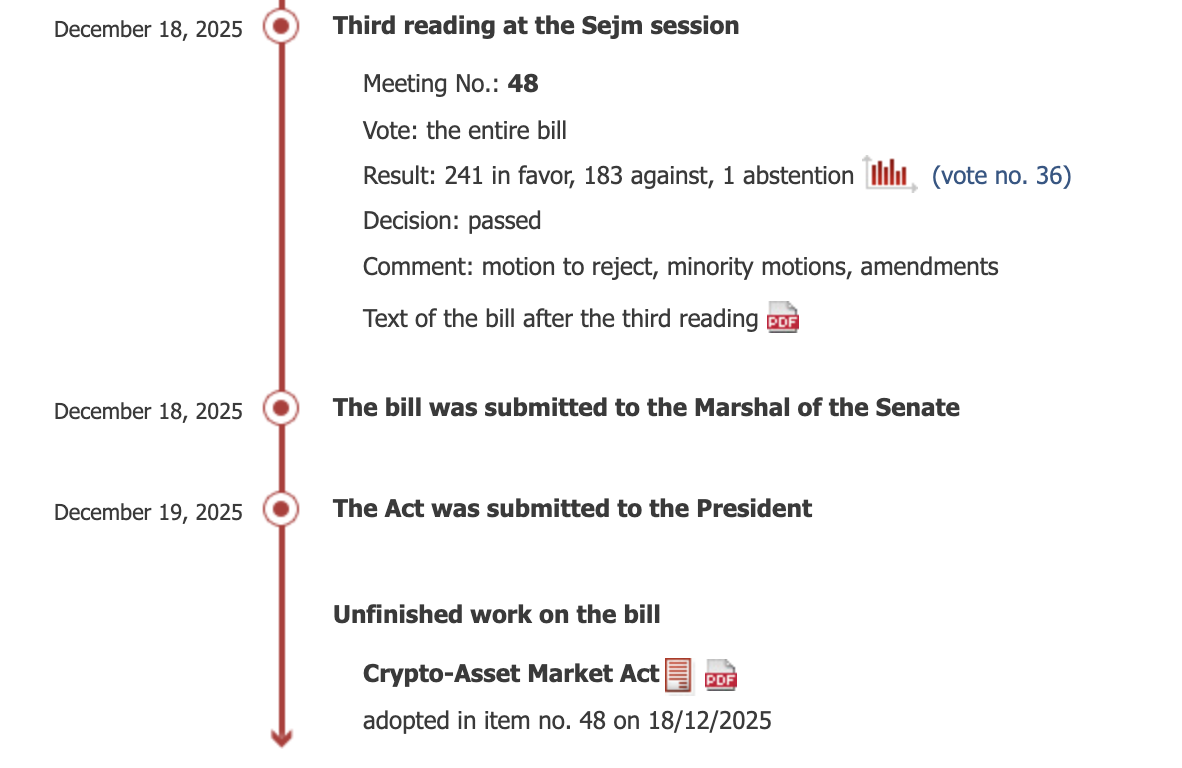
Progress of Poland’s Crypto-Asset Market Act. Source: Sejm

The crypto bill is intended to align Poland’s regulations with the European Union’s Markets in Crypto-Assets Regulation (MiCA) framework, with member states expected to transition by July 2026. The same version of the bill, which passed the lower house in September, received criticism from some lawmakers and industry advocates, who claimed it could threaten the country’s crypto market and its users.

Though the first attempt at passing the bill made it through the Polish Senate, Nawrocki vetoed it in December, claiming that it would “genuinely threaten the freedoms of Poles, their property, and the stability of the state.” Lawmakers reintroduced the bill without any changes last week.

The Senate is now set to review the bill, and, if approved, it may end up once again on Nawrocki‘s desk.

A government spokesperson reportedly said that the bill is likely to be signed into law this time, following a classified security briefing that provided the president with “full knowledge” of its implications for national security.

Related: Binance updates crypto rules in Poland to meet new MiCA requirements

Cointelegraph reached out to the president’s office for comment, but had not received a response at the time of publication.

Polish president campaigned against crypto regulations

Nawrocki, who assumed office in August, sided with crypto industry advocates ahead of the second round of the presidential election. In a May X post, he said that he would guarantee “no oppressive laws” would be implemented in the digital asset industry, adding “Poland needs innovation, not regulation,” according to a translated statement.

Nawrocki narrowly won his election with 50.89% of the vote for a five-year term. He is eligible to run for a second term in 2030.

Magazine: When privacy and AML laws conflict: Crypto projects’ impossible choice

Related Questions

QWhat is the name of the crypto bill passed by the Polish parliament's lower house?

AThe Crypto-Assets Market Act.

QWhy was the previous version of this crypto bill vetoed by President Karol Nawrocki?

AHe claimed it would 'genuinely threaten the freedoms of Poles, their property, and the stability of the state.'

QWhat is the purpose of the Crypto-Assets Market Act in relation to the European Union?

AIt is intended to align Poland's regulations with the European Union's Markets in Crypto-Assets Regulation (MiCA) framework.

QWhat development suggests the bill is more likely to be signed into law this time?

AThe president received a classified security briefing that provided him with 'full knowledge' of the bill's implications for national security.

QWhat was President Nawrocki's campaign stance on cryptocurrency regulation before his election?

AHe sided with crypto industry advocates, stating 'Poland needs innovation, not regulation' and that he would guarantee 'no oppressive laws' in the digital asset industry.

Related Reads

Warsh's First Day in Office, Markets Deliver a 'Wake-up Call': Rate Hike Expected This Year

On his first day in office, newly inaugurated Federal Reserve Chairman Warsh received a stark market warning, with expectations now fully pricing in a 25-basis-point interest rate hike this year. The shift was triggered by hawkish remarks from Fed Governor Waller, who stated that inflation is now the key policy "driver" and that the odds of a hike or cut are evenly split. This sent short-term Treasury yields higher. Waller signaled a significant pivot in his stance, citing disappointing inflation and labor data. He suggested removing "easing bias" language from Fed statements and did not rule out future rate increases if inflation fails to recede, though he noted immediate action isn't warranted without signs of unanchored inflation expectations. Chairman Warsh faces immediate pressure at his first FOMC meeting in June. With the preferred inflation gauge at a three-year high, analysts warn that failing to hike could be interpreted as an implicit easing of policy. The geopolitical situation in the Middle East is adding to existing price pressures. The market's expectation for a hike contrasts sharply with earlier forecasts for multiple cuts. While long-term Treasury yields have been contained by lower energy prices recently, analysts note they remain under structural upward pressure. Warsh's swearing-in at the White House highlights political scrutiny over Fed independence. However, the market has made it clear that inflation is the most urgent challenge, leaving the new chairman little time to settle in.

marsbit8h ago

Warsh's First Day in Office, Markets Deliver a 'Wake-up Call': Rate Hike Expected This Year

marsbit8h ago

Has Microsoft Lost Its Way in the AI Race, and Can Copilot Bring It Back on Track?

Microsoft, once seen as an early AI frontrunner due to its investment in OpenAI, is navigating a strategic shift amid increased competition. Its initial reliance on OpenAI’s GPT models has been complicated by OpenAI’s growing ambitions as a direct competitor, rapid advancements from rivals like Claude and Gemini, and the disruptive rise of AI agents, which challenge its traditional SaaS business model. These factors contributed to stock declines and slower-than-expected adoption of its flagship Copilot products. In response, CEO Satya Nadella has taken a hands-on role in product development, signaling the urgency of change. Microsoft is pivoting from a model-centric strategy to a "model-agnostic" enterprise platform approach. It aims to become the foundational layer connecting various AI models—from OpenAI, Anthropic, or its own new "Superintelligence" team—with enterprise workflows, data, security, and cloud services. Recent organizational changes merged consumer and enterprise Copilot teams to accelerate innovation, exemplified by new products like Copilot Tasks and Copilot Cowork. However, this transformation comes at a high cost. Microsoft faces massive capital expenditures, potentially reaching ~$190 billion by 2026, to support AI infrastructure. While its platform strategy shows early signs of traction with growing Azure AI revenue, it must balance startup-like agility with the reliability expected by enterprise clients. The core challenge is no longer being the sole AI winner but defending its position as the essential enterprise software entry point amidst rapid technological commoditization and the shift towards always-on AI agents.

marsbit8h ago

Has Microsoft Lost Its Way in the AI Race, and Can Copilot Bring It Back on Track?

marsbit8h ago

Trading

Spot
Futures

Hot Articles

Discussions

Welcome to the HTX Community. Here, you can stay informed about the latest platform developments and gain access to professional market insights. Users' opinions on the price of S (S) are presented below.

活动图片