Patrick Witt Teases ‘Breakthrough’ On US Strategic Bitcoin Reserve

bitcoinistPublished on 2026-05-18Last updated on 2026-05-18

Abstract

White House digital-assets official Patrick Witt indicated an upcoming announcement on the U.S. Strategic Bitcoin Reserve, calling recent progress a "breakthrough" in establishing a legally sound and operationally secure framework. He clarified the focus is on implementation, custody, and interagency coordination for Bitcoin already held by the government, not confirming a new open-market purchase program. Witt emphasized the need for robust safeguards, citing past asset thefts, and expressed a desire to codify the reserve into law through pending legislation rather than relying on reversible executive orders. He framed the reserve as part of a broader U.S. strategy to lead in global digital asset financial infrastructure.

White House digital-assets official Patrick Witt said the administration is preparing an announcement on the US Strategic Bitcoin Reserve, describing recent work as a “breakthrough” in making the reserve legally sound and operationally secure. His comments suggest the next step is likely to focus on implementation, custody and agency coordination rather than a confirmed open-market Bitcoin purchase program.

Speaking with Scott Melker in an interview released May 17, Witt confirmed once again that the reserve effort has continued behind the scenes even as broader crypto-market structure legislation has dominated Washington’s digital-asset agenda. The Strategic Bitcoin Reserve, he said, was never dropped; it was simply moving through a slower interagency process triggered by the earlier executive order.

“There’s still progress there. There’s still work going on behind the scenes,” Witt said. “We never stopped working on it.”

US Strategic Bitcoin Reserve Update Nears

Witt credited Harry Jung, his deputy, with leading much of the internal process, including coordination across agencies and White House policy teams responsible for ensuring that executive orders are carried out. The work, he said, has involved the less visible but critical mechanics of government implementation: legal memos, agency authorities, asset safeguards and the question of whether existing powers are sufficient.

“We’ll have an announcement. And I wish I could say more at this time,” Witt said. “It’s a breakthrough as far as getting everything in place, legally sound, properly safeguarding the assets.”

That phrasing matters. The market-sensitive question around the reserve remains whether the US government will eventually move beyond retaining seized Bitcoin and pursue additional accumulation. Witt did not confirm that. Instead, his comments pointed to the architecture of the reserve itself: how Bitcoin already held by the government is identified, secured, transferred, accounted for and separated from the broader US Digital Asset Stockpile.

Witt tied the urgency partly to the government’s existing exposure to digital assets. He referenced the theft of assets from US Marshals Service holdings involving “tier 2 assets,” calling it a proof point that federal digital-asset custody requires a different level of care.

“These assets have to be safeguarded. They are unique,” Witt said. “It’s going to require the government to do this in a bit of a different way and obviously take it very, very seriously because we have more of these assets on the balance sheet.”

The reserve has also become a legislative question. Witt said executive orders are “very reversible,” citing the way incoming administrations often undo prior executive actions. For that reason, he said the administration wants the reserve framework codified into law rather than left dependent on presidential authority alone.

Witt pointed to Senator Cynthia Lummis’ BITCOIN Act and a House effort led by Representative Nick Begich, the American Reserves Modernization Act, or ARMA. According to Witt, the House bill has incorporated stakeholder feedback and could potentially move through a committee markup before seeking a path alongside must-pass legislation.

The broader policy logic is geopolitical as much as domestic. Witt said other jurisdictions are watching Washington’s digital-asset agenda closely, particularly the CLARITY Act and related legislation. In his framing, a US Bitcoin reserve is not isolated from market-structure reform, stablecoin rules or bank-permissible-activity provisions; it is part of a wider attempt to define the financial infrastructure the US wants to lead.

“There’s no more powerful institutional sponsorship than the US government saying we give this a thumbs up and we think that this should be part of the financial architecture,” Witt said. He added that if the US fails to set the rules, “we will be following somebody else’s rule book.”

At press time, BTC traded at $76,825.
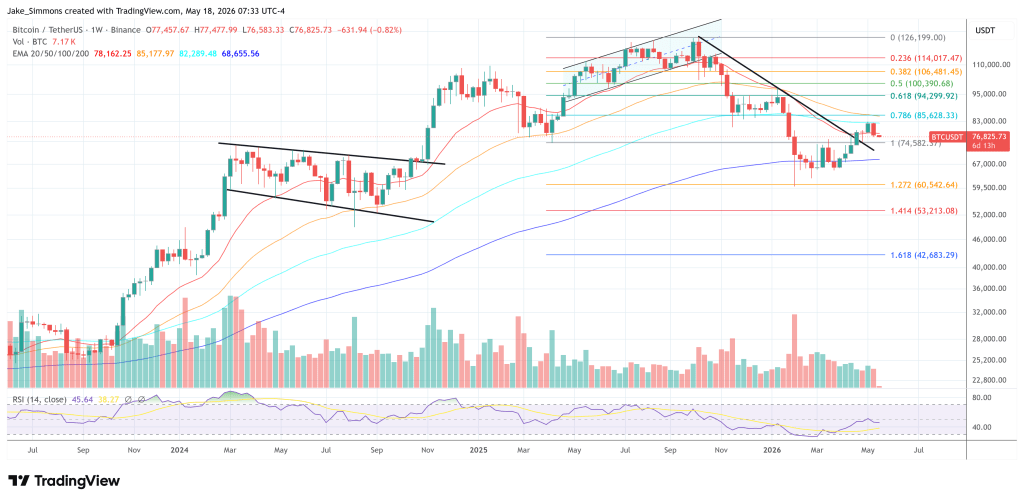
Bitcoin falls below the 20-week EMA again, 1-week chart | Source: BTCUSDT on TradingView.com

Related Questions

QWhat is the main focus of the upcoming announcement regarding the US Strategic Bitcoin Reserve, according to Patrick Witt?

AThe upcoming announcement will focus on making the reserve legally sound and operationally secure. The next steps are likely to center on implementation, custody, and agency coordination, rather than confirming an open-market Bitcoin purchase program.

QAccording to Witt, why has the Strategic Bitcoin Reserve process been moving slowly?

AThe process has been moving through a slower interagency process that was triggered by an earlier executive order. It was never dropped; work has continued behind the scenes even as broader crypto-market structure legislation has dominated the agenda.

QWhat reason did Patrick Witt give for the urgency in establishing a proper framework for the Bitcoin reserve?

AWitt cited the government's existing exposure to digital assets, referencing a theft from US Marshals Service holdings as proof that federal digital-asset custody requires a different, more serious level of care to properly safeguard these unique assets.

QWhy does the administration want the reserve framework codified into law instead of relying solely on an executive order?

AExecutive orders are "very reversible," as incoming administrations often undo prior executive actions. Codifying the framework into law would make it more permanent and less dependent on presidential authority alone.

QWhat broader geopolitical rationale did Witt provide for establishing a US Bitcoin reserve?

AWitt stated that other jurisdictions are watching Washington's digital-asset agenda closely. A US Bitcoin reserve is part of a wider attempt to define the financial infrastructure the US wants to lead, ensuring the US sets the rules rather than following someone else's rulebook.

Related Reads

Anthropic Founder's Handbook: How to Build an AI-Native Company!

Anthropic has released "The Founder's Playbook: How to Build an AI Native Company," a guide that reimagines the startup lifecycle (Ideation, MVP, Launch, Scale) for 2026-era AI capabilities. The core thesis is that AI is fundamentally changing how ideas become reality, shifting the founder's role from an individual contributor to an orchestrator of AI agents. This lowers execution barriers, allowing domain experts (e.g., in medicine, law, education) to build products without deep technical skills, as AI can handle prototyping, coding, research, and operations. However, the playbook warns that easier prototyping increases the risk of building products no one needs, emphasizing that validation, not just building, is critical. It highlights that AI enables small teams to possess capabilities once reserved for large organizations, compressing functions like development, marketing, and support. This challenges traditional competitive advantages based on organizational size. For AI-native companies, sustainable moats will not come from the AI model alone but from deep domain knowledge, user data flywheels (behavioral fingerprints from real usage), and workflow lock-in that makes switching costly. Ultimately, the guide signals a shift in focus from raw model capability to how AI fundamentally reshapes company structure, processes, and competitive strategy. An AI-native company is defined not by using AI tools but by embedding AI into its core operational DNA from inception.

marsbit56m ago

Anthropic Founder's Handbook: How to Build an AI-Native Company!

marsbit56m ago

Trading

Spot
Futures

Hot Articles

What is $BITCOIN

DIGITAL GOLD ($BITCOIN): A Comprehensive Analysis Introduction to DIGITAL GOLD ($BITCOIN) DIGITAL GOLD ($BITCOIN) is a blockchain-based project operating on the Solana network, which aims to combine the characteristics of traditional precious metals with the innovation of decentralized technologies. While it shares a name with Bitcoin, often referred to as “digital gold” due to its perception as a store of value, DIGITAL GOLD is a separate token designed to create a unique ecosystem within the Web3 landscape. Its goal is to position itself as a viable alternative digital asset, although specifics regarding its applications and functionalities are still developing. What is DIGITAL GOLD ($BITCOIN)? DIGITAL GOLD ($BITCOIN) is a cryptocurrency token explicitly designed for use on the Solana blockchain. In contrast to Bitcoin, which provides a widely recognized value storage role, this token appears to focus on broader applications and characteristics. Notable aspects include: Blockchain Infrastructure: The token is built on the Solana blockchain, known for its capacity to handle high-speed and low-cost transactions. Supply Dynamics: DIGITAL GOLD has a maximum supply capped at 100 quadrillion tokens (100P $BITCOIN), although details regarding its circulating supply are currently undisclosed. Utility: While precise functionalities are not explicitly outlined, there are indications that the token could be utilized for various applications, potentially involving decentralized applications (dApps) or asset tokenization strategies. Who is the Creator of DIGITAL GOLD ($BITCOIN)? At present, the identity of the creators and development team behind DIGITAL GOLD ($BITCOIN) remains unknown. This situation is typical among many innovative projects within the blockchain space, particularly those aligning with decentralized finance and meme coin phenomena. While such anonymity may foster a community-driven culture, it intensifies concerns about governance and accountability. Who are the Investors of DIGITAL GOLD ($BITCOIN)? The available information indicates that DIGITAL GOLD ($BITCOIN) does not have any known institutional backers or prominent venture capital investments. The project seems to operate on a peer-to-peer model focused on community support and adoption rather than traditional funding routes. Its activity and liquidity are primarily situated on decentralized exchanges (DEXs), such as PumpSwap, rather than established centralized trading platforms, further highlighting its grassroots approach. How DIGITAL GOLD ($BITCOIN) Works The operational mechanics of DIGITAL GOLD ($BITCOIN) can be elaborated on based on its blockchain design and network attributes: Consensus Mechanism: By leveraging Solana’s unique proof-of-history (PoH) combined with a proof-of-stake (PoS) model, the project ensures efficient transaction validation contributing to the network's high performance. Tokenomics: While specific deflationary mechanisms have not been extensively detailed, the vast maximum token supply implies that it may cater to microtransactions or niche use cases that are still to be defined. Interoperability: There exists the potential for integration with Solana’s broader ecosystem, including various decentralized finance (DeFi) platforms. However, the details regarding specific integrations remain unspecified. Timeline of Key Events Here is a timeline that highlights significant milestones concerning DIGITAL GOLD ($BITCOIN): 2023: The initial deployment of the token occurs on the Solana blockchain, marked by its contract address. 2024: DIGITAL GOLD gains visibility as it becomes available for trading on decentralized exchanges like PumpSwap, allowing users to trade it against SOL. 2025: The project witnesses sporadic trading activity and potential interest in community-led engagements, although no noteworthy partnerships or technical advancements have been documented as of yet. Critical Analysis Strengths Scalability: The underlying Solana infrastructure supports high transaction volumes, which could enhance the utility of $BITCOIN in various transaction scenarios. Accessibility: The potential low trading price per token could attract retail investors, facilitating wider participation due to fractional ownership opportunities. Risks Lack of Transparency: The absence of publicly known backers, developers, or an audit process may yield skepticism regarding the project's sustainability and trustworthiness. Market Volatility: The trading activity is heavily reliant on speculative behavior, which can result in significant price volatility and uncertainty for investors. Conclusion DIGITAL GOLD ($BITCOIN) emerges as an intriguing yet ambiguous project within the rapidly evolving Solana ecosystem. While it attempts to leverage the “digital gold” narrative, its departure from Bitcoin's established role as a store of value underscores the need for a clearer differentiation of its intended utility and governance structure. Future acceptance and adoption will likely depend on addressing the current opacity and defining its operational and economic strategies more explicitly. Note: This report encompasses synthesised information available as of October 2023, and developments may have transpired beyond the research period.

363 Total ViewsPublished 2025.05.13Updated 2025.05.13

What is $BITCOIN

Discussions

Welcome to the HTX Community. Here, you can stay informed about the latest platform developments and gain access to professional market insights. Users' opinions on the price of BTC (BTC) are presented below.

活动图片