Morgan Stanley’s Bitcoin ETF $MBST set to go live – Details

ambcryptoPublished on 2026-04-08Last updated on 2026-04-08

Abstract

Morgan Stanley, with $6.2 trillion in assets, is launching its Bitcoin ETF, the Morgan Stanley Bitcoin Trust ($MBST), effective April 8th, 2026. This makes it the first traditional bank to offer a Bitcoin ETF, featuring a competitive annual fee of 0.14%, significantly lower than BlackRock's iShares Bitcoin Trust (IBIT) at 0.25%. The launch is part of a broader crypto push by the bank, which includes filings for Spot Solana ETFs and plans to enable crypto trading on E*Trade. This move reflects a shift in sentiment among traditional financial giants, who are recognizing the long-term value of crypto. The article notes that despite a recent $159.1 million outflow from Bitcoin ETFs, massive inflows were recorded just days prior, and the MSBT has the potential to challenge MicroStrategy's significant institutional Bitcoin holdings.

Morgan Stanley, an American investment banking giant with $6.2 trillion in assets under management (AUM), has now made a major crypto move.

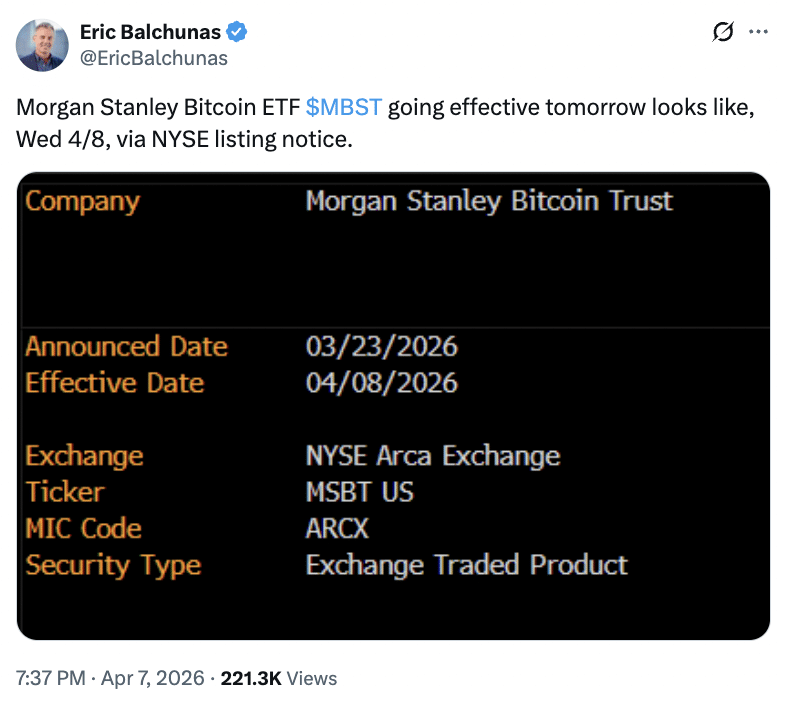
According to Bloomberg’s ETF Analyst Eric Balchunas’ recent X post, Morgan Stanley Bitcoin Trust will be effective from the 8th of April under the ticker $MBST.
Source: Eric Balchunas/X

The banking giant first announced its plans to launch its Bitcoin [BTC] ETF on the 23rd of March, 2026, aiming to start trading on NYSE Arca.

How Morgan Stanley’s MSBT launch stands out

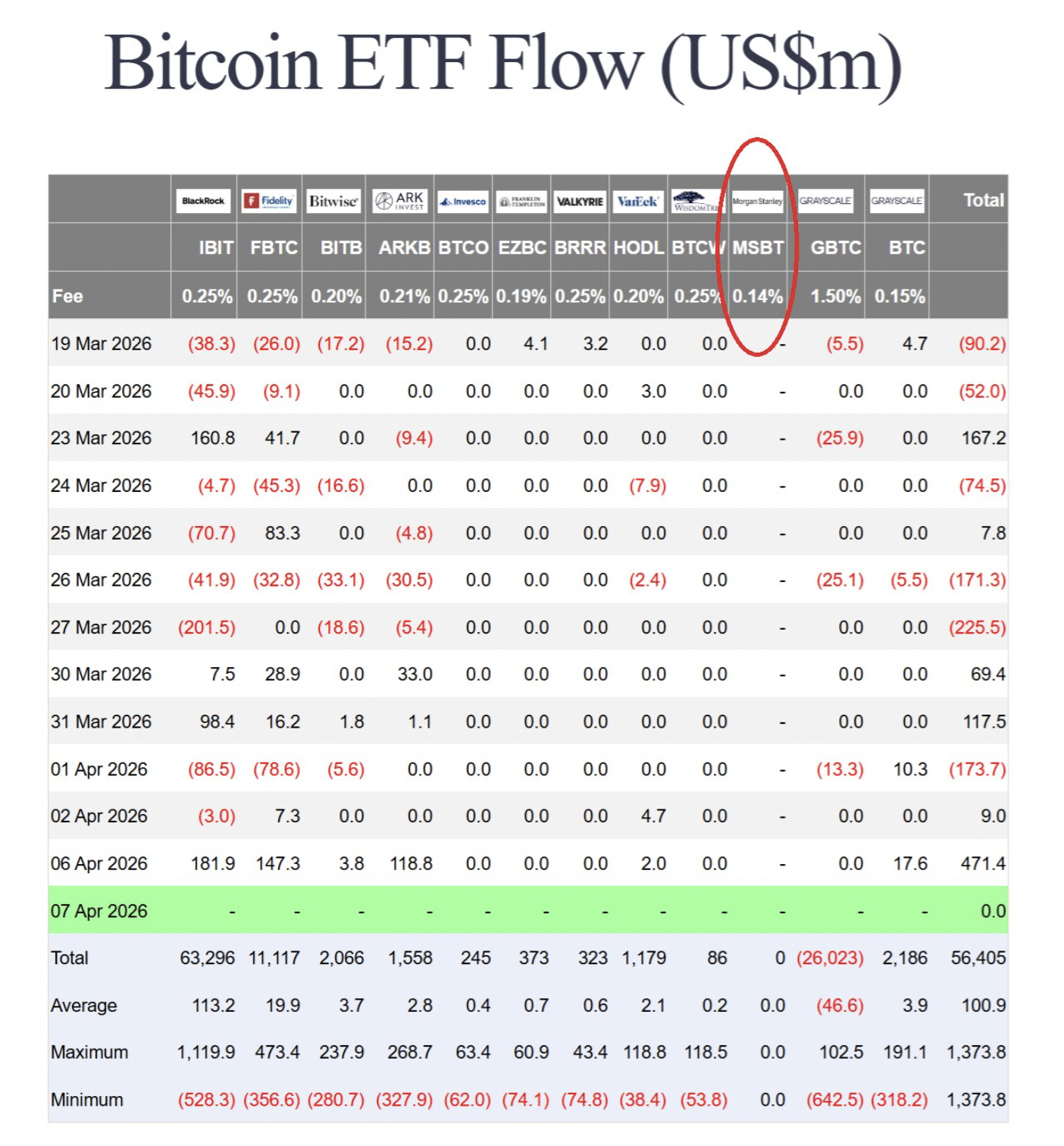
With this move, Morgan Stanley becomes the first traditional bank to offer a Bitcoin ETF with a 0.14% fee. This is much less compared to the biggest Bitcoin ETF, BlackRock’s iShares Bitcoin Trust ETF, which has an annual fee of 0.25%.

Additionally, the Farside Investor’s Bitcoin ETF Flow monitor has also upgraded to include the Morgan Stanley Bitcoin Trust ETF.
Source: Farside Investors

Besides this launch, Morgan Stanley also filed for Spot Solana ETFs earlier this year. Additionally, the banking giant has made plans in collaboration with Zero Hash to roll out E*Trade in the first half of 2026, enabling trading in Bitcoin, Ethereum [ETH], and Solana [SOL].

Shift in sentiment

Traditional giants are now seeing potential in the long-term value of crypto. Supporting this argument are reports that show crypto standing strong against traditional asset classes despite escalating geopolitical turmoil.

That being said, Morgan Stanley is not alone in this crypto race. Recently, JP Morgan’s CEO Jamie Dimon also highlighted the need for banks to catch up with blockchain technology to stand firm against the “new competitors.”

Seeing this shift in sentiment from traditional investors, Strategy’s now CEO, Phhong Lee, noted,

In the last month, Morgan Stanley, Charles Schwab, and Citadel — among the world’s largest wealth managers, broker-dealers, and hedge funds — have announced plans to build Bitcoin capabilities. Probably nothing.

Bitcoin price action and more

This comes as Bitcoin’s price was trading at $71,732.65 at press time after a hike of 4.34% in the past 24 hours. Meanwhile, Bitcoin ETF recorded outflows worth $159.1 million on the 7th of April. However, it did record a massive inflow worth $471.4 million just a day before, on the 6th of April.
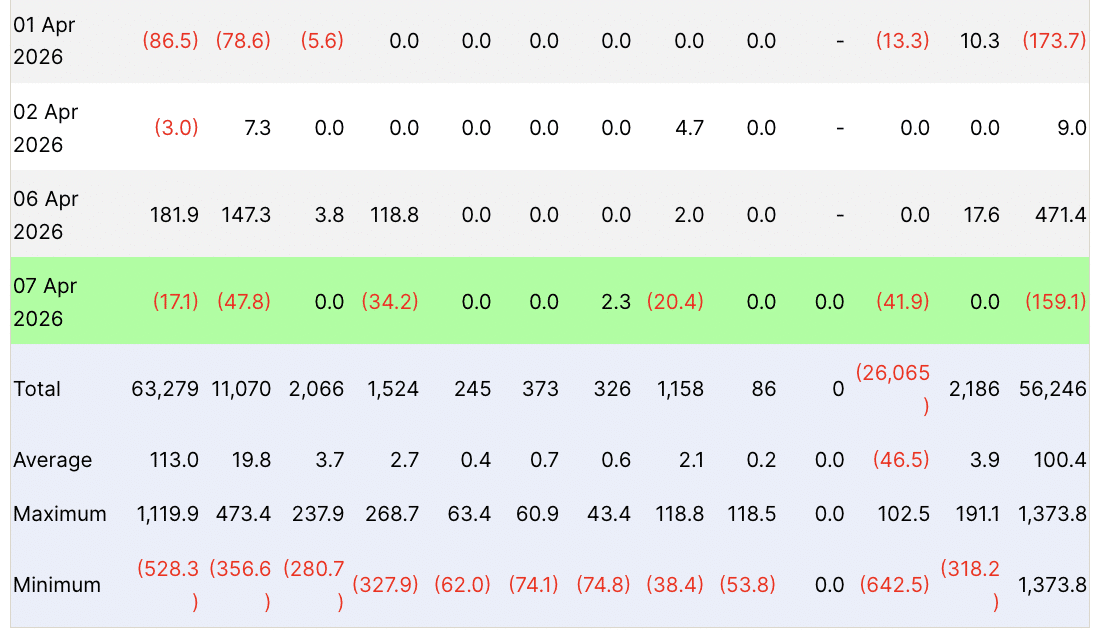
Source: Farside Investors

Amidst these changing dynamics, AMBCrypto still believes that MSBT has the potential to break MSTR’s institutional Bitcoin bet.

Though CryptoQuant data shows that Bitcoin treasury demand is mostly concentrated in the hands of Strategy, the MSBT launch could be a turning point for the overall institutional Bitcoin market.
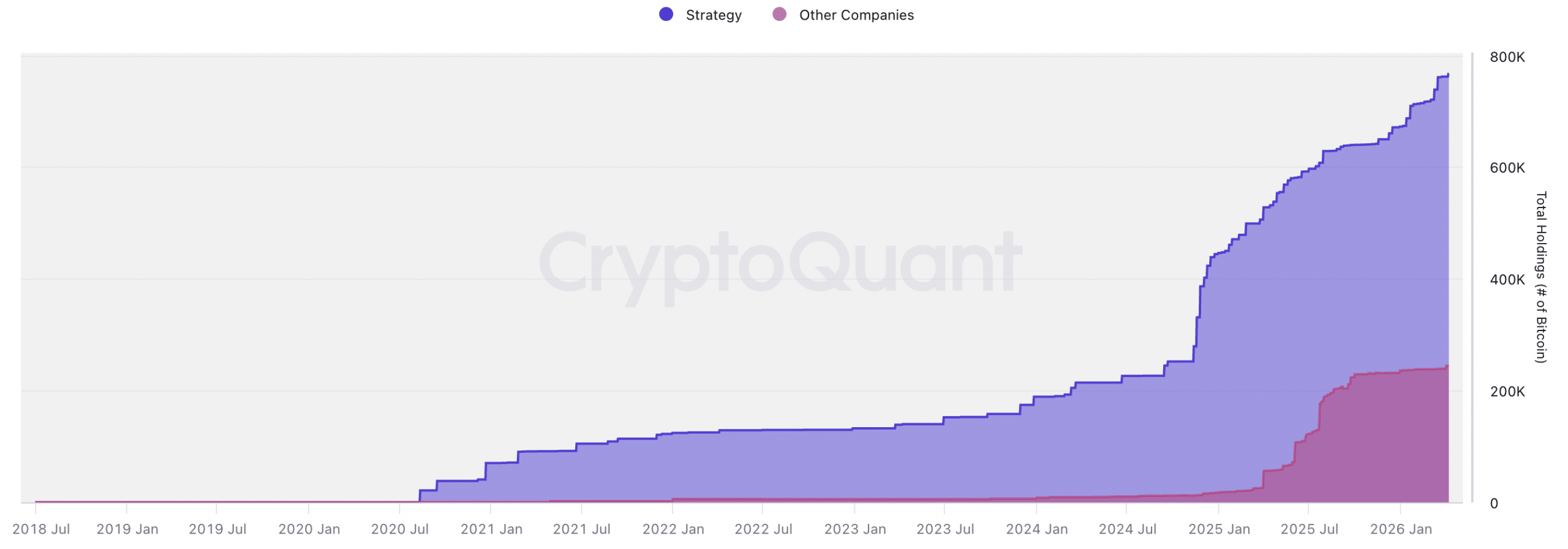
Source: CryptoQuant

Final Summary

  • Announced on the 23rd of March, 2026, the Morgan Stanley Bitcoin Trust will be effective from the 8th of April, 2026.
  • With 0.14% annual fees in comparison to IBIT’s 0.25%, MSBT is here to uplift the game of Wall Street’s crypto strides.


Related Questions

QWhen will the Morgan Stanley Bitcoin Trust (MBST) become effective and on which exchange will it trade?

AThe Morgan Stanley Bitcoin Trust will be effective from April 8th, 2026, and is set to trade on NYSE Arca.

QWhat is the annual fee for Morgan Stanley's Bitcoin ETF and how does it compare to BlackRock's iShares Bitcoin Trust (IBIT)?

AMorgan Stanley's Bitcoin ETF has an annual fee of 0.14%, which is significantly lower than BlackRock's IBIT fee of 0.25%.

QBesides a Bitcoin ETF, what other crypto-related products has Morgan Stanley filed for or planned?

AMorgan Stanley has also filed for Spot Solana ETFs and, in collaboration with Zero Hash, plans to roll out E*Trade in the first half of 2026 to enable trading in Bitcoin, Ethereum, and Solana.

QWhat was the quote from Strategy's CEO, Phhong Lee, regarding the recent moves by traditional financial institutions?

APhhong Lee noted: 'In the last month, Morgan Stanley, Charles Schwab, and Citadel — among the world’s largest wealth managers, broker-dealers, and hedge funds — have announced plans to build Bitcoin capabilities. Probably nothing.'

QWhat was the price of Bitcoin and the net flow for Bitcoin ETFs on April 7th, according to the article?

AAt press time, Bitcoin's price was $71,732.65. Bitcoin ETFs recorded outflows worth $159.1 million on April 7th, following a massive inflow of $471.4 million on April 6th.

Related Reads

Codex Goal Mode Usage Guide: How to Make AI Continuously Pursue a Specific Objective

"Codex Goal Mode: How to Make AI Work Continuously Toward a Specific Goal" OpenAI's Codex "goal mode" (/goal) transforms the AI from a reactive code assistant into a proactive execution agent capable of working autonomously for hours or even days to achieve a defined objective. To maximize its effectiveness, follow these key principles: 1. **Define Clear, Verifiable Exit Criteria:** The goal prompt should be a concise, measurable success condition, not a lengthy specification. Use quantifiable metrics like "reduce build time by 30%" or "achieve 100% test parity." 2. **Provide Initial Guidance and Tools:** Direct Codex toward likely problem areas and specify available tools (e.g., browsers, testing environments) to prevent it from exploring unproductive paths. 3. **Enable Progress Measurement:** Equip Codex with ways to track advancement, such as creating comparison tools for visual tasks or evaluation sets, ensuring it can gauge its own progress. 4. **Use a Realistic Execution Environment:** For tasks like performance optimization, provide access to environments that closely mimic production (e.g., similar configs, databases) to yield valid results. 5. **Be Cautious with Visual Goals:** Avoid vague "pixel-perfect" instructions. Instead, supplement visual references with functional checklists or design system specifications to prevent Codex from obsessing over minor details. 6. **Implement Progress Tracking:** For long-running tasks, have Codex commit code to draft PRs, update progress documents, or send Slack updates to maintain visibility into its work. 7. **Review and Consolidate Results:** Once the goal is met, instruct Codex to review its work, clean up ineffective experimental code, and reflect on what strategies succeeded or failed. Ultimately, using goal mode shifts the developer's role from writing prompts to managing a persistent engineering agent—defining objectives, establishing metrics, configuring environments, and conducting final reviews.

marsbit52m ago

Codex Goal Mode Usage Guide: How to Make AI Continuously Pursue a Specific Objective

marsbit52m ago

From Ethereum to AI's 'CROPS': What Exactly Is This 'Slow Variable' That Vitalik Has Repeatedly Emphasized?

Recently, Vitalik Buterin has frequently emphasized the concept of "CROPS," first outlined in the Ethereum Foundation's March mandate as core principles guiding its focus: Censorship Resistance, Capture Resistance, Open Source, Privacy, and Security. CROPS represents Ethereum's commitment to providing foundational capabilities for user sovereignty—enabling asset ownership, identity expression, and coordination without reliance on centralized platforms or surrendering ultimate control. This framework is gaining new urgency with the rise of AI, particularly AI agents managing digital assets and automating transactions. While AI offers convenience, it risks centralizing user data, intent, and control if dependent on opaque, centralized services. Vitalik argues for "CROPS AI"—AI that is open, privacy-preserving, secure, and capable of local execution to maintain user agency. He highlights convergence between "CROPS Ethereum access layers" and "CROPS AI," such as using zero-knowledge proofs for private remote LLM calls and Ethereum RPC reads, ensuring users can access services without exposing sensitive information. Ultimately, CROPS is not just an abstract ideal but a practical guide for Ethereum's development and AI integration. It addresses the critical long-term question: as digital systems grow more powerful, how can users retain control over their privacy, assets, and autonomy? In an AI-driven era, these principles may define Ethereum's enduring value—prioritizing verifiable, secure, and user-centric design over short-term optimizations like speed and cost alone.

marsbit56m ago

From Ethereum to AI's 'CROPS': What Exactly Is This 'Slow Variable' That Vitalik Has Repeatedly Emphasized?

marsbit56m ago

Trading

Spot
Futures

Hot Articles

Discussions

Welcome to the HTX Community. Here, you can stay informed about the latest platform developments and gain access to professional market insights. Users' opinions on the price of S (S) are presented below.

活动图片