Is Riot Platforms’ 500 BTC sale an early warning for Bitcoin’s Q3?

ambcryptoPublished on 2026-07-01Last updated on 2026-07-01

Abstract

The article discusses how the shift from Bitcoin mining to AI is emerging as a risk for Bitcoin in Q3 2026, highlighted by Riot Platforms' recent sale of 500 BTC (worth ~$30 million). Despite Bitcoin's price falling below $57k, Riot's stock outperformed, closing Q2 up 120%. The company sold more BTC than it mined last quarter, reducing its treasury to fund AI and data center investments. This reflects a broader trend where miners, facing pressure as Bitcoin's market price sits below the estimated $78k production cost, may increasingly use BTC reserves as cash to diversify into AI. The rising Bitcoin hashrate further squeezes miner profits, potentially accelerating this strategic pivot. Riot's sale could be an early warning of this structural shift heading into Q3.

The transition from Bitcoin [BTC] mining to AI is emerging as a growing risk as the market heads into Q3.

In a recent post, On-chain Lens reported that Riot Platforms sold around 500 BTC worth approximately $30 million, highlighting this pivot in real time. This move is notable in terms of timing, as Bitcoin has broken below $57k for the first time since early Q4 2025. Typically, such weakness would weigh on RIOT’s stock, yet price action has diverged.

Notably, RIOT closed Q2 up 120%, marking its strongest quarterly performance since Q2 2023. Despite Bitcoin’s 15% correction during Q2, RIOT has significantly outperformed, highlighting a clear decoupling between miner equities and spot BTC.
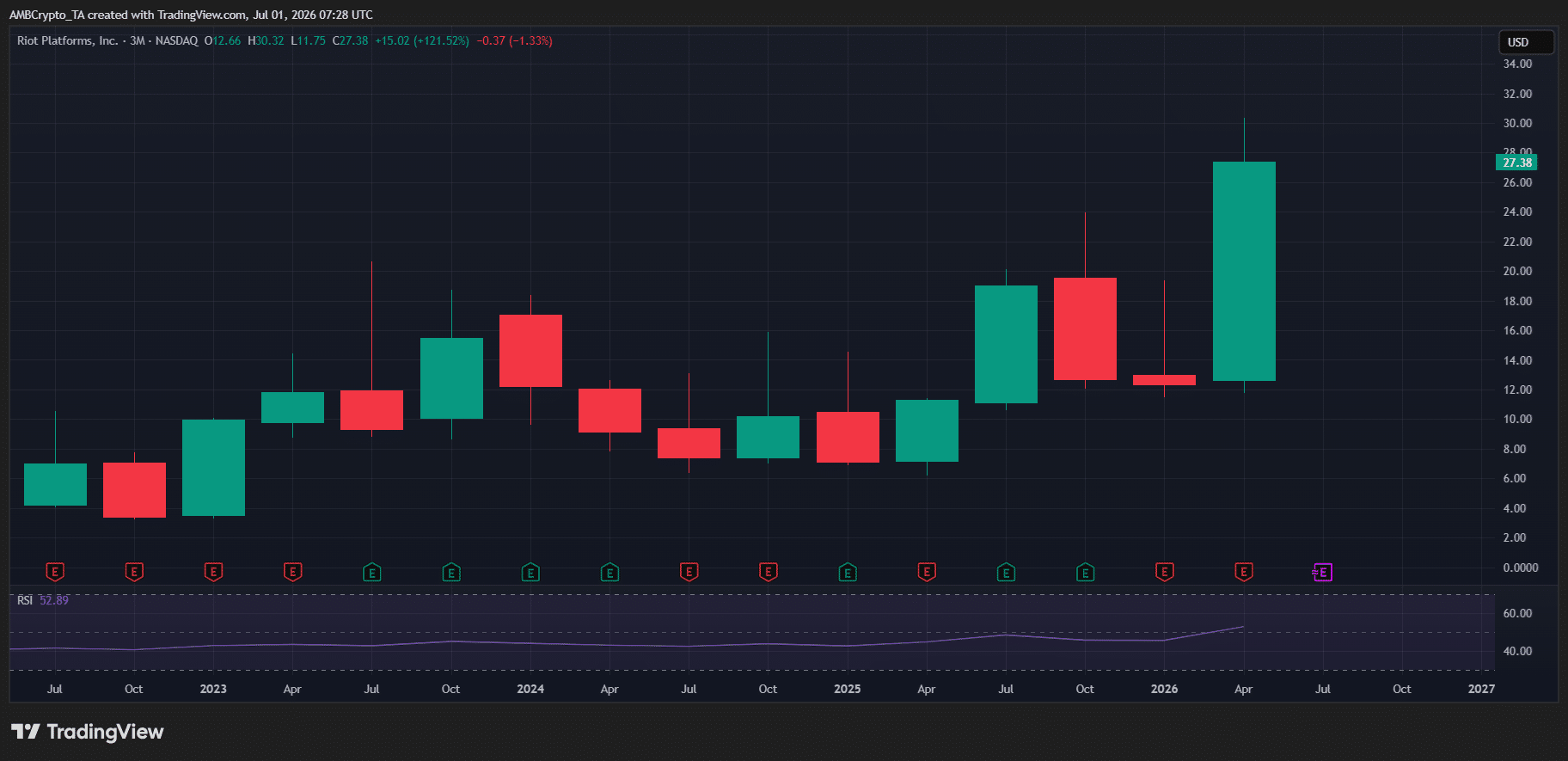
Source: TradingView (RIOT/USD)

This divergence gains relevance in the context of Riot’s capital allocation.

The company sold 3,778 BTC for approximately $289.5 million last quarter, while mining only 1,473 BTC. This means it sold more Bitcoin than it produced, reducing its treasury instead of building it. As a result, holdings fell to around 15,680 BTC, down about 18% year over year.

The recent 500 BTC sale fits into this pattern. It suggests the Bitcoin treasury strategy is flattening, with a growing shift toward AI-related expansion. In this setup, BTC is increasingly being used as a cash reserve to fund data-center and compute investments. Naturally, the question is whether this transition introduces a potential risk factor for Bitcoin heading into H2 2026.

Bitcoin miner stress builds as AI shift accelerates

Miner capitulation is becoming a normal feature of bear cycles.

In H1, Bitcoin saw notable miner stress as it closed two consecutive quarters in the red. This was significant because estimated production costs were around $78k, while the spot price has dropped below $58k. In simple terms, miners are now producing Bitcoin at a higher cost than its market price, which puts sustained pressure on profitability.

Amid this backdrop, the Bitcoin hashrate rebounded in June, rising sharply and moving back toward late May highs. This suggests a short-term recovery in network activity and miner participation, even as miner economics remain under pressure. Put simply, the move highlights a divergence between near-term network strength and underlying cost stress.
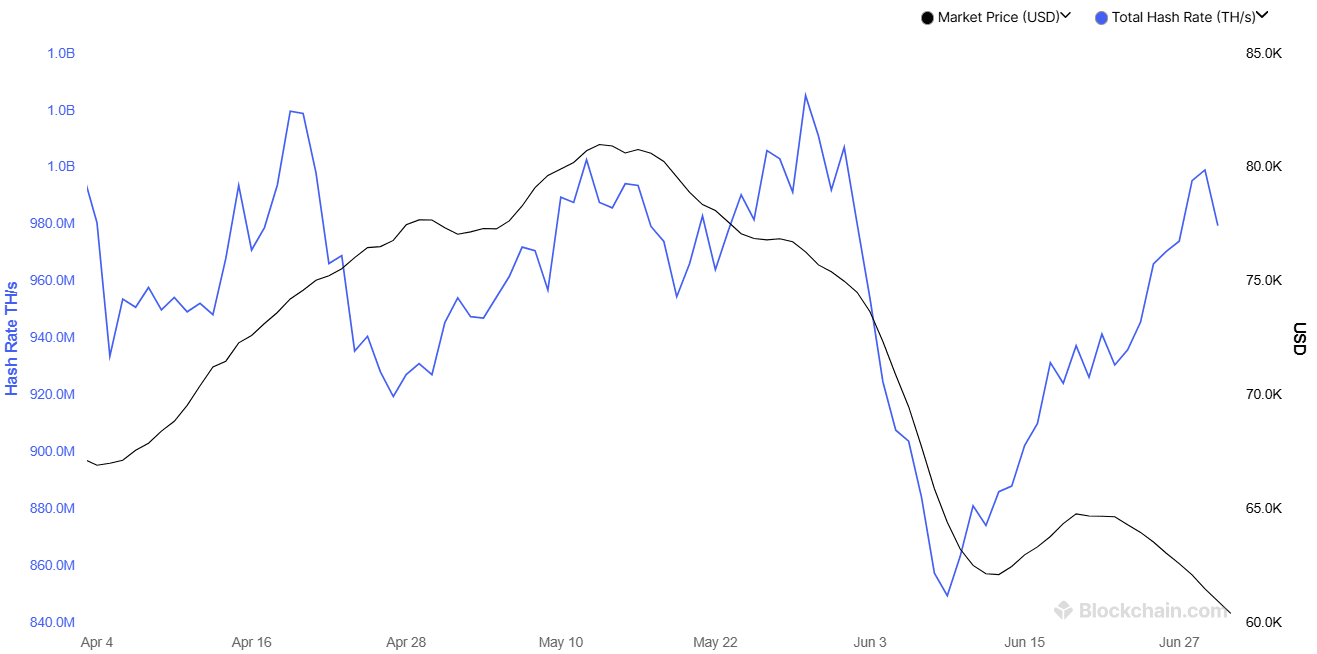
Source: Blockchain

Taken together, if this trend continues through Q3, miner rewards will likely come under pressure as higher hashrate increases competition and raises mining difficulty, reducing earnings per unit of hashpower.

At the same time, this environment can speed up strategic shifts. For larger miners, continued margin pressure increases the need to diversify, including a gradual move into AI and high-performance computing.

As a result, Bitcoin holdings may increasingly be used as cash to fund these investments rather than being held long term, signaling a structural shift in miner behavior through H2. Riot Platforms’s recent sale of 500 BTC, in this context, may be an early sign of this broader trend as Bitcoin heads into Q3.


Final Summary

  • Miners are under pressure because Bitcoin is now cheaper than the cost to mine it.
  • Some miners are selling BTC and shifting toward AI to fund their business.

Trending Cryptos

Related Questions

QWhat did Riot Platforms do with approximately 500 BTC recently, and why is this significant?

ARiot Platforms sold around 500 BTC, worth approximately $30 million. This is significant because it highlights a trend of the company selling more Bitcoin than it mines, using BTC as a cash reserve to fund its strategic shift towards AI and data-center investments, rather than holding it long-term.

QAccording to the article, how did Riot Platforms' stock (RIOT) perform in Q2 despite Bitcoin's price correction?

ADespite Bitcoin correcting by 15% in Q2, Riot Platforms' stock (RIOT) closed the quarter up 120%, marking its strongest quarterly performance since Q2 2023. This shows a clear decoupling between the performance of miner equities and the spot price of BTC.

QWhat is the main economic pressure facing Bitcoin miners mentioned in the article?

AThe main pressure is that the estimated cost to produce (mine) one Bitcoin is around $78k, while the spot price has fallen below $58k. This means miners are producing Bitcoin at a loss, putting sustained pressure on their profitability.

QWhat broader strategic shift does Riot Platforms' BTC sale represent for the mining industry?

AIt represents a broader strategic shift where miners, facing profitability pressure, are diversifying their business. They are increasingly selling Bitcoin holdings to use as cash to fund investments in AI and high-performance computing, rather than holding BTC long-term as a treasury asset.

QHow did the Bitcoin network hashrate behave in June, and what does this indicate about miner activity?

AThe Bitcoin hashrate rebounded sharply in June, moving back toward late May highs. This indicates a short-term recovery in network activity and miner participation, creating a divergence where network strength improves even as underlying miner economics remain under severe cost pressure.

Related Reads

The Largest Upgrade Since The Merge? How Glamsterdam Will Affect Ethereum and Regular Users?

The upcoming Glamsterdam upgrade, scheduled for late 2026, is considered Ethereum's most significant change since The Merge. It focuses on fundamentally restructuring Ethereum's block production, transaction execution, and gas pricing to enable major scalability improvements while preserving decentralization. The upgrade centers on three key innovations: * **Enshrined PBS (ePBS)**: Moves the Proposer-Builder Separation mechanism into the protocol's core, eliminating reliance on external relays. This reorganizes the block pipeline, extending the time window for processing execution payloads, which is crucial for safely increasing block capacity. * **Block-Level Access Lists (BALs)**: Attaches a "map" to each block, declaring in advance which state data its transactions will access. This enables potential parallel transaction processing and faster node synchronization, breaking a key performance bottleneck. * **Gas Repricing**: Introduces a more accurate resource pricing model by separating computation costs from state storage costs. This discourages uncontrolled state growth by making operations that create permanent data (like new accounts) more accurately reflect their long-term network burden. Together, these changes aim to solve the core challenges of increasing Ethereum's throughput (e.g., raising the Gas Limit) without overburdening node hardware or increasing centralization risks. They prepare the infrastructure for higher capacity, targeting a credible post-upgrade capacity of up to 200 million Gas. For users, the impact will be nuanced: * General transaction fees may become lower and more stable as block space increases. * Simple transfers could see cost reductions, while state-intensive operations (like contract deployment) may become relatively more expensive due to the new gas model. * Gas fee estimations by wallets will become more accurate. * L2 networks could benefit long-term from increased data blob capacity. * Standardized logs for all ETH transfers (EIP-7708) will improve tracking for wallets and exchanges. Ultimately, Glamsterdam represents a foundational shift, not a simple block size increase. It seeks to expand Ethereum's capacity by re-engineering its underlying mechanics, maintaining its commitment to decentralization while enabling significant performance gains.

marsbit2h ago

The Largest Upgrade Since The Merge? How Glamsterdam Will Affect Ethereum and Regular Users?

marsbit2h ago

Circle CEO Responds to the OUSD Challenge: Stablecoin is a Winner-Takes-All Business, and We Won't Slow Down

In response to questions about the OUSD stablecoin initiative, Circle CEO Jeremy Allaire argues that the stablecoin market is a "winner-take-most" platform business driven by powerful network effects, and Circle has no plans to slow down. He outlines three key drivers behind USDC's dominant position: 1. **Protocol/Software Layer Network Effects**: The value of a stablecoin network grows as more developers and services integrate it, creating compounding utility and user preference. Circle has spent nearly a decade building this ecosystem with USDC, now accelerated by mainstream adoption and enhanced by software stacks like CCTP and Gateway for interoperability. 2. **Liquidity Network Effects**: Liquidity begets more liquidity. USDC has achieved top-tier global liquidity—ranking among the top three digital assets alongside BTC and USDT—through nearly a decade of building deep primary and secondary market access across regions and venues. 3. **Regulatory and Policy Integration**: Establishing a global stablecoin requires deep regulatory engagement, licensing, and compliance across key markets—a significant, long-term investment where Circle is a leader. Allaire cites Artemis data showing USDC facilitated 80% of all dollar stablecoin on-chain transaction volume in Q1 2026, with USDT at 20% and all others negligible. He addresses OUSD's purported advantages: "free" minting/burning is often not sustainable in practice; redistributing all revenue can starve essential infrastructure investment; and large consortium models historically struggle with inefficiency and slow execution, unlike focused strategic partnerships. He reaffirms Circle's strong ongoing partnership with Coinbase on USDC and notes Circle collaborates with dozens of other stablecoin issuers through its expanding platform (Arc, CCTP, CPN, etc.). While welcoming OUSD to the ecosystem, Allaire asserts that Circle's vast, trusted network and continued investment make USDC the foundational digital dollar infrastructure for the world.

链捕手3h ago

Circle CEO Responds to the OUSD Challenge: Stablecoin is a Winner-Takes-All Business, and We Won't Slow Down

链捕手3h ago

Trading

Spot

Hot Articles

Discussions

Welcome to the HTX Community. Here, you can stay informed about the latest platform developments and gain access to professional market insights. Users' opinions on the price of S (S) are presented below.

活动图片